Iran Fires on Diego Garcia: The War Just Reached the Indian Ocean
Iran launched missiles at the joint UK-US military base on Diego Garcia in the Indian Ocean - 4,000 kilometers from Iranian soil. Simultaneously, an Iranian national was arrested attempting to infiltrate Britain's nuclear submarine base at Faslane, Scotland. Natanz was hit again by airstrikes. And a drone killed an Iraqi intelligence officer in Baghdad. The Iran-US-Israel conflict is no longer a regional war. It's going global.

UK Ministry of Defence confirms Iran fired missiles at Diego Garcia. Unsuccessful strike. Britain condemned "Iran's reckless attacks." Iranian national and Romanian woman charged after attempting to breach Faslane nuclear submarine base. Natanz nuclear facility hit in airstrike - IAEA reports no radiation leak. Iraqi intelligence headquarters drone strike kills one officer in Baghdad.
Diego Garcia: A Strategic Strike That Changes the Geometry of This War
Diego Garcia is not just another base. The small coral atoll in the Chagos Archipelago, roughly 2,500 miles south of Iran's coast, has been the launch platform for some of the most consequential American military operations since the Gulf War in 1991. B-2 Spirit stealth bombers flew from Diego Garcia to bomb Afghanistan in 2001 and Iraq in 2003. The base houses a deep-water port, a naval station, and a strategic bomber ramp capable of hosting aircraft that can reach virtually anywhere on earth without refueling.
Iran's decision to fire on it is a statement of intent. Whether the missiles carried any realistic chance of penetrating the base's layered air defenses is almost beside the point. Tehran is signaling that it can, and will, strike beyond the immediate theater of operations. Every previous Iranian attack since February 28 had targeted positions within a few hundred miles. Diego Garcia is a different order of magnitude.
UK officials confirmed the strike but provided no details on how close the missiles came to the base. The Ministry of Defence said Saturday that Iran's "lashing out across the region and holding hostage the Strait of Hormuz, are a threat to British interests and British allies." The statement is notable for its specificity: Britain is now formally acknowledging that Iranian attacks are threatening British assets, even though London has repeatedly refused to enter the war.
"Iran's reckless attacks...are a threat to British interests and British allies." - UK Ministry of Defence, Saturday March 21, 2026
The timing matters: Britain formally authorized the use of Diego Garcia for American operations to counter Iranian attacks on shipping in the Strait of Hormuz - but that authorization came on Friday, after Iran had already targeted the base. Iran struck before it formally became a launch pad for anti-Iran operations. That suggests Iran has been tracking Diego Garcia's role in the campaign for some time and moved preemptively.
Faslane: An Iranian Spy at Britain's Nuclear Heartland

Two days before the Diego Garcia strike, on Thursday March 19, an Iranian national and a Romanian woman were detained after attempting to enter HM Naval Base Clyde at Faslane, Scotland - home to Britain's entire nuclear deterrent. Police Scotland confirmed Saturday that both have been charged and will appear at Dumbarton Sheriff Court on Monday.
As is customary in Scotland, names were not released ahead of the court appearance. The 34-year-old Iranian man and 31-year-old Romanian woman were stopped at the perimeter of the base, which sits about 40 kilometers northwest of Glasgow and is the permanent home of Britain's four Vanguard-class submarines, each armed with up to eight Trident II D5 ballistic missiles.
The proximity of events is striking. An attempted breach of the UK's nuclear submarine base was followed within two days by Iranian missile fire on a UK base in the Indian Ocean. Whether these were coordinated operations or coincidental is something British intelligence will be determining urgently. The UK government has not explicitly linked the two events, but the simultaneous emergence of both stories on the same Saturday morning has drawn immediate scrutiny.
Britain's nuclear deterrent has been on a continuous at-sea patrol since 1969. At any given moment, one submarine is on patrol somewhere in the Atlantic with the authority to launch nuclear weapons if Britain's command structure is destroyed. The base itself stores the warheads, handles maintenance, and manages the rotational cycle of the four boats. A breach there - even an unsuccessful reconnaissance attempt - would represent one of the most serious security incidents in the base's history.
Source: Associated Press, Police Scotland statement, UK Ministry of Defence
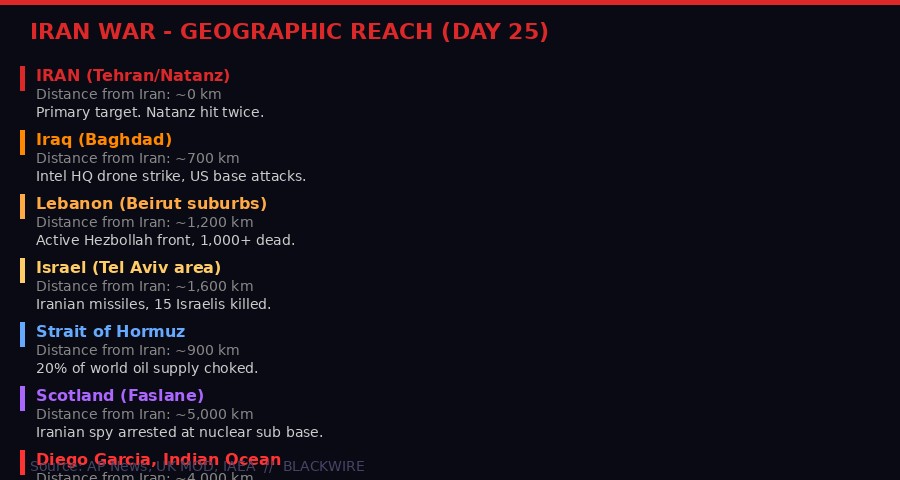
Iran's war now spans from Beirut to Baghdad to Faslane to the Indian Ocean. The conflict's geographic footprint has expanded dramatically in 25 days. (BLACKWIRE graphic)
Natanz Hit Again: The Nuclear Question Refuses to Die
In a separate development Saturday, Iran's Natanz nuclear enrichment facility was struck in an airstrike, according to Iran's official news agency Mizan. Iranian authorities said there was no radiation leakage. The International Atomic Energy Agency confirmed Saturday it had been notified by Iran and reported no increase in off-site radiation levels, though the IAEA said it was still investigating the incident.
Natanz sits roughly 220 kilometers southeast of Tehran and serves as the primary site for Iran's uranium enrichment program. It has been at the center of this conflict since before it started. In the first week of the war, US-Israeli strikes had already damaged several buildings at the facility. Satellite imagery had confirmed visible structural damage. The IAEA issued a statement at the time saying "no radiological consequence" was expected from the first strike.
Natanz was also targeted during what became known as the "12-day war" last June in 2025 - a shorter precursor conflict. That the facility has now been struck in three separate rounds of hostilities raises fundamental questions about how much of Iran's nuclear infrastructure remains functional, and whether the stated US-Israeli objective of eliminating the nuclear program has been achieved.
"We are getting very close to meeting our objectives as we consider winding down our great Military efforts in the Middle East." - Donald Trump, posted to social media, Friday March 20, 2026
Trump's "winding down" language on Friday collided immediately with reality. Within 24 hours of that post, Iran had fired on Diego Garcia, attacked Faslane's perimeter, and struck Natanz. Israeli Defense Minister Israel Katz then publicly contradicted his ally. "This week, the intensity of the attacks that the IDF and the U.S. military will carry out against the Iranian terrorist regime will increase significantly," Katz said Saturday in a video statement.
That is not winding down. That is a direct public rejection of the American president's framing by Israel's defense minister, in real time, on the same day.
Baghdad, Beirut and the Spreading Eastern Front

In Iraq, a drone struck the Iraqi intelligence service's headquarters in Baghdad on Saturday morning, killing one officer. No group claimed immediate responsibility. The nature of the attack - a precision drone strike on a government intelligence building, not a US base or a Shia militia position - marks a new category of target in the Iraqi theater of the conflict.
Iraq has been an active secondary front since roughly Day 15 of the war, when a drone hit the US Embassy compound in Baghdad's Green Zone. Iraqi officials have been walking a narrow line between not wanting to be drawn into the conflict and being unable to prevent their territory from being used as a staging ground for various proxies. The strike on the Iraqi intelligence HQ directly threatens Baghdad's capacity to remain a neutral-ish party.
In Lebanon, the Israeli military launched a fresh wave of strikes early Saturday targeting Hezbollah infrastructure in Beirut's southern suburbs. Loud explosions were heard across parts of central Beirut. The Israeli army said it targeted seven neighborhoods after issuing fresh evacuation warnings. Smoke was visible rising from multiple points across the city's southern perimeter.
The Lebanese government has confirmed that Israeli strikes in Lebanon since the conflict expanded there have killed more than 1,000 people and displaced over one million. Hezbollah remains operationally capable but has taken significant hits to its logistics and command network. The Lebanese state, such as it is, has no capacity to influence the conflict in either direction.
In Israel itself on Saturday, fragments from an Iranian missile hit an empty kindergarten in what Israeli army spokesman Nadav Shoshani confirmed via a video posted to X. No casualties were reported - the building was empty. The attack illustrates the continued reach and frequency of Iranian ballistic missile fire into Israeli territory, even in week four of the war.
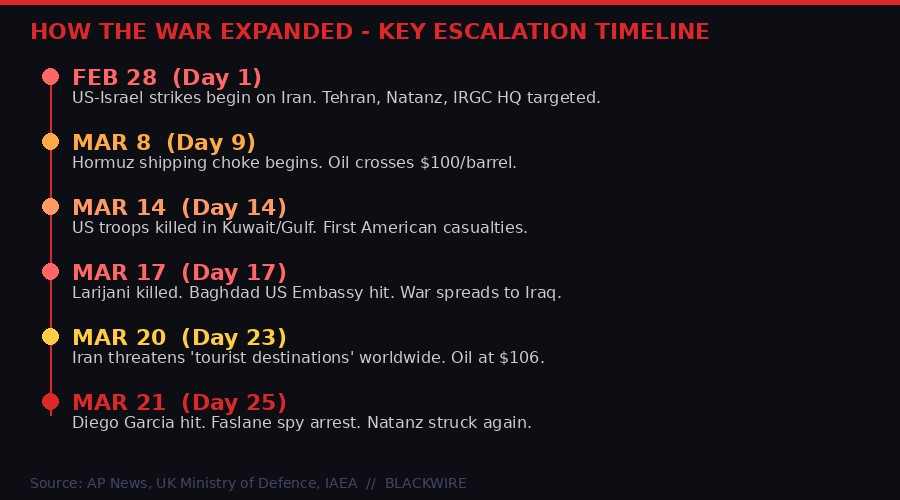
Key escalation moments from Day 1 to Day 25. The conflict's trajectory has been consistently toward expansion, not resolution. (BLACKWIRE graphic)
The Trump Contradiction: "Winding Down" While Deploying More
The central paradox of Saturday's news cycle is the gap between what Trump says and what the US military is doing. On Friday, the president posted that the US was "getting very close to meeting our objectives as we consider winding down our great Military efforts." That same day, the Pentagon confirmed it was deploying three more amphibious assault ships and roughly 2,500 additional Marines to the Middle East.
These Marines join a separate group of 2,500 Marines redirected from Pacific deployment earlier in the week. Together, they will augment a force of more than 50,000 US troops already in the region. The US has also requested an additional $200 billion from Congress to fund the war effort - a figure that, if approved, would make this the most expensive US military operation since the Iraq War.
Trump's "winding down" rhetoric appears calibrated primarily for the domestic American audience. Gasoline prices have surged with Brent crude at $106 a barrel, up from approximately $70 before the war began. The US stock market has taken repeated hits as oil climbs. Consumer confidence is declining. Trump faces a real domestic political problem from an extended war, and is trying to project a sense of imminent conclusion that the facts on the ground do not support.
The pause on Iranian oil sanctions - announced Friday, covering Iranian oil loaded on ships as of that date through April 19 - is another element of the same calculation. It does not materially increase oil supply, but it creates the impression of managing prices. Former Obama-era Treasury officials have noted that Iran has been evading sanctions for years, so much of what it exports already reaches buyers through shadow fleet arrangements. The practical effect of the waiver on actual oil market volumes is likely modest.
"This is not Europe's war. We didn't start the war. We were not consulted." - Kaja Kallas, EU Foreign Policy Chief
Meanwhile, Trump's frustration with allies continues to build. Every major NATO partner has declined his requests to send warships to help secure the Strait of Hormuz. Germany's Defense Minister Boris Pistorius said explicitly: "It is not our war; we did not start it." France will discuss naval escorts only after fighting stops. Britain has allowed US bombers to use its bases, but Starmer has drawn a hard line against British warships entering the combat zone.
Trump's response on Tuesday summed up his position: "We don't need any help, actually." But the absence of allied legitimization - no UN mandate, no broad coalition - is becoming a strategic liability. The 1990 Gulf War succeeded in part because the US built a 34-nation coalition. This war has been fought essentially bilaterally, US and Israel, against a country that has sustained four weeks of intensive bombardment and is still launching missiles 4,000 kilometers from home.
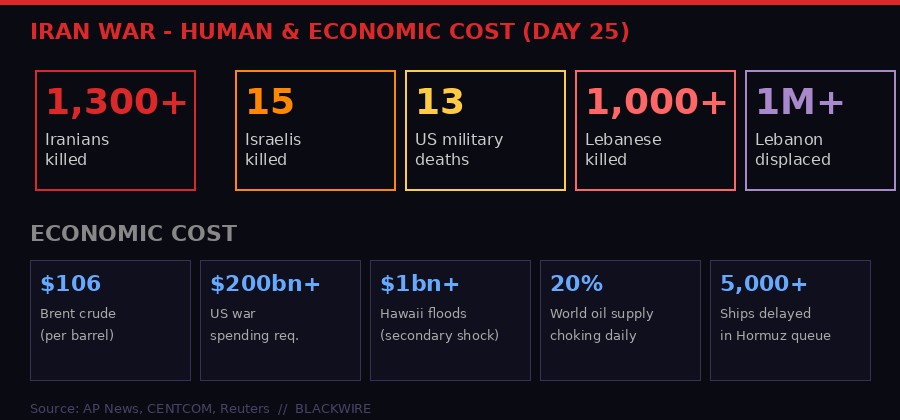
The human and financial toll of 25 days of war. Over 1,300 Iranians killed, 13 US military deaths, oil at $106/barrel. (BLACKWIRE graphic, sources: AP, CENTCOM, Reuters)
Oil, the Economy and the Global Ripple Effect
The economic dimensions of this war are now as significant as the military ones. Brent crude at $106 a barrel is up more than 50 percent from pre-war levels. That figure flows directly into every sector of the global economy: airline fuel costs, trucking costs, heating bills, agricultural logistics, manufacturing inputs. The International Energy Agency has warned repeatedly that prolonged disruption to Strait of Hormuz shipping threatens supply chains across Europe and Asia.
Asia is the most exposed continent. Japan, South Korea, and China import the overwhelming majority of their oil through the Persian Gulf. The Strait of Hormuz is not just an important waterway - it is the only transit point between the Persian Gulf and the open ocean. There is no alternative route. Iran has effectively weaponized this geographic reality, and even the threat of closure is enough to send prices surging.
China's response has been revealing. Beijing declined Trump's request to send warships to help secure the strait - the same strait that Chinese oil tankers must transit daily. China has determined that staying out of a US-initiated war while watching the US burn political capital is strategically preferable to joining a coalition that makes it complicit in strikes on a country it maintains diplomatic relationships with. The calculation appears to be: let America own this, pocket the geopolitical IOUs with Iran, and watch NATO fracture.
In the US, gas prices at the pump have become the most politically potent metric. The average American doesn't follow strike packages on Natanz or the nuances of allied coalition-building. They see the gas price every day. That is the political clock Trump is racing against, and it is why his "winding down" rhetoric, however disconnected from military reality, is not entirely irrational as a political strategy.
The newly announced sanctions pause on Iranian oil is a small release valve. But it will have limited market impact given how well Iran already circumvents its existing sanctions architecture. The shadow fleet - hundreds of tankers operating under false flags, as evidenced by the French navy's interception of the vessel Deyna in the Mediterranean Friday, which was flying Mozambican colors while coming from Murmansk - is the infrastructure through which Iran moves its oil regardless of US policy.
Who Is Running Iran Right Now?

One of the defining uncertainties of this war is the question of who is actually making decisions inside Iran. Ayatollah Ali Khamenei was killed in Israeli strikes during the opening days of the conflict. His son Mojtaba Khamenei has been designated the new Supreme Leader but has not been seen in public. He has communicated via written statements read on Iranian television - most recently marking Nowruz, the Persian New Year - but has offered no visual confirmation of his location or physical condition.
The Islamic Revolutionary Guard Corps appears to be managing military operations autonomously. Reports from the conflict suggest that various IRGC commanders have been making operational decisions with limited central coordination - which partly explains the diffuse and sometimes unpredictable nature of Iranian strike activity. The decision to fire on Diego Garcia, for example, may have reflected IRGC operational logic rather than a deliberate political signal from Iran's formal leadership.
Iran has sustained over 1,300 deaths according to official wartime figures. The actual figure is almost certainly higher. The country's internet has been intermittently shut down, making independent verification difficult. Satellite imagery has shown damage to Tehran's oil storage facilities, portions of the Natanz complex, IRGC command buildings, and several radar installations. How much of Iran's military infrastructure remains functional is not publicly known.
What is known: Iran is still launching missiles. It is still operating in the Strait of Hormuz. It has now fired on targets 4,000 kilometers from its borders. Whatever leadership structure exists inside Iran, it retains the operational capability and the will to escalate. That is the most important military fact of Day 25.
The Faslane Connection: Espionage in the Nuclear Shadow
The Faslane arrest deserves separate analysis from the Diego Garcia strike, though both point in the same direction. Britain's Vanguard-class submarines - HMS Vanguard, HMS Victorious, HMS Vigilant, and HMS Vengeance - rotate through continuous-at-sea deterrent patrol. The UK's nuclear deterrent is entirely submarine-based. Unlike the US, Britain does not maintain land-based or airborne nuclear delivery systems. Faslane is, in effect, the physical embodiment of Britain's nuclear deterrent on land.
The arrest of an Iranian national attempting to enter the base has to be read in that context. The most charitable interpretation is that this was a crude intelligence-gathering operation - someone trying to photograph perimeter defenses or establish points of vulnerability. The darker interpretation is that it was part of a broader effort to assess or plan a future strike on the base itself, coordinated with the Diego Garcia missile attack as part of a signal to Britain: we can reach your nuclear infrastructure.
British authorities have not publicly connected the two events. The police statement was brief and factual. But inside GCHQ, MI5, and Downing Street, the simultaneous occurrence of these two events - one kinetic, one reconnaissance - will be generating considerable activity. Britain's threshold for entering the war has been consistent: it will not be drawn into combat operations. The question is whether attacks on British military assets, even unsuccessful ones, eventually move that threshold.
Prime Minister Starmer's position has already shifted once. He initially blocked American bombers from using British bases to attack Iran, then reversed that decision for strikes on ballistic missile sites, and then Friday authorized Diego Garcia for Hormuz operations. Each step has been justified as defensive and limited. But the trajectory is one of gradual escalatory involvement. At some point, "not our war" becomes harder to sustain when Iranian missiles are targeting British territory.
What Happens Next: The Endgame Nobody Can Define
The US and Israel entered this war with stated objectives that have shifted repeatedly. The original framing centered on eliminating Iran's nuclear weapons capability. That evolved into destroying Iran's ballistic missile program. That evolved into regime change - "hoping to foment an uprising." Then back to nuclear and missile elimination when no uprising materialized. Trump said Friday the US is "near completion" of its objectives. Israel's Katz said Saturday the strikes will intensify.
Neither statement is logically compatible with the other, and neither corresponds to observable reality. Iran is damaged but fighting. Natanz keeps getting struck and the IAEA keeps finding no radiation - suggesting whatever weapons-grade capability existed may have already been deeply buried or dispersed. Iran's missile inventory has taken losses, but four weeks of continuous US-Israeli strikes have not suppressed its ability to launch at Diego Garcia, maintain Hormuz pressure, or keep Hezbollah operating in Lebanon.
The three most likely near-term trajectories are: First, Iran exhausts its precision missile stocks and is forced into a ceasefire on terms unfavorable to Tehran - the Israeli scenario. Second, the political cost to Trump of high gas prices and no visible victory forces a negotiated pause before full objectives are met - the domestic political pressure scenario. Third, the conflict widens further, pulling in additional parties either through Iranian proxies or through the kind of calculated escalation that Diego Garcia and Faslane represent.
What is not in the cards, based on 25 days of evidence, is a swift decisive conclusion. Iran has demonstrated that it can absorb punishment and continue to project force across a geographic arc from Lebanon to Scotland to the Indian Ocean. That is not the behavior of a state near collapse. It is the behavior of a state that has concluded it has more to lose from surrender than from continued war.
"This week, the intensity of the attacks that the IDF and the U.S. military will carry out against the Iranian terrorist regime and against the infrastructures on which it relies will increase significantly." - Israeli Defense Minister Israel Katz, Saturday March 21, 2026
For the global economy, for Allied cohesion, and for the broader question of whether international norms mean anything when the world's most powerful military decides to launch a unilateral war - this moment matters. Day 25 is not the beginning of the end. It may be the end of the beginning.
Get BLACKWIRE reports first.
Breaking news, investigations, and analysis - straight to your phone.
Join @blackwirenews on TelegramSources: Associated Press (multiple dispatches, March 20-21, 2026), UK Ministry of Defence statement, Police Scotland, International Atomic Energy Agency, US Central Command, Reuters. All quotes sourced from primary news agency reporting.