The war that started on February 28 with US-Israeli airstrikes on Iranian military and nuclear infrastructure has entered its 14th day with no clear end in sight - and with an entirely new set of threats on the table. Two weeks in, three major variables have collided in the last 48 hours that may define whether this war ends soon or spirals into something far larger.
First: Iran's president has quietly signaled willingness to negotiate, laying out explicit ceasefire conditions for the first time. Second: Iran's most powerful military force - the Islamic Revolutionary Guard Corps - is making clear it answers to nobody offering peace. Third: A specific and chilling threat has been issued against regional power infrastructure, one that American military planners cannot dismiss as rhetoric.
Somewhere in the gap between those three facts, four US airmen died over Iraq on Friday when a KC-135 refueling aircraft went down in what the US military is calling non-combat circumstances. The Islamic Resistance in Iraq claims they shot it out of the sky.
This is where the war stands on day 14.
Key Developments - March 13, 2026
- Israel launches new "extensive wave" of strikes on Tehran Friday morning
- Iran President Pezeshkian sets 3 conditions for peace: reparations, rights recognition, international guarantees
- IRGC and new Supreme Leader Mojtaba Khamenei reject any off-ramp language
- Ali Larijani warns power grid strike would make "the whole region go dark in half an hour"
- US KC-135 refueler down in western Iraq - 4 dead, 2 missing; Islamic Resistance claims responsibility
- UNHCR: 3.2 million Iranians displaced since Feb 28
- Oil stays above $100/barrel, Hormuz fully closed
- Lebanon death toll reaches 687, including 98 children
Day 14: The Dawn Offensive That Has Not Stopped
Friday morning began with air raid sirens across Tehran. The Israeli military announced a new "extensive wave" of air attacks on the Iranian capital, the city left covered in thick smoke by early afternoon. The strikes come on top of what CENTCOM disclosed Thursday: approximately 6,000 targets have been struck in Iran since operations began on February 28, according to a US Central Command press statement. More than 90 Iranian vessels have been damaged or destroyed, including over 60 ships and more than 30 mine-laying craft. [Source: CENTCOM, March 12, 2026]
In the US, President Donald Trump told reporters the war was going "very well" and moving "very rapidly," while in the same breath declining to directly address the first statement issued by Iran's new Supreme Leader Mojtaba Khamenei. "Our military is unsurpassed," Trump said at the White House on Thursday. He did not take questions about the downed KC-135. [Source: White House pool report, March 13, 2026]
Iran has not been silent in response to the 6,000 targets figure. Its ambassador to the United Nations, Amir Saeid Iravani, put Iran's civilian death count at at least 1,348 as of Thursday - victims ranging in age from eight months to 88 years old. Iran's Deputy Health Minister Ali Jafarian told Al Jazeera that more than 30 hospitals and health facilities have been damaged. [Source: Al Jazeera, March 12, 2026]
On the regional front, the toll widens daily. In Lebanon, Israeli bombardments have killed at least 687 people since last Monday - 98 of them children - and displaced an estimated 700,000 to 750,000 people. A single strike on the village of Arki near Sidon killed nine people, five of them children, on Thursday. In Iraq's autonomous Kurdish region, a drone attack wounded six French soldiers stationed in Erbil - France confirmed this through presidential statement Thursday. Dubai's International Airport was struck. Qatar's airspace remains closed, though Qatar Airways has launched more than 140 special repatriation flights. Australia has ordered all non-essential officials to leave the UAE and Israel. [Sources: Al Jazeera, Reuters, AFP, March 12-13, 2026]
Tehran's Off-Ramp: Pezeshkian Sets Three Conditions
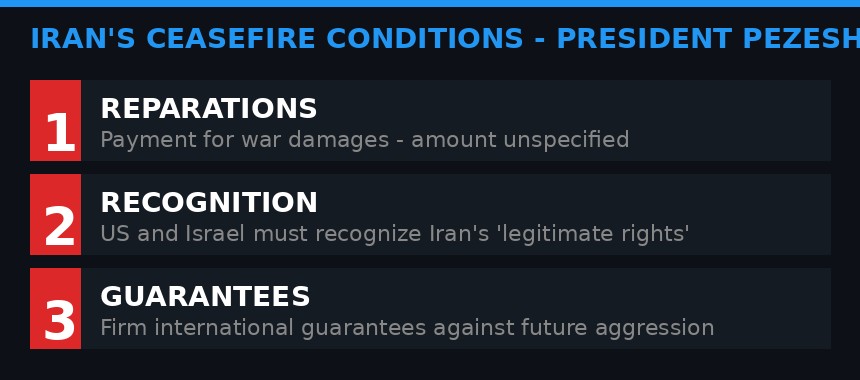
On Wednesday, Iranian President Masoud Pezeshkian posted directly to X in what analysts quickly flagged as a significant departure from Tehran's previously defiant posture. Pezeshkian said he had spoken to his counterparts in Russia and Pakistan, confirming Iran's "commitment to peace." He then named three conditions for ending the war. [Source: X / formerly Twitter, @pezeshkian, March 12, 2026]
"The only way to end this war - ignited by the Zionist regime and the US - is recognizing Iran's legitimate rights, payment of reparations, and firm international guarantees against future aggression." - Iranian President Masoud Pezeshkian, via X, March 12, 2026
The statement - precise, public, and directed at an international audience - is the clearest signal yet that part of Tehran's political leadership is looking for a way out. Analysts note it is a rare posture from a country that initially rejected any possibility of negotiations or ceasefire when the war broke out. [Source: Al Jazeera analysis, March 12, 2026]
The framing matters as much as the content. Pezeshkian is not offering surrender. The demand for reparations carries significant face-saving weight in Iranian domestic politics - it casts Iran as a victim of aggression seeking justice rather than a defeated power accepting terms. The "recognition of legitimate rights" language is deliberately broad, encompassing nuclear ambitions, regional sovereignty, and sanctions removal simultaneously. The guarantee against future aggression invokes international law in a way designed to embarrass Washington into either accepting or publicly rejecting a rules-based framework.
Whether these conditions are realistic is a different question entirely. The Trump administration, which on Tuesday claimed Iran had "no navy, no air force, no anti-aircraft" remaining, has not officially responded to Pezeshkian's post. Senator Lindsey Graham, one of the war's most vocal congressional supporters, told reporters Thursday: "I don't see this conflict ending today." [Source: Reuters, March 13, 2026]
Economic pressure is clearly part of the calculation. The Trump administration's own estimates put US war costs at $11.3 billion in the first six days alone, according to a report that circulated Thursday. More than 250 US organizations have now signed a joint letter to Congress demanding a halt to war funding, arguing the costs are diverting resources from domestic programs including food benefits. [Source: Al Jazeera, March 12, 2026]
The IRGC Doesn't Answer to the President
The problem with Pezeshkian's overture is structural. The Iranian president does not control Iran's military. The Islamic Revolutionary Guard Corps - the IRGC - operates as a parallel armed force with its own chain of command running to the Supreme Leader, not the president's office. And the IRGC's messaging this week has been unambiguous.
On Wednesday, the IRGC announced that it would not allow "a litre of oil" through the Strait of Hormuz and warned the world to expect a $200-per-barrel oil price. The Strait of Hormuz - through which roughly 20 percent of global oil and gas traffic normally passes - has been effectively closed since the war's early days, with Iran's military promising Wednesday that it has the capability to wage a long war capable of "destroying" the world economy. [Source: Al Jazeera, IRNA, March 11-12, 2026]
Iran's new Supreme Leader Mojtaba Khamenei - appointed last week following the assassination of his father, Ayatollah Ali Khamenei - delivered his first public statement this week, directly contradicting the diplomatic tone of the president. Khamenei said that attacks on Israel and on US military assets and infrastructure across the Middle East will continue unless US forces close all bases in the region. [Source: IRNA/Al Jazeera, March 12-13, 2026]
This split is not new. It predates the war. But it has become dramatically more visible - and more dangerous - under war conditions. "Iran wants to go to the end to make sure that the United States and Israel never attack Iran again," Al Jazeera's Resul Serdar Atas said Thursday. "So this has to be the final battle." That is IRGC doctrine. Pezeshkian's three conditions are presidential diplomacy. The IRGC does not take orders from the president.
Zeidon Alkinani of Georgetown University Qatar told Al Jazeera that the divisions between the political leadership and the IRGC "always existed even prior to this war," but that they are now exposed because "the IRGC believes it has the right to take the front seat in leading this regional war." Pezeshkian's apology to neighboring countries last week - in which he promised Iran would stop hitting Gulf neighbors as long as they didn't allow US launch operations from their territory - was followed within hours by fresh air defense sirens across Saudi Arabia, Qatar, the UAE, and Bahrain. Someone was still firing. It was not the president. [Source: Al Jazeera, Reuters, March 8-12, 2026]
Larijani's Threat: "The Whole Region Will Go Dark"
On Thursday, a new and specific threat entered the public record. It came from Ali Larijani, secretary of Iran's Supreme National Security Council and among the most senior officials in the Tehran power structure. It was triggered by Trump's Tuesday claim that the US could eliminate Iran's entire electrical capacity "within one hour" and that it would take Iran "25 years to rebuild."
Trump made the remark at a rally in Hebron, Kentucky, where he also declared that the US had already "won" the war with Iran and must now "finish the job." The electric grid threat was framed as a warning - a next-step option if Iran did not capitulate. [Source: Reuters, White House pool, March 11, 2026]
Larijani's response on X the following day was direct:
"If they do that, the whole region will go dark in less than half an hour and darkness provides ample opportunity to hunt down US servicemen running for safety. While starting a war is easy, it cannot be won with a few tweets. We will not relent until making you sorry for this grave miscalculation." - Ali Larijani, Secretary of Iran's Supreme National Security Council, via X, March 12, 2026
The statement is calibrated. Larijani is not claiming Iran will knock out US power grids - he is threatening to knock out the power infrastructure of the Gulf states hosting US forces. That means Saudi Arabia's eastern oil facilities. The UAE. Qatar. Bahrain, where the US Fifth Fleet is headquartered. Potentially Kuwait and Jordan, both active in the operational theater.
Iran has already demonstrated capability and willingness here. A drone was filmed striking Oman's Salalah oil port on Wednesday, March 11, though Tehran has denied direct involvement. Dubai International Airport has been hit. Qatar's LNG facilities - the largest in the world - were struck by Iranian drones and went offline on force majeure, despite Qatari officials' denials that production was intentionally halted. [Sources: Al Jazeera video newsfeed, AFP, Bloomberg, March 11-12, 2026]
A coordinated strike on Gulf power infrastructure - targeting transformers, transmission lines, and generation facilities simultaneously - is a different order of escalation. It would disrupt oil exports, air traffic, water desalination (critical across the region), and civilian supply chains within hours. It would also directly degrade the military logistics of every US base in the theater. Larijani knows this. The threat is not idle.
Four Americans Dead: The KC-135 Over Iraq
The specific human face of this war's escalating cost came Thursday in western Iraq. A US Air Force KC-135 Stratotanker refueling aircraft - workhorse of long-range strike operations - crashed. Four crew members were confirmed dead. Two more are missing. US Central Command issued a formal statement confirming the deaths and stating the aircraft went down "in friendly airspace" and was "not the result of hostile fire." [Source: CENTCOM press release, March 12, 2026]
The Islamic Resistance in Iraq - the Iran-linked militia coalition that has attacked US forces repeatedly since the war began - immediately claimed responsibility. The group said it used air defense systems to shoot down the aircraft. CENTCOM's denial and the militia's claim are now irreconcilable in the public record. Both cannot be true.
The KC-135 is not a combat aircraft. It is a tanker - vital support infrastructure for the strike packages hitting Iran and for combat air patrols protecting the theater. Its loss represents a logistics gap, not just a casualty count. The previous BLACKWIRE report on the US aircraft downed in Iraq covered the initial crash on March 12; the confirmed death toll is the new development. The families of four service members have now been notified. Two more sets of families are still waiting. [Sources: CENTCOM, NYT, Washington Post, March 12-13, 2026]
The divergence between CENTCOM's "not hostile fire" and the Islamic Resistance's claim also matters politically. If a US refueling aircraft was shot down by Iran-linked forces operating inside Iraq, it raises direct questions about Iraqi sovereignty, the legal basis for US operations, and whether Iraq's government can control what happens on its territory. Iraq has already shut all its oil port operations after Iranian drone boats attacked two fuel tankers in Iraqi waters, killing one crew member. The geography of this war keeps expanding. [Source: Reuters, March 12-13, 2026]
Day 14 Timeline - March 13, 2026
The Human Cost: Cities in Rubble, 3.2 Million Displaced
The UN High Commissioner for Refugees published its first comprehensive displacement estimate on Thursday: 3.2 million people have been forcibly displaced within Iran since February 28. That represents between 600,000 and one million Iranian households - most of them fleeing Tehran and other major urban centers toward northern provinces and rural areas. [Source: UNHCR, March 12, 2026]
"This figure is likely to continue rising as hostilities persist," said UNHCR official Ayaki Ito, "marking a worrying escalation in humanitarian needs." The agency has not yet been able to access large parts of Iran to assess conditions directly. Iran's Deputy Health Minister Ali Jafarian told Al Jazeera that more than 30 hospitals and health facilities have been damaged. Medical teams are responding to a growing casualty load as strikes on urban areas have intensified. "Most of these people are civilians," Jafarian said.
Al Jazeera correspondent Tohid Asadi filed from a hard-hit eastern neighbourhood of Tehran where rescuers were digging through mounds of rubble from several damaged multi-story apartment buildings. "We saw bodies taken out of the rubble," Asadi said. "The situation was far beyond what I can call disastrous."
The UN figure of 1,348 civilian deaths - from Iran's own official count, which Western governments have neither confirmed nor refuted - represents a war now past the early-stage "military operation" framing. Strikes have hit schools, hospitals, and residential neighborhoods. Iran has accused the US and Israel of targeting approximately 10,000 civilian sites - a figure the US disputes. The gap between the two counts will matter enormously in any eventual accountability process. [Sources: UNHCR, Al Jazeera, IRNA, March 12, 2026]
Beyond Iran's borders, Lebanon is absorbing a parallel catastrophe. At least 687 Lebanese civilians have been killed in Israeli bombardments since last Monday alone, 98 of them children. The strike on Arki that killed five children in a single hit on Thursday set off condemnation from the UN Secretary-General and European foreign ministries. The number of displaced in Lebanon - 700,000 to 750,000 - adds to a regional displacement crisis with no current mechanism for resolution. [Source: Lebanese Health Ministry, Al Jazeera, March 12-13, 2026]
Oil as a Weapon: Hormuz, $100 a Barrel, and the $200 Threat
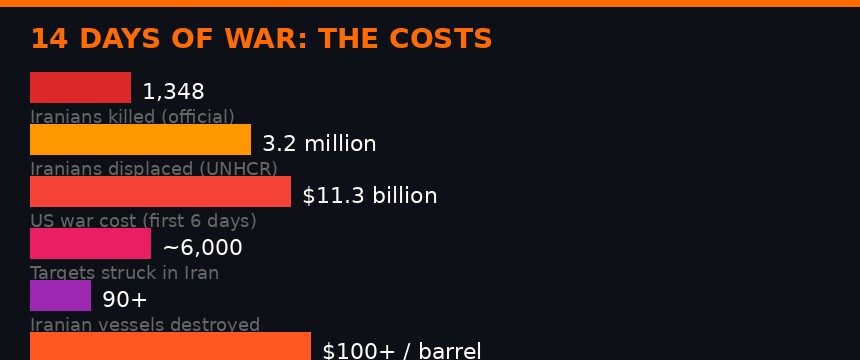
Oil prices have not pulled back since crossing $100 per barrel last week. Brent crude opened Friday above $100, with Iran maintaining its full closure of the Strait of Hormuz - the only waterway to open sea for Gulf oil and gas producers. Iran's latest statement is that any vessel with US or Israeli connections is banned from the strait. All other vessels must receive Iranian military permission to pass. The effective closure of the strait has removed approximately 20 percent of global oil and gas traffic from normal circulation. [Source: Bloomberg, Al Jazeera, OPEC data, March 13, 2026]
The IRGC's $200 threat - made Wednesday - cannot be dismissed as an opening negotiating position. Iran's ability to sustain Hormuz closure depends on its naval assets, many of which have been degraded. CENTCOM counts 90 vessels damaged or destroyed. But Iran has demonstrated mine-laying capability, drone boat capability, and coastal missile capability that collectively make the strait very difficult to safely transit under fire, regardless of how many ships the US has sunk. A single mine incident on a VLCC would spike prices by $15 per barrel within hours.
The International Energy Agency on Wednesday agreed to release 400 million barrels from the emergency reserves of member states - one of the largest coordinated emergency releases in the IEA's history. The speed and scale of the release signals how seriously consuming nations view the supply disruption. "We don't know how quickly it'll revert back," said Freya Beamish, chief economist at GlobalData TS Lombard. "We do think it'll revert back to $80 in due course, but the ball is to some degree in Iran's court." [Source: Al Jazeera, Bloomberg, March 12, 2026]
Trump's Thursday Truth Social post framing soaring oil prices as economically beneficial to the US - "The United States is the largest oil producer in the world, by far, so when oil prices go up, we make a lot of money" - collided immediately with economic reality. US consumers are paying those higher prices at the pump. US airlines are absorbing fuel cost increases. The manufacturing sector is experiencing input cost inflation. The political calculus that oil price gains benefit America at the macro level does not translate to the household level that drives US voter behavior. [Source: Trump Truth Social post, March 12, 2026]
Several Gulf countries have now declared force majeure on oil and gas shipments - a legal mechanism that allows contract parties to suspend obligations due to extraordinary circumstances. Qatar declared force majeure on LNG production after Iranian drone attacks on its facilities, and Bahrain has reported intercepting 114 missiles and 190 drones since February 28. Saudi Arabia intercepted 10 drones over its eastern oil region and later destroyed 28 more that breached its airspace. The Gulf is being hit on a daily basis. Force majeure declarations are not panic; they are legal acknowledgment that the situation is beyond normal commercial risk. [Sources: Bloomberg, Al Jazeera, Gulf state government statements, March 12-13, 2026]
Southeast Asia has already begun shutting offices and limiting travel in response to the oil crisis and supply disruptions. Fuel queues have appeared in several African capitals. The economic pain is no longer contained to the immediate theater of operations. [Source: Al Jazeera, March 12, 2026]
What Comes Next: No Exit in Sight
The critical question - whether Pezeshkian's ceasefire terms represent a genuine Iranian off-ramp or a tactical pause - turns on one variable: whether the political leadership in Tehran can actually deliver what it is promising. The evidence so far suggests it cannot. The IRGC has continued operations every time the president has signaled flexibility. The new Supreme Leader's first statement was a hardline demand, not a diplomatic overture. The missiles keep flying regardless of what the president posts to X.
On the US side, Trump's domestic political position is more complicated than his public confidence suggests. The $11.3 billion war cost in six days is accumulating. The 250+ organization letter to Congress represents organized political opposition that did not exist at the war's start. Senator Graham's acknowledgment that "I don't see this conflict ending today" is a rare moment of public realism from a reliable administration ally. [Source: Reuters, March 13, 2026]
Israel's stated objectives add another layer of complexity. Prime Minister Benjamin Netanyahu said Thursday that Israel is aiming to create conditions for regime change in Iran - "but it is up to Iran's people to take to the streets." He also said Israel is working to prevent Iran from moving nuclear and ballistic programs underground. These are not short-war objectives. Striking underground-hardened nuclear facilities requires specific bunker-buster munitions deployed at scale. The logistics of that campaign imply months, not weeks. [Source: Reuters, Times of Israel, March 13, 2026]
The power grid threat from Larijani is the new wildcard. If Trump follows through and strikes Iranian electrical infrastructure, Tehran has signaled it will respond by targeting power systems across every Gulf state hosting US forces. That scenario - simultaneous or near-simultaneous attacks on Saudi, Emirati, Bahraini, and Qatari power infrastructure - would trigger cascading failures in oil production, water desalination, and air operations across a theater where US military logistics depend on functioning host-nation infrastructure. It is not a theoretical risk. The Salalah port drone strike and the Dubai airport hit suggest Iran is willing to strike infrastructure it has previously avoided targeting.
The Pezeshkian ceasefire terms are real. They represent something the Iranian presidency wants. But Iran's presidency is not Iran's government. Until the IRGC and the office of the Supreme Leader - now occupied by a man who took power one week ago in a war he did not start and cannot easily end - signal the same flexibility, the three conditions posted on X are a wish, not a policy. And wishes do not stop the missiles.
On day 14, Tehran is simultaneously negotiating and fighting. The region is simultaneously running on emergency reserves and shutting its airspace. Four US airmen are dead in a crash that either was or was not hostile fire, depending on who you ask. And a specific threat to power every American base in the Gulf into darkness hangs in the air, unanswered and unretracted.
The off-ramp exists. Whether anyone can actually reach it is the only question left that matters.
Get BLACKWIRE reports first.
Breaking news, investigations, and analysis - straight to your phone.
Join @blackwirenews on Telegram