Two Blue Check Marks: Iran's "Barracks Internet" and the Families It Severed
Iran is building a permanent two-tier internet - global access for 16,000 elites, a sealed intranet for 90 million citizens. For the diaspora, it means waking up every morning and staring at gray check marks, waiting for proof that your family survived the night.

For millions in the Iranian diaspora, the two-bar signal icon on a smartphone has become the measure of life itself. Photo: Pexels
The first thing she checks every morning is not the news. Not the weather. Not the price of oil, which has a direct bearing on whether her country of birth still exists in its current form.
It is two small check marks on her phone. A WhatsApp message she sent the night before to her mother in Tehran. If they are blue, she breathes. If they are gray - still one check mark, or two gray ones stuck in "delivered" - something in her chest tightens in a way that does not have a name in English.
"I know gray doesn't mean anything, not necessarily," she told a researcher documenting diaspora experiences this winter. "But my body doesn't know that. My body thinks gray means she's gone."
This is what the Islamic Republic's internet war looks like from the outside. Not the satellite imagery. Not the NetBlocks charts showing 98.5% connectivity collapse. Not even the body counts, which are staggering and real and still undercounted. It looks like a 34-year-old woman in Stockholm staring at a phone screen at 6:47 AM, running the math on what gray check marks might mean today versus what they meant yesterday versus what they might mean tomorrow.
Iran has conducted its most sophisticated and most severe internet shutdown in history - and it may not end. According to confidential planning documents obtained by the digital rights monitoring group Filterwatch, the government is not planning to restore open internet access. It is planning to replace it permanently with something called "Barracks Internet" - a tiered architecture that gives global access to 16,000 vetted elites while locking 90 million citizens inside a domestic intranet with no outside view.
The human cost of that plan is measured in check marks. In cassette tapes in a drawer. In cousins rotating SIM cards like other people rotate tires. In an entire diaspora that has spent generations learning to say everything important without saying anything that could get someone killed.
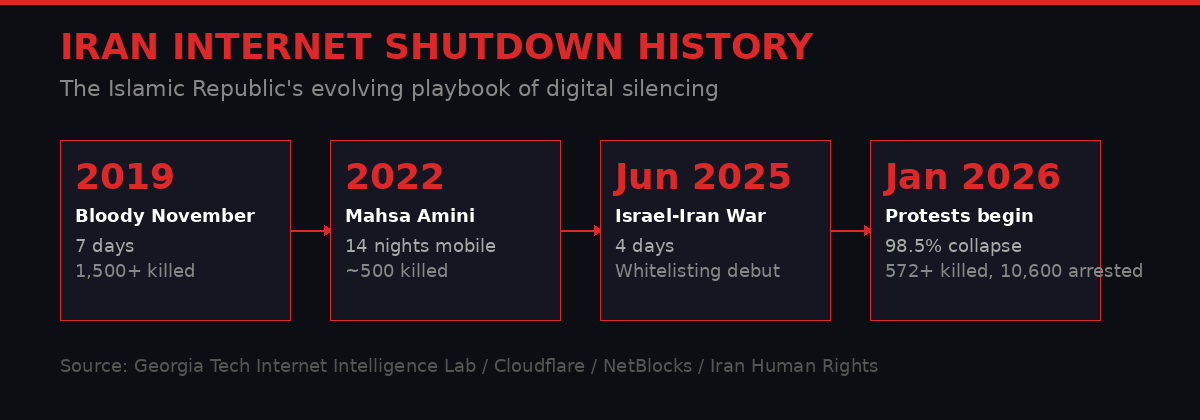
Iran's shutdown playbook has grown more sophisticated with each wave of protests. Source: Georgia Tech Internet Intelligence Lab / Cloudflare / NetBlocks.
The Longest Silence in Iranian History

Iran's internet infrastructure is now effectively controlled by the Revolutionary Guard. Photo: Pexels
On January 8, 2026, Iranian authorities initiated what researchers at the Georgia Institute of Technology's Internet Intelligence Lab called "the most sophisticated and most severe shutdown in Iran's history." Within 30 minutes, Cloudflare recorded a 98.5% collapse in Iranian internet traffic. The internet monitoring group NetBlocks confirmed non-satellite connectivity dropped below 2% of normal levels.
This was not a simple switch-off. Iran has been perfecting its shutdown technique for years. The 2019 "Bloody November" uprising saw a blunt routing announcement blackout - everything went dark at once, leaving about 3% residual connectivity. By the 2022 Women, Life, Freedom protests following Mahsa Amini's killing in custody, the regime had refined the approach: targeted nightly mobile shutdowns only, keeping fixed-line internet running to limit economic damage.
The June 2025 shutdown during the first wave of U.S.-Israel strikes introduced a new technique entirely. Rather than killing routing announcements, the regime interfered with key protocols - transport layer security and the domain name system - while using a whitelist system to allow selected government entities to continue operating. Iran's communications minister stayed connected to X (blocked for ordinary Iranians since 2009) even as 90 million citizens lost access to the outside world.
The current shutdown, which began in January and which government spokesperson Fatemeh Mohajerani confirmed will not return to its "previous form," represents the next phase. It is not a temporary emergency measure. It is the test run for permanent infrastructure.
According to the Human Rights Activists News Agency, at least 572 people have been killed and more than 10,600 arrested since protests erupted in late December 2025. Iranian Nobel laureate Shirin Ebadi warned of a "massacre under the cover of a sweeping communications blackout." The darkness is not incidental to the violence. It is the condition that makes the violence possible to commit without witnesses.
Barracks Internet: The Plan to Wall Off a Nation

Iran's "Barracks Internet" plan would create a permanent information apartheid. Photo: Pexels
The system's internal name, "Barracks Internet," appears in confidential planning documents obtained by Filterwatch, the Texas-based organization monitoring Iranian censorship. The architecture is designed to make the current blackout the last of its kind - not because the blackouts stop, but because a permanent version of the blackout becomes the default state.
Under Barracks Internet, global access to the internet would be granted only through a strict security whitelist. Ordinary Iranians would live inside a domestic intranet - able to use government-approved domestic services, but unable to access the global web, communicate with family abroad on international platforms, or read international news. The Islamic Republic would build its own WeChat, its own Alibaba, its own version of the whole digital world, and then lock the door behind it.
The idea of a tiered system is not new. Since at least 2013, the regime has quietly maintained "white SIM cards" for approximately 16,000 people - government officials, state media figures, Revolutionary Guard leadership. This group has always had unrestricted global internet access, even as the platforms they browse have been blocked for everyone else. The system gained public attention in November 2025 when X's location feature revealed that Iranian officials were posting from inside Iran despite X being blocked since 2009.
What Barracks Internet represents is scale and permanence: making that 16,000-person privilege the permanent architecture for 85 million more people left in the dark.
"The regime is terrified of one thing: Iranians being heard telling their own truth and having crimes documented. The question becomes: How do we give Iranians an unbreakable voice?" - Mahsa Alimardani, digital rights researcher, Witness (as cited by Rest of World)
Iran is attempting something that has never been done before: sealing off a fully connected modern economy while keeping it functioning. North Korea built its Kwangmyong intranet from scratch for a population that never had internet access. China constructed the Great Firewall over two decades while simultaneously nurturing domestic alternatives - WeChat, Baidu, Alibaba - that could replace Western platforms. Iran is trying to accomplish both in weeks, with sanctions preventing it from accessing Western technology and no mature domestic alternatives in place.
Kaveh Ranjbar, former chief technology officer at RIPE NCC, calls the plan a "digital airlock" that cannot fully seal a modern economy. Technical experts doubt its long-term viability. But "not fully viable" and "not deeply damaging" are not the same thing. The damage is happening now, in real time, regardless of what Iran's digital wall ultimately looks like in five years.
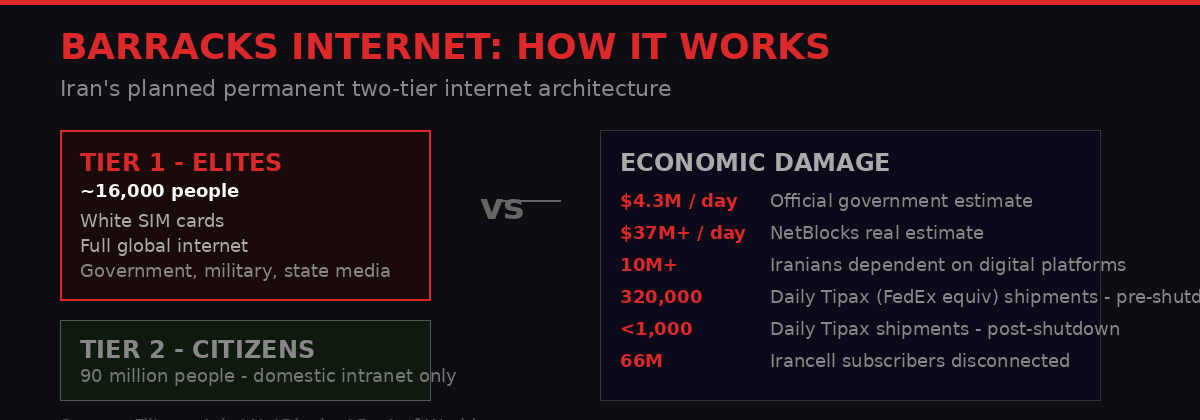
The architecture of Iran's planned permanent internet control. The economic costs are already catastrophic. Source: Filterwatch / NetBlocks / Rest of World.
Cassette Tapes and Check Marks: The Long History of Severed Contact

For the Iranian diaspora, the phone is a lifeline and a source of daily dread. Photo: Pexels
The current blackout is new in its scale and technological sophistication. The experience of having communication with Iran cut, monitored, and weaponized against families is not new at all.
Bahareh Sahebi, writing for Rest of World, describes the Iranian diaspora's long education in communicating under surveillance. In the 1980s and 1990s, it meant handwritten letters that arrived weeks or months late, slit open and resealed by state censors - sometimes with entire sections missing. Phone calls were brief and expensive and rehearsed. Families learned to say everything important while appearing to say nothing.
When someone traveled between Iran and the diaspora, they became a human postal service. Cassette tapes of family gatherings - dishes clinking, children shouting, laughter drifting in from another room - were carried in luggage and replayed for months. On rare occasions, a VHS tape would arrive: a wedding, a holiday dinner, the footage shaky and the colors slightly off, but the faces familiar enough to feel "almost unbearable and miraculous at the same time."
Then came email, then social media, then WhatsApp and Signal and Telegram. The distance shrank. And then the Islamic Republic systematically began attacking every tool that had shortened it.
VPNs became utilities - budgeted for like electricity, rotated when blocked, constantly replaced. A cousin rotates SIM cards: one for everyday use, one for tense periods, one kept in reserve. "It's not paranoia; it's preparation," Sahebi writes. Messages got shorter, more coded. "We are okay. Situation normal. Will write later." Sometimes messages disappeared minutes after arriving - deleted automatically "so if they take the phone, there won't be anything on it."
The pattern that emerges from decades of this is a diaspora that has become expert at reading silence. At knowing what gray check marks might mean at 7 AM versus 7 PM. At distinguishing "the internet is slow" from "something happened." At the particular kind of dread that is not quite fear because nothing has been confirmed yet but is also not calm because something has not been confirmed yet.
"When the phone rings unexpectedly, my heart drops," Sahebi writes. "Sometimes I hesitate to ask the question I want to ask; it is easier to ask about internet speed than to ask who has been hurt."
The Fight to Stay Connected: Tools, Tactics, and a Jamming War

Starlink was supposed to be the unjammable last resort. Iran proved that assumption wrong. Photo: Pexels
Starlink was supposed to be the solution that could not be shut down. Its thousands of low-Earth orbit satellites, shifting frequencies, and independence from terrestrial infrastructure made it the ultimate fail-safe. Russia tried to jam the service in Ukraine starting in 2022; SpaceX pushed software updates within hours that countered the attacks. Activists smuggled an estimated 50,000 terminals into Iran following the 2022 Mahsa Amini protests. SpaceX offered the service free to Iranian users.
Iran broke it anyway.
According to Amir Rashidi, director of digital rights at the Miaan Group, military-grade GPS jammers deployed since January 8 have cut satellite internet performance by as much as 80% in parts of the country. The technique exploits Starlink's reliance on GPS signals to locate terminals and connect to satellites - by disrupting those GPS signals, Iranian authorities can render terminals unreliable without touching the satellites themselves.
"The level of violence by the government is unlike anything I have ever witnessed," Rashidi wrote on LinkedIn. "The Islamic Republic is killing to survive."
The government claims it disabled 40,000 Starlink connections and jammed some terminals. Reuters confirmed on January 12 that some Starlink service persists in border towns and some rural areas, but reduced and unreliable. The terminals that remain working are dangerous to possess and expensive to obtain. For most Iranians, they are not a practical option.
Outside Iran, volunteers have deployed tools like Psiphon Conduit, Lantern, Outline, Tor bridges, and the Snowflake browser extension - tools that allow internet users outside Iran to act as temporary relays, giving people inside the country a fragile path to the global internet. The systems are imperfect and constantly disrupted. As soon as one pathway stabilizes, another is blocked. The infrastructure of censorship evolves alongside the infrastructure designed to evade it.
"We need to revolutionize access to the internet. And move beyond the limiting structures and norms of 'internet sovereignty.'" - Mahsa Alimardani, digital rights researcher, Witness
The broader implications extend far beyond Iran. Myanmar, Sudan, and other conflict zones have come to rely on Starlink as critical infrastructure for rebels, aid workers, and journalists. If Iran's GPS jamming playbook spreads to other authoritarian states - and there is no technical reason it should not - the workaround that activists and international organizations have staked lives on becomes significantly less reliable.
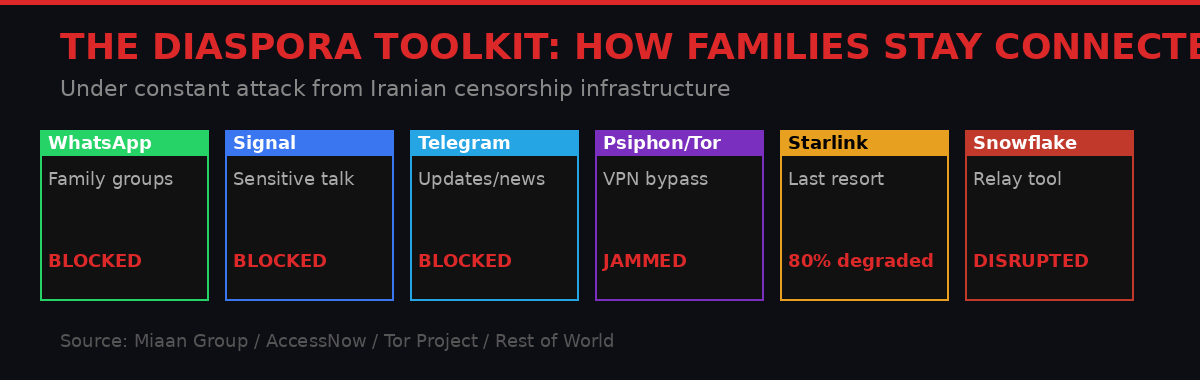
The tools the diaspora relies on to stay connected - and how Iran has attacked each one. Source: Miaan Group / AccessNow / Tor Project.
The Disinformation Problem: When Truth Drowns in Noise

Diaspora group chats have become impromptu fact-checking networks, sorting real footage from AI-generated fakes. Photo: Pexels
The internet blackout creates a secondary crisis: when almost nothing gets out, everything that does get out becomes suspect.
Iranian diaspora group chats have transformed into ad hoc intelligence operations. Someone in Chicago scans Telegram channels. Someone in Australia compares news broadcasts. A relative in Stockholm reads European coverage. Together, the group assembles something like a picture of reality from scattered fragments. They check timestamps in Persian. They listen for regional accents in audio recordings. They examine the angle of sunlight against the reported hour. They reverse image search everything.
The Meta Oversight Board this month cited Meta's failure to label an AI-generated video of alleged damage during the 2025 Israel-Iran war as a case study in the problem. The board found Meta should have flagged the synthetic video - which spread widely - as AI-generated. The company failed to do so. For diaspora communities already struggling to verify anything from inside a nearly-closed information environment, AI-generated footage is not just a misinformation problem. It is an active weapon that the regime and its supporters can deploy to muddy every genuine piece of evidence that filters out.
"Still, when videos of wounded protesters circulate through personal networks, people hesitate," Sahebi writes. "They squint at the screen and say it is probably AI. Even when you explain that the footage came from someone you know, someone who risked arrest to film it. Doubt lingers, and in that moment something disappears. The suffering, the violence, the grief never enter the conversation. They dissolve into speculation."
This is the other purpose of the blackout - not just to prevent information from leaving Iran, but to make whatever information does escape impossible to trust. A protest that nobody can document cleanly is a protest that the world can choose to doubt. Violence committed in the dark is violence that can be denied, or attributed to "foreign interference," or buried under a avalanche of AI-generated counternarratives.
The Islamic Republic has had 40 years to study how information control works. The current shutdown represents the synthesis of those decades - technological sophistication married to political will and built on a model that explicitly divides the population into those with access to truth and those without.
The People Inside the Architecture: Profiles of the Severed

Ordinary Iranians navigating daily life under the most severe communications blackout in the country's modern history. Photo: Pexels
Ten million Iranians depend directly on digital platforms for their livelihoods. That is not an abstraction. That is freelancers, small business owners, tutors, designers, developers, and merchants who ran their entire economic lives through platforms that no longer work.
Tipax, one of Iran's largest private delivery companies - handling roughly 320,000 daily shipments before the protests - now processes fewer than a few hundred, according to Filterwatch. The company operates a nationwide logistics network comparable to FedEx in the United States. It is currently functionally dead.
The government fired Irancell's CEO, Alireza Rafiei, for failing to comply with shutdown orders fast enough. Irancell, the country's second-largest mobile operator with 66 million subscribers, is partly owned by South Africa's MTN Group. Rafiei was removed for disobeying orders on "restriction of internet access in crisis situations," according to Fars news agency. Foreign telecom partners have left Iran under security escort, without media coverage. What replaces them, according to Filterwatch, will likely be the Revolutionary Guard's construction arm or limited cooperation with Huawei - infrastructure that serves the state's surveillance needs rather than its citizens' communication needs.
Iran's deputy communications minister pegged the daily economic losses from the blackout at $4.3 million. NetBlocks estimates the real cost exceeds $37 million daily. The difference between those numbers - one official, one independent - tells you something about what the government is willing to acknowledge publicly and what it is willing to absorb privately.
For the diaspora, the economic frame misses the point entirely. You cannot put a dollar figure on a cousin in Stockholm crying at 7 AM because two check marks have been gray for 18 hours. You cannot quantify the particular quality of a voice note from an aunt in Tehran - the sound of water running in her kitchen in the background, the ordinary proof of existence that you replay when the messages stop coming.
"In some ways you worry more than we do. It's like when someone is sick, sometimes the caregiver suffers more than the patient." - Bita, Tehran, in a message to her cousin abroad (cited by Bahareh Sahebi, Rest of World)
The Resistance: Fifty Thousand Terminals and the People Who Smuggled Them

Every act of digital resistance inside Iran carries real-world consequences. Photo: Pexels
Against this architecture of silence, a parallel infrastructure of resistance has grown over years of practice.
Fifty thousand Starlink terminals were smuggled into Iran between 2022 and 2025, according to digital rights advocates. The Biden administration exempted Starlink from Iran sanctions in 2022. SpaceX made the service free for Iranian users. For two years, those terminals were a fragile but real lifeline - the difference between silence and visibility during protests and crackdowns.
Iran has been systematically attacking those terminals since January. The GPS jamming campaign has cut performance by 80% in some areas, rendering many terminals unreliable. The government claims to have disabled 40,000 connections. Some terminals - particularly in border towns and rural areas - remain partially operational after firmware updates designed to bypass blocking. But possession of a Starlink terminal is dangerous, and the risk calculus has shifted.
The circumvention community has adapted. Psiphon Conduit, Lantern, Outline, and Snowflake allow internet users outside Iran to serve as relay points - essentially volunteering their own internet connections to tunnel traffic in and out of the country. These tools have real limitations: they are slower than direct connections, increasingly targeted by Iranian censorship infrastructure, and dependent on volunteers in the outside world staying engaged with a crisis that competes for attention with many other crises.
The Article 19 human rights organization has documented extensively how 20 days of shutdown hid the full scale of human rights abuses during the early 2026 protests. AccessNow's KeepItOn campaign has recorded and reported on the digital darkness. The Tor Project has published guides on staying ahead of censors. But documentation and guides are not connectivity, and connectivity is what the 90 million people inside need.
The White House press secretary confirmed in January that President Trump and Elon Musk discussed restoring internet access in Iran. No agreement has been publicly announced. SpaceX has not commented on the degradation of its service inside the country. The company's relationship with the current U.S. administration - and the current administration's relationship with its own foreign policy toward Iran - makes the politics of Starlink support unusually complicated in 2026.
What Comes Next: The North Korea Question

The question is whether Iran can permanently close its digital borders without economic collapse. Photo: Pexels
The comparison to North Korea is everywhere in analysis of Barracks Internet - and everywhere, the same qualification follows: Iran is not North Korea. North Korea built its isolation from scratch, for a population that had never been connected. Iran is attempting to seal off a connected, educated, urban population that has used global internet for decades, runs businesses that depend on it, and has millions of family members outside the country who expect to be able to communicate with them.
Technical experts are skeptical that Barracks Internet can work in its most extreme form. Kaveh Ranjbar's "digital airlock" that cannot fully seal a modern economy captures the core problem: if you cannot buy from Shopify, communicate with international clients on Zoom, use any foreign-hosted SaaS tool, or access global payment systems, your economy degrades faster than your censorship infrastructure can compensate for. Iran's economy was already under severe pressure from sanctions and the war's effects before the blackout added $37 million daily to its damage.
But "won't work perfectly" is not comfort. China's Great Firewall does not work perfectly either - motivated users can circumvent it. It works well enough to prevent the vast majority of the population from accessing outside information most of the time, which is all it needs to do. If Barracks Internet achieves something similar for Iran - most people, most of the time, cut off from the global information environment - the regime may consider that a success even if determined activists, diaspora families, and business users find workarounds.
The timeline the government has given for the Barracks Internet architecture runs to late March and beyond. The parallel crackdown - with over 10,600 arrested, thousands more documented as disappeared by human rights organizations, and a shooting death toll that Iran Human Rights says is likely far higher than the 572 confirmed - shows no sign of winding down as the U.S.-Israel military campaign continues to create cover for domestic repression.
For the diaspora watching from Stockholm and Chicago and Sydney and Toronto, the immediate question is not geopolitical. It is: are those check marks going to turn blue today?
"Every call feels like goodbye. Sometimes it feels like we are trying to reach a distant planet through a fragile signal, hoping the transmission holds." - Bahareh Sahebi, Iranian diaspora, writing for Rest of World
The cassette tapes from the 1980s - shaky VHS footage of weddings, the sound of a relative's laughter from another room - were an imperfect solution to the problem of distance enforced by politics. Those tapes still sit in drawers across the diaspora. The people who pressed play on them are still pressing play on voice notes from Tehran, listening for water running in a kitchen, evidence of ordinary life continuing.
What Barracks Internet threatens is not just connectivity. It is the accumulated, hard-won technology of staying in touch across a border that has always tried to sever contact. Every tool the diaspora has built and adapted and deployed over 40 years - letters, cassettes, satellite TV, VPNs, Telegram, Starlink - has been met with a new version of the same strategy: cut the wire, and make the silence look like peace.
The check marks will turn gray again. They always do. The question is whether what the diaspora has built - the relay networks, the volunteers, the redundant tools, the informal fact-checking chains running from Tehran to Stockholm to Chicago - will hold enough of a thread to keep 90 million people from becoming entirely unreachable.
Most mornings, for most families, the checks turn blue eventually. And that has to be enough, because it is all there is.
Timeline: Iran's Road to Barracks Internet
Get BLACKWIRE reports first.
Breaking news, investigations, and analysis - straight to your phone.
Join @blackwirenews on Telegram