Institutions Buy the Chaos: Corporate Bitcoin Hits Record as $100 Oil Week Breaks Markets
While retail traders bailed on Bitcoin and oil spiked 10% in a single session, institutions quietly loaded up. Corporate BTC holdings hit a record this week - 2.8x the rate miners are producing new coins. Strategy alone bought 4,100 BTC in a Thursday where equities bled out. Somewhere else, a trader just turned $50 million into $36,000 on Aave. The Senate banned CBDCs. And AI tokens are up 17% in a day. This is the divergence trade playing out in real time.
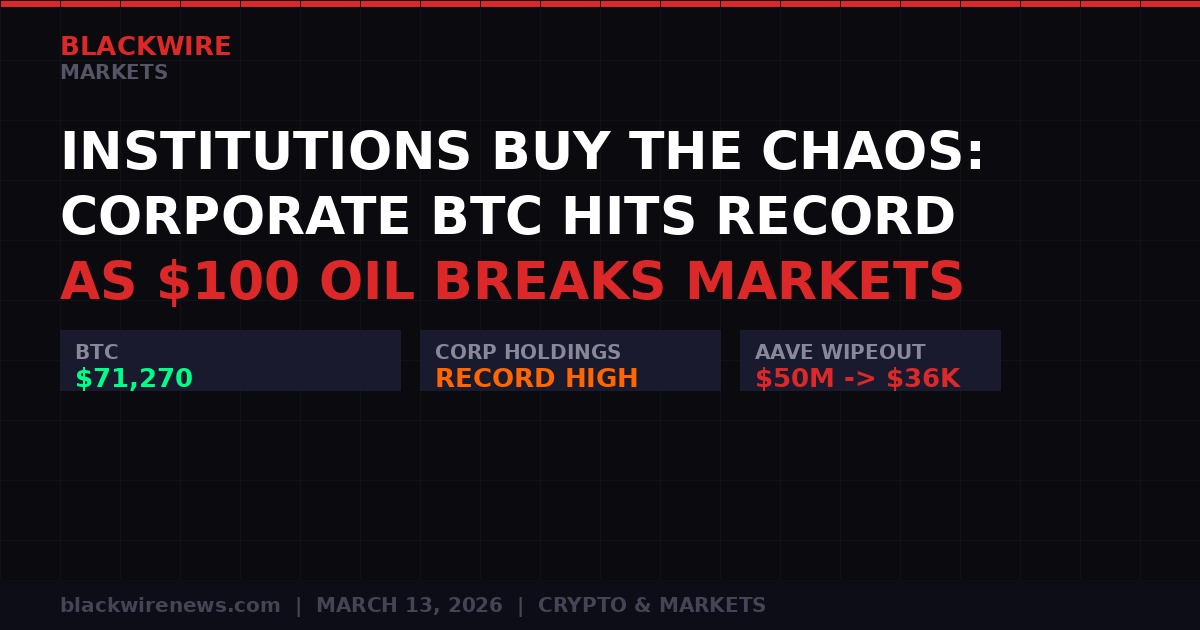
Corporate Bitcoin accumulation has hit record highs even as macro panic grips global markets. Source: BLACKWIRE / PIL
The Week That Defined the Divergence
Oil surged 10% Thursday. Trump told reporters stopping Iran matters more than oil prices. WTI was threatening triple digits again. Stock indices buckled under the combined weight of geopolitical risk, credit stress, and a Federal Reserve that cannot cut rates without risking another inflation leg higher.
Bitcoin held $70,000.
That sentence deserves to sit alone, because twelve months ago it would have been unthinkable. The asset that once moved in lockstep with the Nasdaq - that crashed 80% every time the Fed blinked - just absorbed a 10% oil shock and a stock market selloff without breaking its key support level. By Friday morning Asian time, BTC had climbed back to near $72,000 after Treasury Secretary Scott Bessent moved to calm oil market fears, providing temporary authorization for countries to purchase Russian oil currently in transit.
The broader crypto market followed. Ethereum rose 4.09% to $2,106. Solana surged 4.87% to $89.14. Hyperliquid jumped 6.32% to $38.43. But the real fireworks were in AI-adjacent infrastructure tokens - Bittensor (TAO) up 15.12%, Render (RENDER) up 16.7%, and Fetch.ai (FET) up 17.56% in a 24-hour window. (Source: CryptoSlate, March 13, 2026.)
The picture: macro chaos at the surface, institutional accumulation underneath, and a regulatory landscape reshaping itself in real time. This was not a random week. This was a structural inflection.
MARKET SNAPSHOT - MARCH 13, 2026 (04:00 UTC)
Corporate Bitcoin: 2.8x Mining Supply and Climbing
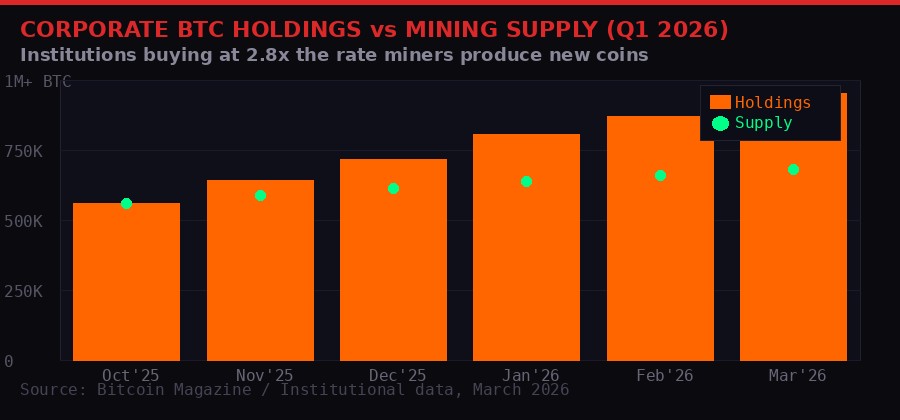
Corporate BTC holdings (orange) have dramatically outpaced the cumulative new supply added by miners (green). Source: BLACKWIRE data visualization based on Bitcoin Magazine / institutional data.
The headline number that should reshape how you think about Bitcoin's supply dynamics: corporations and institutional treasuries are now absorbing Bitcoin at 2.8 times the rate that miners are producing new coins. That ratio has never been higher. (Source: Bitcoin Magazine, March 12, 2026.)
Let that ratio sink in. The Bitcoin network produces roughly 450 new BTC per day post-halving - approximately 13,500 BTC per month. If institutions are absorbing at 2.8x that rate, they are taking 37,800+ BTC per month off the market. Every month. In a sustained way that structural demand analysis suggests is not cyclical noise - it is balance sheet strategy.
Leading the charge on Thursday: Strategy (MSTR) bought over 4,100 Bitcoin using proceeds from its STRC preferred stock offering - the latest in a sequence of Bitcoin treasury additions that has turned Michael Saylor's software company into the world's largest corporate Bitcoin holder. (Source: Bitcoin Magazine, March 12, 2026.) Strategy's total holdings now sit well above 500,000 BTC. The company is a one-way ratchet: it never sells, it only issues equity or debt to buy more.
The ETF complex tells a similar story. Spot Bitcoin ETFs in the U.S. continue to pull assets from retail investors who want passive exposure without self-custody. BlackRock's IBIT alone has accumulated over $50 billion in Bitcoin under management. When you add ETF inflows to corporate treasury buyers to sovereign wealth fund allocations now appearing in SEC filings, the math on available liquid Bitcoin supply becomes deeply uncomfortable for anyone with a short position.
The counterweight: on-chain data firm Glassnode reported this week that its Accumulation Trend Score for Bitcoin has dropped to 0.04 - near its minimum value - as smaller wallet cohorts actively offload BTC while macro headwinds intensify. (Source: CoinDesk, March 12, 2026.) This means retail is selling. Institutions are buying. The divergence trade is live.
The implication is stark: if retail panic-sells into institutional hands during a $100 oil shock, and those institutions hold through the noise the way Strategy has held through every correction since 2020, the effective float of liquid Bitcoin continues to shrink. That is not a price prediction - it is a supply observation with obvious directional implications.
"ETFs and major corporate treasuries like Strategy are absorbing new supply at unprecedented rates." - Bitcoin Magazine, reporting on institutional accumulation data, March 12, 2026
Beyond the U.S., a new piece of regulation adds a compliance layer that could drive more institutional adoption. Paraguay's tax authority this week announced that residents and crypto platforms must now report digital asset transactions over $5,000 - including wallet addresses and transaction hashes. (Source: Bitcoin Magazine, March 12, 2026.) The measure integrates cryptocurrencies into the national tax system. It raises privacy concerns. But in institutional terms, it legitimizes Bitcoin as an asset class requiring formal treatment - which is often a precondition for institutional entry in that market.
The $50 Million Aave Disaster: DeFi's UI Problem, Quantified
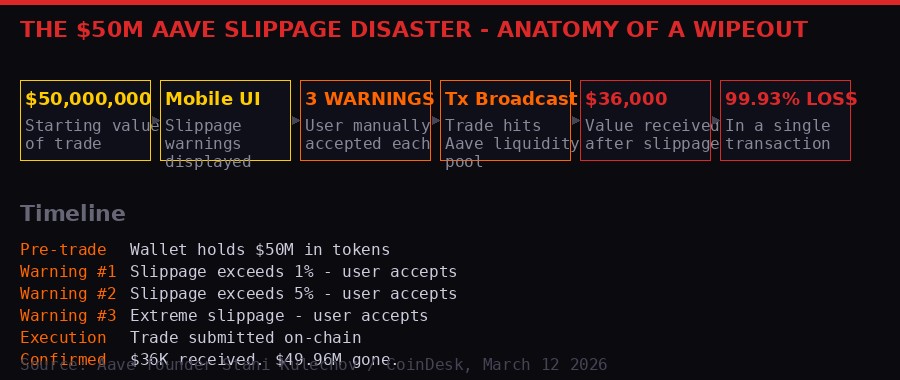
How $50 million became $36,000 in a single DeFi transaction. Source: BLACKWIRE data visualization.
On Wednesday, an anonymous trader entered what should have been a routine Aave transaction. When the dust cleared, $50 million had become $36,000. A loss of 99.93%. Not from a hack. Not from a rug pull. From slippage - and from three separate warnings that the user manually dismissed on a mobile device. (Source: CoinDesk, March 12, 2026.)
Aave founder Stani Kulechov confirmed the incident publicly, noting that the interface had displayed multiple slippage warnings which the user accepted. Kulechov's statement was factual, measured, and deeply uncomfortable for the DeFi community: because it places the blame squarely on the user. Three warnings. Three accepts. $49.96 million gone.
The trade presumably involved a large position being swapped through thin liquidity. When you are moving $50 million through a liquidity pool, you are the liquidity. If the pool depth is insufficient, the price impact of your own trade obliterates your value before the transaction confirms. This is not a bug in Aave's smart contracts - it functioned exactly as designed. The flaw is in how humans interact with financial systems built by engineers who assume users will read and understand percentage-based slippage warnings on a 6-inch screen.
DeFi's user experience problem has been documented for years. But $50 million to $36,000 in a single transaction is a number that even skeptics cannot dismiss. It is the kind of loss that ends careers, triggers lawsuits, and - in traditional finance - would result in immediate regulatory intervention. In DeFi, it results in a tweet from the protocol founder and a Reddit thread.
The incident will accelerate pressure on DeFi protocols to implement more aggressive safeguards - mandatory confirmation delays for large transactions, hard caps on single-transaction slippage regardless of user override, and mobile interface redesigns that make extreme-slippage warnings impossible to dismiss with a thumb tap. Whether that pressure translates into code is a governance question. Aave's governance just watched a user lose $50 million. The question is whether that is enough to change anything.
For the broader market, the incident raises a less sympathetic but important point: $50 million was sitting in a DeFi protocol wallet, in liquid form, ready to be traded. That is a measure of real adoption. The whale who lost it is presumably still solvent - this kind of position size implies significantly larger total holdings. But it is a reminder that DeFi liquidity, for all its growth, remains thin at the edges where it matters most.
Senate Kills CBDCs, SEC Embraces Tokenized Stocks: Regulation Week
Two regulatory developments this week point in opposite directions for crypto - and together they sketch the emerging shape of U.S. digital asset policy in 2026.
First, the kill shot: the U.S. Senate passed a bipartisan housing bill that carries an embedded ban on U.S. central bank digital currencies. The CBDC ban was attached to housing legislation with no direct connection to digital currency policy - a congressional move that signals deep, cross-party opposition to the Federal Reserve issuing a digital dollar. (Source: CoinDesk, March 12, 2026.)
The bill now faces uncertain prospects in the House, where the unrelated CBDC provision could become a sticking point. But the Senate vote itself is significant: it demonstrates that anti-CBDC sentiment has moved from the libertarian fringe to the legislative mainstream. Both Republican and Democratic senators backed the housing bill, meaning opposition to a digital dollar is not a partisan issue - it is a bipartisan consensus that government-issued programmable money represents a surveillance threat that neither side wants to own politically.
For Bitcoin holders, the CBDC ban is unambiguously positive. A government digital dollar would compete directly with stablecoins and potentially with Bitcoin as a means of payment. Its death - even if temporary - keeps the field clear for private crypto infrastructure to mature without facing a government competitor with legal tender status and Federal Reserve backing.
The second development cuts the other way: the SEC's Investor Advisory Committee this week voted to support a new effort to regulate stock transactions on blockchains. The committee - which steers the U.S. securities regulator on investor protection issues - backed a framework for keeping tokenized securities safe. (Source: CoinDesk, March 12, 2026.) The move signals that the SEC under the current administration is willing to engage with blockchain-based settlement infrastructure rather than simply litigating against it.
Tokenized securities - traditional stocks and bonds represented as on-chain tokens - have been growing rapidly. The RWA (real-world assets) sector already holds over $25 billion in tokenized assets globally, with Wall Street institutions including BlackRock, Franklin Templeton, and JPMorgan all running tokenization programs. SEC advisory committee backing doesn't immediately change the legal landscape, but it signals regulatory intent: this is a space the SEC wants to shape, not shut down.
The Bitcoin Policy Institute added another dimension on Thursday, urging Congress to include Bitcoin in proposed de minimis tax relief for digital assets. Current proposals under the GENIUS Act framework focus primarily on payment stablecoins. The BPI argues that excluding Bitcoin from de minimis transaction relief creates a two-tier system where using BTC for everyday purchases triggers capital gains reporting requirements - effectively making Bitcoin unusable as a payment medium compared to stablecoins. (Source: Bitcoin Magazine, March 12, 2026.)
The regulatory week verdict: the U.S. is not going to issue a digital dollar. It is going to tokenize stocks instead. And it might - eventually - make spending Bitcoin less of a tax compliance headache. For an industry that spent 2022-2024 under existential legal pressure, this is a material improvement in the operating environment.
AI Tokens Break Out: The Infrastructure Play Nobody Predicted This Week
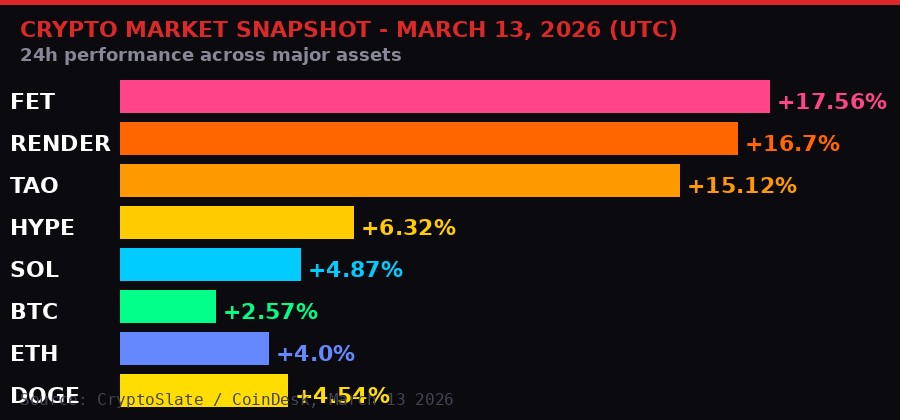
AI-adjacent infrastructure tokens dominated crypto performance on March 13, 2026, with FET, RENDER, and TAO all posting double-digit gains while BTC held steady. Source: BLACKWIRE / CryptoSlate data.
While the macro fear trade had retail selling Bitcoin, a different category of crypto assets was ripping higher. Fetch.ai (FET) surged 17.56% in 24 hours. Render Network (RENDER) gained 16.70%. Bittensor (TAO) jumped 15.12%. These are not meme coins. They are infrastructure tokens for decentralized AI compute, GPU rendering networks, and AI model training and inference markets. (Source: CryptoSlate, March 13, 2026.)
The divergence within crypto is telling. Bitcoin at $71,270 up 2.57%. Ethereum at $2,113 up 4.09%. But AI infrastructure plays up 15-17%? That spread reflects a narrative rotation that has been building for months but crystallized this week: AI demand for compute is not going to be solved by centralized hyperscalers alone. The bottleneck is GPU availability, energy costs, and geographic distribution of inference capacity. Decentralized compute networks like Render and the Bittensor subnet ecosystem offer an alternative infrastructure layer that major AI labs are increasingly taking seriously.
The FET move is particularly notable because Fetch.ai merged with SingularityNET and Ocean Protocol to form the Artificial Superintelligence Alliance - a consortium positioning itself as the decentralized AI infrastructure for the post-AGI transition. The token's 17.56% daily gain reflects market speculation that the Alliance's positioning could attract enterprise and government contracts as AI deployment accelerates in 2026.
Bittensor deserves special attention. TAO at $230, up 15.12% in 24 hours, represents a market cap of approximately $2.47 billion for a network that is building a decentralized marketplace for AI model weights. The thesis: if the world's most valuable AI models are trained on decentralized infrastructure and their weights are available for permissionless use on Bittensor's subnet system, the network captures value that would otherwise accrue entirely to OpenAI, Anthropic, and Google. At $2.47 billion market cap, it is either wildly overvalued or at early innings of a multi-hundred-billion dollar infrastructure play. There is limited in-between.
The Render Network runs GPU rendering infrastructure that serves both AI training workflows and traditional 3D/visual effects pipelines. Its 16.70% gain this week follows a 24.37% gain over the past seven days - a 7-day performance of +24.37% against a backdrop of oil shock and market fear. That kind of relative strength in a risk-off week is a market signal. Someone is accumulating Render ahead of an anticipated catalyst.
Bitcoin at $70K: The Bessent Put and What Oil Means for BTC Mining
The macro context for Bitcoin's resilience this week comes in two parts: the Bessent intervention on oil, and the structural insensitivity of Bitcoin mining to crude prices.
On Thursday, WTI crude climbed roughly 10% as geopolitical escalation around Iran dominated headlines. Trump's public statement - that stopping Iran is "more of a concern than oil prices" - signaled that the White House would accept higher crude prices as a cost of its Iran policy. Stocks fell. Credit spreads widened. Bitcoin held $70,000 with minimal volatility relative to equities.
By Friday morning, Treasury Secretary Scott Bessent moved to calm fears by announcing temporary authorization for countries to purchase Russian oil currently in transit - a targeted supply relief measure that helped moderate crude's upward pressure. Bitcoin responded by climbing toward $72,000. The causal link is indirect but real: lower oil pressure reduces the probability of a stagflation scenario that forces the Fed's hand on rates, which is bearish for all risk assets including crypto.
A separate research report this week addressed the oft-repeated concern that $100+ oil is existential for Bitcoin mining. The answer: mostly no. Research cited by CoinDesk found that only 8% to 10% of global Bitcoin hashrate runs in oil-sensitive power markets. The vast majority of Bitcoin mining runs on hydroelectric, nuclear, natural gas, and increasingly solar/wind power sources in jurisdictions with highly localized energy costs. Geopolitical oil shocks affect BTC prices through macro risk-off sentiment far more than they affect the actual economics of mining operations. (Source: CoinDesk, March 12, 2026.)
Cathie Wood's Ark Invest weighed in on a different risk vector this week, releasing analysis arguing that quantum computing represents a long-term risk for Bitcoin - but not an imminent one. Today's quantum computers are "far from breaking Bitcoin's cryptography," and any real threat would emerge gradually, giving the network time to adopt post-quantum cryptographic standards. (Source: CoinDesk, March 12, 2026.) The Ark statement effectively closes down a common bear argument: quantum is not a 2026 or 2027 risk. It may not be a 2030 risk. The Bitcoin developer community has been working on post-quantum migration paths for years.
"Only 8% to 10% of global Bitcoin hashrate runs in oil-sensitive power markets, suggesting that geopolitical shocks may affect BTC prices more than mining costs." - Research cited by CoinDesk, March 12, 2026
The net macro read for Bitcoin at $70,000: the floor is holding because institutional demand is structural, oil price sensitivity to BTC mining is lower than the narrative suggests, and the regulatory environment is improving in the U.S. The ceiling is being tested by macro uncertainty - a Fed that cannot pivot easily, credit stress in equities, and a geopolitical environment that remains genuinely unpredictable. Bitcoin's next major leg depends on whether those macro conditions clear or deteriorate further.
$TRUMP Token, OP Labs Cuts, and the Signals You Should Not Miss
A week this dense always has loose threads that matter. Three deserve attention before the weekend open.
The $TRUMP Dinner: Donald Trump announced another "gala luncheon" for the top 297 holders of his $TRUMP memecoin - a direct repeat of the Mar-a-Lago dinner format that generated headlines and regulatory scrutiny earlier in 2026. (Source: CoinDesk, March 12, 2026.) The $TRUMP token is currently trading at $2.98, up 3.61% in 24 hours but still down 8.76% over the past week. The fundamental case for holding $TRUMP is access: the President is literally offering dinners to his top holders. The fundamental case against: the token has no utility beyond this social contract with a head of state, and that contract terminates at some point with no on-chain recourse. The market is making its own assessment. $692 million market cap implies a lot of people think the access is worth something real.
OP Labs Cuts Roles: Optimism's developer OP Labs this week announced it is cutting roles to "narrow focus." (Source: CoinDesk, March 12, 2026.) Optimism (OP) is an Ethereum layer-2 scaling network. OP trades at $0.12, down 31.76% over the past 30 days. The headcount reduction at OP Labs comes as the broader L2 landscape is increasingly competitive - Arbitrum, Base (Coinbase's L2), and ZKSync are all fighting for the same developer mindshare. "Narrowing focus" is startup language for a strategic pivot under capital pressure. Watch what OP Labs focuses on narrowing to: if it doubles down on the Superchain / OP Stack ecosystem as an L2 infrastructure play rather than a standalone chain, there is a path back. If this is just a cost-cut with no strategic reset, OP's downtrend has further to run.
Circle's USDC Outperformance: William Blair analyst coverage this week highlighted Circle's continued outperformance, arguing that USDC's recent rally reflects more than macro factors - specifically pointing to growing recognition of Circle's stablecoin infrastructure advantage. USDC has a market cap of $78.88 billion, up 0.26% monthly. In a week where depegging risks were elevated by macro stress, USDC held its peg without drama. The SEC advisory committee backing tokenized securities indirectly benefits Circle: a world where stocks settle on-chain is a world where USDC is the dominant settlement currency. That is an enormously valuable position. (Source: CoinDesk, March 12, 2026.)
The Forward Picture: What Next Week Decides
The week of March 9-13, 2026 established a clear structure for what comes next. The institutional accumulation data is not a rumor - it is in SEC filings and on-chain. The regulatory environment is shifting away from enforcement and toward frameworks. The macro environment remains genuinely dangerous, but Bitcoin's behavior this week suggests it has matured past simple risk-asset correlation with the Nasdaq.
The critical data point for next week: whether Glassnode's Accumulation Trend Score begins to reverse. At 0.04, it signals that smaller holders - retail - are aggressively distributing. If institutions absorb that retail supply at $70,000-$72,000 and the score begins climbing back toward 0.5-1.0, the setup for a sustained move higher becomes compelling. If institutional bids thin at these levels and retail distribution accelerates, $70,000 gets tested as support rather than floor.
The oil situation is the wild card. Bessent's intervention Thursday bought time, but the underlying geopolitical dynamics - Iran policy, Hormuz shipping risk, OPEC production decisions - have not resolved. A second oil spike would re-test Bitcoin's newly claimed macro independence. The 10% single-session crude move this week did not break BTC. Whether a second shock produces the same result is the experiment nobody wants to run.
For DeFi, the $50 million Aave incident is an industry moment. The protocol is not broken. The UX is. Whichever team ships mobile DeFi interfaces with genuinely idiot-proof large-transaction safeguards first - mandatory time delays, hard slippage caps, biometric confirmation for whale-size trades - captures a real market. $49.96 million evaporated because the confirmation button was too easy to tap. That is not an unsolvable engineering problem. It is an unsolved one.
The AI token move - TAO, FET, RENDER up 15-17% in a week that scared most risk assets - is the most underreported signal in this week's noise. Decentralized AI compute is not a crypto narrative anymore. It is an infrastructure thesis that intersects with every major technology trend of 2026. The first protocol that can demonstrably serve a tier-one AI lab's inference needs at competitive cost wins a position that no regulator can easily threaten and no competitor can easily replicate. Watch the developer activity on these networks. The price is telling you something. So are the commits.
The week closed with Bitcoin near $72,000, institutions loading up, retail selling, CBDCs dead in the Senate, tokenized stocks getting regulatory blessing, and a trader somewhere sitting with $36,000 wondering what just happened to their $50 million. That is the crypto market in 2026: simultaneously the most sophisticated capital allocation system on earth and a platform where a single mobile screen tap can obliterate generational wealth. Both things are true. Both things matter.
Get BLACKWIRE reports first.
Breaking news, investigations, and analysis - straight to your phone.
Join @blackwirenews on Telegram