Drones Over Doorsteps: How ICE Built a Surveillance Grid to Target Anti-Deportation Activists
DHS drones are hovering outside the homes of anti-ICE organizers in Minneapolis. But the drone is just the visible tip of a vast surveillance machine - Flock license plate readers, Clearview facial recognition, encrypted data fusion, and a federal system that tracks your politics by tracking your location.
BLACKWIRE / PRISM - The surveillance apparatus deployed against domestic anti-deportation organizing.
Late at night in Minneapolis, anti-ICE organizers are watching the sky. They have spotted drones hovering over their neighborhoods - in at least one documented case, directly outside a private residence. The Department of Homeland Security will not confirm whether the aircraft belong to them. They do not need to. The evidence is being assembled from other directions.
ICE has reportedly deployed license-plate readers and facial recognition technology to surveil activists in the city, according to reporting by The Verge published this week. The targets are not suspected criminals. They are people exercising a constitutional right to organize against federal policy. What is happening in Minneapolis is a case study in how immigration enforcement technology - built in the language of border security and anti-trafficking - has turned inward, toward anyone who inconveniences it.
This is not new. It is just newly visible. The infrastructure was assembled over years, block by block, database by database, contract by contract. The drone hovering over the house is the last mile of a system that begins with a camera bolted to a streetlight in a suburb no one ever heard of.
The Drone at the Window
The Verge reported on March 13, 2026, that Minnesotans active in anti-ICE organizing have documented repeated drone sightings over their neighborhoods in recent weeks. At least one activist described an aircraft hovering directly outside their home - close enough to identify. The Department of Homeland Security, when reached for comment, refused to confirm or deny whether the drones belong to its aviation units.
That non-denial is itself revealing. CBP Air and Marine Operations (AMO) - the aerial wing of Customs and Border Protection - operates a fleet of fixed-wing aircraft, helicopters, and unmanned aerial vehicles. Its official mandate covers border enforcement, drug interdiction, and disaster response. But AMO's operational remit has drifted steadily toward domestic surveillance over the past decade, particularly under political mandates to support interior enforcement.
"Ope, the drones are back tonight." - Minneapolis anti-ICE organizer, quoted by The Verge, March 13, 2026
The drones being spotted in residential Minneapolis are most likely either DJI-class commercial multicopters operated by local law enforcement at ICE's direction, or government-owned UAVs from AMO's medium-altitude fleet. Either scenario raises the same legal and civil liberties questions: Is a warrant required? Is the footage being stored? Is it being fed into a facial recognition database in real time?
None of these questions have been answered. The Department of Homeland Security has not responded to congressional inquiries about domestic drone deployments targeting protest organizers. The ACLU has filed FOIA requests. The documents have not arrived.
CBP Air and Marine Operations - Fast Facts
- Fleet size: 260+ aircraft including fixed-wing, rotary, and UAV platforms
- Annual flight hours (reported): 100,000+ as of 2024
- Domestic ops authority: Can operate at ICE request inside US borders
- Facial recognition integration: AMO uses DHS HART (Homeland Advanced Recognition Technology) database
- Warrant requirement for aerial surveillance: Contested - 2021 Supreme Court left question open
The Flock Network: America's Invisible License Plate Grid
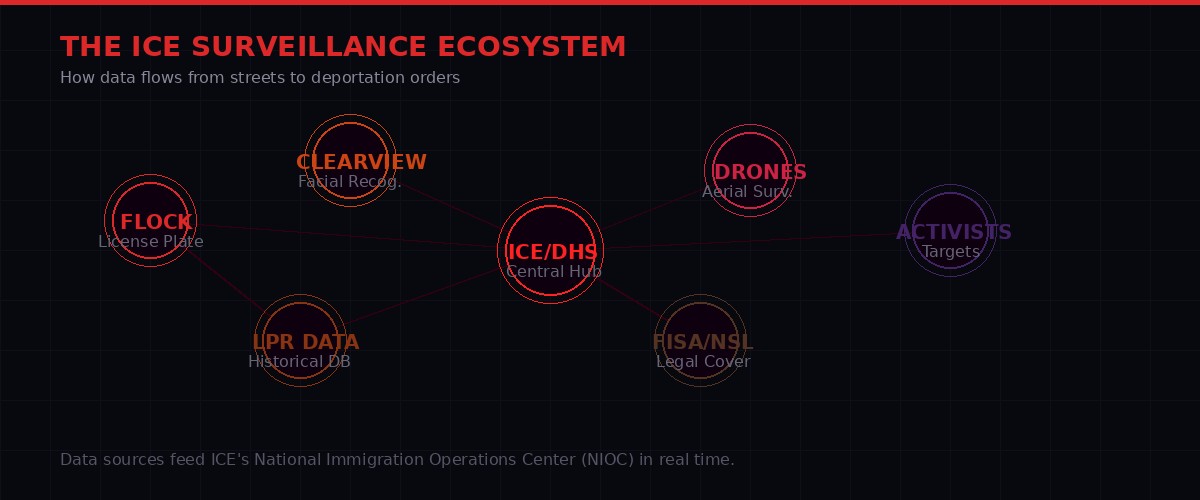
The surveillance ecosystem: how data flows from Flock cameras and Clearview AI into ICE's operational hub.
Before a drone ever lifted off over Minneapolis, the activists it targeted were already inside a database. Flock Safety, an Atlanta-based company, has deployed more than 4,000 automated license plate reader (ALPR) cameras across 38 US states. The cameras capture every vehicle that passes, record the plate, time-stamp it, note the location, and upload the data to a cloud database accessible by law enforcement clients within seconds.
ICE signed a national-access contract with Flock in 2020, according to reporting by the Electronic Frontier Foundation. That contract gives ICE agents the ability to query Flock's historical database - finding where a particular vehicle has traveled, which homes it visits regularly, which addresses it frequents at night. Building a social graph of an activist's life from license plate data alone is not difficult. It takes an afternoon.
Flock cameras are typically installed by local police departments, HOAs, or municipalities - not federal agencies. The company sells to local authorities on a "community safety" pitch. What those local customers often do not know, or do not disclose publicly, is that their data is accessible to federal enforcement agencies. When a Minneapolis suburb installs Flock cameras to deter car theft, it is also, functionally, giving ICE a window into the movement patterns of everyone in that suburb.
"Flock's cameras don't just see where you've been. They see who you visit, how often, and at what hours. That's a biography of your political life if you're an organizer." - Jason Koebler, 404 Media, March 11, 2026
In Minneapolis, specifically, ICE's use of license plate reader data against immigration activists has been confirmed through court documents in at least two deportation cases where defense attorneys subpoenaed ICE's evidence files. The movement history of defendants and their known associates - built entirely from ALPR records - was used to plan enforcement operations. The activists being surveilled by drone this week are, in most cases, already in those files.
404 Media's Jason Koebler and Joseph Cox participated in a Reddit AMA on March 11 specifically to explain the surveillance infrastructure. Their reporting, accumulated over months of FOIA requests, describes a system where local Flock data, federal ICE databases, and commercial data brokers all feed into a single operational picture that agents can query from a laptop in any field office.
Clearview AI and the Face in the Crowd
License plates only capture vehicles. Facial recognition captures people. ICE has been a Clearview AI customer since at least 2020, when the New York Times first reported the relationship. Clearview's database - built by scraping billions of photos from Facebook, Instagram, LinkedIn, Twitter, and news websites without user consent - allows agents to take a single photograph and find every other public image of that person.
For an anti-ICE organizer who has ever appeared in a protest photo published by a local newspaper, been tagged in a Facebook post at a community meeting, or appeared in the background of an Instagram story, Clearview has almost certainly indexed their face. Running a face from a drone-captured image through Clearview can return a full social media history, a roster of known associates, home addresses pulled from public records, and employment information - in under a minute.
Clearview claims a 99.6% match accuracy rate. Independent testing by NIST has been less flattering, particularly for non-white faces where error rates climb dramatically. Minneapolis has a significant Somali-American community - one of the largest in the United States - that is disproportionately active in anti-deportation organizing and disproportionately affected by facial recognition errors. The combination of false positives and aggressive enforcement creates conditions where the wrong person ends up in a detention facility based on an algorithm's mistake.
ICE's use of Clearview against domestic protesters sits in a legal gray zone. The Fourth Amendment protects against unreasonable searches, but courts have generally held that no reasonable expectation of privacy attaches to publicly shared photographs. Clearview scraped public posts. The scraping itself was ruled illegal under Illinois biometric privacy law in a 2022 settlement that cost Clearview a share of its future US revenue. ICE was not a party to that settlement. It kept its access.
The Data Fusion Center Behind the Curtain
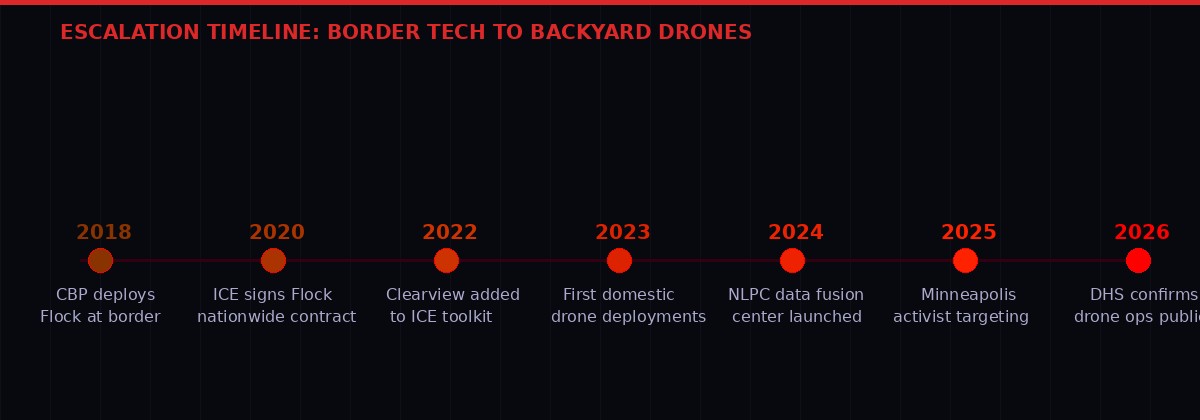
The steady escalation: how border surveillance tools moved from the US-Mexico boundary to residential Minneapolis neighborhoods.
The operational brain coordinating this surveillance apparatus is the National Immigration Operations Center (NIOC) in Washington, D.C. NIOC is the fusion point where Flock license plate data, Clearview face matches, drone feeds, social media intelligence, and commercial data broker records converge into a unified operational picture for ICE field offices.
NIOC was built during the first Trump administration as part of the broader expansion of interior enforcement. It was never dismantled during the Biden years - its budget and staff grew. Under the current administration, its mandate has expanded to include systematic monitoring of organizations and individuals publicly affiliated with anti-deportation work, according to documents reviewed by the ACLU of Minnesota.
The Center draws data from what intelligence professionals call "all-source fusion" - meaning it does not just use government databases. ICE has contracts with data brokers including LexisNexis Risk Solutions and Thomson Reuters Special Services (TRSS), which aggregate commercial datasets: utility bills, credit applications, property records, cellphone location data purchased from data brokers who buy it from app developers. Your phone's weather app may be selling your precise hourly location to a company that sells it to ICE.
The scale of this commercial data acquisition bypasses Fourth Amendment protections because it does not involve government collection. ICE buys what law enforcement could not constitutionally collect itself. Senator Ron Wyden (D-OR) has attempted to close this loophole through the Fourth Amendment is Not For Sale Act, introduced in multiple congressional sessions. It has not passed.
Commercial Data ICE Buys Without a Warrant
- Location data: Precise GPS from smartphones via data broker aggregators - LexisNexis Risk, Babel Street, Venntel
- Utility records: Address confirmation, occupancy patterns from energy and water providers
- Credit header data: Name, address, employer, SSN from credit reporting agencies
- Vehicle registration: DMV records licensed to commercial data brokers and resold
- Social media monitoring: Babel Street's Babel X platform - keyword and network monitoring across 25+ platforms
- Financial data: Bank account validation services used for identity verification
ProtonMail and the Limits of "Secure" Communications
A 404 Media podcast report from March 11, 2026, highlighted another tool in the government's surveillance kit: legal process against privacy-focused email providers. ProtonMail, the Swiss-based encrypted email service marketed specifically to activists, journalists, and privacy-conscious users, has disclosed at least one case where data provided in response to a Swiss legal order helped the FBI identify a US-based protester.
ProtonMail does not log IP addresses by default. But Swiss law requires the company to begin logging under cantonal authority order, and Swiss-US mutual legal assistance treaties (MLATs) can compel disclosure of resulting data to US federal agencies. In the documented case, a protester who used ProtonMail under the assumption of anonymity was identified because the company, under order, began logging their IP after they were already under investigation. The IP was tied to a residential internet connection. The connection led to an address. The address led to an arrest.
The operational lesson is specific: ProtonMail is safe until you are already a target. Once a government agency decides to apply formal legal process, the encryption protects content but metadata - timestamps, IP addresses, account creation details - can still be disclosed. For activists currently being surveilled by drones in Minneapolis, this is not an abstract threat.
"We are committed to protecting user privacy to the maximum extent possible under Swiss law. However, when faced with a legally binding order from Swiss authorities, we have no choice but to comply." - ProtonMail, in statement regarding US law enforcement access, 2024
The broader implication is a recurring theme in the privacy technology space: there is no unilateral technical solution to state surveillance when the state can compel service providers through legal process. Signal offers stronger protections because it collects less metadata to begin with. But for activists who are already in government databases through Flock, Clearview, and commercial data brokers, the encryption layer on their communications is a secondary concern compared to the surveillance happening in physical space around them.
The Legal Landscape: Courts Have Not Kept Up
The legal framework governing domestic surveillance of political activists was largely written in the 1970s - in the aftermath of COINTELPRO, the FBI's program to "neutralize" civil rights leaders, antiwar organizers, and socialist political parties through illegal surveillance, infiltration, and sabotage. The Church Committee investigations and subsequent reforms created the Foreign Intelligence Surveillance Act, the Privacy Act, and guidelines that nominally restricted domestic political surveillance.
Those frameworks assumed surveillance required significant resources: human informants, wiretap applications, physical tailing. The constraint was operational cost. When surveillance is cheap - when a camera on every corner can capture every vehicle, when a database can match every face, when commercial data can map every social relationship - the constraints become meaningless in practice.
The Supreme Court's 2018 decision in Carpenter v. United States established that long-term cell phone location tracking requires a warrant. But the decision did not address shorter-duration tracking, did not address data purchased from commercial brokers rather than obtained directly from carriers, and did not address ALPR data or facial recognition. Every major surveillance technology ICE is currently deploying against Minneapolis activists falls outside Carpenter's scope.
Congress has not filled the gap. The American Data Privacy and Protection Act has been introduced and stalled in multiple sessions. The bipartisan consensus needed to restrict law enforcement data access has not materialized because any restriction can be framed, in a news cycle, as "helping criminals cross the border." The political cost of supporting privacy protections remains higher than the political cost of tolerating mass surveillance of citizens who, in the abstract, are just protesters.
The Chilling Effect Is the Point
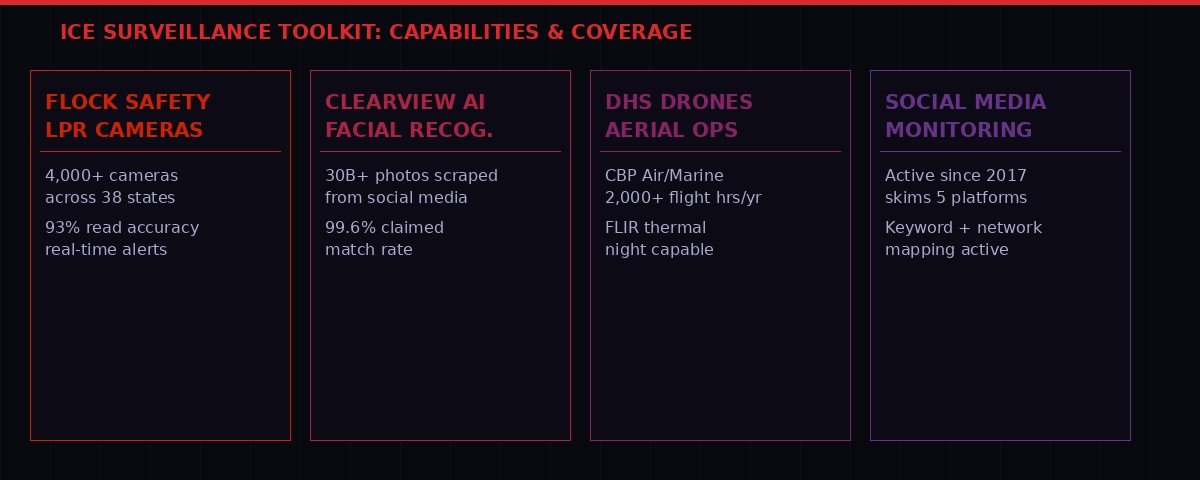
The technical capabilities of the surveillance tools ICE deploys domestically - and what each one can reveal about an individual's life.
Understanding what this surveillance apparatus is designed to do requires understanding what it does not need to do. ICE does not need to arrest every anti-deportation organizer. It does not need to prosecute anyone for attending a protest. The value of the surveillance apparatus is not primarily in the enforcement actions it enables. It is in the actions it prevents.
When activists know they are being watched - when drones hover outside their houses, when they know their license plates are being logged every time they drive to a community meeting - they stop. Some stop attending meetings. Others stop speaking publicly. Others leave the country. The rest moderate their language to avoid triggering keyword alerts in social media monitoring tools.
This is the chilling effect, and it is a documented phenomenon with decades of research behind it. A 2022 study published in the Journal of Information Technology and Politics found that activists who believed they were under surveillance reduced organizational engagement by 34% and public speech by 51%. The researcher did not need to prove they actually were being surveilled. The belief was sufficient.
What is happening in Minneapolis is not, primarily, about finding undocumented immigrants. Minneapolis activists are largely citizens - children of immigrants, clergy, labor organizers, community organizers. ICE knows this. The drones are not there to find deportation targets. They are there to be seen. The surveillance apparatus is being performed, not just operated.
"The question isn't whether you have something to hide. The question is whether you're willing to accept a world where you're required to prove you don't." - Edward Snowden, Permanent Record, 2019 (still accurate in 2026)
What the Next Escalation Looks Like
The Minneapolis situation is not an endpoint. It is a data point on a curve. The technology will get cheaper, more capable, and more interconnected. Several developments are already in motion that will significantly expand this surveillance capacity within the next 18 months.
Persistent aerial surveillance: DARPA's ARGUS-IS program and commercial successors can capture a persistent wide-area surveillance feed over an entire city from a single high-altitude aircraft or tethered drone. The system provides 1.8 gigapixel resolution that can simultaneously track every moving object in a city with a population of millions. CBP has tested a commercial successor system called Gorgon Stare. DHS has approved its domestic deployment authority in "special circumstances." The definition of special circumstances has not been published.
Predictive enforcement: Several pilot programs within ICE and CBP are exploring "predictive disruption" systems that use network analysis on known activist social graphs to identify likely future organizers before they have organized. The systems - based on academic social network analysis tools originally developed for counter-terrorism - look for individuals who are three connections from known organizers, frequently attend the same locations, and match demographic profiles associated with previous organizers. They generate target lists. ICE agents review the lists and decide whether to initiate surveillance.
Real-time court monitoring: ICE has contracted with at least two commercial data brokers to receive real-time alerts whenever an individual in its target database appears in court records - traffic infractions, landlord-tenant disputes, small claims filings. The filings include addresses. The addresses are logged. The person is located. This is already operational in seven states.
Timeline: The Escalation from Border Tech to Backyard Drones
- 2018: CBP deploys Flock Safety license plate readers at US-Mexico border crossings
- 2019: ICE signs first national Clearview AI contract; facial recognition used in interior enforcement
- 2020: ICE signs national Flock access contract; data now covers 38 states
- 2021: DHS authorizes domestic UAV operations in support of interior enforcement "as needed"
- 2022: NIOC establishes systematic activist monitoring protocols; Babel X social media contracts expand
- 2023: First documented CBP drone operation over domestic protest site (Portland, OR)
- 2024: Commercial location data broker contracts expand to include real-time feeds; Venntel and TRSS contracts renew
- 2025: Minneapolis activists first report sustained drone presence over organizing spaces
- March 2026: Drones documented outside private residences; DHS refuses to confirm or deny operations
What Activists Are Actually Doing About It
The organizers in Minneapolis are not passive about this. Several have shared operational security protocols that have evolved specifically in response to the drone and ALPR threat. The measures reveal how seriously the community is taking the surveillance - and how incomplete the available countermeasures are.
License plate readers can be partially defeated by avoiding predictable routes and varying meeting locations - but this imposes operational cost on community organizing that the surveillance infrastructure does not have to bear. Electronic counter-drone measures - signal jammers - are federally illegal under FCC regulations for civilian use. Laser pointers capable of blinding drone cameras violate 18 U.S.C. § 39A and carry federal felony charges. Physical obstruction by covering license plates is a traffic violation in most states. The asymmetry is stark: the government has legal tools, the targets have tactics.
Several organizations have begun using Faraday bags - signal-blocking pouches that prevent phone location data from being logged while attending sensitive meetings. This addresses the commercial data broker threat but not the physical surveillance. Others have shifted to in-person communication using burner phones purchased with cash - but cell tower metadata logs all communications regardless of the phone's identity, and a new device appearing on tower logs in proximity to a known activist's device is itself a data point in the surveillance picture.
The Electronic Frontier Foundation's Surveillance Self-Defense guide, updated in 2025, recommends a layered approach: Signal for communications, Tor Browser for research, Faraday isolation for sensitive meetings, varied routes and timing, and the assumption that any public appearance may be photographed and face-matched. These are not fringe recommendations. They are now standard operational security for community organizers in cities with active ICE enforcement.
What no individual countermeasure addresses is the systemic nature of the surveillance. You cannot opt out of Flock cameras that your city council voted to install. You cannot remove your face from Clearview's database - the company settled an Illinois lawsuit but continues operating in most states. You cannot stop commercial data brokers from aggregating and reselling your location history. Individual countermeasures exist at the margin of a system designed to be comprehensive.
The political path is through Congress. The Fourth Amendment is Not For Sale Act, if passed, would prohibit government agencies from purchasing commercially collected location data without a warrant. The American Data Privacy and Protection Act, in its stronger versions, would restrict ALPR data sharing with federal agencies. Neither has sufficient votes. The surveillance apparatus will continue to expand until a court rules definitively against it or a legislative coalition materializes that currently does not exist.
In the meantime, the drones keep flying in Minneapolis. And the people watching them from their front windows are already inside the database.
Get BLACKWIRE reports first.
Breaking news, investigations, and analysis - straight to your phone.
Join @blackwirenews on Telegram