The Drones Are Back Tonight
"Ope, the drones are back tonight." That text, shared in a Minneapolis community group on the evening of March 13, 2026, arrived with a mix of dark humor and genuine fear. Minnesotans active in anti-ICE organizing say they have spotted unidentified aerial vehicles circling their neighborhoods - and in at least one documented instance, hovering motionless directly outside an activist's home window.
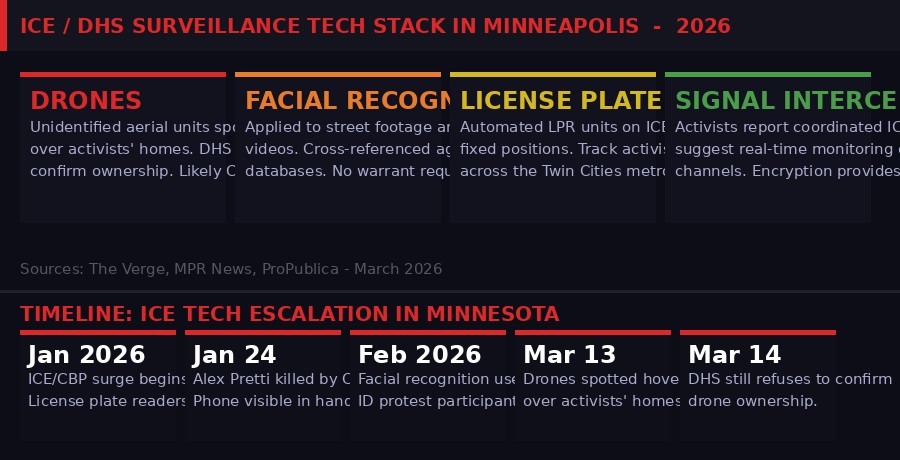
The source of the drones remains officially unconfirmed. The Department of Homeland Security will not say whether the aircraft belong to any of its agencies. But the context leaves little room for ambiguity. ICE and CBP have already been documented using license plate readers and facial recognition technology to surveil activists in Minneapolis, according to reporting by The Verge. The drones fit a pattern, not an anomaly.
What has unfolded in Minneapolis over the past eight weeks is not simply a crackdown on illegal immigration. It is a live test of an AI-powered domestic surveillance architecture that the federal government has been building for years - one that can now track a person's face, their car, and their location in near-real time, with no judicial oversight required and no court order needed to begin.
The implications extend far beyond Minnesota. What ICE and DHS have deployed in the Twin Cities is a template. If it is not challenged legally and politically, it will spread to every city where the federal government perceives resistance.
The Tech Stack: How the Apparatus Actually Works
To understand what is happening in Minneapolis, it helps to understand the specific technologies involved and how they work together. This is not science fiction. Each component is commercially available, federally procured, and in active use.
Drones. CBP's Air and Marine Operations division operates a fleet of unmanned aerial systems, including large fixed-wing Predator drones capable of continuous surveillance over urban areas, and smaller tactical drones for targeted close-range observation. The agency has deployed UAS assets domestically in support of ICE operations before - most visibly during the George Floyd protests in 2020, when a CBP Predator drone flew over Minneapolis at high altitude streaming video to federal command centers. The 2026 deployments appear different in character: lower altitude, neighborhood-level, specifically targeted at known activists rather than general crowd monitoring.
Facial recognition. DHS has spent hundreds of millions of dollars on biometric surveillance capabilities since 2020. Customs and Border Protection operates facial recognition at airports through its Biometric Entry-Exit system, which has processed over 750 million travelers since deployment began, according to CBP's own figures. The agency's facial recognition contracts include work with companies like Clearview AI and NEC Corporation. When applied to street surveillance - matching faces from protest footage against government databases - these systems can identify individuals who have never been arrested or charged with any crime.
The critical legal point: on a public street, in the United States in 2026, there is no federal law requiring a warrant before law enforcement uses facial recognition to identify someone. A handful of cities have passed local bans, but federal agencies are not bound by them. ICE can scan your face at a protest, match it to your driver's license photo, and add you to a surveillance file without ever appearing before a judge.
License plate readers. Automated license plate recognition (ALPR) systems mounted on ICE vehicles and potentially on fixed infrastructure can capture and log every vehicle passing a given point. The data is cross-referenced against national databases in real time, flagging vehicles associated with immigration holds, criminal records, or - increasingly - individuals of interest to enforcement operations. Privacy researchers at the EFF have documented ALPR networks capable of building detailed movement profiles of individuals over months of data. You cannot join an ICE watch patrol, drive to a mutual aid distribution, or park outside an activist meeting without potentially logging your vehicle's presence in a federal database.
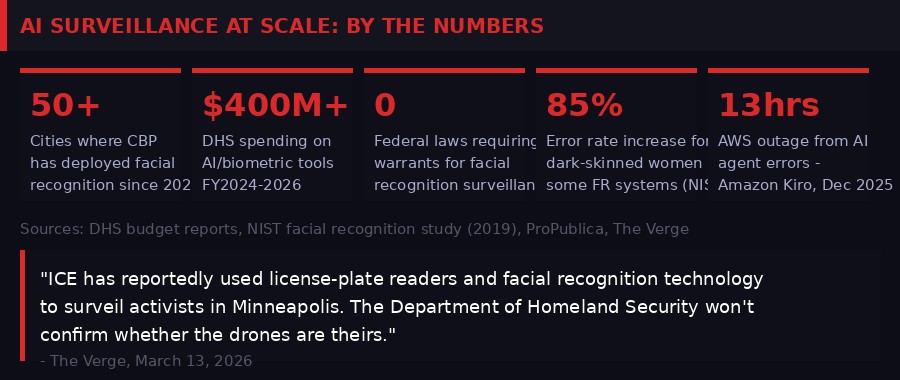
Key data points on AI surveillance deployment by DHS. Facial recognition error rates are highest for dark-skinned women according to NIST's landmark 2019 study. No federal warrant requirement exists for any of these tools.
Signal intelligence and communications monitoring. Activists in Minneapolis have noted a pattern that troubles them: ICE operations seem to track mutual aid activity with uncanny accuracy, appearing at checkpoints shortly after the locations are shared in what were believed to be encrypted channels. The degree to which federal agencies are monitoring encrypted communications directly - through legal intercept mechanisms, confidential informants, or technical vulnerabilities - remains unknown. But the pattern is consistent with targeted communications monitoring rather than random patrol activity.
No Warrants, No Limits: The Legal Vacuum
The most important thing to understand about the Minneapolis AI surveillance operation is what does not exist to constrain it. There is no federal law regulating law enforcement use of facial recognition. There is no federal law governing how long license plate data can be retained or who can access it. There is no statutory framework requiring that drone surveillance of American citizens on American soil be authorized by a court.
The Fourth Amendment theoretically protects against unreasonable searches and seizures. But decades of case law have created what legal scholars call the "third party doctrine" - the principle that information voluntarily shared with third parties, including your face visible in public, your car's presence on a road, or your phone's location visible to cell towers, carries no reasonable expectation of privacy. Courts have not yet fully grappled with what this means when AI systems can aggregate those individually unprotected data points into a comprehensive surveillance record.
"The aggregate of all this individually unprotected information creates something qualitatively different - a permanent, searchable record of a person's life that no court has ever said the government has an unrestricted right to collect. But no court has clearly said they don't, either." - Constitutional law scholars have described this gap as one of the most urgent unresolved questions in Fourth Amendment jurisprudence
Federal courts have occasionally pushed back. In Carpenter v. United States (2018), the Supreme Court held that cell-site location data required a warrant because of its comprehensiveness. But Carpenter was narrowly written and has not been extended clearly to facial recognition or license plate data. ICE's legal position is that it is operating within existing authority. There is no pending federal case that directly challenges the Minneapolis surveillance operation.
At the state level, Minnesota's legislature has not passed a comprehensive AI surveillance law. The American Civil Liberties Union of Minnesota has been monitoring the situation, but litigation takes time - and the surveillance happens in real time.
The Chilling Effect: When Surveillance Becomes Suppression
Surveillance does not have to be used to arrest someone to achieve its intended effect. The knowledge of being watched changes behavior. That is, in many ways, the point.
Community activist Kai Shelley, a senior policy aide for Minneapolis City Council member Aisha Chughtai, described the situation to The Verge in February: "Our immigrant neighbors can't leave their homes, are afraid to send their kids to school, are afraid to do pickup and drop-off at schools, are afraid to go to work, can't go to work, are afraid to be in the neighborhood. Immigrant-owned businesses are closing or are going to close."
But the surveillance apparatus has also suppressed the organized resistance to ICE operations. Activists report that mutual aid networks, once relatively open, have gone dark. People who joined early ICE watch patrols have stopped participating. The Signal groups coordinating rapid response to ICE activity have fractured, with some members leaving entirely after concerns that their communications might be monitored. Every drone sighting - including the ones hovering outside activists' windows this week - serves notice that participation in anti-ICE organizing may result in being permanently identified, tracked, and filed.
This is the second-order effect that most surveillance analysis misses. The first-order effect is identifying and arresting individuals. The second-order effect is deterring the thousands of people who might otherwise organize, protest, provide legal support, or document federal abuses - but who now have reason to believe they are being watched and catalogued. A drone over your house is a message. The message is: we know who you are and we know where you live.
The social science literature on surveillance and political participation is unambiguous on this point. Studies by scholars including Jonathon Penney (York University) and Laura Brandimarte (Carnegie Mellon) have documented measurable reductions in online political expression following revelations of government surveillance programs. The effect is strongest among minority communities and individuals engaged in dissent or activism. Minneapolis is providing a real-world case study in how AI surveillance at scale can hollow out organized civic opposition without making a single additional arrest.
The Broader Architecture: From Minneapolis to Everywhere
What makes Minneapolis significant is not just what is happening there. It is what Minneapolis represents as a deployment model.
CBP and ICE have been assembling the technological components of this system for years. The facial recognition databases were built in the name of border security. The license plate networks were justified as tools for finding stolen vehicles and wanted fugitives. The drone programs were authorized for disaster response and search and rescue. Each individual program had a defensible stated purpose. The integration of all of them into a real-time urban surveillance apparatus targeting political activists is a different thing entirely - but it happened without any single authorization decision that could be challenged or reversed.
This is a pattern that surveillance researchers have a name for: function creep. Technologies procured and approved for one purpose are repurposed for another, often without new authorization, sometimes without even a policy decision being made. The infrastructure just gets used in new ways because it is there and it works.
"The question isn't whether any single technology is appropriate for any single use. The question is what happens when you connect all of these systems together and point them at a political movement. That's a qualitatively different thing, and it's happening now." - Privacy researchers have documented this integration pattern across multiple DHS programs since 2021
The DHS budget documents make the trajectory clear. Federal spending on AI and biometric systems for immigration enforcement grew from approximately $180 million in FY2022 to over $400 million in FY2026, according to budget appropriations tracked by surveillance researchers at the Electronic Frontier Foundation and the Georgetown Center on Privacy and Technology. That spending has accelerated under the current administration, with specific line items for "enhanced operational awareness" tools that align with license plate, facial recognition, and aerial surveillance capabilities.
Other cities are already seeing the same tools. San Antonio, Chicago, and Los Angeles have all reported ICE surveillance activity using technology consistent with the Minneapolis deployment. The difference is that Minneapolis - because of the intensity of the operation and the organized resistance it provoked - has made what is usually invisible visible. Activists are documenting. Journalists are reporting. The drones are no longer deniable.
The Alex Pretti Dimension: When Surveillance Precedes Lethal Force
Any analysis of the Minneapolis surveillance apparatus must reckon with what happened on January 24, 2026. Alex Pretti, a 33-year-old man, was shot and killed by Border Patrol agent Jesus Ochoa and CBP officer Raymundo Gutierrez, whose identities were later confirmed in records reviewed by ProPublica. An eyewitness video analyzed frame by frame by the New York Times shows Pretti raising one hand and holding a phone in the other when he was tackled and shot.
The Trump administration has claimed Pretti was shot because of his legally carried firearm. Civil rights advocates and local witnesses dispute this account. What is not disputed is that Pretti was known to federal agents. He had been present at multiple ICE resistance activities. His vehicle, his face, and his name were almost certainly in federal databases before the encounter that killed him.
This is the ultimate end state of unaccountable surveillance: a system that identifies you, tracks you, and then - when a confrontation escalates - turns that prior knowledge into a file that can be used to justify whatever happened. The surveillance does not just enable targeting. It enables retroactive narrative construction about the target.
The phone Pretti was holding when he was shot - the tool the New York Times noted in its frame-by-frame analysis - represents the other side of the surveillance equation. Citizens filming police and federal agents have created a counter-surveillance record that has become essential to accountability. The Trump administration's legal and administrative moves to restrict this counter-surveillance - including arrests of journalists covering ICE operations and pressure on social media platforms to remove protest footage - are not separate from the surveillance story. They are part of the same story.
Legal Challenges and What Comes Next
Civil liberties organizations have not been idle. The ACLU of Minnesota has been documenting the Minneapolis operation since January, and has filed public records requests with DHS, CBP, and ICE seeking documentation of the surveillance programs deployed. As of mid-March, those requests have produced minimal responsive documents - a pattern consistent with agencies using operational security exemptions to shield surveillance programs from FOIA disclosure.
At the federal legislative level, several members of Congress have called for hearings on DHS surveillance activities in Minneapolis. Representative Ilhan Omar, who represents the Minneapolis district most affected, has been among the most vocal. But hearings are not injunctions. They do not stop the drones tonight.
The most promising near-term legal avenue may be through state courts rather than federal ones. Minnesota has stronger state constitutional privacy protections than many states, and at least one legal organization is exploring whether state law can be used to challenge the specific deployment of facial recognition and drone surveillance that does not connect to the federal immigration enforcement function that exempts CBP from many local restrictions.
The technological countermeasures are also evolving. Privacy advocates recommend a set of practices for activists operating in high-surveillance environments:
- Use end-to-end encrypted communications (Signal remains the strongest option despite concerns about targeted monitoring, which would require compromising individual devices rather than the protocol)
- Vary routes and avoid predictable movement patterns that can be tracked by license plate readers over time
- Cover faces when attending actions where aerial surveillance is suspected (this is legal and effective against current facial recognition systems that rely on frontal face capture)
- Document drone sightings with GPS coordinates and timestamps - this data can support legal challenges and public accountability efforts
- Use mesh network tools for local coordination when cellular networks may be monitored
These are workarounds, not solutions. The fundamental problem is structural: federal agencies have acquired AI surveillance capabilities that outpace both legal frameworks and public awareness of what is possible. Minneapolis is where those capabilities are being used at scale in visible ways. Most of the country has no idea this infrastructure exists in their own cities, pointed at their neighbors.
The Second-Order Effects: What This Means for American Democracy
The deepest implication of the Minneapolis AI surveillance operation is not about immigration enforcement. It is about the relationship between technology and political power.
Every democratic society depends on a margin of civic engagement that exists outside state control - people who organize, protest, report, document, and resist. That margin is not a loophole or a bug in the system. It is the mechanism by which governments are held accountable between elections. When surveillance collapses that margin - not by arresting everyone who participates, but by making participation feel dangerous enough that most people opt out - the system changes fundamentally even if no single law has been broken.
The Minneapolis surveillance apparatus is not unique to this administration. The tools were built over many administrations. The legal gray zones were created by decades of court decisions. The budget appropriations were approved by Congresses of both parties. What this administration has done is combine these elements into an operational system and deploy it against domestic political opposition at a scale and targeting precision not seen before.
The next administration will inherit this infrastructure. So will the one after that. Technology, once deployed and normalized, rarely retreats. The drones that are hovering over Minneapolis activists' homes this week are a preview of a future in which any government, of any political orientation, can deploy AI surveillance against any movement it chooses to designate as a threat. The question of whether that future becomes permanent is being decided right now - not in abstract policy debates, but in the streets and the courts and the community meetings of Minneapolis, Minnesota.
"There's a real contradiction here right now. It's eerie and it's terrifying, and it's inspiring and there's resistance here. It's always both." - Kai Shelley, Minneapolis community activist and senior policy aide, to The Verge, February 2026
The drones will be back tonight. And the night after that. The question is who is watching them back - and whether enough people are paying attention to what their presence actually means.
Get BLACKWIRE reports first.
Breaking news, investigations, and analysis - straight to your phone.
Join @blackwirenews on Telegram