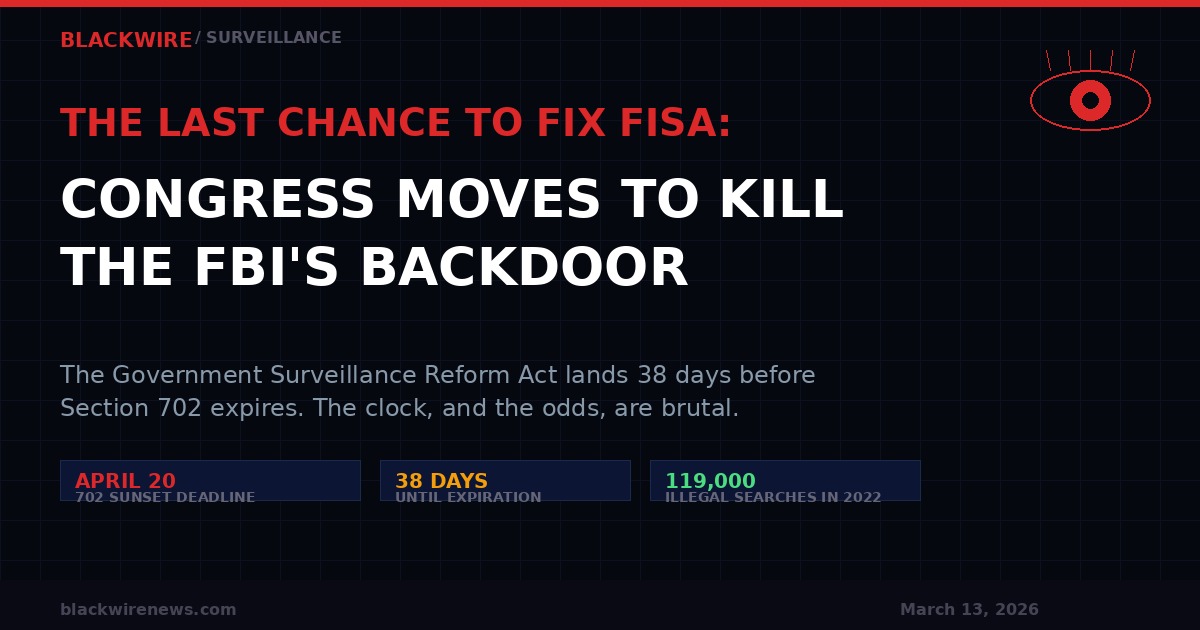
BLACKWIRE / March 2026. Section 702 expires April 20. The clock is now the most powerful argument either side has.
On Thursday, March 12, senators Ron Wyden and Mike Lee stood together in one of those rare moments where the American left and right find common cause. The bipartisan pair, joined by Representatives Warren Davidson and Zoe Lofgren, introduced the Government Surveillance Reform Act of 2026 - a bill that would fundamentally change how the federal government is allowed to read Americans' private communications. It would require the FBI to get a warrant first.
That this is still a fight in 2026 is its own story. The warrantless practice has been ruled unconstitutional by a federal court. The internal oversight unit that once caught abuses has been deleted. The Director of National Intelligence faces a whistleblower complaint alleging she shared spy intercepts with the White House for political purposes. And the man who once vocally opposed warrantless searches is now the FBI Director defending them as a "critical tool."
All of this converges on a single date: April 20, 2026. That is when Section 702 of the Foreign Intelligence Surveillance Act expires. What Congress does in the next 38 days will define the shape of American surveillance for at least the next four years - and possibly longer.
What Section 702 Actually Is - and What It Was Supposed to Be
Section 702 of the Foreign Intelligence Surveillance Act was created in 2008 as a legal framework for one specific purpose: allowing US intelligence agencies to collect communications from foreigners located outside the United States, without getting individual warrants for each target. The logic was sound on paper. The NSA needed to monitor foreign threats, and requiring a warrant for every foreign person they wanted to watch was impractical and often impossible when targeting was based on transient or partial information.
The program works like this: The NSA, FBI, and CIA can compel US-based internet and telecom providers - Google, Microsoft, AT&T, Verizon, and many others - to hand over communications to or from approved foreign "selectors," meaning phone numbers, email addresses, or other identifiers linked to people abroad. The Foreign Intelligence Surveillance Court approves the targeting procedures, not individual targets. There is no individualized judicial review for each person put on the target list.
The problem that immediately arises, and that privacy advocates warned about from day one, is physics. When you email someone in another country, both sides of that conversation exist. The NSA collects both. The American side of the exchange - your email to your contact in Berlin, your WhatsApp message to a family member in Mumbai, your business call with a partner in Seoul - ends up in a database alongside the foreign data it was ostensibly targeted for.
Those incidentally collected communications are retained. They are searchable. And the FBI has treated that database like a domestic surveillance gold mine for years, running searches on American names, email addresses, and phone numbers against communications data that was collected without any warrant authorizing the surveillance of those Americans specifically. This practice is what privacy advocates call the "backdoor search" - because the government couldn't get a front-door warrant to read your messages, so it reads them through the side entrance created by a foreign surveillance program.
The program is, by government figures, enormous. According to the Office of the Director of National Intelligence, the NSA collected communications involving an estimated 171,000 foreign targets under Section 702 in 2021 alone. Each of those targets communicated with Americans. The database those conversations sit in is the one the FBI searches without warrants.
The Backdoor: Anatomy of a Domestic Dragnet
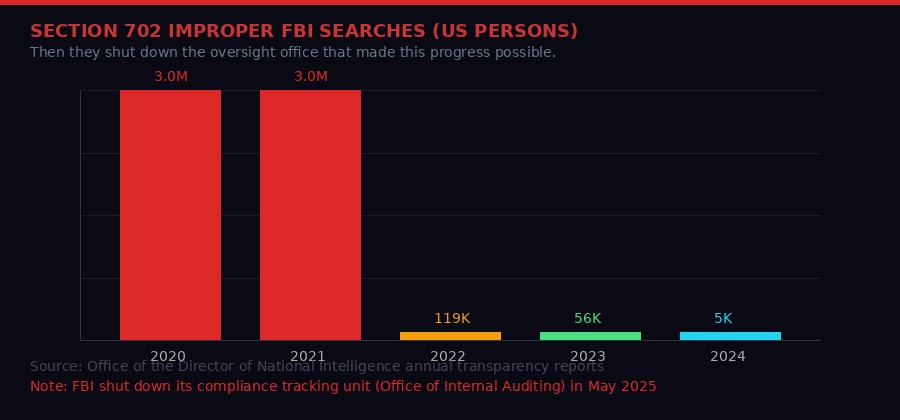
FBI improper searches of US persons data under Section 702, 2020-2024. The compliance unit that drove this reduction was shut down in May 2025. BLACKWIRE / ODNI data.
The scale of the abuse is documented in official government reports, which makes it all the more remarkable that the practice has continued. In 2021, the FBI ran 3.4 million queries of the Section 702 database that touched US person data. In 2022, the Office of the Director of National Intelligence reported 119,000 improper searches - searches that violated the government's own guidelines, not just civil libertarians' standards. That number came down dramatically after compliance reforms and the creation of tighter internal review processes, falling to 56,000 in 2023 and 5,518 in 2024.
But here is the critical fact that the government's own data reveals: that compliance improvement was driven almost entirely by the FBI's Office of Internal Auditing. That office was the entity that caught violations, flagged improper queries, and forced the bureau to clean up its processes. In May 2025, FBI Director Kash Patel shut it down.
The FBI offered no public explanation for the closure. The institutional knowledge embedded in years of compliance work - what triggers a legitimate query, what constitutes improper targeting, how to audit search rationale - was simply deleted. There is no replacement mechanism. The FBI is now self-policing against a practice a federal court has ruled unconstitutional, using systems deliberately stripped of their oversight function.
"Unfortunately, there's a fundamental structural problem: the executive branch consistently prioritizes its own power over civil liberties, regardless of who sits in the Oval Office." - Senior Republican congressional aide, speaking to WIRED anonymously
The context matters here. The 2024 reauthorization of Section 702 - the most recent renewal - included an expanded definition of "electronic communications service provider" that privacy advocates warned was sweeping in scope. The provision could potentially force private citizens, businesses, even landlords who provide WiFi to their tenants, to become involuntary surveillance arms of the federal government. The GSRA would repeal that expansion entirely.
Beyond the legal mechanics, the FBI has used Section 702 data in ways that stretch the program well past its foreign intelligence mandate. Following a 2024 internal directive from former FBI deputy director Paul Abbate, agents were reportedly encouraged to actively run queries on Americans specifically to justify the program's existence - a practice that inverts the program's stated logic and turns foreign intelligence collection into a pretext for domestic surveillance.
A Court Finally Said Stop - and Congress Ignored It
The legal battle over Section 702 backdoor searches has been grinding through federal courts for over a decade. The case that produced the landmark ruling - United States v. Hasbajrami - began in 2011, when a US resident named Agron Hasbajrami was arrested at JFK airport on his way to Pakistan and charged with providing material support to terrorists. The government's case rested partly on emails collected under Section 702 without a warrant.
What followed was more than a decade of litigation. The Second Circuit Court of Appeals found in 2019 that backdoor searches constitute "separate Fourth Amendment events," meaning each search is its own surveillance action that requires its own constitutional justification. The court sent the case back to the district level to determine whether a warrant was required. That district court finally issued its ruling in January 2025: yes, a warrant is required.
The ruling was unambiguous. The court held that the FBI cannot rely on a "foreign intelligence exception" to the Fourth Amendment when searching databases full of Americans' private communications. Even if the initial collection of those communications was lawful, the act of searching them against American identities is a new Fourth Amendment event - one that requires individualized judicial authorization.
The Electronic Frontier Foundation, which fought the case for years, called the ruling a victory that was "better late than never." The practical impact was immediate: the ruling gave the GSRA's warrant requirement a solid constitutional foundation that reformers lacked during the 2024 renewal fight. Congress could no longer claim that the courts had blessed the practice. A federal judge had explicitly said otherwise.
That ruling has not stopped the practice. The FBI continued its searches. The FISA Court, which oversees Section 702 operations, did not change its rules to require warrants. And the government pushed for clean reauthorization anyway, citing national security needs that, in its view, override the court's constitutional analysis. This is the situation the GSRA is trying to fix: a practice ruled unconstitutional, still ongoing, with the legislative clock running out.
Kash Patel's Flip and the Systematic Gutting of Oversight
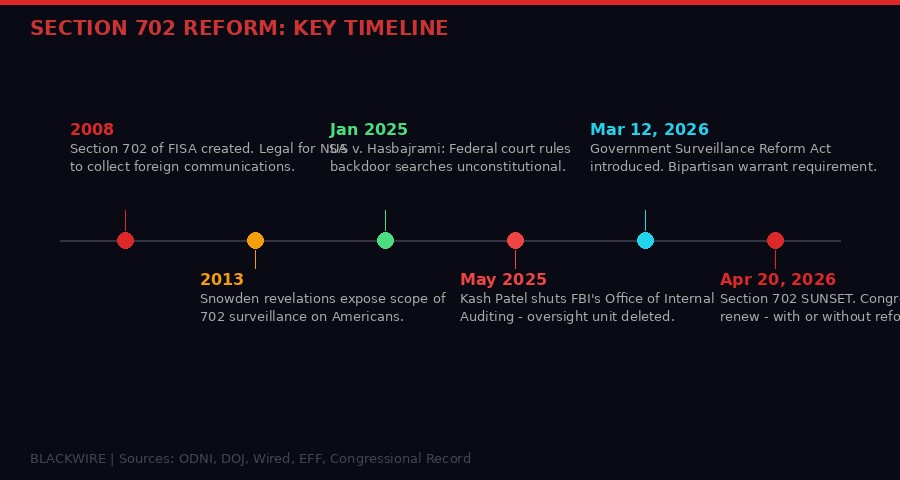
Section 702 reform timeline: from creation to the April 2026 sunset deadline. BLACKWIRE / Congressional Record, EFF, ODNI.
The most politically jarring element of the current Section 702 fight is the reversal of Kash Patel. During his confirmation process, Patel was on record opposing warrantless searches. He had publicly criticized the practice and positioned himself as a skeptic of the surveillance state. Privacy reformers cautiously hoped his appointment as FBI Director might create unusual political space for change.
That hope evaporated quickly. Patel, once in office, flipped entirely. He now defends warrantless backdoor searches as a "critical tool" for national security. His first major institutional action on Section 702 compliance was not reform - it was deletion. The Office of Internal Auditing, which had driven the reduction in improper searches from 119,000 to 5,518, was shut down in May 2025 without explanation or replacement.
Patel's reversal is one data point in a broader pattern. Director of National Intelligence Tulsi Gabbard has overseen the mass firing of inspectors general across the intelligence community and effectively incapacitated the Privacy and Civil Liberties Oversight Board, the independent watchdog created after the Snowden revelations specifically to check Section 702 abuses. Without PCLOB functioning, there is no independent body reviewing how the program operates, no one producing public reports on compliance, and no institutional check on the intelligence community's self-reporting.
Gabbard faces additional scrutiny through a whistleblower complaint that alleges she shared NSA intercepts with the White House for political purposes - a direct inversion of the program's mandate, using foreign intelligence tools for domestic political advantage. Her office did not respond to comment requests from WIRED.
The combination creates a specific structural problem that Senator Wyden raised on the Senate floor this week: Congress is being asked to reauthorize a sweeping surveillance program with incomplete information about what that program actually does. Wyden noted the existence of "secret law" related to Section 702 that he cannot publicly describe - classified legal interpretations that expand the program beyond what public law suggests, which successive administrations have refused to declassify. His warning: "When it is eventually declassified, the American people will be stunned."
The Kash Patel Problem: During confirmation, Patel opposed warrant requirements for Section 702. Once confirmed, he shut down the oversight unit that enforced them. The FBI now conducts warrantless searches of Americans' messages with no functioning compliance mechanism - a practice a federal court has ruled unconstitutional.
AI Supercharges Everything - That's the Problem
When Section 702 was created in 2008, "search the database" meant keyword matching against text. The surveillance state has gained an enormous capability upgrade since then. The same AI systems that power Google's search, that can summarize thousands of documents in seconds, that can identify behavioral patterns across millions of data points - those systems are now available to intelligence agencies, and they transform what a warrantless search database means in practice.
A human analyst running 5,518 searches per year against a text database is a manageable, auditable phenomenon. An AI system running continuous pattern analysis against the same database - looking for social networks, behavioral anomalies, communication patterns that correlate with specific activities - operates at a scale and with a granularity that 2008 lawmakers could not have envisioned and that no oversight mechanism in the current law addresses.
Senator Wyden explicitly cited this dynamic in his framing of the GSRA: "The explosion of commercially available data and rapid advances in AI have far outpaced the laws protecting Americans' privacy." The bill's warrant requirements would apply to AI-driven searches just as they apply to human queries - any technique that searches the database against American persons requires individualized judicial authorization.
The commercial surveillance dimension compounds this. The intelligence community has spent the last two years pouring hundreds of millions of dollars into data broker contracts - companies that aggregate location data, financial records, social media activity, and other commercially available information on essentially every American adult. These purchases are conducted outside FISA entirely. The government doesn't need a warrant, a subpoena, or any judicial process. It just buys the data. The GSRA would prohibit this practice, closing what bill sponsors call the "giant loophole" left open by the failure to include a data broker ban in the 2024 defense authorization bill.
Recent commercial surveillance contracts include a $22.8 million deal for Thomson Reuters' CLEAR database, expanded agreements with LexisNexis, real-time cell phone location tracking through broker Pen-Link, and - most expansively - a Border Patrol contract with Clearview AI granting access to its 60-billion-image scraped facial recognition database. All of this data flows into federal systems that, in practice, feed the same analytical infrastructure that Section 702 collection feeds. The legal distinctions matter; the analytical distinctions do not.
What the GSRA Would Actually Do
The Government Surveillance Reform Act is not a bill to kill Section 702. That framing, which the Trump administration and intelligence community allies have been pushing, is misleading. The bill would reauthorize the program for four more years while attaching the constitutional safeguards that reformers have sought since 2013. The core changes:
Warrant requirement for backdoor searches. The FBI, CIA, and NSA would be required to obtain a court order before querying Section 702 databases using US person identifiers - names, email addresses, phone numbers, social security numbers. Emergency exceptions exist for genuine time-critical situations, but the default changes from "search freely" to "get judicial authorization."
Prohibition on reverse targeting. Reverse targeting is the practice of surveilling a foreigner overseas not because you care about the foreigner, but because they communicate with an American you actually want to watch. By targeting the foreigner, you collect the American's communications without needing domestic surveillance authorization. The GSRA explicitly bans this practice.
Repeal of the 2024 ECSP expansion. The expanded "electronic communications service provider" definition that could conscript private businesses and individuals into the surveillance apparatus would be reversed. The bill returns to the pre-2024 definition, which covered established communications providers rather than potentially any entity that facilitates digital communication.
Data broker ban. Federal agencies would be prohibited from purchasing commercially available data on US persons as a workaround to Fourth Amendment warrant requirements. This closes the loophole that has allowed intelligence and law enforcement agencies to buy what they could not legally compel through legal process.
Updated technology coverage. The bill extends warrant requirements to web browsing data, search queries, location information, and vehicle telematics - forms of data that did not exist in a legally meaningful way when earlier surveillance statutes were written.
"Congress should not reauthorize broad domestic surveillance authorities without putting meaningful safeguards in place." - Representative Zoe Lofgren (D-CA), GSRA co-sponsor
The Data Broker Loophole: The Second Backdoor Nobody Talks About
The warrant requirement for Section 702 searches gets most of the attention in surveillance reform debates. The data broker ban may matter more in the long run.
The commercial data market has grown into a parallel surveillance infrastructure that operates entirely outside constitutional constraints because no government agent compels the collection. Private companies collect location data from phone apps, financial transaction records from payment processors, browsing behavior from tracking pixels and ad networks, social connections from platform scraping, and biometric data from an expanding universe of sensors. They package this data and sell it to anyone willing to pay - including federal agencies.
The legal theory is that information shared with a business voluntarily is not protected by the Fourth Amendment. The practical reality is that the aggregation of commercially available data creates profiles of American citizens more detailed than anything a 2008 wiretap program could produce. Knowing everywhere someone went over the last year, every purchase they made, every site they visited, every person they communicated with, and what they look like from multiple angles in public - that is more comprehensive than reading their email.
ICE has been the most aggressive purchaser under the Trump administration, spending tens of millions on commercial databases to support deportation operations. CBP secured the Clearview AI contract. But the practice extends throughout the intelligence community, and the data flows once purchased are opaque. There is no requirement to report what was purchased, how it was used, who it was shared with, or what queries were run against it.
The GSRA's data broker ban would not prohibit private companies from collecting this data, nor would it prevent them from selling it to private buyers. It would prohibit federal agencies from using appropriated funds to purchase data that Fourth Amendment warrant requirements would otherwise prevent them from obtaining through compulsory legal process. The effect is to close the constitutional arbitrage - you cannot buy what you cannot compel.
This is the provision the intelligence community has fought hardest to kill in previous reform battles. Stripping the data broker ban from the 2024 defense authorization bill was a deliberate choice by congressional leadership, and it preserved a surveillance capability that the intelligence community values precisely because it operates without any judicial oversight at all.
April 20 and the War Against Reform
The April 20 Countdown
The two-year extension passed in 2024 - deliberately short - was designed to force this precise reckoning. Reformers calculated that shorter reauthorization cycles would accumulate political pressure. After two more years of documented abuses, after a federal court ruling, after the gutting of internal oversight, after ICE's surveillance expansion, the argument for meaningful reform would be stronger. That calculation may have been correct. Whether it is strong enough is the open question.
The Trump administration is demanding a clean extension of Section 702 with zero reforms. That position is backed by Senate allies including Tom Cotton and driven internally by White House adviser Stephen Miller. The intelligence community and its congressional allies are making two arguments: first, that warrantless searches are essential counterterrorism tools that a warrant requirement would cripple; second, that the ongoing conflict with Iran makes any constraint on surveillance capabilities a national security risk that Congress cannot afford to take.
The Iran war argument is potent. Senators who might privately support reform face the prospect of being blamed for any intelligence failure that follows a vote for restrictions. The intelligence community is expert at making this case, and in wartime conditions, the framing lands hard. It is worth noting the perverse logic embedded in this argument: the Iran war began partly because of intelligence failures that Section 702 surveillance did not prevent. The program's defenders are using the consequences of its limitations to argue against limiting it further.
The political dynamics inside Congress are more complex than the partisan surface suggests. Some Democrats who voted for previous reauthorizations are now alarmed by ICE's use of commercial data against immigrant communities and appear ready to pivot toward reform. Some Republicans who championed privacy measures in 2024 are facing White House pressure to abandon those positions. The result is the kind of scrambled partisan alignment that surveillance reform typically produces - and that historically has made it easier to kill reform in committee than to pass it in plenary.
To pass the Senate, the GSRA needs 60 votes to overcome a filibuster. That requires Republican votes beyond the bill's sponsors, in a chamber where the White House has significant influence over Republican caucus behavior. The math is difficult. What is different this time is the accumulation of factors that makes the "trust us" argument from the intelligence community harder to sustain: a court ruling, a deleted oversight office, a DNI facing a whistleblower complaint, and an administration that has already used surveillance tools against journalists and domestic political opponents.
Senator Wyden's warning about secret law is particularly significant. He is telling colleagues that there are classified legal interpretations of Section 702 that expand the program beyond what any public-facing description acknowledges. He cannot say what those interpretations are. He can say that when they are eventually declassified, the public will be shocked. That is not a minor procedural point - it is a senator on the relevant oversight committee telling his colleagues that they are being asked to vote on a program whose actual scope is being hidden from them.
The reformers' bet is that this combination - constitutional ruling, gutted oversight, commercial surveillance expansion, AI amplification, secret law, and an administration willing to weaponize intelligence tools politically - gives them more leverage than they had in 2024. The intelligence community's counter-bet is that wartime fear and 60-vote math in the Senate will defeat reform as reliably as it has before. One of them is right. The answer arrives April 20.
The Second-Order Stakes
The immediate stakes are clear: whether the FBI needs a warrant before reading Americans' messages that were swept up in foreign surveillance. The second-order stakes are larger.
If the GSRA fails and Section 702 is renewed clean, the intelligence community will draw the correct lesson: that documented constitutional violations, federal court rulings, gutted oversight, and bipartisan opposition are not sufficient to produce reform. The practical implication is that the next reauthorization fight - whenever it comes - will begin from a position of further entrenched abuse, with whatever oversight mechanisms currently exist having been further degraded in the intervening years.
The AI dimension will not wait for political cycles. The convergence of AI analytical capability with warrantless surveillance databases is not a hypothetical threat - it is the current trajectory of federal intelligence and law enforcement capability. The legal frameworks that govern what those systems can do to Americans' data are being decided in the next 38 days. If the answer is "anything, without a warrant," the surveillance state that results will be qualitatively different from anything the 2008 Congress authorized.
The commercial data broker market will also not wait. Every year that federal agencies are allowed to purchase around the Fourth Amendment is another year of infrastructure built, data pipelines established, analytical integrations deepened. Banning those purchases becomes harder the more embedded the practice becomes - not because the legal argument changes, but because the institutional dependencies become harder to unwind. The GSRA's data broker ban, if it passes now, prevents the commercial surveillance apparatus from calcifying further. If it fails, the next reform attempt will face an even larger and more entrenched commercial surveillance market to dismantle.
There is also the simple democratic question of whether Americans are governed by the laws on the books or by classified addenda they are not allowed to know about. Senator Wyden's reference to secret law is not rhetorical flourish - it describes a real phenomenon where the public text of statutes has been given classified interpretations that expand executive power well beyond what legislators and citizens understood themselves to have authorized. The GSRA would require declassification of those interpretations as part of any reauthorization. That provision alone may be enough to kill the bill in intelligence committee - which is its own data point about what the secret law contains.
The bill's bipartisan sponsors have bet that transparency, constitutional grounding, and accumulated evidence of abuse are enough. Wyden and Lee, Davidson and Lofgren, have built a coalition that spans the political spectrum. Civil liberties organizations across left and right have endorsed the measure. The court system has backed the core legal argument. The only question is whether that coalition can survive the intelligence community's wartime appeals, the White House's political pressure, and the Senate's arithmetic.
The clock started running the moment the bill was introduced. It stops on April 20.
Get BLACKWIRE reports first.
Breaking news, investigations, and analysis - straight to your phone.
Join @blackwirenews on TelegramSources: Wired (Dell Cameron, March 12, 2026), Office of the Director of National Intelligence Annual Transparency Reports 2020-2024, Electronic Frontier Foundation (US v. Hasbajrami analysis, January 2025), Congressional Record (Wyden floor speech, March 2026), ACLU (Section 702 court ruling summary), WIRED (Section 702 FBI query directive, Paul Abbate), New York Times (FBI Office of Internal Auditing closure, May 2025), WSJ (Kushner-Gabbard whistleblower complaint), Bloomberg (commercial surveillance contracts), Lawfare (PCLOB incapacitation analysis), Government Surveillance Reform Act of 2026 (bill text).