The Intelligence That Wasn't: How Trump's Own Officials Dismantled the Case for War With Iran
Tulsi Gabbard told Congress Iran was not rebuilding nuclear enrichment before the war. Joe Kent resigned saying Israel deceived the president. The justification for a conflict that has already killed hundreds and closed the Strait of Hormuz is being torn apart - by Trump's own people, from the inside.
CIPHER / BLACKWIRE • March 18, 2026 • Berlin • War Fraud Bureau

The corridors of power where the Iran war was sold to the public look very different from the inside. Photo: Pexels
The war is 19 days old. Hundreds are dead. The Strait of Hormuz - through which 20 percent of global oil supply flows - has been effectively closed by Iran. Oil prices are above $108 a barrel. The Federal Reserve is trapped between a collapsing jobs market and an energy-driven inflation shock it cannot control.
And now, the intelligence justifications that launched the whole thing are falling apart in real time - not from opposition leakers, not from hostile foreign governments, but from the very officials Trump appointed to build and maintain them.
On March 18, 2026 - Day 19 of the US-Israel campaign against Iran - two separate bombshells detonated in Washington. Director of National Intelligence Tulsi Gabbard testified before Congress that Iran was not, in fact, rebuilding its nuclear enrichment program prior to the start of hostilities. And Joe Kent, the director of the National Counterterrorism Center, became the first senior Trump administration official to resign over the war, writing in his resignation letter that Iran "posed no imminent threat to our nation" and that Israel had run a pressure campaign to "deceive" the president. NPR, March 18, 2026
This is not a minor contradiction. These are the pillars of the case for war. And they are crumbling.
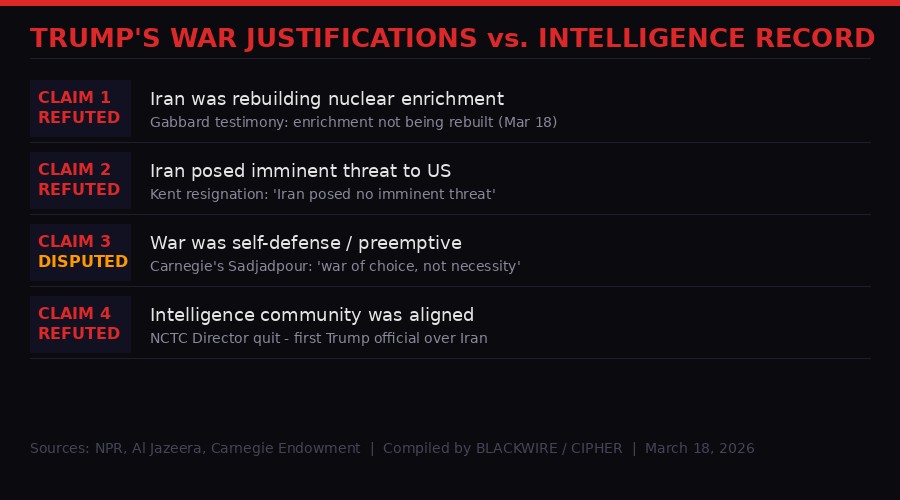
Four core justifications for the Iran war, mapped against what Trump's own officials have now confirmed. BLACKWIRE / CIPHER analysis.
The Justifications That Were Never Real
When Trump launched strikes on Iran in late February 2026, the administration offered several overlapping justifications. Iran was racing toward nuclear weapons. Iran posed an imminent threat to the United States and its regional partners. The intelligence community was unified. The strikes were a preemptive act of self-defense, not a war of choice.
Each of these has now been directly contradicted by officials who served inside the same administration.
Gabbard's testimony - that Iran was not actively rebuilding nuclear enrichment capacity before the war - strikes at the most fundamental premise. The nuclear threat was the justification that gave the strikes their air of legal necessity. Without it, what remains is a decision to destroy a country's military infrastructure, close a major international waterway, and trigger a regional war - without the threshold condition that justified doing so. Al Jazeera, March 18, 2026
Karim Sadjadpour, senior fellow at the Carnegie Endowment for International Peace, put it plainly: "There was no imminent threat that Iran was about to acquire nuclear weapons or launch missile strikes on the US or its partners." He called it a "war of choice" - not a war imposed on the United States, but one the administration elected to start. NPR, March 17, 2026
"I don't think President Trump, in his own words frankly, understood what he was getting into. This has morphed from a war of choice into a war of necessity - but it was a choice. And the people making that choice had the intelligence to know it." - Karim Sadjadpour, Carnegie Endowment for International Peace, NPR (March 17, 2026)
That is the core of the fraud: the decision was made before the case was built. The intelligence was assembled to justify a conclusion that had already been reached - a process with a long and ugly precedent in modern American warfare.

The architecture of intelligence fraud: when policy drives analysis, rather than the other way around. Photo: Pexels
Joe Kent: Eleven Deployments, One Resignation
Joe Kent is not a peacenik. He is an Army Special Forces veteran with 11 combat deployments across the Middle East and Afghanistan. He lost his wife, Shannon Kent, in a suicide bombing in Syria in 2019. He ran for Congress in 2022. He was appointed by Trump to run the National Counterterrorism Center - the body responsible for coordinating the US government's response to terrorist threats.
He was, in other words, precisely the kind of hardened national security professional whose endorsement of a military campaign would carry weight. His resignation carries even more.
In his resignation letter, Kent wrote that he could not "in good conscience" support the war. He stated that Iran "posed no imminent threat to our nation." And most damaging of all, he wrote that Israel had pushed the United States into the conflict through a pressure campaign designed to "deceive" President Trump. NPR Up First, March 18, 2026
The word "deceive" is not bureaucratic language. It is an accusation. Kent is saying that a foreign government - an ally - manipulated the American intelligence and policy apparatus to get the United States to start a war it would not otherwise have started. If that accusation has merit, it belongs in congressional hearings, in criminal referrals, and in history books alongside other American intelligence disasters.
Kent is the first senior Trump official to resign specifically over the Iran conflict. He will not be the last.
11 combat deployments. Wife KIA in Syria, 2019. First Trump administration official to quit over Iran. Resignation letter: Iran "posed no imminent threat" and Israel "deceived" Trump into war.
Trump's own intelligence chief. Testified March 18, 2026 that Iran was NOT rebuilding nuclear enrichment prior to the war. Directly undercuts the most important public justification for military action.
The Nuclear Pretext: What the Evidence Actually Shows
The nuclear question has always been the linchpin of the Iran case. Every American president who has confronted Tehran has framed it in nuclear terms - the threshold between tolerating a difficult adversary and choosing military action. The argument in early 2026 was that Iran was racing toward weapons-grade enrichment, that time was running out, and that the window for military action was closing.
That argument is now contradicted by Gabbard's testimony. She told Congress that prior to the war's start, Iran was not actively rebuilding nuclear enrichment capacity. The satellite imagery at Natanz - which showed tunnel construction activity and associated spoil piles near the nuclear facility as recently as November 2025 - was apparently not evidence of an active weapons program, but of something else entirely, or was misrepresented. NPR / Vantor satellite imagery, November 2025
The gap between what was said publicly and what the intelligence showed is not a minor discrepancy. It is the difference between a defensive preemptive strike and an unprovoked act of war.
Sadjadpour, speaking in his assessment of American intelligence failures around the conflict, noted that Trump's own stated goals kept shifting - some days nuclear disarmament, some days regime change, some days a "Venezuela deal." That incoherence, he argued, is itself evidence that the war was not driven by a clear intelligence finding but by a political desire, retrofitted with justifications. NPR, March 17, 2026
"What we've seen is that the president has kind of been all over the place when asked what his goal is. Some days it's just to get a nuclear deal. Some days a Venezuela deal. Some days implode the regime. That lack of clarity has been deeply detrimental - if you don't know what you're trying to achieve, you're putting the US military and our partners in very difficult positions." - Karim Sadjadpour, Carnegie Endowment for International Peace
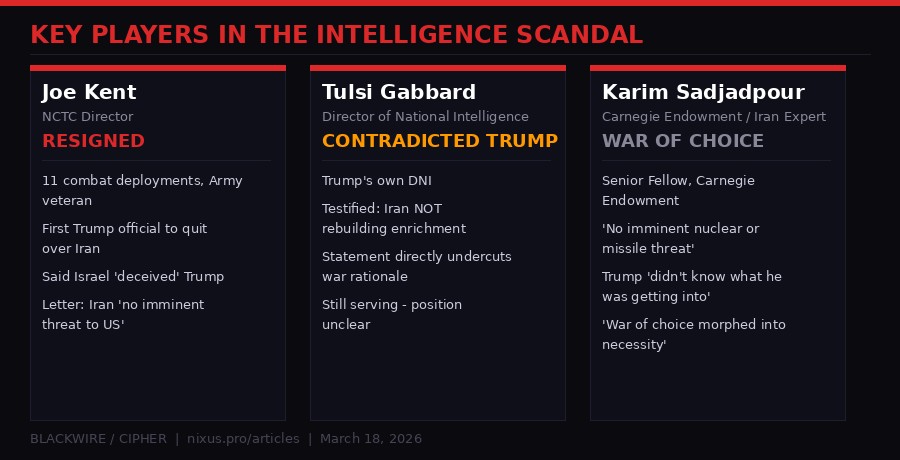
The key figures whose testimony and resignations are now dismantling the official justification for the Iran war. BLACKWIRE analysis.
The Deception Architecture: Israel's Pressure Campaign
Kent's specific claim - that Israel ran a deception campaign to push the United States into war - opens one of the most explosive lines of inquiry in recent American foreign policy history.
The US-Israel relationship has always involved asymmetric information flows. Israel has extensive intelligence collection on Iran, and shares selectively with American partners. It has its own existential interests in preventing Iranian nuclear capability or a hostile regional axis. It has also, repeatedly, pressured American administrations toward harder lines on Iran than those administrations would have chosen on their own.
What Kent is alleging is something more specific: not that Israel advocated forcefully, which is normal diplomatic behavior, but that it actively misrepresented or selectively presented intelligence to mislead the American decision-maker. If true, that is not advocacy. It is manipulation of an ally's decision-making process through disinformation. It is, in the most precise sense of the term, a deception operation.
The consequences of that alleged deception are now measured in civilian deaths in Tehran, in sailors stranded in the Persian Gulf, in an energy crisis affecting hundreds of millions of people who had no voice in the decision. The people who made or enabled that deception have not been named. They have not been charged. They have not faced any accountability beyond one man's resignation letter. NPR Up First, March 18, 2026
Timeline: The Unraveling of the War Justification
Treasury as a Weapon: Sanctions, Lifted and Imposed, by Political Signal
The intelligence fraud around Iran does not exist in isolation. It sits inside a broader pattern: the Trump administration's weaponization of the entire national security apparatus - including the Treasury Department's sanctions regime - for political rather than law-enforcement purposes.
The same NPR reporting from March 18, 2026 that documented the Kent resignation also detailed a separate scandal: Trump's Treasury has been removing sanctions from foreign officials accused of corruption and destabilization - not because their behavior changed, but because their political relationships with Trump did. NPR Up First, March 18, 2026
The most documented case is Milorad Dodik, formerly the president of Republika Srpska in Bosnia. The United States previously sanctioned Dodik specifically for "undermining the stability of the Western Balkans region through corruption and threats to long-standing peace agreements." Former US ambassadors and senators who reviewed the case confirmed they saw no evidence that Dodik's behavior had changed in any meaningful way. The sanctions were lifted anyway. Dodik subsequently met with Trump administration officials. NPR, March 18, 2026
The mechanism here matters. Sanctions are supposed to be a law-enforcement and national security tool. They are imposed when someone poses a threat or has committed specific harmful acts. They are supposed to be lifted when that threat is removed or the behavior changes. When they are instead lifted as diplomatic gifts or political rewards, the entire system becomes something else: a protection racket, where access to the American market and financial system is available to the highest bidder or the most politically convenient ally.
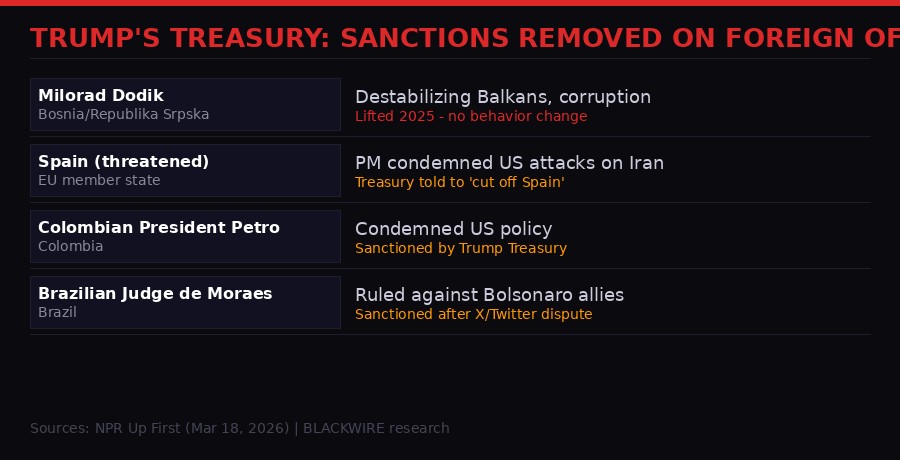
A pattern emerges: Trump's Treasury uses sanctions not as law enforcement tools but as political signals - imposed against critics, lifted for allies regardless of behavior. BLACKWIRE research, March 2026.
The Spain Threat: Sanctions as Foreign Policy Intimidation
The sanctions-as-weapon dynamic reached a new level when Spanish Prime Minister Pedro Sanchez condemned the US attacks on Iran as a violation of international law. Trump's response was to instruct Treasury Secretary Scott Bessent to "cut off all dealings with Spain."
Spain is a member of the European Union, a NATO ally, and an economy deeply integrated with the United States. Spanish Foreign Minister Jose Manuel Albares said publicly that such targeting would "make no sense" and would harm the entire European Union. NPR Up First, March 18, 2026
But this is the logic of the current administration: sovereign countries that exercise their right under international law to criticize American military action face the Treasury Department as a coercive instrument. The same tool used against Iranian oil smugglers and terrorist financiers is now being explicitly threatened against a major European democracy because its prime minister said something Trump did not like.
Colombia's President Gustavo Petro was sanctioned. Brazil's Supreme Court Justice Alexandre de Moraes was sanctioned. Both had taken positions in opposition to Trump's political interests or those of his allies. Former State Department officials confirmed to NPR that these actions "depart from historical norms" - norms that existed because indiscriminate use of sanctions destroys their credibility as tools against genuine threats. NPR, March 18, 2026
"Traditionally, the Treasury Department imposes sanctions on individuals who pose serious threats to the US and their own countries. Under Trump, the agency has lifted sanctions it previously imposed on people accused of crimes and corruption - despite former US ambassadors citing a lack of clear evidence of a change in their behavior." - NPR, March 18, 2026

The US Treasury Department - once a technical sanctions-enforcement body - now operates as a political instrument for rewarding allies and punishing critics. Photo: Pexels
The Pattern: Intelligence Fraud and Sanctions Corruption as a System
These two scandals - the intelligence justification for war and the political weaponization of Treasury sanctions - are not separate stories. They are parts of the same operating system.
Both involve the conversion of law-enforcement and national security tools into instruments of political will. Both require the erosion of the internal guardrails - the professional officials, the career intelligence analysts, the foreign service officers - who are supposed to ensure that power is used according to rules rather than personal interest. And both produce the same outcome: a world where the rules exist only for those without political protection.
Joe Kent's resignation letter describes the result at the macro level: a war started on false premises, pushed by a foreign government's deception operation, fought without clear goals, and now spiraling beyond anyone's control. The Strait of Hormuz is functionally closed. The global energy market is in shock. The US military is fighting a war that its own intelligence director says was not necessary - and the people responsible for starting it are still in power, still setting policy, and still using the tools of state to protect allies and punish critics.
Meanwhile, the human cost accumulates. NPR correspondent Arezou Rezvani, reporting from the Haji Omeran border crossing where Iranians flee into Iraq, spoke to a woman in her 60s who said she wished the airstrikes had killed her. Iranian internet has been blacked out for weeks. Checkpoints multiply. Security forces demand access to phones to search for circumvention apps. The population of a country of 89 million people is living inside a digital blackout while its government fights a war built partly on intelligence that Trump's own officials now say was manipulated. NPR, March 18, 2026

The accountability gap: in 19 days of war, not a single senior official has faced consequence for the intelligence failures that launched it. Photo: Pexels
What Accountability Looks Like - and Where It Is
In normal functioning democracies, the sequence of events documented above would trigger specific processes. A resignation letter accusing a foreign government of deceiving the president into war would prompt congressional hearings. DNI testimony contradicting the president's stated war justification would prompt official inquiries. Sanctions lifted without behavioral change would prompt oversight investigations.
None of these processes are currently running.
Congress passed a war powers resolution earlier in the conflict, but it failed to pass the Senate with a veto-proof margin. The intelligence committees, which have the authority to subpoena the relevant documents and testimony, have not publicly announced any investigation into the gap between what was told to Trump and what was actually known. The sanctions removals have been noted by former officials in press interviews but have not resulted in any formal review.
In the absence of institutional accountability, what remains is the documentary record: Gabbard's testimony, Kent's resignation letter, Sadjadpour's assessment, the NPR deep-dive on sanctions removals. The case for intelligence fraud is not theoretical. It is in the public domain, confirmed by the administration's own appointees, and growing with each passing day.
The question is not whether this happened. Multiple sources with direct knowledge are saying it happened. The question is whether any institution retains the will and capacity to treat it as the scandal it is - or whether the architecture of accountability in American democracy has been hollowed out enough that a war launched on manipulated intelligence simply continues, burns through whatever it burns through, and is eventually forgotten.
History suggests the latter is the more common outcome. Iraq is instructive. The Office of Special Plans, the aluminum tubes, the yellowcake uranium - these were intelligence frauds that eventually received official acknowledgment but no criminal accountability. Those responsible for them went on to respected positions in think tanks, on boards of directors, in the media.
The pattern is repeating. The names are different. The scale may be larger. The mechanism is the same.

Following the evidence: the public record now contains multiple corroborating sources for intelligence manipulation in the run-up to the Iran war. Photo: Pexels
Following the Money: Who Benefits?
The investigative baseline requires asking who benefits from the decisions being examined. In this case, several answers present themselves.
The Israeli government, which Kent directly accuses of orchestrating a deception campaign, has achieved several of its longstanding objectives: Iran's military command has been decimated, its air defenses destroyed, its nuclear facilities hit, and its regional proxies degraded. Whatever happens next, Israel exits this war in a dramatically stronger strategic position relative to Iran than it entered. Whether those gains were worth the cost in regional destabilization is a question Israeli politicians will debate. Whether the deception campaign Kent describes constitutes a betrayal of the allied relationship is a question American officials should be asking. Kent resignation letter, as reported by NPR, March 18, 2026
Defense contractors have benefited. Oil majors operating outside the Strait of Hormuz have benefited from price spikes. Political figures in the Trump orbit who have financial interests in energy infrastructure have benefited. These connections require formal investigation to document fully - but the pattern of who gains when wars start on thin pretexts is not historically mysterious.
Milorad Dodik, whose sanctions were lifted without behavior change, has benefited. He regained access to US financial markets and political networks. Whoever in the Trump orbit decided to lift those sanctions - and received what in return - has benefited. The transactions that accompany sanctions removals are not always documented in ways that are publicly visible. Forensic accountants, congressional investigators, and FOIA litigants should be looking.
BLACKWIRE Summary - What the Record Shows
Confirmed: DNI Gabbard testified Iran was not rebuilding nuclear enrichment before the war started (March 18, 2026).
Confirmed: NCTC Director Kent resigned, wrote that Iran posed "no imminent threat" and that Israel ran a "deception" campaign on Trump (March 18, 2026).
Confirmed: Expert assessment from Carnegie Endowment characterizes this as a "war of choice" with no imminent triggering threat (NPR, March 17, 2026).
Confirmed: Trump's Treasury lifted sanctions on Milorad Dodik without documented behavior change; former ambassadors say there was no justification (NPR, March 18, 2026).
Confirmed: Trump threatened Treasury sanctions against Spain - an EU/NATO ally - for criticizing the Iran war (NPR, March 18, 2026).
Not yet confirmed: The identities of Israeli officials involved in the alleged deception campaign; the specific intelligence products that were manipulated or misrepresented; what, if anything, was received in exchange for the Dodik sanctions removal.
The Road Ahead: Accountability Is Not Inevitable
Joe Kent is 44 years old. He has served his country under conditions that most officials in Washington cannot imagine. His resignation letter is a primary source document that will appear in the histories of this period. The question is whether it produces any consequence in the present.
Gabbard's testimony is in the congressional record. It cannot be erased. It will be cited by lawyers, researchers, and future prosecutors for decades. The question is whether any institution has the will to act on it now, while the consequences can still be shaped.
The sanctions fraud is documented in press reporting with named former officials. The Treasury Department's actions are public record. The connections between political relationships and sanctions decisions can be traced. The question is who traces them.
History is not automatically written by the truth. It is written by whoever has the institutional power to establish the record and define what it means. The Trump administration understands this better than most. It has systematically dismantled the institutional mechanisms - inspectors general, watchdog offices, career professional appointments - that normally convert documented misconduct into formal accountability.
What remains is journalism. Courts. International law, which applies even to American presidents. The memory of career officials who saw what happened and kept notes. And the public record - accumulating, day by day, into something that eventually becomes undeniable.
The intelligence that justified this war was not there. The people appointed to safeguard that standard have said so, in writing, under oath, at personal professional cost. The question is not whether a fraud occurred. The question is what anyone with power is going to do about it.
Get BLACKWIRE reports first.
Breaking news, investigations, and analysis - straight to your phone.
Join @blackwirenews on Telegram