Inside Fukushima: Drones Confirm Hole in Reactor 3 Pressure Vessel 15 Years After Meltdown
Micro-drones weighing less than a hundred grams have captured the first clear footage of Unit 3's damaged core since the 2011 disaster - and what they found confirms the worst. A gaping hole in the pressure vessel floor, with lumps of melted fuel hanging above it like radioactive stalactites.

Industrial nuclear facility. Unit 3 at Fukushima Daiichi remains one of the most radioactive structures ever built. Credit: Pexels
Fifteen years of silence ended late Thursday. Tokyo Electric Power Company Holdings released drone footage captured inside the Unit 3 reactor at Fukushima Daiichi that shows, for the first time, a hole punched through the bottom of the reactor's thick-walled steel pressure vessel - with brown and gray objects described as melted fuel debris hanging above it like icicles from the breach.
The footage was taken by micro-drones measuring just 12 by 13 centimeters and weighing 95 grams each. They flew through broken equipment, debris fields, and extreme radiation environments during a two-week mission beginning March 5, navigating the primary containment chamber of the wrecked reactor in what TEPCO officials called "a remarkable technical achievement." (Source: AP News, March 20, 2026)
TEPCO spokesperson Masaki Kuwajima confirmed the finding directly: officials have now verified there is a hole at the bottom of the pressure vessel, and that the hanging objects - "lumps and deposits" in his description - are believed to be melted nuclear fuel debris.
"We have obtained valuable data that can be used for our future internal investigations and to develop melted fuel debris removal strategy," Kuwajima said.
The footage does not solve the problem. It quantifies it. And what the numbers reveal is enormous: at least 880 tons of melted fuel debris remain inside the three damaged reactors at Fukushima Daiichi, 15 years after the tsunami-triggered meltdown that triggered the worst nuclear disaster since Chernobyl. The full extent of the damage to Unit 3 has remained unknown - until now.

Micro-drone technology similar to what TEPCO deployed inside Unit 3. Each unit weighed just 95 grams. Credit: Pexels
The Hole Nobody Could See
The pressure vessel at a nuclear reactor is not a metaphorical concept - it is a literal steel fortress designed to contain the most radioactive materials on earth under extreme heat and pressure. Its walls are thick enough to stop almost anything. The fact that there is now a confirmed hole in the floor of Unit 3's pressure vessel is a structural fact with profound implications for how the decades-long decommissioning of Fukushima Daiichi will proceed.
TEPCO has known for years that something went wrong inside Unit 3's pressure vessel. When the March 11, 2011 magnitude 9.0 earthquake struck the northeastern coast of Japan and the subsequent tsunami disabled cooling systems, three of the six reactors at Fukushima Daiichi suffered catastrophic meltdowns. Units 1, 2, and 3 all lost coolant. The reactor cores overheated, fuel rods melted, and the resulting corium - a lava-like mixture of molten nuclear fuel, metal, and reactor components - pooled at the bottom of each vessel and eventually burned through to varying degrees.
What happened next inside each reactor is what TEPCO has been trying to determine through 15 years of increasingly sophisticated robotic probes. The challenge is extreme: radiation levels inside the containment structures remain so high that conventional equipment cannot survive long enough to gather comprehensive data. Most early robots were destroyed within minutes of entering the most contaminated zones.
Unit 3 presented a particular challenge because its March 14, 2011 hydrogen explosion was catastrophic - the blast blew apart the reactor building's upper structure and scattered debris across the facility. An earlier underwater robot probe conducted nearly a decade ago provided limited imagery of Unit 3's interior, but could not approach the pressure vessel floor directly.
The micro-drone mission that completed last Thursday changed that entirely.

Inside Fukushima Daiichi, broken pipes and structural damage have made internal inspection nearly impossible for 15 years. Credit: Pexels
The Drone Mission: Twelve Centimeters of Courage
The micro-drones TEPCO deployed inside Unit 3 represent a genuine leap in nuclear inspection technology. At 12 by 13 centimeters and 95 grams each, they are smaller than a paperback book. They had to be - anything larger could not navigate the debris fields, broken structural components, and tight spaces inside Unit 3's primary containment chamber.
The mission ran from March 5 to approximately March 19, 2026. During that time, remote operators flew the drones one at a time through the primary containment chamber - a massive steel and concrete structure that surrounds the pressure vessel itself. Their flight paths took them through obstacles and around corners that had never been seen up close.
The primary objective was clear: get as close as possible to the bottom of the pressure vessel. That target had been set specifically because earlier missions could not confirm whether the vessel had been breached - a key question for any future fuel removal strategy. Previous data suggested the fuel may have fallen through, but no visual confirmation existed.
The footage released Thursday provides that confirmation. The drones filmed tubes with ruptures, broken equipment, and damaged structures that once operated inside the vessel under normal conditions. Then they captured the hole itself - and the hanging debris above it.
Alongside the visual data, the drones collected radiation measurements throughout their missions. That information, combined with the footage, allows TEPCO engineers to begin constructing a detailed three-dimensional map of Unit 3's interior - the kind of comprehensive picture that robotic systems will need to plan actual fuel removal operations in the years ahead.
"Sending drones as close as possible to the pressure vessel's bottom was an important goal of the latest probe," TEPCO stated in its release of the footage. The company said the data would be used to develop robots capable of physically entering the space for future fuel retrieval work.

Nuclear control room instruments. TEPCO engineers have been working for 15 years to understand the internal state of the damaged Fukushima reactors. Credit: Pexels
The Scale of What Remains Inside
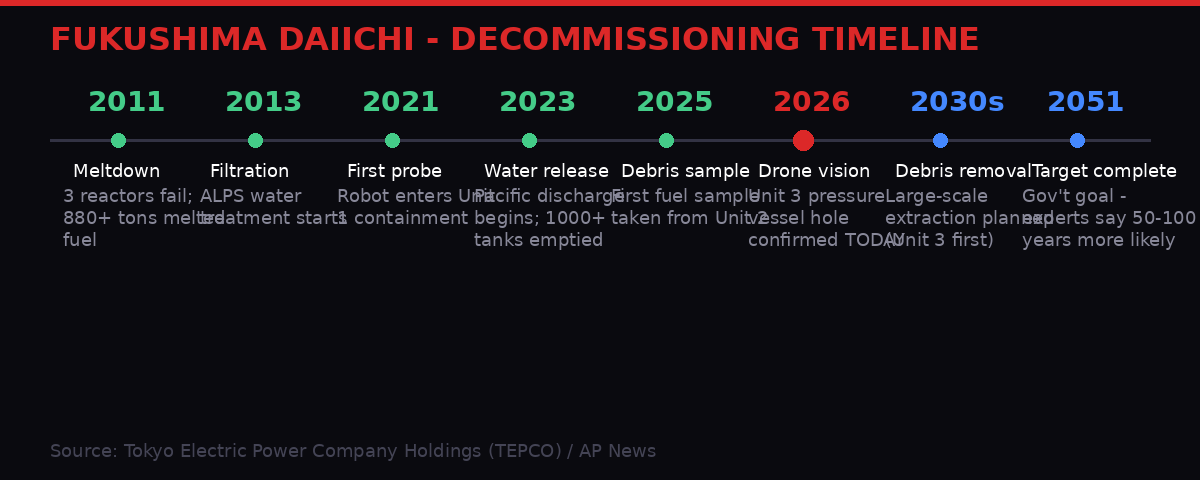
BLACKWIRE Infographic: Key milestones in the 15-year Fukushima decommissioning effort. The 2026 drone mission is the latest in a series of escalating inspection operations. Credit: BLACKWIRE / TEPCO data
To understand why the drone footage matters, the scale of the cleanup problem must be stated plainly. Fukushima Daiichi's three damaged reactors - Units 1, 2, and 3 - contain at minimum 880 tons of melted nuclear fuel debris. That number comes from TEPCO's own estimates, and nuclear engineers note it may be conservative given the degree of structural damage and the difficulty of measuring material that has mixed with broken reactor components and concrete.
For comparison: the Three Mile Island partial meltdown in Pennsylvania in 1979, previously the worst nuclear accident in American history, involved roughly 60 tons of damaged fuel. The fuel removal operation at Three Mile Island took more than a decade and cost billions of dollars. What remains at Fukushima is approximately 15 times larger by mass - and far more radioactive, because the entire cores of three reactors underwent full meltdown.
TEPCO removed the first-ever physical sample of Fukushima's melted fuel debris in November 2024, extracting a tiny fragment from the Unit 2 reactor using a specialized robot. That sample weighed a fraction of a gram - the opening move in what will be one of the most technically demanding industrial operations in human history.
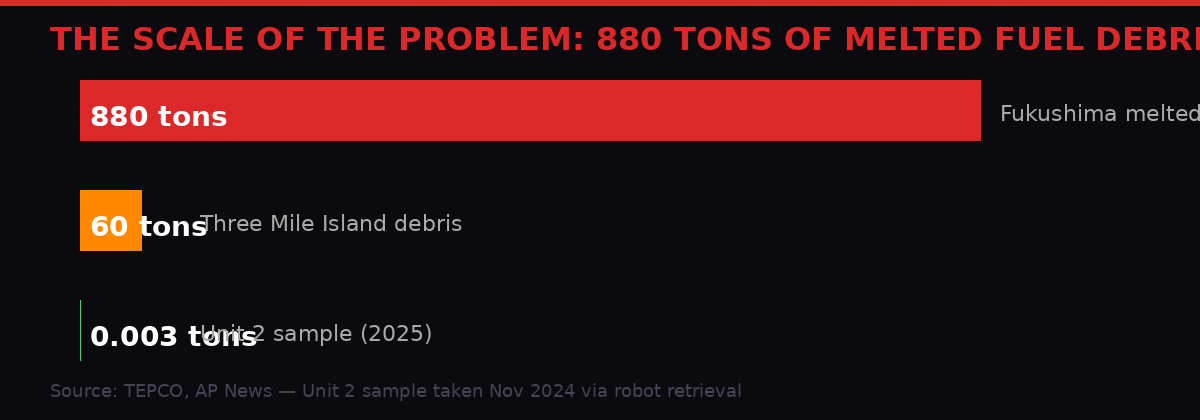
BLACKWIRE Infographic: The scale of melted fuel debris at Fukushima compared to other nuclear incidents. Credit: BLACKWIRE / TEPCO, AP News data
The government of Japan has set a target of completing Fukushima's decommissioning by 2051 - a 40-year timeline from the accident. Nuclear engineers and independent experts have called that schedule unrealistic. Some estimate the true timeline for removing all melted fuel debris runs between 50 and 100 years, if it can be accomplished at all with current technology.
Source: TEPCO estimates as of March 2026
Why Unit 3 Is Different - and More Dangerous
Of the three damaged reactors at Fukushima Daiichi, Unit 3 occupies a particular place in the disaster's history. It was the only one of the three reactors running on mixed-oxide fuel - a blend of uranium and plutonium that produces different types of radiation than standard uranium fuel and presents additional health risks if released.
The March 14, 2011 hydrogen explosion at Unit 3 was the most visually dramatic of the disaster's early days. Video footage shot from a helicopter showed a massive upward blast that sent debris flying hundreds of meters in every direction. The explosion was so severe that it damaged the roof of the nearby Unit 4 reactor building - which had not itself suffered a meltdown but contained spent fuel that required careful cooling.
In the immediate aftermath, the explosion complicated efforts to pump cooling water into Unit 3 because workers could not safely approach the building. The delay allowed temperatures inside the reactor to rise further, worsening the extent of the meltdown.
Fifteen years later, Unit 3 retains the highest radiation levels of the three damaged reactors in many areas. The hydrogen explosion destroyed the upper structure of the reactor building completely - its replacement structure was not completed until recently. The debris field inside the primary containment chamber has made robotic inspection particularly difficult.
The fact that the March 2026 drone mission penetrated close enough to the pressure vessel to film a hole in its floor represents a significant operational achievement against that backdrop. Prior drone and robot missions have approached - but not reached - this level of detail inside Unit 3.
"There's 880 tons of nuclear fuel in there and we still don't know exactly where most of it is. This footage is the first honest look at what we're actually dealing with. And what we're dealing with is a breach." - Nuclear engineering analyst briefed on TEPCO data, March 2026

Aerial industrial site. Fukushima Daiichi covers a massive footprint, with decontamination and decommissioning operations ongoing across multiple reactor buildings. Credit: Pexels
The 15-Year Road to This Footage
The history of Fukushima Daiichi's robotic inspection program is a story of incremental technological achievement against relentless radiation damage. The first robots sent into the damaged reactors in the years after 2011 survived only minutes before their electronics failed under the intense radiation. Engineers from TEPCO, Hitachi, and various robotics institutes spent years developing radiation-hardened systems capable of operating longer and deeper inside the contaminated structures.
By 2017, TEPCO had deployed underwater robot probes into Units 1 and 3. The Unit 3 probe that year provided the clearest pre-2026 look at its primary containment chamber, capturing footage of debris and structural damage - but it could not penetrate close enough to the pressure vessel's base to assess whether a hole existed.
A major milestone came in 2024 when TEPCO completed the physical retrieval of melted fuel samples from Unit 2 - the first time any melted fuel had been physically extracted from any of the three damaged Fukushima reactors. The operation used a 22-meter extendable robotic arm that pushed through the primary containment wall and reached inside to grip tiny fragments of debris. The samples were taken to specialized laboratories for analysis, with the goal of understanding the chemical composition and physical properties of Fukushima's corium - information essential for planning how to eventually remove 880 tons of it.
The shift to drone technology for Unit 3 represents a different approach. Where the robotic arms used in Unit 2 worked by mechanical extension, the micro-drones can fly around obstacles and survey wide areas. Their small size allows them to navigate the irregular terrain of a reactor that has been damaged by both meltdown and explosion. Their radiation data fills in gaps that visual footage alone cannot.
The two-week mission that began March 5 was the most ambitious drone operation TEPCO has attempted inside the damaged reactor complex. The footage released Thursday represents the culmination of that effort and the most complete picture anyone has obtained of Unit 3's core since 2011.

Nuclear facility workers. TEPCO employs thousands of people in ongoing decommissioning operations at Fukushima Daiichi, with radiation exposure management a constant challenge. Credit: Pexels
The Human Cost Behind the Numbers
The drone footage and its technical implications do not fully capture what the Fukushima disaster has meant for the communities around the plant. At least 154,000 people were forced to evacuate from the area around Fukushima Daiichi in the immediate aftermath of the 2011 disaster. Many have never returned.
Towns like Odaka, part of the former evacuation zone, have seen only a fraction of their pre-disaster populations come back over the past 15 years. Tomoko Kobayashi, who operates a family-run inn in Odaka and conducts her own radiation monitoring work, told AP News that about one-third of the town's pre-disaster population of 13,000 has returned. The kindergarten she attended as a child is now a museum - there are not enough children in the town to use it as a school.
"The town was destroyed, and we need to rebuild it. It's a time-consuming process that cannot be accomplished in just a couple of decades," Kobayashi said. (Source: AP News)
Radiation monitoring remains a deeply personal practice for many Fukushima residents. Yukio Shirahige, who worked in decontamination and radiation surveys at the plant and now assists community monitoring projects, reports that government pressure to declare the area "safe" is growing - even as his tests of locally caught wild boar show radiation levels more than 100 times above the legal safety limit.
"Radiation levels have come down significantly over the past 15 years, but I wouldn't use the word 'safe' just yet," Shirahige told AP News. "We are under growing pressure to be silent." (Source: AP News)
Japan reversed a decade of post-Fukushima nuclear policy in 2022, announcing plans to restart nuclear reactors and build new ones as part of an energy security push. The political context matters: as the government promotes nuclear energy's return, it has strong incentives to frame Fukushima's cleanup as progressing smoothly. The drone footage released Thursday, showing a confirmed breach in Unit 3's pressure vessel, complicates that narrative in ways that cannot easily be spun away.
Key Facts: Fukushima Daiichi March 2026
- Unit 3 drone mission ran March 5-19, 2026 - footage released March 19-20
- Micro-drones: 12 x 13 cm, 95 grams each - small enough to navigate reactor debris
- Confirmed: a hole exists in the pressure vessel floor of Unit 3
- Hanging debris believed to be melted fuel corium - brown and gray deposits
- 880+ tons total melted fuel across Units 1, 2, and 3 (TEPCO estimate)
- First physical fuel sample extracted from Unit 2 in November 2024
- Large-scale debris removal from Unit 3 planned for 2030s
- Government target for full decommissioning: 2051 - experts say 50-100 years more realistic
- Sources: TEPCO, AP News, Akira Ono (TEPCO decommissioning head)
What Comes Next: The Decades-Long Endgame
The drone footage is not a solution. It is a diagnosis. What TEPCO does with the data it gathered during the March 2026 mission will determine how the decommissioning of Unit 3 proceeds into the 2030s.
According to Akira Ono, the head of decommissioning at TEPCO, remote-controlled probes and sampling missions will continue across all three damaged reactors. The goal is to analyze the melted fuel - its composition, its physical state, how it has moved and settled over 15 years - before developing robots capable of actually removing it. The fuel removal operation at Unit 3 is currently scheduled to begin in the 2030s. For Units 1 and 2, removal methods have not yet been decided.
The three-dimensional map produced by the March 2026 drone mission will feed directly into that planning. Engineers need to know not just that there is a hole in Unit 3's pressure vessel, but where the hole is, how large it is, and how much fuel debris has fallen through it versus remaining suspended in the vessel. That information shapes the entire robotics development program for Unit 3.
The broader decommissioning challenge at Fukushima remains staggering in scale. Japan has allocated hundreds of billions of yen for the cleanup, but independent analysts note that no technology currently exists to safely remove 880 tons of corium from three heavily damaged reactors while protecting workers from fatal radiation exposure. The robots that will ultimately do that work have not been built yet - they require years of testing before they can be deployed in actual removal operations.
Meanwhile, the plant continues to produce contaminated water. Cooling must be maintained for the melted fuel indefinitely - stopping cooling would allow the corium to heat up again, potentially triggering further radioactive releases. Every day of cooling produces water that picks up radioactive contamination, which must then be filtered, stored, or released into the ocean under the ALPS treatment process that began in August 2023.
The wastewater storage tanks that once covered much of the Fukushima Daiichi site are being emptied as the treated water discharge continues. But with 880 tons of fuel in the reactors still requiring active cooling, that process continues indefinitely. TEPCO plans to release treated water into the Pacific gradually over 30 years.
Japan's nuclear regulators have requested TEPCO conduct specific risk assessments on Unit 1, where the reactor core's main supporting structure - the pedestal - was found to have extensive concrete damage, with steel reinforcement exposed. Unit 3, now confirmed to have a breached pressure vessel, will require similar updated risk modeling in the wake of Thursday's footage.
The decommissioning of Fukushima Daiichi is often described as the most complex industrial undertaking in human history. Thursday's drone footage is a milestone in understanding what that complexity actually looks like from the inside. The hole in Unit 3's pressure vessel has been there since 2011. Now, finally, humans have seen it.

The Pacific Ocean. TEPCO has been releasing ALPS-treated water from Fukushima Daiichi into the Pacific since August 2023, a process expected to continue for 30 years. Credit: Pexels
The Global Nuclear Safety Context
The Fukushima drone footage lands at a moment when nuclear power is experiencing a global political revival. Japan reversed its post-2011 phaseout in 2022. The United States has approved new reactor designs and provided billions in subsidies for nuclear energy. The United Kingdom, France, and South Korea are all expanding nuclear capacity. Multiple countries cite nuclear power as essential for meeting climate targets while maintaining energy security.
Advocates for nuclear energy argue that Fukushima, like Chernobyl, was an accident of its era - the result of outdated reactor designs, inadequate safety protocols, and inadequate tsunami defenses - and that modern reactor designs with passive safety systems make similar accidents far less likely. The meltdowns at Fukushima were triggered by the loss of external power and cooling systems in the wake of a once-in-a-century natural disaster. Modern reactor designs, proponents argue, are physically incapable of the same failure mode.
Critics counter that the drone footage released this week provides an unfiltered view of what nuclear accidents actually cost. Fifteen years after a disaster, a major industrial nation is still deploying 95-gram drones to look inside a wrecked reactor because no human, robot, or instrument can safely approach the pressure vessel directly. The cleanup of Fukushima will consume resources, require sacrifice, and demand continued technical innovation for decades beyond 2026 - and possibly beyond 2051.
That debate will continue. But the footage from Unit 3's primary containment chamber - of hanging melted fuel, breached steel, and structures that have not been seen in 15 years - provides a concrete and unambiguous reference point for it. However nuclear energy's political future unfolds, the physical reality at Fukushima Daiichi is now a little clearer.
The drones found the hole. The hard part starts now.
Get BLACKWIRE reports first.
Breaking news, investigations, and analysis - straight to your phone.
Join @blackwirenews on Telegram