War Profiteers Caught: France Seizes Russian Shadow Fleet Tanker in Mediterranean as Iran War Reshapes Global Enforcement
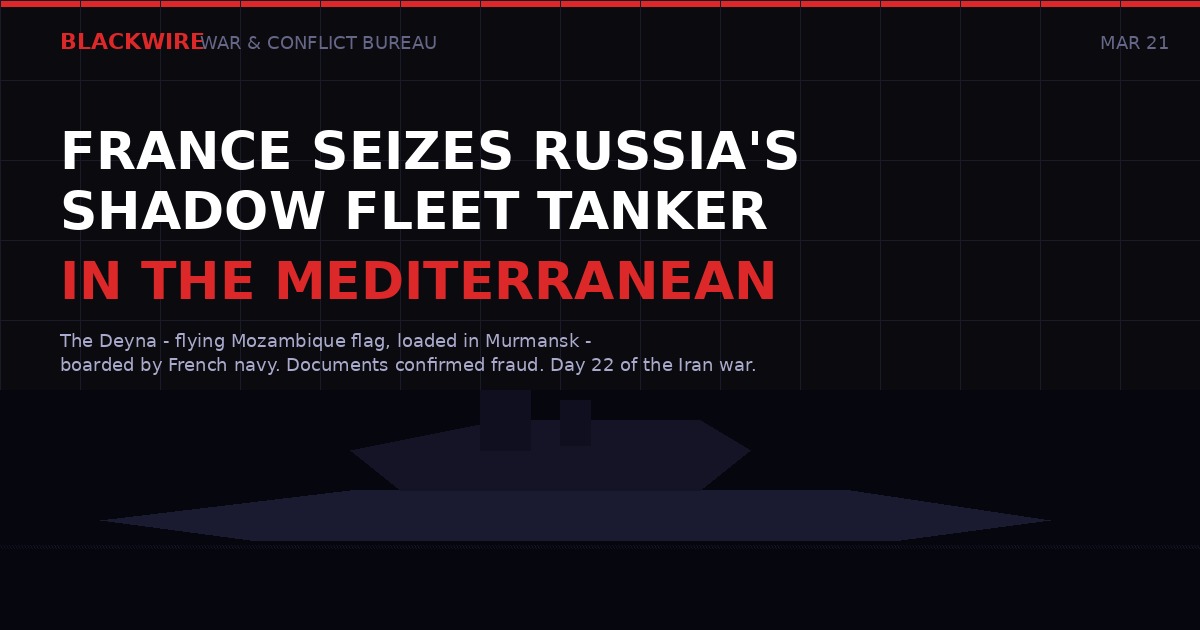
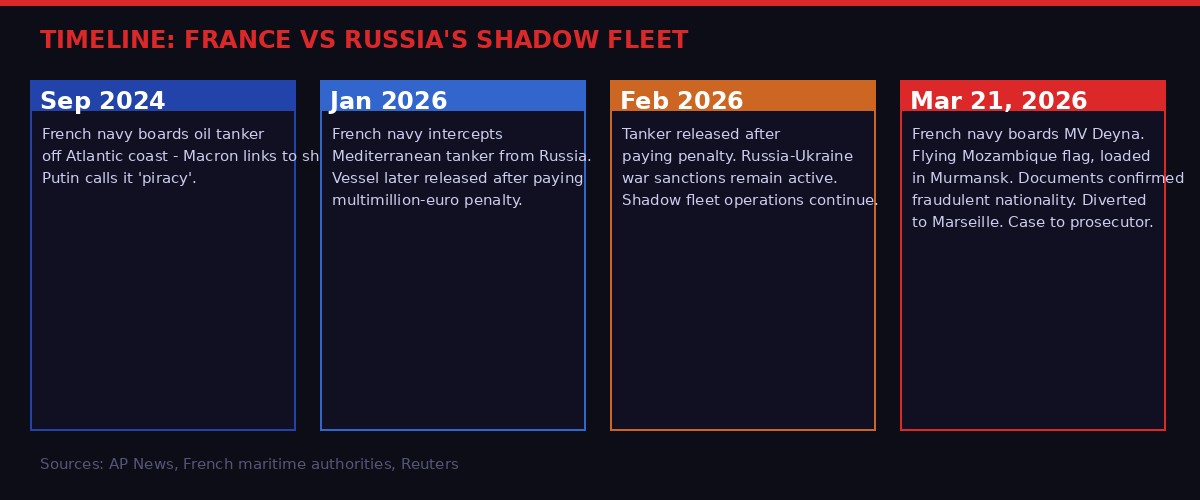
The tanker was flying the flag of Mozambique. It had come from Murmansk. Its documents said one thing; French investigators found another. On Friday, the French navy boarded the MV Deyna in the Western Mediterranean and diverted it to an anchorage off Marseille - the third Russian shadow fleet seizure by France in six months, and the most politically charged yet.
The action came as French President Emmanuel Macron has deployed an unprecedented naval force to the Mediterranean in connection with the US-Israeli war on Iran - making France the most visible European power in two simultaneous maritime confrontations. Russia's war financing machine and Tehran's Hormuz blockade are now both straining against French sea power at the same time.
The timing is not coincidence. It is policy. And the message from Paris is unambiguous: the rules of the sea apply to everyone, including the country helping fuel a land war in Europe while the Mediterranean burns.
The Deyna Boarding: What Happened
French maritime authorities for the Mediterranean confirmed the boarding on Friday. The MV Deyna was intercepted in the Western Mediterranean, with the operation carried out in cooperation with allied nations including the United Kingdom, which tracked the ship prior to the French action. (Source: French maritime authorities statement, AP News, March 21, 2026)
The stated purpose: verify the vessel's nationality. The Deyna was flying the flag of Mozambique - but it had departed the Russian port of Murmansk. Mozambique does not operate major oil loading terminals in the Arctic. The combination was a red flag.
"The operation aimed to verify the nationality of the vessel. The documents found onboard confirmed doubts about the validity of the flag." - French maritime authorities statement, March 21, 2026
The tanker was escorted to an anchorage point for further investigation. The case was referred to a prosecutor in Marseille. No crew members have been named publicly.
Macron addressed the seizure directly on the social platform X, calling the Deyna a shadow fleet vessel and framing the operation in starkly moral terms.
"These vessels, which circumvent international sanctions and violate the law of the sea, are war profiteers. They seek to generate profits and finance Russia's war effort. We won't let this happen." - French President Emmanuel Macron, March 21, 2026
The word "profiteers" is deliberate. Macron is not presenting this as a technical customs matter. He is placing it within the moral architecture of European security - the same architecture that, barely 48 hours earlier, was being stress-tested by Donald Trump's demands that Europe join him in the Persian Gulf.
A Pattern of Escalating Enforcement
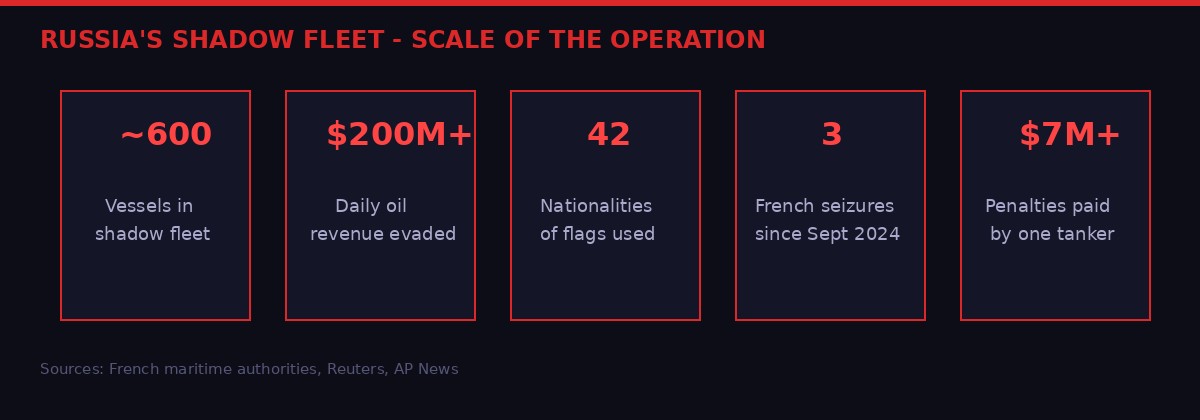
The Deyna is not an isolated case. It is the third shadow fleet seizure by France in roughly six months - a deliberate and escalating campaign of maritime enforcement that began in September 2024 and has intensified as Russia's invasion of Ukraine drags into its fourth year.
In September 2024, French naval forces boarded an oil tanker off France's Atlantic coast. Macron personally linked it to the shadow fleet. Russian President Vladimir Putin denounced the interception as "an act of piracy" - a characterization France's judiciary system has consistently declined to accept.
In January 2026, France's navy intercepted a second tanker in the Mediterranean sailing from Russia. That vessel was eventually released last month after paying a multimillion-euro penalty to French authorities - the first known case of a shadow fleet operator paying direct financial penalties to a European naval power. (Source: AP News)
The Deyna seizure suggests the enforcement posture is hardening, not softening. France is no longer seizing and releasing. It is seizing and prosecuting.
How the Shadow Fleet Works - and Who It Hurts
Russia's shadow fleet did not emerge overnight. It was built systematically after the G7 oil price cap came into force in December 2022, when Western nations agreed that Russian oil could only be purchased at or below $60 per barrel if it used Western-controlled shipping insurance, financing, or flagging.
Moscow's response was to build an alternative logistics chain. Old tankers were purchased through shell companies registered in the UAE, Turkey, and other jurisdictions outside Western sanctions reach. Flags of convenience - Gabon, Cameroon, Palau, Mozambique - were acquired. Western insurance was replaced with Russian state guarantees or informal arrangements. Crews from countries with no G7 commitments were hired.
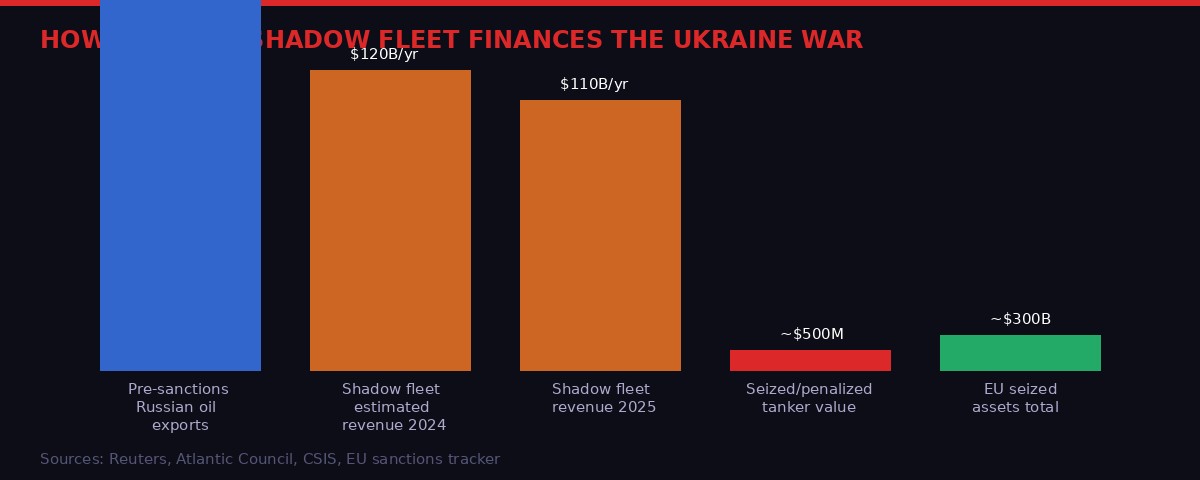
The scale of the operation became staggering. The Center for Strategic and International Studies (CSIS) estimated in late 2025 that the shadow fleet comprises approximately 600 vessels and moves between 70 and 90 percent of Russian crude oil exports - oil that, at pre-war prices, generated $120 billion to $180 billion annually for the Russian state.
That money funds the Ukraine war. It pays for the missiles hitting Kyiv. It keeps the Russian military logistics chain running. Western sanctions, without maritime enforcement, are a ceiling with no floor.
The Deyna seizure - like the two before it - represents France's argument that maritime law is the floor. That the ocean is not a sanctions-free zone. That "war profiteer" is not hyperbole but a legal designation with consequences.
Macron's Two-Front Maritime Strategy
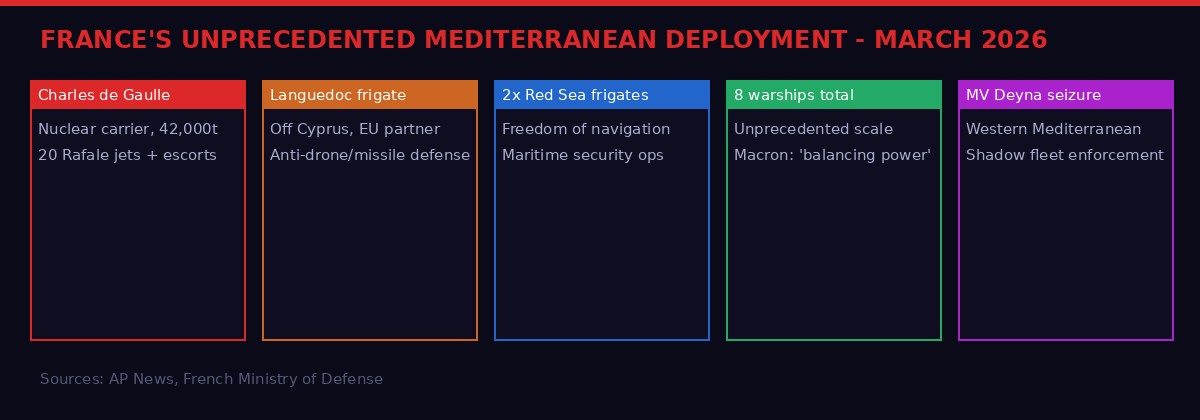
The shadow fleet seizure did not happen in isolation. It happened on the same Friday that Macron's France is managing the most extensive naval deployment in its modern history - 8 warships, two helicopter carriers, and the 42,000-ton nuclear-powered aircraft carrier Charles de Gaulle, all dispatched to the Mediterranean and wider Middle East in connection with the US-Israeli war on Iran. (Source: AP News, French Ministry of Defense)
That deployment itself produced a security embarrassment this week. A French naval officer's use of the Strava fitness application during a morning jog on or near the carrier on March 13 enabled French newspaper Le Monde to geolocate the Charles de Gaulle using a publicly available satellite image. The French military has confirmed the incident and said "appropriate measures" are being taken.
But the Strava incident has not diminished the strategic significance of the deployment. France is now simultaneously:
- Deploying its carrier strike group to deter Iranian aggression against France's 400,000+ citizens in the Middle East
- Intercepting Russian shadow fleet tankers in the Western Mediterranean under sanctions enforcement
- Positioning Paris as the European "balancing power" - present in both the Ukraine sanctions regime and the Iran war theater
- Refusing to be drawn into active combat against Iran while maintaining a large enough forward presence to claim diplomatic leverage in any eventual ceasefire talks
Macron has described France's Iran war posture as "strictly defensive" - but the Charles de Gaulle group's Rafale jets have reportedly intercepted Iranian drones targeting France's partner, the UAE, where France maintains a permanent military base in Abu Dhabi. That is not neutrality. That is calibrated participation with deniability.
The Shadow Fleet in Wartime - Russia's Strategic Calculation
The Deyna boarding raises a question that Western governments have been reluctant to answer publicly: how does Russia's sanctions-evasion network interact with the ongoing Iran war?
The answer is more complicated than it might appear. Iran and Russia are not formal military allies - but they share both strategic interests and logistical infrastructure. Iranian drones (the Shahed series) were being used by Russia in Ukraine before the US-Israeli war on Iran began on February 28. That relationship did not disappear when bombs started falling on Tehran.
The shadow fleet is, at its core, a financial lifeline for a state engaged in active warfare. Every barrel of oil that Russia moves through a false-flagged tanker is revenue that does not depend on Western banking, Western insurance, or Western approval. The tankers transiting the Mediterranean with fraudulent nationality documents are not just economic actors - they are strategic assets in an ongoing conflict.
France's determination to interdict them, even as its own carrier group operates in the same sea for a different war, reflects a coherent - if complex - strategic vision. Macron's France is arguing that the international order cannot be selectively enforced. That you cannot insist on the rules of war while allowing the rules of trade to be systematically violated to fund the same wars you are trying to constrain.
"France didn't choose this war. We're not taking part." - Emmanuel Macron on the Iran war, addressing EU leaders at Brussels summit, March 20, 2026
That statement - simultaneously true and misleading - encapsulates France's strategic position in March 2026. It did not choose the Iran war. But it has chosen to be present. And in the same week, it chose to board a tanker from Murmansk flying an African flag in the sea between France and North Africa.
Allied Fragmentation and the Enforcement Gap
France's shadow fleet campaign is notable partly because it is so unusual. Most European nations with the naval capacity to interdict sanctions-busting tankers have not done so with comparable frequency or legal follow-through.
The broader geopolitical backdrop makes this gap more significant. In the same week the Deyna was seized, several developments illustrated the fragmented state of Western alliance solidarity:
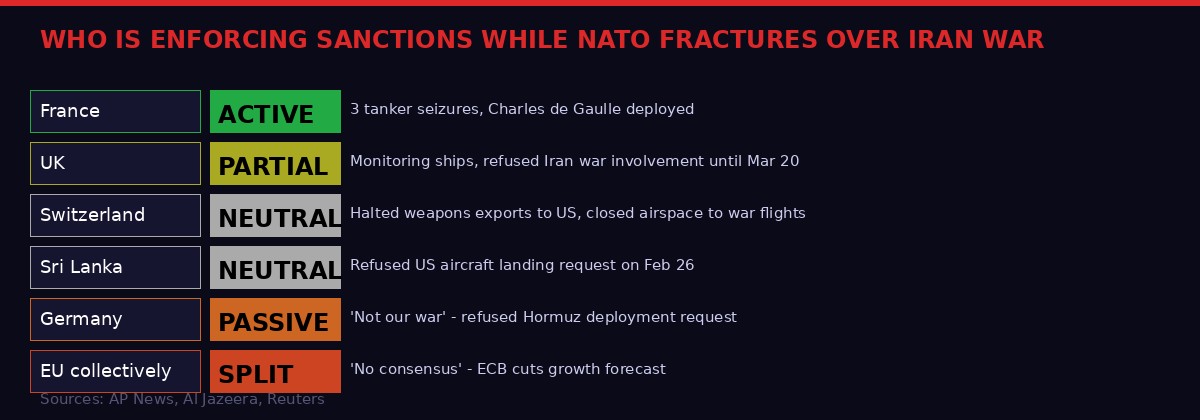
Switzerland announced on Friday that it was halting all weapons export licences to the United States for the duration of the Iran war, citing its longstanding neutrality law. The Swiss government said no new export licences for war materiel to the US had been issued since February 28. Switzerland also closed its airspace to US military flights directly linked to the Iran war - rejecting two US flyover requests while permitting three others. (Source: Al Jazeera, Swiss federal government statement)
Sri Lanka's president revealed to parliament on Friday that his government had denied a US request - made on February 26, two days before the war began - to land two combat aircraft at Mattala Rajapaksa International Airport in the south of the country. The aircraft were described as carrying anti-ship missiles and based in Djibouti. Sri Lanka had simultaneously received a request from Iran for a goodwill naval visit. Both were denied. (Source: Al Jazeera, President Dissanayake's parliamentary statement)
Trump called NATO countries "COWARDS" in a Truth Social post Friday for their refusal to help open the Strait of Hormuz - which Iran has effectively closed to most shipping, cutting off approximately 20 percent of the world's traded oil. European leaders at the Brussels EU summit said clearly that the Iran war "is not Europe's war." (Source: AP News, Al Jazeera)
The Marseille Prosecutors and What Comes Next
The legal case against the Deyna is now in the hands of prosecutors in Marseille, one of France's major Mediterranean ports. The nature of the charges has not been publicly confirmed - but based on the January 2026 precedent, the investigation will likely focus on violations of EU sanctions regulations, false flag navigation, and potentially maritime fraud related to the vessel's documentation.
The crew's situation is publicly unclear. French maritime authorities have not disclosed how many people were aboard or from which countries they originate. In the January 2026 case, the vessel was eventually released after paying the multimillion-euro penalty - but that resolution took approximately six weeks.
The Deyna case may move differently. France has been escalating, not softening, its enforcement posture. And the political climate in Paris - where Macron is navigating simultaneous pressure from Trump over Iran, from Moscow over Ukraine, and from domestic audiences skeptical of both wars - creates incentives to demonstrate legal follow-through rather than quiet resolution.
Russia has not formally responded to the Deyna seizure. After Putin's "piracy" claim over the September 2024 seizure went nowhere legally, Moscow appears to have recalibrated toward silence. A tanker publicly denounced as a shadow fleet vessel, then released after paying a penalty, is a worse outcome than one quietly held while maritime courts deliberate.
Timeline: The Deyna Seizure and Its Context
War Profiteers: The Legal and Moral Framework
Macron's choice of the phrase "war profiteers" is worth examining. Under international law and French domestic law, operating a vessel under a false flag is a serious maritime offence. Circumventing EU sanctions is a separate criminal category with its own penalties. But "war profiteers" is a moral and political designation, not a legal one - it situates the Deyna and vessels like it within the moral logic of wartime accountability.
The G7 price cap mechanism, which underpins the sanctions regime Russia's shadow fleet evades, was explicitly designed to limit Russian oil revenues without cutting off global supply. It was a compromise: the West wanted to hurt Russia's war machine without triggering a global energy crisis of its own creation.
That compromise is now under severe strain. The Iran war has already triggered the energy crisis the price cap was meant to prevent - not because the cap failed, but because a different conflict closed the Strait of Hormuz and struck Qatar's LNG facilities. Oil prices have surged past $118 per barrel in recent days, with some analysts no longer ruling out $200/barrel if Hormuz remains closed. (Source: Al Jazeera, Reuters)
In this environment, Russian shadow fleet tankers moving Murmansk crude through the Mediterranean are not just sanctions violations. They are an additional source of market distortion in an already disrupted global energy system. The oil they carry reaches refineries in India, China, and Turkey - keeping demand for Russian crude robust even as European buyers have theoretically exited the market.
France's interdiction campaign cannot close that gap. Three seized tankers against an estimated 600-vessel fleet is a 0.5 percent enforcement rate. But enforcement at scale was never the French objective. The objective is deterrence and signaling - demonstrating to shadow fleet operators that Mediterranean transit carries legal risk, and demonstrating to allies and adversaries alike that France's maritime legal order is not performative.
The Broader Stakes: Maritime Law in a World at War
There is a more fundamental question embedded in the Deyna seizure, one that goes beyond Russia or Ukraine or Iran. It is the question of whether the rules that govern international maritime commerce can survive a period in which two major wars are simultaneously disrupting the global order.
The Strait of Hormuz is currently closed to most commercial shipping - not because of a naval blockade in the traditional sense, but because Iran has made the transit risk high enough that insurance rates have become prohibitive and most operators have voluntarily rerouted. This is a de facto closure achieved without a formal declaration of war on shipping. (Source: Lloyd's List, Al Jazeera)
Iran is simultaneously developing a vetting system for Hormuz transit, reportedly in direct talks with India, Pakistan, Iraq, Malaysia, and China to allow approved ships through its territorial waters via a "safe corridor." Some vessels have already paid $2 million or more for the right to pass. (Source: Lloyd's List, via Al Jazeera)
That system - a state charging per-transit fees for access to an internationally recognized waterway - represents exactly the kind of precedent that maritime law was designed to prevent. It is the Strait of Hormuz as toll booth.
Russia's shadow fleet represents a different precedent: states using commercial shipping infrastructure to evade wartime accountability while maintaining the appearance of civilian commerce. The false flag, the shell company, the informal insurance arrangement - all designed to make a vessel invisible to the enforcement mechanisms that legitimate maritime commerce depends on.
France's response to both challenges is the same: enforce the rules as written, publicly, with legal follow-through. Whether that is sufficient - against a 600-tanker fleet and a closed strait - is a different question entirely.
The MV Deyna is sitting at anchor near Marseille. The crew is aboard. The documents are with the prosecutors. And the same French carrier group that is watching Iranian missiles arc over the eastern Mediterranean is also watching the Western end of the same sea, where Russia's war financing moves through waters that France refuses to treat as a law-free zone.
In 2026, both ends of the Mediterranean are contested. That is the summary of where the world currently stands.
Get BLACKWIRE reports first.
Breaking news, investigations, and analysis - straight to your phone.
Join @blackwirenews on Telegram