FOMC Fire Test: Bitcoin Holds $74K, the SEC Drops Its First Token Taxonomy, and Mastercard Spends $1.8 Billion on Stablecoins
Three events on a single day reshaped the entire crypto-finance landscape. The Federal Reserve is hours away from a decision. The SEC just told markets what is and isn't a security. And Mastercard just handed $1.8 billion to a stablecoin startup. Wednesday, March 18, 2026 is already live.
Bitcoin at $74,200 as the FOMC meets Wednesday. Three stories are colliding that will define the next six months of crypto markets.
Three institutions moved on Tuesday. The SEC finally told you what crypto is and isn't. Mastercard wrote a check for $1.8 billion to own a stablecoin company. And the Fed is sitting on a rate decision that could either kill or ignite Bitcoin's fragile $74K-$76K range.
Any one of these would dominate the news cycle on a normal day. On Tuesday, March 17, 2026, they all landed within hours of each other. This is not coincidence. This is the financial system repricing what crypto actually is - as an asset class, as infrastructure, and as a political battleground.
BLACKWIRE ran the sources, read the filings, and talked to the analysts. Here's what every trader, regulator, and institution needs to understand before the opening bell Wednesday morning.
Market Snapshot - Tuesday Close
Section 1: Bitcoin's $74K Ceiling and the FOMC Test
Bitcoin briefly touched $76,000 on Monday night. By Tuesday afternoon, it had slipped back to $74,200. The timing isn't random - it's fear. Specifically, it's the fear of Jerome Powell.
The Federal Open Market Committee meets Wednesday, March 18. Every mainstream analyst, derivatives desk, and prediction market is pricing in a hold at 3.50%-3.75%. That part isn't the story. The story is what Powell says afterward - and whether he signals any rate cuts are still on the table for 2026 or whether the Iran war's effect on oil prices has quietly killed that plan.
Bitfinex analysts summarized the risk plainly: "A hot PPI number followed by a hawkish FOMC would be the most damaging combination for equities and risk assets." The Producer Price Index report also lands Wednesday, just hours before Powell takes the podium. Two data bombs in one day.
"We expect the $74,000 to $76,000 region to cap price momentarily." - Bitfinex Research, March 17, 2026
The Iran war is the wildcard that no Fed model accounted for. Crude oil prices have surged as the conflict in the Persian Gulf disrupts shipping and refinery capacity across the region. That oil shock feeds directly into PPI readings and potentially into CPI in the months ahead. The Fed was already threading a needle between sticky services inflation and a slowing labor market. Now it has a geopolitical oil shock on top of that.
Vetle Lunde, head of research at K33, flagged the most striking number: the probability of interest rates remaining unchanged through the July meeting has jumped to 62% - from just 22% last month. In one month, the market moved 40 percentage points toward "no cuts." That is a massive repricing of the risk environment, and it hasn't fully worked its way into Bitcoin prices yet.
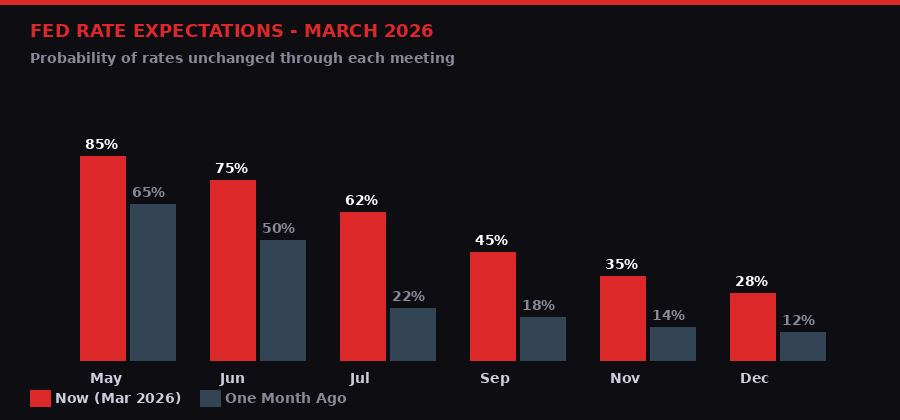
Probability of rates remaining unchanged at each upcoming FOMC meeting, comparing March 2026 expectations vs. one month prior. Source: K33 Research, BLACKWIRE
The macro logic is straightforward: if rates stay high, the dollar strengthens. A stronger dollar compresses dollar-denominated assets like Bitcoin. Meanwhile, higher rates increase the opportunity cost of holding non-yielding assets. Institutional money that rotated into BTC expecting 2026 rate cuts as a tailwind is now sitting on an uncomfortable question - was that trade thesis wrong?
Bitcoin's correlation with Nasdaq has held above 0.60 for most of Q1 2026. What happens to tech stocks when Powell sounds hawkish also happens to BTC, just with more volatility. The Nasdaq's 0.5% gain Tuesday was fragile - a relief rally that could vanish the moment Powell mentions "data dependent" in a tone that reads as hawkish.
For Bitcoin bulls, the scenario they need is simple: PPI comes in soft, Powell signals that rate cuts remain the base case for late 2026, and he frames the oil shock as transitory. If all three happen, the $76K ceiling breaks fast and the path to $80K opens. If even one piece is missing, BTC retraces to $70K-$72K support and the next two months become a grind.
Strategy (formerly MicroStrategy) is watching this closely. The company just raised $1.18 billion through its STRC preferred stock series - more than the $396 million it raised from common stock sales in the same period. Annual dividend obligations on preferred stock have now passed $1 billion. Michael Saylor has bet the company on Bitcoin staying above certain price levels. An FOMC-driven selldown isn't just a paper loss for Strategy shareholders - it's a structural risk to the most aggressive corporate Bitcoin treasury in existence.
Section 2: The SEC Just Answered a Decade-Old Question
For over ten years, every crypto project launch, token sale, and DeFi protocol lived under the same regulatory fog: is this a security? The answer from the SEC was always some variation of "maybe" - communicated through enforcement actions rather than clear rules.
That changed Tuesday. SEC Chairman Paul Atkins, standing at the Digital Chamber's DC Blockchain Summit in Washington, released joint guidance with the Commodity Futures Trading Commission that creates - for the first time - a formal classification framework for crypto assets under U.S. law.
"After more than a decade of uncertainty, this interpretation will provide market participants with a clear understanding of how the Commission treats crypto assets under federal securities laws." - SEC Chairman Paul Atkins, March 17, 2026
The guidance establishes five categories. Only one - digital securities - is subject to SEC regulation. The rest fall outside the agency's traditional jurisdiction.
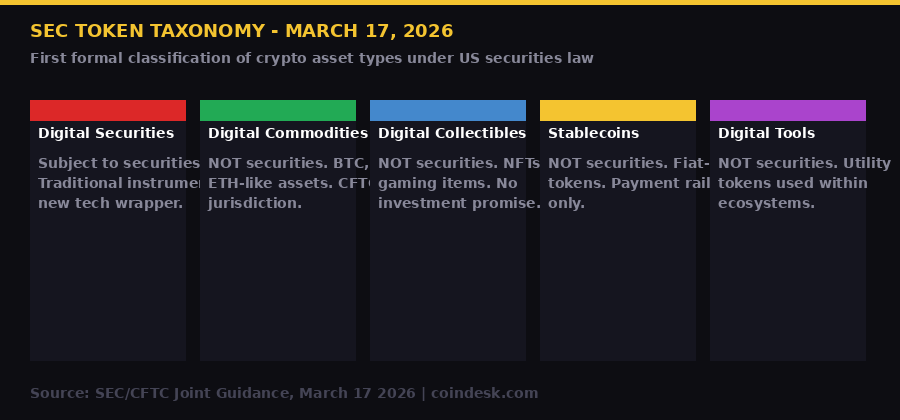
The SEC's five-category token taxonomy, released March 17, 2026 in joint guidance with the CFTC. Source: SEC, CFTC, BLACKWIRE
The five categories in the taxonomy:
- Digital Securities: Traditional securities dressed in blockchain clothes. Think tokenized equity, tokenized bonds, any instrument where there's an issuer promising returns based on management effort. Subject to full securities law. This is the narrowest category.
- Digital Commodities: Assets like Bitcoin and Ethereum - no issuer, decentralized, not offering profit-sharing. Under CFTC jurisdiction, not SEC.
- Digital Collectibles: NFTs, gaming items, collectibles with no investment intent or common enterprise. Not securities.
- Stablecoins: Fiat-pegged tokens used as payment rails. Not securities. No profit expectations involved.
- Digital Tools: Utility tokens used within specific ecosystems to access services. Not securities when there's no investment return promise.
The bombshell line from Atkins at the summit: "Most crypto assets are not themselves securities." Then, in a moment that drew applause from the assembled crypto crowd: "We're not the securities and everything commission anymore."
This is a historic reversal from the Gary Gensler era. Gensler's SEC operated on the theory that virtually every crypto token was a security and proceeded to enforce that view through litigation rather than rulemaking. The result was years of legal uncertainty, billions spent on lawyers, and a chilling effect on U.S.-based crypto development. Projects launched offshore to avoid the regulatory fog.
Atkins has flipped that default. The new starting assumption is: crypto assets are NOT securities unless they fit specific criteria - namely, an issuer offering profit participation based on management effort. That's the Howey test applied precisely and narrowly, not expansively.
There's a sunset mechanism that's equally important. Under the new guidance, an investment contract doesn't maintain securities status permanently. Once an issuer has either fulfilled its promises or clearly failed to, the token stops being a security. This means early-stage tokens that launched as investment instruments can eventually graduate to commodity or utility status as the underlying protocol matures. That addresses one of the longest-standing tensions in crypto law - the question of whether Ethereum's 2014 ICO made it a permanent security.
Atkins told reporters after the event to "hold on to your seats" - noting the agency has dozens of proposals coming, including a formal rulemaking expected to exceed 400 pages within the next few weeks. That rulemaking will also include an "innovation exemption" for crypto firms that want to operate while compliance frameworks are still being developed.
Senator Tim Scott added fuel Tuesday, saying the stalled market structure bill is advancing and he expects to have a draft of stablecoin yield language in hand by end of week. The legislative and regulatory tracks are now moving simultaneously for the first time in the industry's history.
Section 3: Mastercard Writes a $1.8 Billion Check to Own the Future of Payments
Mastercard announced Tuesday it would acquire BVNK, a London-based stablecoin infrastructure company, for $1.8 billion. BVNK enables businesses to send, receive, store, and convert stablecoins across more than 130 countries. The company processed over $30 billion in stablecoin payments in 2025.
The number that matters isn't the acquisition price - it's the multiple. BVNK generated roughly $40 million in revenue as of late 2024. That's a 45x revenue multiple. Mastercard, one of the most financially disciplined companies on the planet, paid a startup price for a stablecoin infrastructure play. That tells you everything about where Mastercard thinks payments are heading.
"Stablecoins are integral to the future of payments." - Mizuho analyst Dan Dolev, March 17, 2026
The deal logic from multiple sell-side firms converged on the same theme:
TD Cowen (Buy, $671 target): "BVNK is a clear answer" - connecting on-chain payment rails with Mastercard's existing network. Stablecoins as complementary infrastructure, not competitor.
Cantor Fitzgerald (Overweight, $650 target): The acquisition positions Mastercard for the coming "stablecoin adoption wave," especially demand from financial institutions and fintechs for cheaper cross-border payments.
Oppenheimer (Outperform, $683 target): BVNK expands Mastercard's ability to support end-to-end digital asset flows, including fiat-to-stablecoin conversion. Aligns with the interoperability push between TradFi and blockchain.
William Blair (Outperform): "We see Mastercard's BVNK acquisition as further affirmation of the stablecoin market for cross-border commerce, rather than B2C payments, which are well served by card."
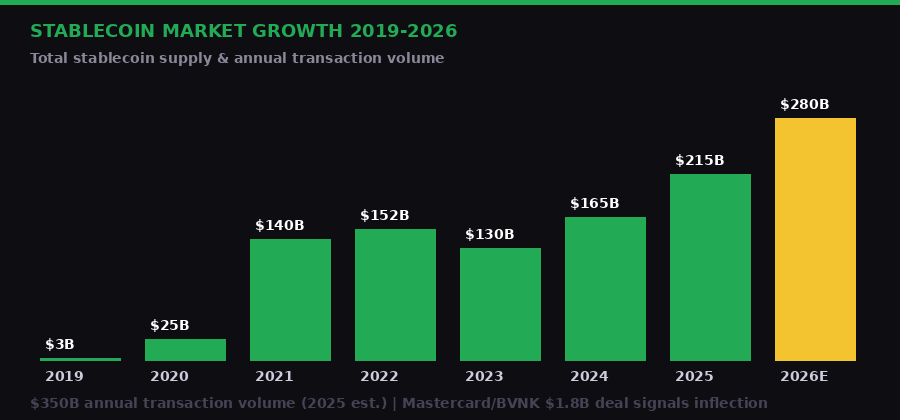
Total stablecoin supply growth 2019-2026. Annual transaction volume hit an estimated $350 billion in 2025. Mastercard/BVNK signals institutional commitment at the inflection. Source: Visa/Allium, BLACKWIRE
Context: Stripe acquired stablecoin infrastructure company Bridge in 2025 for $1.1 billion. Morgan Stanley led a $104 million raise into Zerohash. Now Mastercard pays $1.8 billion for BVNK. The pattern is clear - every major payments company is buying stablecoin infrastructure as fast as it can, because the ones that don't will be disintermediated by the ones that do.
Harvey Li, founder of Tokenization Insight, put the threat plainly: "Card networks are the most exposed payment rail to stablecoin disruption." USDC and USDT don't charge interchange fees. They settle in minutes, not days. They operate 24/7 globally. On every performance metric that matters to the merchant, stablecoins win. The only things card networks have right now are distribution, trust, and regulatory relationships. BVNK helps Mastercard turn stablecoin infrastructure into a service it controls rather than a threat it faces.
Even Bitcoin purists have moved. Jack Dorsey, who spent years betting on Bitcoin as the payment layer, has reportedly shifted his view as stablecoin demand from customers proved overwhelming. When the hardest-of-the-hard Bitcoin believers accept stablecoin realities, the ideological war is over. The pragmatists won.
Section 4: Kalshi Faces 20 Criminal Counts in Arizona - The States Strike Back
While the SEC was issuing its pro-crypto framework in Washington, Arizona Attorney General Kris Mayes was filing 20 criminal counts against Kalshi on the other side of the country. The charges: operating an unlicensed gambling business and offering election betting in violation of Arizona law.
The timing is deliberately provocative. The CFTC - Kalshi's federal regulator - released new guidance earlier this month asserting "exclusive jurisdiction" over event contracts, framing prediction market platforms as regulated derivatives venues rather than gambling operators. Arizona's response: criminal charges anyway.
Kalshi Criminal Charges - Arizona, March 17, 2026
Count breakdown: Operating an unlicensed wagering business + election betting prohibition violations. Contracts cited: 2028 presidential race outcomes, 2026 Arizona gubernatorial race. AG Mayes: "Arizona law prohibits operating an unlicensed wagering business, and separately bans betting on elections outright." Kalshi's response: "States like Arizona want to individually regulate a nationwide financial exchange, and are trying every trick in the book."
Kalshi sued Arizona on March 12 - before these charges were filed. The company has also filed preemptive suits in Iowa and Utah. The strategy is aggressive: don't wait for state enforcement, take them to federal court and establish that CFTC jurisdiction preempts state gambling laws.
The court record is messy. A federal judge in Nevada ruled last year that Kalshi's sports contracts ARE subject to state gaming regulators. A Massachusetts court said the same. A Tennessee federal judge ruled the opposite this year, temporarily blocking state regulators. Ohio denied Kalshi's preliminary injunction request and affirmed state authority. The legal patchwork is real and growing.
The fundamental tension isn't going away: is a contract on who wins the Super Bowl a derivative (CFTC jurisdiction) or gambling (state jurisdiction)? Both characterizations are technically defensible. The answer depends on which legal theory a given judge prefers. Kalshi is betting that federal preemption will eventually win across enough circuits to make state-level enforcement unviable. Arizona is betting that 20 criminal counts will force a settlement or deter other prediction market platforms from expanding.
The election betting piece is the sharpest edge. Most of the earlier state-level battles were about sports contracts. Arizona's filing explicitly targets election wagering - betting on the 2028 presidential race and the 2026 governor's race in Arizona specifically. That's politically charged territory where elected state AGs have strong incentive to make the case, regardless of what federal regulators say. Mayes called it what it is: "betting on elections outright."
Section 5: The Stablecoin Legislative Track and Tim Scott's Play
Senator Tim Scott (R-SC), chair of the Senate Banking Committee, told reporters Tuesday that the stalled stablecoin legislation is moving. He expects the first draft of yield-bearing stablecoin language to land in his hands by end of week.
The stablecoin bill has been the most closely watched piece of crypto legislation in Congress. Its central unresolved question: can stablecoins pay yield to holders? The banking lobby says no - that turns them into unregulated money market funds. The crypto industry says yes, or at minimum, issuers should be able to hold yield-bearing assets in reserve and pass some of that to users.
The resolution of that question has massive commercial implications. Circle (CRCL), whose stock gained 5% Tuesday, makes its money by holding the dollars backing USDC in Treasury bills and keeping the yield. If regulation forces it to share yield with holders, that revenue model changes. If regulation permits yield-bearing stablecoins, new competitors emerge - banks, fintech companies, payment processors who can use stablecoins as interest-bearing demand deposits.
The legislative timeline Scott outlined: stablecoin language draft by week's end, market structure bill negotiations ongoing in parallel. Both chambers need to reconcile versions before anything reaches Trump's desk. But the direction of travel is clear - the U.S. regulatory framework for crypto is being built right now, in real time, by people who want it to work rather than people who want to stop it.
Chairman Atkins said the permanence of the SEC's new token taxonomy depends on legislation. The interpretive guidance issued Tuesday doesn't have the force of law - it's the SEC's stated policy position. A future administration with a different chairman could reverse it without rulemaking. Only congressional action locks it in. That's why Scott's timeline matters even beyond stablecoins - the market structure bill is the container for everything Atkins is trying to build.
Section 6: What Wednesday's FOMC Means for Every Crypto Position
Here is the scenario matrix every trader is running right now. The FOMC announces rates unchanged - that's the base case, fully priced in. The action is in the statement language and Powell's press conference.
Scenario A - Dovish hold: Powell acknowledges the Iran oil shock as temporary, maintains two 2026 rate cuts in the dot plot, emphasizes labor market resilience over inflation concerns. Bitcoin breaks $76K within 24 hours, Nasdaq rallies 1%-1.5%, crypto stocks (Circle, Coinbase, Bitdeer) surge. This is the bull case.
Scenario B - Neutral hold: Powell says "data dependent" in every answer, no strong signals either way, dot plot unchanged. Bitcoin stays in the $73K-$76K range for another week. Boring is fine if you're already long.
Scenario C - Hawkish hold: Powell removes one or both projected 2026 rate cuts from the dot plot, frames the Iran oil shock as potentially persistent inflationary pressure, emphasizes higher-for-longer. This is the danger scenario. Bitcoin re-tests $70K support. Stocks sell off. The dollar strengthens. Risk assets broadly compress.
The PPI wildcard: If February PPI comes in hot before the FOMC announcement, even a neutral Powell press conference reads as hawkish given the context. PPI feeds into PCE - the Fed's preferred inflation gauge - with a lag. Hot PPI today means difficult PCE readings in 6-8 weeks. Markets know this.
Wednesday March 18 - Key Events Timeline
The market consensus from Bitfinex and K33 is that the $74K-$76K range caps Bitcoin "momentarily" before the next directional move. That word - momentarily - is doing a lot of work. It assumes Wednesday doesn't deliver the hawkish shock. If it does, "momentarily" becomes "indefinitely" and everyone re-prices their H1 2026 Bitcoin targets.
Section 7: The Bigger Picture - Three Events, One Signal
Tuesday's triple-header - SEC taxonomy, Mastercard-BVNK, Bitcoin at $74K - isn't coincidental. These events share a common thread: institutional legitimation at scale.
The SEC taxonomy says: the U.S. government has decided crypto is a real asset class with specific legal categories. Not a scam, not an experiment, not something to be litigated into submission. A real asset class with rules. That's what institutional money needs before it moves.
The Mastercard deal says: the largest consumer payments infrastructure company in the world believes stablecoins are the plumbing of the next financial system. At $1.8 billion, they're not experimenting. They're committed. When Mastercard does something, every Visa, PayPal, and major bank compliance team gets a memo asking "what are we doing about this."
Bitcoin at $74K says: all of this maturation is happening in a market that remains deeply sensitive to traditional macro forces. The Iran war, oil prices, Fed rates - these aren't crypto problems, they're macro problems that crypto can't escape. Bitcoin is still a risk asset. The regulatory clarity and institutional adoption create a higher floor, but they don't insulate BTC from a hawkish Fed.
The synthesis: crypto is being absorbed into the mainstream financial system faster than at any prior point in history, while simultaneously remaining exposed to the same forces that move every other risk asset. That's not a contradiction. That's maturity. The question is whether the absorption happens at $74K Bitcoin or $90K Bitcoin. Wednesday's FOMC will give a meaningful answer to that question.
Key Positions to Watch Into FOMC
BTC support: $70K-$72K. Resistance: $76K. Strategy's STRC preferred stock trading near par - a FOMC selldown would stress that. Circle (CRCL) is the direct legislative play - stablecoin bill progress lifts it. Kalshi: binary outcome, criminal charges or federal preemption. The stablecoin ETF space: if the SEC's new taxonomy classifies USDC explicitly as not-a-security, the regulatory path for products built on stablecoins accelerates dramatically.
The regulatory regime that Gary Gensler spent years building through enforcement is being dismantled in weeks, not years. Paul Atkins is moving faster than anyone expected. The combination of SEC taxonomy + CFTC harmonization + congressional market structure + Tim Scott's stablecoin yield language represents the most coordinated pro-crypto regulatory push in U.S. history.
The remaining risk is execution - not political will. The details of the 400-page formal rulemaking Atkins promised could introduce complexity and compliance burdens that inadvertently harm the smaller projects the guidance is meant to protect. The devil lives in implementation, not intent. But the intent, for the first time, is aligned with building rather than stopping.
Bitcoin at $74K heading into FOMC. Stablecoin infrastructure being acquired for billions. The first legal map of crypto assets in U.S. history. Three data points from one Tuesday in March. The system is repricing.
Get BLACKWIRE reports first.
Breaking news, investigations, and analysis - straight to your phone.
Join @blackwirenews on TelegramSources: CoinDesk (Krisztian Sandor, Jesse Hamilton, Helene Braun, Nikhilesh De) - March 17, 2026 | SEC Chairman Paul Atkins - DC Blockchain Summit | CFTC Chairman Mike Selig - joint guidance | Bitfinex Research - March 17, 2026 | K33 Research / Vetle Lunde | Mizuho / Dan Dolev | TD Cowen | Cantor Fitzgerald | Oppenheimer | William Blair / Andrew Jeffrey | Tokenization Insight / Harvey Li | Arizona AG Kris Mayes - criminal filing | Senator Tim Scott - Senate Banking Committee