Brendan Carr has never revoked a single broadcast license. He does not need to. Since becoming FCC chairman in January 2025, Carr has opened investigations, threatened enforcement actions, leveraged merger approvals, and publicly accused network executives of federal violations - all without a single formal revocation proceeding reaching its conclusion.
The result is a media environment where America's largest broadcasters have demonstrably changed their behavior: shows cancelled, interviews scrubbed, coverage decisions made with one eye permanently watching the FCC's public calendar. The chilling effect is real, documented, and growing.
This week, Carr added CNN to the list. According to a post on X, Carr threatened CNN's broadcast license over the network's coverage of the US war with Iran - the latest in a pattern that now stretches across virtually every major television outlet in the country.
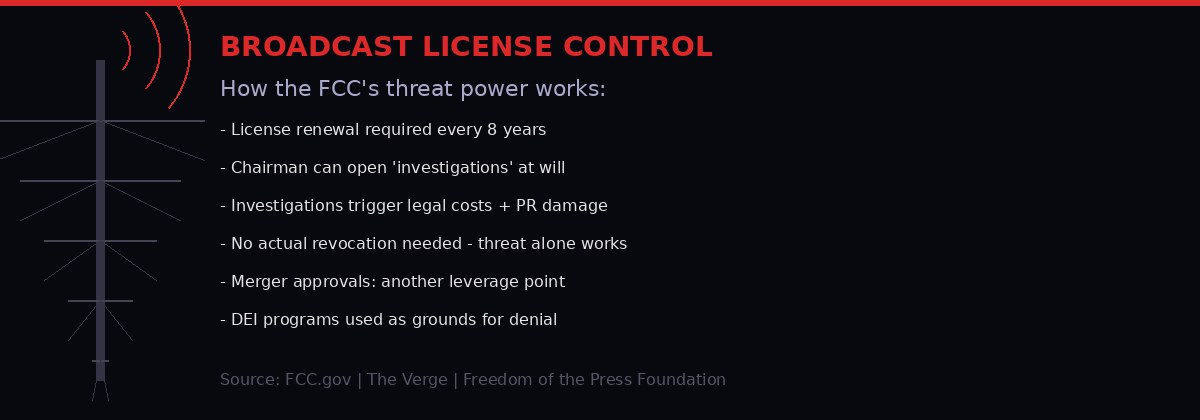
The mechanics are precise and calculated. Understanding how this works requires understanding something most Americans don't: every broadcast television station in the United States operates under a federal license, renewed on an eight-year cycle, that can theoretically be revoked for failing to serve "the public interest, convenience, and necessity." That phrase, deliberately vague since it was written into the Communications Act of 1934, is the wedge Carr is driving into the First Amendment.
The Architecture of Coercion
Broadcast licenses are not like car registrations. Losing one does not just mean one station goes dark - it means a network loses the affiliate capacity it needs to distribute content at national scale. ABC, NBC, CBS, and Fox all operate through hundreds of locally licensed affiliates. Threatening a broadcaster's license is functionally threatening its entire distribution infrastructure.
What makes Carr's approach particularly effective is that he is not actually threatening to pull licenses. He is threatening to investigate. The distinction matters enormously.
An FCC investigation does not require evidence of wrongdoing to launch. The chairman can announce that the commission is looking into a complaint about a broadcaster's conduct - the news distortion rules, equal time compliance, or the DEI programs standard Carr invented - and the legal exposure begins immediately. Broadcasters must now document their response, retain communications lawyers, and make editorial decisions with explicit awareness that regulators are watching.
This is not theoretical. The Freedom of the Press Foundation filed a formal disbarment complaint against Carr in early 2026, describing his conduct as an "unconstitutional shakedown." The complaint, submitted to the Office of Disciplinary Counsel at the DC Court of Appeals, alleges Carr repeatedly leveraged his regulatory authority to coerce editorial decisions in violation of both the First Amendment and basic professional conduct standards for licensed attorneys.
"There's no reasonable way to spin the combination of Trump and Carr's actions except as an attack on the First Amendment - an unconstitutional shakedown. Trump disliked how a news outlet edited an interview with a political rival. In retaliation, one of his officials threatened its parent company." - The Verge, February 2026, summarizing the Freedom of the Press Foundation complaint
The FCC's own website acknowledges that the agency's authority over "news distortion" is "narrow" and only applies when there is evidence showing a broadcast was "deliberately intended to mislead viewers or listeners." Carr has used the standard anyway, applying it to coverage the Trump administration simply did not like.
The Target List: Every Major Network, Systematically
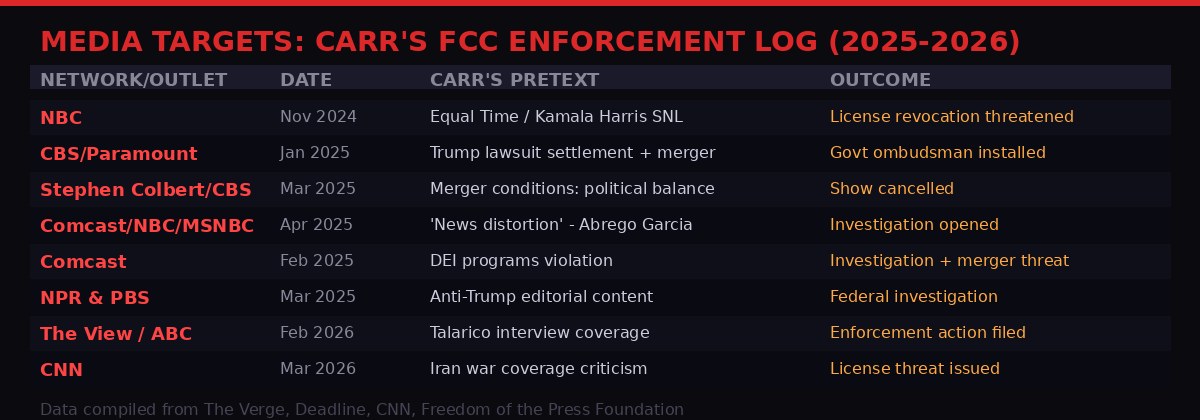
The pattern begins with NBC in November 2024, before Carr was even confirmed as chairman - when he appeared on Fox Business and threatened to revoke NBC's broadcast license over Kamala Harris's Saturday Night Live appearance. The equal time rule, he said, had been violated. "We need to keep every single remedy on the table," Carr told host Maria Bartiromo, explicitly including "license revocation if we find that it's egregious."
Legal observers noted at the time that NBC had followed the equal time rule precisely. The Trump campaign had been notified and provided comparable airtime. SNL itself had hosted every major presidential candidate in living memory without a similar regulatory eruption. The threat was nakedly political, and it worked anyway - signaling to every broadcaster in the country what the incoming administration's regulatory posture would be.
CBS became the central target. Carr leveraged the Paramount-Skydance merger approval - a massive corporate consolidation that required FCC sign-off - as a pressure point over CBS's journalism. The deal had languished while Paramount negotiated a Trump lawsuit over the network's editing of a Kamala Harris interview. CBS eventually paid Trump $16 million to settle. But that was not enough. The merger was approved only on the condition that the new company install a government-appointed ombudsman tasked with ensuring "a diversity of viewpoints" across CBS programming.
The ombudsman condition is unprecedented in modern American broadcast regulation. Nominally it sounds benign - who doesn't want diverse viewpoints? But in practice, the standard is defined by the same administration that found a CBS interview with a Democratic candidate insufficiently favorable, cancelled a late-night comedian, and called another network's DEI programs illegal. "Diversity of viewpoints" under Carr means viewpoints acceptable to the Trump White House.
"The American people simply do not trust the mainstream media, and for broadcasters - they have a federal license, and they are obligated to operate in the public interest. And to the extent that we're starting to see some changes, I think that's a good thing." - FCC Chairman Brendan Carr, commenting on Stephen Colbert's cancellation, CNBC interview, 2025
Colbert's cancellation at CBS - officially framed as a financial decision - came after Carr implied in multiple media appearances that it helped the network comply with its FCC public interest obligations. The broadcaster denied the connection. Carr essentially celebrated the outcome publicly. The timeline made the relationship between the two events impossible to ignore.
The Abrego Garcia Case: "News Distortion" As a Partisan Tool
In April 2025, Carr opened a formal "news distortion" investigation against Comcast after MSNBC and CNN declined to air a White House press briefing in which Press Secretary Karoline Leavitt defended the deportation of Kilmar Armando Abrego - a Maryland man deported to El Salvador in what the government's own documents described as an "administrative error."
The Supreme Court had ordered the administration to return Abrego Garcia. Comcast's networks chose not to broadcast a White House event defending the administration's conduct in a case they were actively losing at the Supreme Court. Carr accused them of "news distortion" and "misleading the American public."
The FCC's own standards make this incoherent. News distortion under FCC rules requires deliberate intent to mislead - choosing not to air a government press conference is an editorial decision, not a fabrication. Networks decline to carry White House briefings constantly. Fox News frequently declines to air Democratic press events. None of these decisions have ever triggered FCC investigations under any previous chairman.
Carr had opened a separate investigation into Comcast's DEI programs in February 2025, and later announced that DEI policies would factor into the FCC's evaluation of corporate mergers and acquisitions. Comcast, which holds broadcast licenses through its NBC ownership, was thus facing simultaneous regulatory pressure on three separate fronts: news coverage, merger approvals, and internal corporate policy.
A Structural Analysis: Why This Works Even Without Revocations
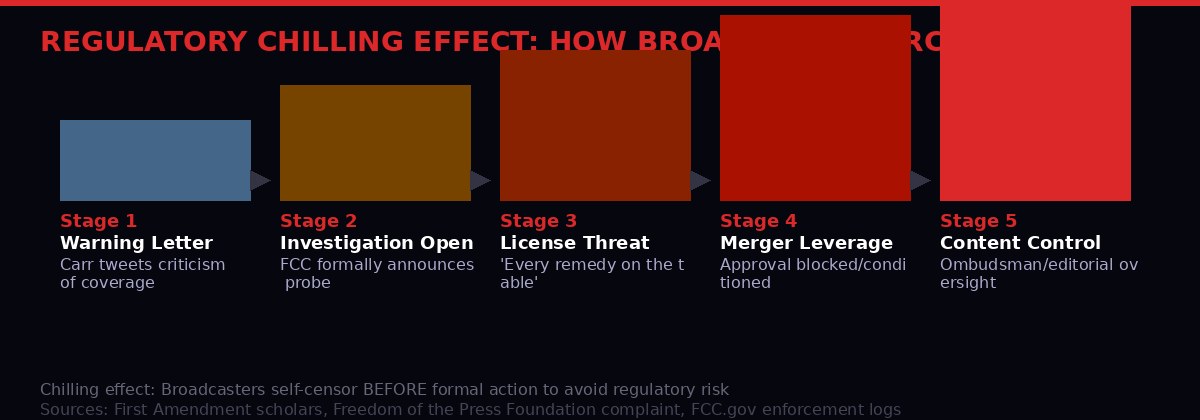
First Amendment scholars use the term "chilling effect" to describe how regulatory pressure suppresses speech without requiring direct action. The concept is well established in constitutional law: if speakers know that certain content might trigger government retaliation, they will avoid that content even when they cannot be sure the retaliation would succeed.
Carr's method exploits this at industrial scale. Broadcasting a single primetime news segment costs hundreds of thousands of dollars in production. Defending against an FCC investigation costs tens of thousands in legal fees minimum, regardless of the outcome. The asymmetry is built in: challenging the government's interpretation is expensive; not challenging it is free.
The math is more brutal at the corporate level. Paramount paid $16 million to settle a lawsuit with a politician who regulated its parent company. That is not a free speech calculation - that is a pure cost-benefit analysis in which regulatory risk was converted directly into cash payment. Every broadcaster watching that transaction learned the same lesson: political compliance has a price, and it is cheaper than legal resistance.
The "Pledge America Campaign" - Carr's initiative to encourage broadcasters to air "patriotic, pro-America content" in celebration of the US's 250th anniversary in 2026 - crystallizes the logic. Carr calls it voluntary. Broadcasters with renewal applications pending, merger approvals needed, and active investigations open know better. When the regulator whose signature you need on paperwork suggests you should run more patriotic programming, "voluntary" carries a specific weight.
"I look forward to broadcasters showcasing its inspiring history by taking the Pledge and fulfilling their public interest mandate to serve the needs and interests of their local communities." - FCC Chairman Brendan Carr, announcing the "Pledge America Campaign," 2026
The FCC's own rules and regulatory tradition directly contradict this posture. For decades, both Republican and Democratic FCC chairs maintained a doctrine that the agency does not dictate content - that the "public interest" standard exists to protect broadcast quality and diversity of ownership, not to enforce political viewpoints. Carr has rejected that entire tradition without changing a single regulation. He simply acts as if the rules say something they do not.
The CNN Threat and the Iran War Variable
The March 2026 threat against CNN adds a new dimension to the pattern. Previous targets were threatened primarily over domestic political coverage - how they framed candidates, whether they covered White House briefings, what their DEI policies looked like. CNN is being threatened over coverage of an active war that the US government is directly conducting.
That is a qualitatively different category of pressure. Wartime government information control has a long and troubling history in American media, but it has historically operated through voluntary cooperation agreements, press pool restrictions, and access leverage - not through regulatory licensing threats against broadcasters who report critically on military operations.
The specific content of the CNN threat remains unclear - Carr posted criticism of the network's Iran war coverage on X, and The Verge reported the threat. What is clear is that it arrives in the context of an administration that has demonstrated it is willing to weaponize every regulatory lever available to shape coverage of inconvenient stories.
CNN is a cable network, which actually creates an interesting legal wrinkle: cable channels do not hold broadcast licenses the way ABC, NBC, and CBS affiliates do. CNN cannot technically be threatened with broadcast license revocation in the same way. But CNN's parent company, Warner Bros. Discovery, holds other licensed broadcast properties and has ongoing regulatory business with the FCC. The threat vector still exists - it is just more indirect.
This is precisely the point. The chilling effect does not require a clean, legally coherent threat. It requires the target to perceive that the regulator has the intent to harm and some avenue to do so. Carr has demonstrated both, repeatedly, in the preceding 14 months. The ambiguity of the CNN threat may be deliberate - maximum uncertainty imposes maximum editorial caution.
The FEMA Tornado Tracking Debacle: When Regulatory Budget Games Kill People
The FCC broadcast pressure campaign exists within a broader pattern of the Trump administration using regulatory and budgetary decisions to punish perceived enemies and reward compliance. A parallel story from March 2026 makes the human cost of this posture visceral in a different domain.
CNN reported exclusively that during a recent series of devastating tornado outbreaks, search-and-rescue teams across multiple states were unable to access critical tornado-tracking data because FEMA had allowed a key $200,000 contract to lapse under DHS Secretary Kristi Noem's spending review policies. Rescuers were, in the CNN source's words, "flying blind" - operating without the pinpoint touchdown location data that determines where to deploy search teams in the critical first hours after a tornado strike.
The contract had been caught in a bureaucratic approval backlog created by Noem's austerity directives. Two hundred thousand dollars. That is approximately one-eightieth of what CBS paid Donald Trump to settle a lawsuit about a news interview. The federal government found the money for the latter and not the former, and people in tornado-struck communities paid the price.
The connection to the FCC story is not direct - but it illuminates a governing philosophy in which political considerations systematically outrank operational necessities. The same administration that cannot approve a $200,000 emergency management contract is spending significant political capital on ensuring CNN covers the Iran war favorably. The prioritization reveals the actual values at work.
What History Says About Where This Ends
The Fairness Doctrine - the FCC policy requiring broadcasters to present multiple viewpoints on controversial issues - was repealed in 1987 under the argument that it actually chilled speech because broadcasters avoided controversial topics entirely rather than risk FCC complaints. The Reagan administration killed it specifically because it suppressed rather than promoted free expression.
Conservatives spent 40 years citing the Fairness Doctrine as the ultimate example of government overreach in media. They were largely correct. And yet the mechanism Carr is deploying is structurally identical to the Fairness Doctrine's worst tendencies - using the threat of regulatory action to make broadcasters second-guess their editorial decisions - except more targeted, more politicized, and without even the fig leaf of a formal rule.
The Fairness Doctrine at least applied symmetrically. What Carr is doing is asymmetric by design. Networks critical of the administration face investigations. Networks favorable to the administration do not. The standard is not "serve the public interest." The standard is "serve this administration's interests."
Legal challenges are moving through the courts. The Freedom of the Press Foundation's disbarment complaint against Carr is a long shot as a legal matter - disbarring a sitting federal chairman is extraordinarily difficult - but as a documentation exercise it is valuable. It creates a formal record of the conduct pattern that future courts, legislators, or administrations can use.
Multiple First Amendment organizations have described Carr's conduct as unconstitutional. The legal consensus among broadcast attorneys who are not employed by networks (and therefore free to speak plainly) is that the license-revocation threats, the merger conditions tied to editorial content, and the DEI investigations are all legally vulnerable. The problem is the timeline: by the time courts rule definitively, the chilling effect will have operated for years.
The Broadcaster's Dilemma: Fight or Accommodate
What is most striking about the past 14 months is how many of the targeted broadcasters have chosen accommodation over confrontation. CBS paid. Colbert's show ended. The merger conditions were accepted. Comcast has not publicly challenged the DEI investigation in the way the Freedom of the Press Foundation has challenged Carr himself.
This is rational corporate behavior. Broadcasters are not news organizations first - they are businesses that happen to own news operations, sitting inside larger corporations with diverse regulatory needs. The same executive team that decides not to fight Carr on the news distortion investigation also decides whether to challenge FCC merger reviews, spectrum allocation decisions, and a dozen other regulatory matters that affect the core business far more than editorial independence does.
The institutional journalism organizations - The Verge, The Atlantic, the Freedom of the Press Foundation, and others without broadcast licenses - have been more aggressive. They do not have the same leverage exposure. A publication that does not hold a broadcast license cannot be threatened with license revocation, and Carr has not, to date, found an equivalent lever for digital-native press. But digital news audiences continue to shrink relative to broadcast, and the broadcasters are where most Americans still get their national news.
The second-order effect that most analysis misses: this is not primarily about the specific coverage decisions being pressured. It is about the composition of newsrooms. Reporters learn quickly which stories trigger regulatory scrutiny and which do not. Editors hire and promote people who navigate that landscape successfully. Over time, the newsroom culture shifts without any single identifiable moment of capitulation. The building empties of people with the instinct to push against power, replaced by people who learned to anticipate what power wants before being asked.
That is how press freedom dies in a country that still has a First Amendment. Not through formal revocations or direct censorship orders. Through the slow, rational accumulation of accommodations, each individually defensible, that collectively add up to something unrecognizable.
The Mechanism: How Regulatory Coercion Suppresses Speech Without Censorship
- No conviction required: The investigation announcement itself imposes legal costs and reputational risk, regardless of outcome.
- Merger leverage: Any broadcaster needing FCC approval for corporate changes becomes instantly vulnerable to editorial pressure as a quid pro quo.
- Renewal cycle exposure: All broadcast licenses renew on 8-year cycles; the regulator reviewing renewal has enormous informal leverage in the years before renewal dates.
- DEI as wildcard: By declaring internal corporate diversity programs to be illegal or grounds for regulatory scrutiny, Carr created a new threat vector with no legal foundation that requires expensive court challenges to defeat.
- "Voluntary" initiatives: The Pledge America Campaign demonstrates how regulatory authority converts nominally voluntary requests into obligations for license-holders.
- Asymmetric enforcement: Only politically unfavorable coverage triggers investigations; favorable coverage is unremarked. The asymmetry itself communicates the standard without stating it.
The Timeline: 14 Months of Escalation
Carr, not yet chairman, threatens NBC license revocation over Kamala Harris SNL appearance. Network had fully complied with equal time rules. Threat is nakedly pretextual - and sends the intended signal to every broadcaster in the country.
FCC lets the Paramount-Skydance merger application sit while Paramount negotiates a Trump lawsuit settlement. CBS pays $16 million. Merger approved with unprecedented condition: government-appointed ombudsman to monitor editorial content "across the political and ideological spectrum."
Carr opens formal FCC investigation into Comcast's diversity, equity, and inclusion programs. Later announces that DEI policies will be factored into merger and acquisition approvals. Zero legal foundation under existing FCC rules.
CBS cancels The Late Show with Stephen Colbert. Officially financial. Carr celebrates the cancellation on CNBC, implying it demonstrates compliance with the broadcaster's FCC public interest obligations. CBS denies connection. The simultaneity is documented.
FCC investigates Comcast for "news distortion" after MSNBC and CNN decline to air a White House briefing about the Abrego Garcia deportation. FCC's own rules state the standard only applies to deliberate fabrication - declining to air a press conference is an editorial decision, not distortion.
FCC announces enforcement action against The View for an interview with Democratic state representative James Talarico, a Senate candidate. Stephen Colbert simultaneously blocked by CBS from airing his own Talarico interview.
FCC opens investigations into NPR and PBS. Carr threatens CNN's broadcast operations over Iran war coverage. Freedom of the Press Foundation files formal disbarment complaint against Carr at DC Court of Appeals.
The disbarment complaint documents these actions as a pattern rather than a series of isolated incidents - which is what makes it legally interesting. Individual FCC actions are easy to dismiss as within the chairman's discretionary authority. The cumulative pattern, all pointing in the same political direction over 14 months, is much harder to characterize as neutral regulatory enforcement.
What the Legal Record Actually Says
First Amendment case law on broadcast regulation is genuinely complex. The Supreme Court upheld the Fairness Doctrine in Red Lion Broadcasting Co. v. FCC (1969), a decision legal scholars have criticized for decades as incompatible with modern First Amendment doctrine. Since Red Lion, courts have carved back broadcast-specific speech restrictions significantly, and the current Court's conservative supermajority is broadly hostile to government speech restrictions.
The FCC's power to revoke licenses for political speech reasons is almost certainly unconstitutional under current doctrine. The problem is that nobody has been pushed to the point of forcing the question. Networks threatened with investigations settle, accommodate, or change behavior before the legal challenge reaches that stage.
An actual license revocation targeting clearly protected political speech would face immediate injunctive relief in federal court and would almost certainly be reversed on appeal - potentially with an opinion that explicitly limits future FCC discretion in this space. That outcome would be bad for Carr's project. It may be why the threats remain threats.
Media lawyers tracking the situation privately note that the strategy is sophisticated precisely because it avoids creating the judicial record that would constrain it. Every investigation gets dropped or concluded quietly before it generates an appealable order. Every "voluntary" initiative is never formally compelled. Every editorial "change" is attributed to commercial decisions rather than regulatory pressure. The dots are all there. The line connecting them carefully avoids getting drawn in a legal document.
Congress has oversight authority over the FCC. Multiple members have demanded explanations for specific Carr actions. None have resulted in hearings or legislative action that would constrain the chairman's conduct. The executive controls the FCC through appointment. The FCC controls the broadcasters through licensing. The circle is closed.
What breaks it, historically, is either a change in administration - the next president appoints a different FCC chair, who resets the regulatory posture - or a judicial ruling that explicitly defines the limits of FCC discretion in ways that bind future chairs. Neither appears imminent. In the meantime, America's broadcast journalists are working under the eye of a regulator who has made his standards unmistakably clear, even if he has never written them down.
Get BLACKWIRE reports first.
Breaking news, investigations, and analysis - straight to your phone.
Join @blackwirenews on Telegram