Europe's Air Defense Gap: Iran War Strips NATO of Patriots as Russia Watches
Day 22 of Operation Epic Fury. Patriot batteries are moving from Germany to Turkey. Ukraine's air defenses are thinning. NATO's eastern flank is more exposed than at any point since the Russian invasion of 2022. And in the Kremlin, they are paying attention.
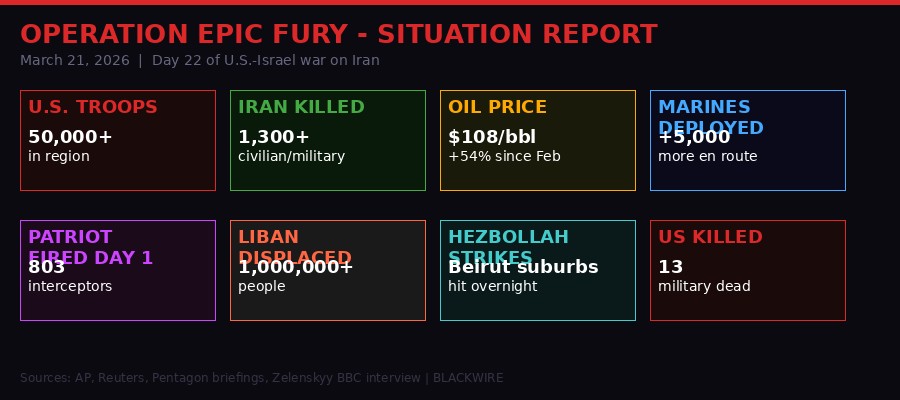
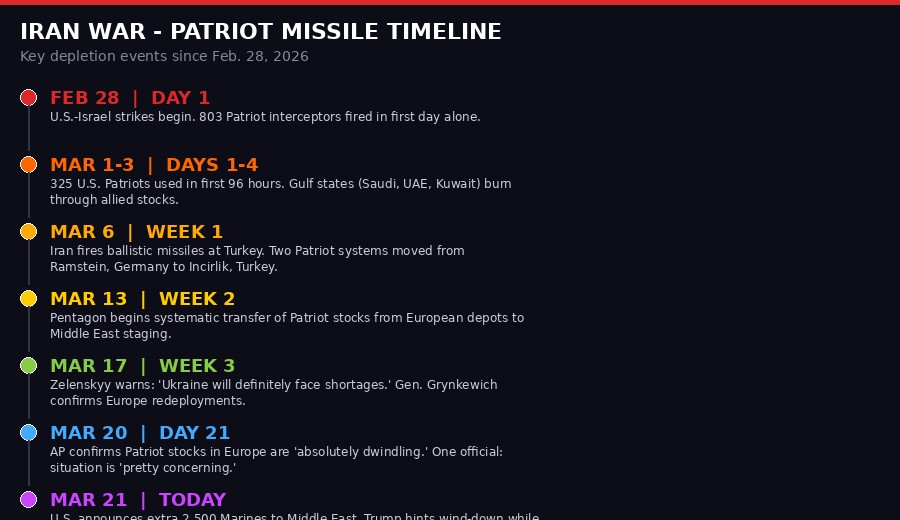
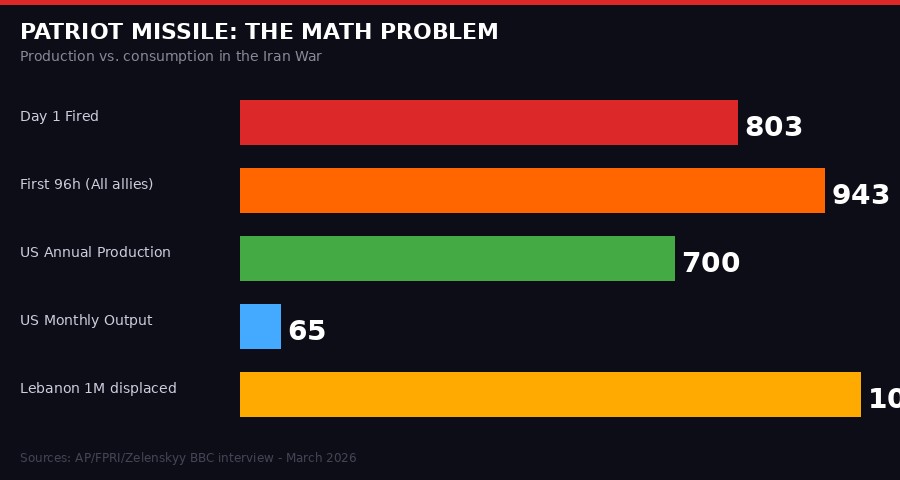
The math is simple and brutal. The United States produces between 60 and 65 Patriot interceptor missiles per month - roughly 700 to 800 per year. On the first day of the Iran war alone, the U.S. and its partners fired 803 of them. Within 96 hours of that first strike, the collective count stood at approximately 943 interceptors.
That is a year's worth of American Patriot missile production consumed in under four days.
Three weeks later, on the morning of March 21, the war has not slowed. It has metastasized. Iran is striking Saudi Arabia - 20 drones intercepted in the Saudi eastern oil region in just two hours overnight. Israel is hitting Hezbollah in Beirut's southern suburbs again, with residents woken by gunshots warning them to flee. And in Washington, President Trump is simultaneously sending 2,500 more Marines to the theater while hinting at a "wind-down" that no one in the field is seeing.
Somewhere in the middle of this, Patriot missile batteries are being quietly pulled out of Europe.
The Patriot Drain: From Germany to the Gulf
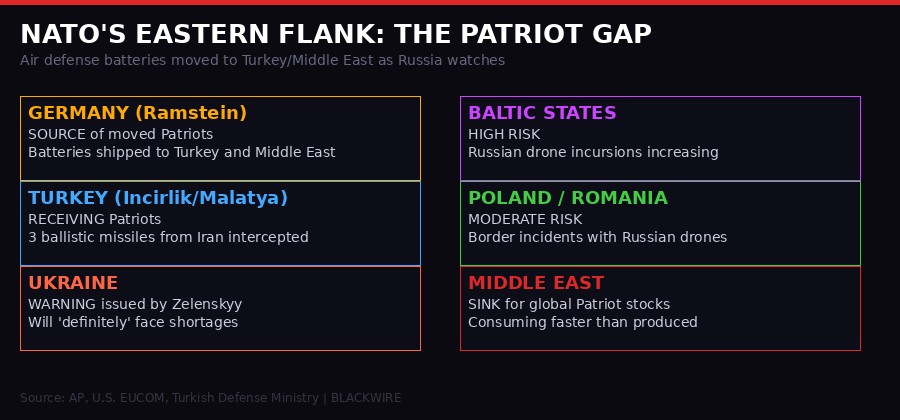
The mechanics of the shortage have been confirmed in detail by multiple U.S. defense officials speaking anonymously to the Associated Press. At least two Patriot missile systems were transferred from Ramstein Air Base in Germany to Incirlik Air Base in Turkey, after Iran fired several ballistic missiles at Turkish territory since the war began. A third system was positioned in Malatya, in Turkey's southeast, where a NATO radar installation is based.
Turkey's defense ministry confirmed the Ramstein-to-Incirlik transfer. Three separate U.S. defense officials confirmed broader movement of Patriot stocks from "various locations around Europe" toward the Middle East theater. General Alexus Grynkewich, commander of U.S. and NATO forces in Europe, confirmed Wednesday that air defense capabilities in Europe had been moved toward the Middle East.
That is not a leak. That is the NATO command structure publicly acknowledging it has less capacity in Europe than it did four weeks ago.
"One of the officials said stocks of Patriot missiles are 'absolutely' dwindling in Europe and elsewhere because of the war in Iran, and added the situation is 'pretty concerning.'" - Associated Press, March 20, 2026
The White House's response was a statement from press secretary Karoline Leavitt: "The US military has more than enough munitions, ammo, and weapons stockpiles to achieve the goals of Operation Epic Fury laid out by President Trump - and beyond." One other U.S. official said there is still "plenty" of capacity in NATO to defend Europe.
Those two responses in the same 24-hour period are not the same message. One is an official press statement. The other is a person with actual knowledge of inventory levels.
The core technical problem: in the Middle East, the U.S. and its allies are using Patriot systems - designed to intercept hypersonic ballistic missiles and high-end cruise missiles - against cheap Iranian Shahed-series drones that cost roughly $20,000 to $50,000 each. A single Patriot interceptor costs approximately $4 million. The exchange ratio is unsustainable.
"Patriots should be used to protect high-end ground systems - not against threats that don't require them." - U.S. defense official, via AP
The Ukraine Equation: A Third War Within the War
Ukraine is not in the Iran war. Ukraine is also not unaffected by it.
President Volodymyr Zelenskyy has been warning for days that the Patriot shortage forming in the Middle East will reach Kyiv. In an interview with the BBC this week, he laid out the numbers himself: the U.S. produces 60 to 65 Patriot missiles per month, approximately 700 to 800 per year. On the first day of the Iran war, 803 were fired. The arithmetic closes itself.
"Ukraine will definitely face shortages of Patriots because of the U.S. war against Iran." - President Volodymyr Zelenskyy, BBC interview, March 2026
Russia has not paused its war. Russian drones continue to cross into Baltic airspace. The border incidents in Poland and Romania - Russian drone incursions that have required interception - are not isolated. They are a pattern. European NATO nations near Russia are already experiencing what the alliance would describe as hybrid warfare: sabotage campaigns, cyberattacks, disinformation operations, probing drone flights.
A German military official, speaking anonymously on sensitive military matters, told the AP he has not yet seen "operational shortfalls in Ukraine caused by the war in the Middle East." He added immediately: but shortfalls "may occur in the near future, eventually weakening Ukraine's endurance and capabilities."
That is a hedge with a countdown clock built in.
The Foreign Policy Research Institute calculated that approximately 325 U.S. Patriots were used in just the first 96 hours of the Iran war. When you include Gulf state allies firing their own stocks in defense of UAE, Saudi Arabia, Kuwait, Qatar and Oman - the first 96-hour total across the coalition reached approximately 943 interceptors. Each Gulf state that burns through its Patriot supply is a Gulf state that will require resupply from the same limited production pipeline.
Iran's Escalation: Tourism Sites and a Leaderless Military
On March 20, as Iranians were observing Nowruz - the Persian New Year - Israeli airstrikes hit Tehran. Iran's top military spokesperson, General Abolfazl Shekarchi, issued a public threat hours later: "parks, recreational areas and tourist destinations" worldwide would not be safe for Iran's enemies.
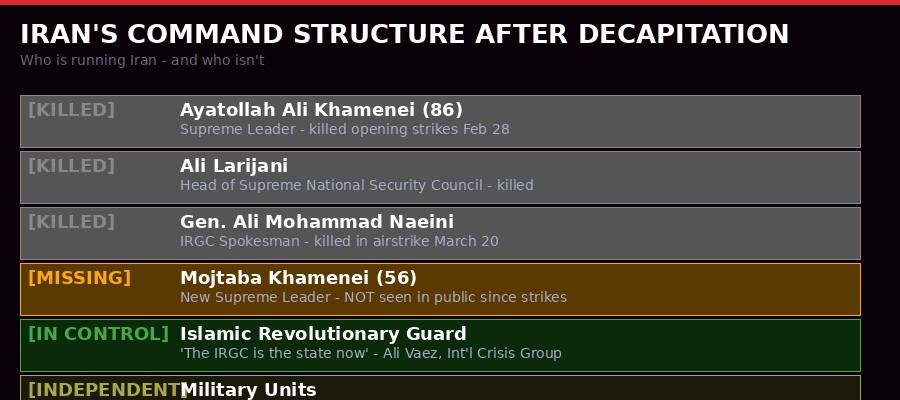
Also on March 20, Iranian state television reported that General Ali Mohammad Naeini - the IRGC spokesman who had just told a state newspaper that Iran continued to manufacture missiles despite Israeli claims of destroying its production capabilities - was killed in an airstrike. The day's events captured the condensed horror of this conflict: a military official gives an interview, claims his country's defense industry is intact, and is dead by nightfall.
The tourism threat is not theater. It marks a documented shift in Iranian strategy from direct military engagement toward the use of proxy and asymmetric attack - what Tehran has historically called its "Axis of Resistance" toolkit. Hezbollah operatives in Europe, sleeper networks in Latin America, Iranian intelligence assets across Asia - these are the instruments that generate attacks on "tourist destinations." The 2012 Burgas bus bombing in Bulgaria. The 2012 Bangkok operation. The 2018 Antwerp plot. All attributed by Western intelligence to Iranian networks when Tehran felt cornered.
The threat lands differently now because of what has happened to Iran's central command.
Supreme Leader Ayatollah Ali Khamenei was killed in the opening strikes of the war on February 28. His son, 56-year-old Mojtaba Khamenei, was quickly installed as the new Supreme Leader. He has not been seen in public since. His wife was killed in the same strike that killed his father. U.S. and Israeli officials believe he was also wounded.
Ali Larijani, the secretary of Iran's Supreme National Security Council and one of the country's most powerful figures, has also been killed. A raft of top military commanders eliminated. The IRGC spokesman is now dead too.
"I'm not sure who's running Iran right now. Mojtaba, the replacement ayatollah, has not shown his face. Have you seen him? We haven't, and we can't vouch for what exactly is happening there." - Israeli Prime Minister Benjamin Netanyahu, March 20, 2026
The operational answer to that question is increasingly: the Islamic Revolutionary Guard Corps is running Iran. Or rather, the IRGC's pre-positioned units are executing standing orders with no meaningful central command to countermand them.
Iranian Foreign Minister Abbas Araghchi said as much in the first days of the war, on Al Jazeera: "Our military units are now in fact independent and somehow isolated and they are acting based on instructions - general instructions - given to them in advance." He was pressed about why Iranian missiles had struck Oman, which had been serving as a diplomatic intermediary. His answer: "What happened in Oman was not our choice."
A military that is striking its own diplomatic intermediaries - accidentally - is a military operating without effective central command. That is not just a problem for the U.S. and Israel. It means the other side of any ceasefire negotiation may not have the ability to actually stop the war even if they want to.
The Saudi Front: 20 Drones in Two Hours
In the early hours of March 21, Saudi Arabia's defense ministry announced that air defense batteries had intercepted 20 Iranian drones within two hours, over the kingdom's eastern region. The eastern region is where Saudi Arabia's major oil infrastructure sits: the Abqaiq processing facility, the Ras Tanura export terminal, the Ghawar oil field - the largest in the world.
No injuries. No damage. The drones were intercepted.
But that announcement deserves careful reading. Saudi Arabia is not in the Iran war. It has not entered as a combatant. It has maintained a careful non-alignment posture even as Iranian weapons have hit its territory repeatedly. The defense ministry's statement was calibrated: "no injuries or damage" - an implicit message to Tehran that the Saudi position remains hold-for-now.
How long that posture holds depends on Iranian restraint, and Iranian restraint is being exercised by units operating on pre-set orders with degraded central command. The conditions for miscalculation are structurally present.
Iran has escalated attacks on Gulf neighbors since Israel bombed its South Pars offshore natural gas field. Iran and Qatar share the South Pars / North Dome field - the largest natural gas reservoir in the world. Qatar has been another de facto neutral, another diplomatic intermediary. It has also been struck. If Saudi Arabia suffers significant infrastructure damage - or if the kingdom interprets the pattern of strikes as a sustained campaign rather than deterrence signaling - the geography of the war expands dramatically.
Saudi Arabia's air defense inventory includes Patriot systems. Those systems are now being used. Every Patriot fired over the eastern oil region is one that cannot be reloaded from a global supply chain that is already depleted.
Trump's Contradiction: More Troops, Hint of Wind-Down
The contradictions emanating from Washington on March 20 were not subtle.
The Pentagon confirmed deployment of three more amphibious assault ships and roughly 2,500 additional Marines to the Middle East. Days earlier, another group of amphibious ships carrying 2,500 Marines was redirected from the Pacific. This puts Marine presence in the region at 5,000 new arrivals on top of an existing force of over 50,000 U.S. troops. The Pentagon simultaneously sought an additional $200 billion from Congress to fund what it is calling Operation Epic Fury.
That same evening, Trump posted on social media: "We are getting very close to meeting our objectives as we consider winding down our great Military efforts in the Middle East."
The "winding down" signal was followed within hours by the announcement that the U.S. would lift sanctions on Iranian oil loaded on ships, applying from March 20 through April 19. Treasury Secretary Scott Bessent had previously floated the measure as a way to prevent China from being the sole buyer of Iranian oil while also attempting to depress global fuel prices, which had climbed to $108 per barrel for Brent crude - up from roughly $70 before the war.
The gap between the wind-down rhetoric and the actual military posture is significant. The U.S. is not drawing down. It is escalating at the operational level while signaling strategic conclusion at the political level. The domestic political logic is clear - Trump needs to manage oil prices, stock market declines and war fatigue simultaneously. The military logic points in the opposite direction.
Gen. Naeini's claim that Iran was still manufacturing missiles - issued hours before he was killed - was not propaganda. The U.S. officials confirming Patriot stocks are "dwindling" are not describing a war that is nearly over. Iran has managed to maintain some production capability despite sustained strikes on its industrial facilities. Its drones are still flying over Riyadh. Its missiles are still arcing toward Tel Aviv.
"Iran looks like they want to make a deal very badly - as they should." - President Trump, March 20, 2026, aboard Air Force One
Indirect talks between the U.S. and Iran in Muscat, Oman on March 20 involved U.S. Navy Admiral Brad Cooper - head of CENTCOM - attending in dress uniform. His presence was a message: the carrier group is offshore. Iran's foreign minister said the talks were productive but preliminary, focused on "finding a framework for further negotiations." He said: "The mistrust that has developed is a serious challenge."
That is diplomatic language for: no deal is close.
The Strava Lesson: Digital Signatures in a Hot War
On March 13, a French naval officer went for a jog. He used the Strava fitness app to track the run. The route was uploaded to Strava's public heatmap. French newspaper Le Monde noticed. Using the Strava data and a satellite image taken the same day, journalists located the aircraft carrier Charles de Gaulle in the Mediterranean.
The carrier's deployment was not secret. Its commander had briefed reporters by video call. But the precise location - the real-time position of a nuclear-powered 42,000-ton vessel carrying 20 Rafale jets, two Hawkeye surveillance planes, three helicopters and an unknown number of escort frigates - was now public, on a fitness app.
France took "appropriate measures." French military spokesman Col. Guillaume Vernet said the app usage "does not comply with current guidelines" and that sailors are "regularly made aware of the security risks associated with connected devices."
This is not the first time Strava has exposed military operations. In 2018, Strava's global heatmap revealed the outlines of U.S. Special Operations bases in Syria, patrol routes in Niger, and forward operating positions across multiple conflict zones. The military learned the lesson then. It had to learn it again in 2026 - during an active conflict in a theater where Iranian assets have already demonstrated the willingness to target infrastructure as far away as Dubai's Burj Al Arab.
The Charles de Gaulle incident is a window into a structural vulnerability that no amount of briefings fully solves. The convergence of commercial fitness technology, social media, satellite imagery-on-demand and a live conflict creates a persistent intelligence leak that operates at the individual human level. You cannot patch it with a policy memo. You can only contain it with culture change - and culture change in military institutions moves slowly.
A drone attack on March 12 had already killed French Chief Warrant Officer Arnaud Frion at a Kurdish military base in the Erbil region of Iraq, wounding six others. France is not a distant observer of this conflict. Its carrier is in the Mediterranean. Its soldiers are dying. And one of its sailors went for a jog with GPS tracking enabled.
What Comes Next: Russia's Window and NATO's Test
The U.S. went into the Iran war with a theory: kill the leadership, destroy the nuclear and missile programs, foment an uprising. Three weeks in, the theory is failing on all three counts.
The supreme leader is dead - and has been replaced. The new supreme leader is invisible and possibly wounded, but the IRGC is still functioning. The nuclear program's status is genuinely unknown; Iranian state media claims production continues. No public signs of an uprising exist. Iran's missiles and drones are still flying.
"The expectation that this regime will implode by removing a few dozen senior leaders, I think is nothing but an illusion." - Ali Vaez, Iran Project Director, International Crisis Group
Burcu Ozcelik, senior research fellow for Middle East security at the Royal United Services Institute (RUSI), described the dynamic more precisely: "The fixation on the terminology of 'regime collapse' is obscuring the fact that the regime is already changing. But the full impact of the war on the country could take time to emerge. We need to be prepared for change that may take years, not weeks or months."
That timeline - years - is incompatible with the Patriot production rate. At 60 to 65 missiles per month, fully restoring European Patriot stocks to pre-war levels will take more than a year after the Middle East war ends, assuming production is redirected entirely to European resupply. Production will not be redirected entirely. Gulf states will need resupply. Ukraine will need resupply. NATO's eastern flank will need resupply.
The U.S. defense official who told AP that everything moving out of Europe is capability that "can't respond to Russia" if Moscow decides to take advantage of an opportunity was not speculating. Russia is watching this war the way it watched the 2020 Nagorno-Karabakh conflict, or the way it watched NATO's attention shift after the 2003 Iraq invasion. Moscow has a documented history of treating Western strategic distraction as an operational window.
This does not mean Russia will invade tomorrow. It means the structural deterrence that has contained Russia on NATO's eastern flank since 2022 is measurably thinner than it was on February 27, and will remain thinner for an extended period after the Iran war ends - regardless of how or when it ends.
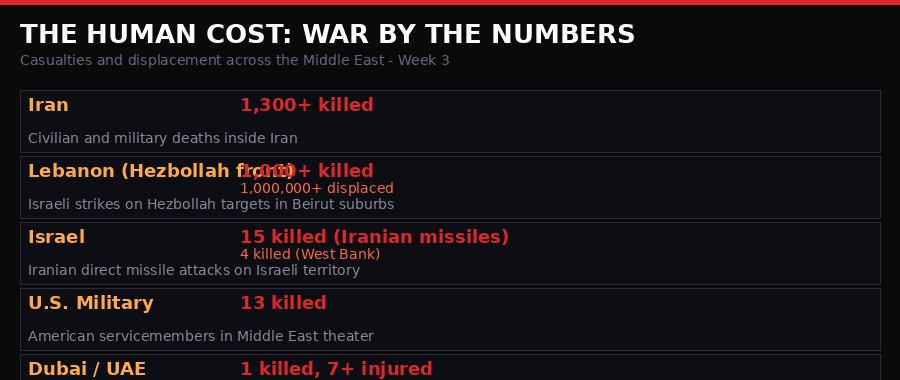
The Lebanon front is still open. Over 1 million people have been displaced by Israeli strikes on Hezbollah positions in the southern suburbs of Beirut, according to the Lebanese government. More than 1,000 people have been killed in Lebanon in the same period. Israel issued new evacuation warnings for seven neighborhoods overnight on March 21. The Hezbollah-Lebanon front is not a sideshow to the Iran war - it is the Iran war, distributed across another country's territory.
The Hormuz Strait remains partially strangled. Iran has maintained pressure on shipping through the waterway that carries roughly a fifth of the world's oil supply. That is why Brent crude is at $108. That is why stock markets are falling. That is why TSA officers in the United States are working without pay while the government pursues a $200 billion war supplemental.
The Patriot missile shortage is not just a military logistics problem. It is a ledger entry in a larger accounting: the cost of choosing to fight a regional war while maintaining two other active deterrence postures simultaneously. The bill comes due in hardware, in geography, in time. Europe's air defense gap is where those three dimensions converge.
U.S. and Israeli strikes begin against Iran. 803 Patriot interceptors fired on Day 1 alone.
943 total Patriot missiles fired across U.S. and Gulf state allies in first 96 hours. Iran begins striking UAE and Gulf neighbors. Dubai hotels, airport hit by debris.
Iran fires ballistic missiles at Turkey. Ramstein (Germany) begins transferring Patriot systems to Incirlik Air Base (Turkey). Third system positioned at NATO radar site in Malatya.
French soldier Arnaud Frion killed in drone attack on Kurdish military base, Erbil, Iraq. Six others wounded.
French naval officer tracks morning jog on Strava. Satellite imagery cross-referenced. Position of aircraft carrier Charles de Gaulle in Mediterranean made public by Le Monde.
General Grynkewich (U.S./NATO Europe Command) confirms air defense capabilities moved from Europe to Middle East. Zelenskyy warns of "inevitable" Patriot shortfall in Ukraine.
Israeli strikes hit Tehran during Nowruz. IRGC spokesman Gen. Naeini claims missile production continues - killed in airstrike same day. Iran threatens global "tourist sites." Indirect U.S.-Iran talks in Muscat.
Saudi Arabia intercepts 20 Iranian drones in two hours over eastern oil region. Israel strikes Hezbollah in Beirut suburbs again. U.S. announces 2,500 more Marines. Trump posts wind-down hint. Patriot shortfall confirmed to AP by multiple officials.
Three weeks into Operation Epic Fury, the war is neither won nor wound down. It is consuming resources faster than they can be replaced, on a geographic scale that extends from Beirut to Riyadh to Incirlik to Kyiv. The Patriot gap over Europe's eastern flank is not a footnote to the Iran war. It is the Iran war's most consequential secondary effect - the one with the longest tail and the fewest easy fixes.
Russia is watching. It always is.
Get BLACKWIRE reports first.
Breaking news, investigations, and analysis - straight to your phone.
Join @blackwirenews on Telegram- Associated Press: "Iran threatens tourism sites and US sends more Marines to Middle East as Trump hints at wind-down," March 20, 2026
- Associated Press: "US shifts Patriot missiles from Europe to Middle East amid Iran conflict," March 20, 2026
- Associated Press: "A look at who holds the reins of power in Iran," March 2026
- Associated Press: "What to know about Iran's Revolutionary Guard," March 2026
- Associated Press: "Sailor's jog app inadvertently leaks French aircraft carrier's location," March 21, 2026
- Associated Press: "Iran and US hold indirect talks in Oman over Tehran's nuclear program," March 2026
- Foreign Policy Research Institute: "Over 5,000 munitions shot in the first 96 hours of the Iran war," March 2026
- Burcu Ozcelik, Senior Research Fellow, Royal United Services Institute (RUSI), quoted via AP
- Ali Vaez, Iran Project Director, International Crisis Group, quoted via AP
- President Zelenskyy, BBC interview, March 2026
- Turkish Defense Ministry, official statement, March 2026
- French military spokesman Col. Guillaume Vernet, statement to AP, March 21, 2026