Ethereum Writes Its Own Constitution: The EF's 38-Page Manifesto vs. BlackRock's Yield Machine
The Ethereum Foundation dropped a 38-page philosophical manifesto on Friday - its most comprehensive statement of purpose since Vitalik Buterin's original whitepaper. It talks about freedom, self-sovereignty, and an "infinite garden." On the same day, BlackRock's staked Ethereum ETF hit $15 million in its first trading session. That's the tension in one picture: Ethereum as liberation infrastructure vs. Ethereum as Wall Street yield product.

Ethereum sits at a crossroads - a freedom protocol colliding with institutional finance's demand for yield products. (Unsplash)
March 13, 2026 - Key Numbers
The Document That Defines Ethereum
The Ethereum Foundation published its first formal mandate on March 13, 2026 - a 38-page document titled "EF Mandate" that attempts to do something the organization has never done in 11 years of operation: explain, in explicit philosophical terms, what Ethereum is actually for.
The answer, per the document, is individual freedom. "The Ethereum Foundation is the original steward of the Ethereum project," it opens. "The Foundation is not the parent, owner, or ruler of Ethereum. We are not 'the system' itself."
That disclaimer matters more than it sounds. For years, critics - including many inside the crypto community - have accused the EF of being exactly that: a de facto ruler, controlling funding, research direction, and protocol upgrades through concentrated influence even while maintaining a decentralization narrative. The new mandate reads partly as a self-correction, and partly as a boundary-setting exercise ahead of an era where institutional capital is moving in fast.
"Our work is not about capturing markets, corporates, or states, nor about helping them extract or capture. We are here to uncapture the individual, and to entrench their freedoms of association."
The language is deliberately expansive - almost manifesto-style. The EF describes Ethereum as part of an "infinite garden," a growing network of builders and communities working to keep digital infrastructure open and resilient. The document explicitly frames the blockchain as part of a broader ecosystem of "open technologies that support free and decentralized systems."
This is not the language of a financial product. It's the language of a movement. And publishing it on the same day as BlackRock's staked ETH ETF debut is either extraordinary timing or extraordinary irony - possibly both.
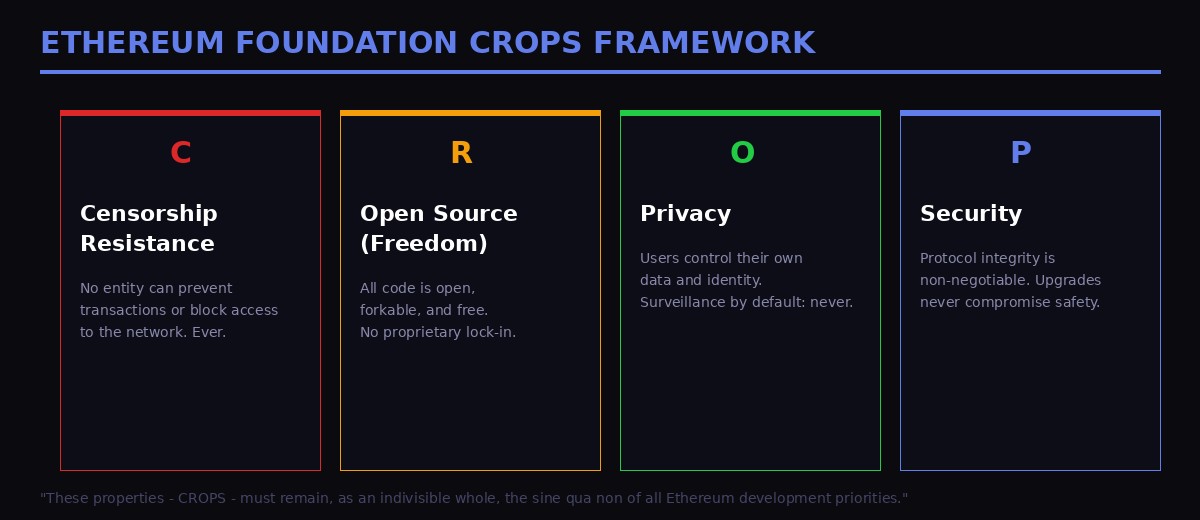
The CROPS framework - Censorship Resistance, Open Source (Freedom), Privacy, Security - forms the core of the EF's new mandate. (BLACKWIRE/Generated)
CROPS: The Four Properties That Cannot Be Traded Away
At the heart of the 38-page document is a four-part framework the EF is calling CROPS: Censorship Resistance, Open Source (freedom), Privacy, and Security. The foundation states these four properties must remain what it calls the "sine qua non" of all Ethereum development priorities.
The Latin phrase translates literally to "without which not" - meaning: if any of these properties is compromised, Ethereum ceases to be Ethereum. The EF is drawing a line in the sand on what the protocol can and cannot become, even as financial pressure from institutional products grows.
Censorship Resistance means no single entity - government, corporation, or majority validator - can prevent a transaction from being processed on the network. This is a direct response to growing concerns that Ethereum's validator set, increasingly dominated by large staking providers like Lido and Coinbase, could be pressured by regulators to block transactions to certain addresses.
Open Source and Freedom covers not just software openness but the freedom to fork, build upon, and modify the protocol without permission. BlackRock's ETF might stake ETH and charge fees, but under this principle, Ethereum's underlying code remains free for any competitor to replicate.
Privacy is the thorniest of the four. Ethereum is a public ledger - every transaction is visible on-chain. The EF's commitment to privacy here refers to the principle that surveillance should never be baked in by default, and that users should have the tools to obscure their on-chain activity when they choose. This sits in direct tension with the regulatory trajectory being pursued by OFAC and FinCEN, which increasingly demand that DeFi protocols implement KYC and transaction monitoring.
Security is the most straightforward: protocol upgrades cannot compromise the integrity of the chain. No shortcuts, no backdoors, no emergency admin keys. This is as much a statement about governance as about code.
"We hold that these properties - CROPS - must remain, as an indivisible whole, the sine qua non of all Ethereum's development priorities, which cannot be displaced."
The CROPS framework is notable for what it excludes. Nowhere does the document mention scalability as a core property. It does not list low fees, fast finality, or compatibility with traditional financial systems as fundamental. The EF is making a deliberate choice about what Ethereum must be before it can be anything else.
Critics will note that the CROPS framework is just words. The EF does not control the validators, the MEV-boost relays, or the major L2s that now process most Ethereum transactions. If Coinbase's cbETH validators start censoring OFAC-flagged transactions - which they already do to some degree - the CROPS framework doesn't stop it. The question is whether the manifesto creates community norms strong enough to resist that drift over time.
Why Now: The Leadership Crisis Behind the Manifesto
The EF doesn't release 38-page philosophical documents without a reason. The timing of this mandate is inseparable from a turbulent period in the foundation's recent history.
In February 2026, co-executive director Tomasz Stanczak resigned from the position he had only recently taken. The departure followed months of public friction over Ethereum's technical roadmap - specifically, a controversial pivot in direction that drew criticism from long-time contributors who accused the foundation of moving too slowly on privacy features while over-investing in L2 scaling infrastructure.
ETH price performance amplified those tensions. While Bitcoin traded around $70,000-$74,000 and outperformed every major asset class since the Iran war began two weeks ago, Ethereum struggled to maintain $2,000. The token was sitting 62% below its late-2025 all-time high at its worst, finding a floor around $1,680-$1,720 before the recent recovery. The narrative damage was severe: "ETH is dead" content was going viral in January.
The mandate is also a succession document. The EF explicitly states its long-term goal is to make itself unnecessary. "Our goal is to reduce the Foundation's relative influence over time," the document says. "Subtraction is rather a process of ensuring Ethereum's maturity: a trajectory of growth with decentralization, robust enough to outgrow and outlast us."
This is unusual language for an organization to use about itself. Most institutions do not voluntarily describe a future where they no longer matter. The EF is trying to signal that its current concentration of influence is temporary and its legitimacy comes from principles, not power.
Whether the broader community believes that is another question.
The BlackRock Paradox: $100M in Staked ETH on Day One
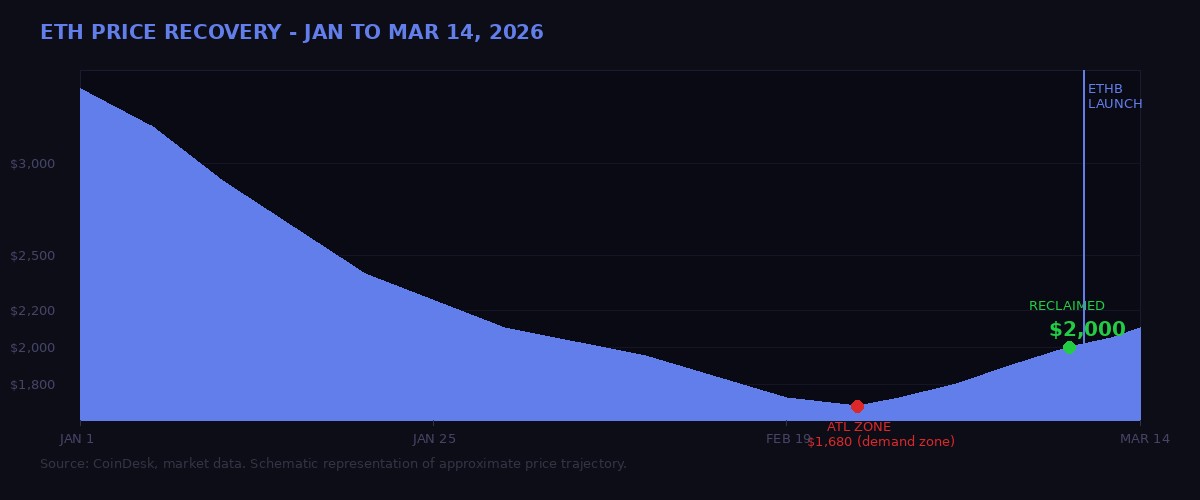
ETH's trajectory from its January 2026 floor near $1,680 to the $2,050 reclaim on March 13. The ETHB launch appears to have catalyzed the final leg of the recovery. (BLACKWIRE/Generated)
Here's the tension made tangible: on the same day the EF published its freedom manifesto, BlackRock's iShares Staked Ethereum Trust - ticker ETHB - racked up $15.5 million in first-day trading volume on Nasdaq, launching with over $100 million in initial assets.
ETHB is not just another spot ETF. It's a fundamentally different financial product. The fund stakes between 70% and 95% of its ETH holdings at any given time, distributing 82% of the staking rewards to investors through monthly payouts. The remaining 18% goes to the trust itself, custodians, and staking service providers.
That structure, charges a 0.25% sponsor fee (discounted to 0.12% on the first $2.5 billion in AUM), turns ETH into a yield-generating asset - something closer to a dividend-paying ETF than a pure crypto exposure play.
Bloomberg ETF analyst James Seyffart called the launch "a pretty good start for any ETF." Wenny Cai, COO at derivatives platform Synfutures, attributed part of ETH's $2,000 reclaim directly to the ETHB launch.
"Ethereum has just reclaimed the psychological $2,000 level after a punishing structural drawdown, finding a bid at the $1,700-$1,800 demand zone. The key mechanic right now is the reversal of a roughly $4 billion spot ETH outflow cycle, catalyzed in the last 48 hours by BlackRock's launch of the iShares Staked Ethereum Trust."
This is the paradox the EF now lives inside. Its manifesto declares Ethereum exists to "uncapture the individual." BlackRock's ETF exists to capture institutional capital and convert it into yield. Both depend on the same underlying network. Both are currently growing simultaneously.
The crucial question: does institutional adoption via products like ETHB undermine the CROPS properties the EF is trying to protect? Or does it provide the economic gravity that makes Ethereum's security model sustainable?
The bulls argue that more economic activity securing the network - even via BlackRock's ETF - strengthens Ethereum against attacks. The bears argue that when 82% of staking rewards flow through a single asset manager's product, the network's validator distribution becomes increasingly concentrated in the hands of one firm. If BlackRock's staking service providers ever faced regulatory pressure to censor transactions, ETHB's stake could represent a meaningful fraction of the network.
The EF's manifesto has no mechanism to prevent this. It can state principles. It cannot control who stakes.
Druckenmiller Drops His Verdict: Stablecoins Win, Most of Crypto Loses
The philosophical debate over Ethereum's future arrived on the same day that one of the most respected macro investors alive delivered his assessment of crypto's long-term prospects - and his view is both validating and ruthless depending on which part of the market you're in.
Stanley Druckenmiller, founder of Duquesne Family Office, spoke in a Morgan Stanley video interview published Thursday. The 72-year-old, who has been selectively bullish on Bitcoin since 2020, laid out his current thinking with characteristic bluntness.
On stablecoins: "I assume our whole payment systems will be stablecoins in 10 or 15 years. They are efficient, quicker and cheaper. Blockchain and the use of stablecoins are incredibly useful in terms of productivity."
On Bitcoin: He acknowledged BTC has successfully established itself as a store of value, even if he personally finds that outcome disappointing from a technology standpoint. "I'm actually disappointed it ended up becoming a store of value because it wasn't originally needed for that. But it's become a brand, and people love it. So it's probably going to be a store of value."
On everything else in crypto: "I said this a long time ago, and I'm going to say it again: it's a solution looking for a problem."
Druckenmiller's Crypto Taxonomy - March 2026
Where does Ethereum fit in Druckenmiller's framework? The EF's mandate positions ETH as critical infrastructure for a free and open financial system - precisely the kind of thing Druckenmiller thinks stablecoins will dominate. Ethereum's smart contract layer is what makes decentralized stablecoins possible. But Druckenmiller's stablecoin vision sounds more like Circle's USDC or Tether's USDT - centralized, regulated, USD-pegged - than the decentralized DAI-style vision that first emerged from Ethereum's ecosystem.
His dollar reserve status commentary is separately important. "We're doing everything we can to destroy it," he said of the US dollar's global position. "But I'm 72, it'll probably outlive me. I doubt it'll be the reserve currency in 50 years, but I don't have a clue what would be. Maybe some crypto thing I hate."
That last line - "maybe some crypto thing I hate" - is one of the most interesting things said about the space in 2026. Druckenmiller is openly acknowledging that his personal preferences about Bitcoin vs. altcoins vs. stablecoins may be irrelevant to the actual outcome. The reserve currency question is being resolved by forces outside any one investor's analysis.
The Stablecoin Layer Druckenmiller Is Betting On
Druckenmiller's stablecoin bullishness arrived on a day that provided specific evidence for why he might be right. USDC, issued by Circle, recorded approximately $2.2 trillion in adjusted transaction volume in 2026 so far - compared to $1.3 trillion for Tether's USDT.
That gives USDC roughly 64% share of adjusted volumes - a dramatic reversal from 2019 through 2025, when Tether consistently dominated and USDC averaged around a 30% share. It's the first time USDC has outpaced USDT in transaction volume since 2019. Japanese investment bank Mizuho lifted its Circle price target to $120 from $100 in response, though it maintained a neutral rating.
The Mizuho analysts pointed to "USDC activity trends and use cases like Polymarket or agentic commerce expectations" as drivers. Agentic commerce - AI agents transacting autonomously - is an emerging use case that Circle has been actively courting, and the numbers suggest it's generating real volume.
Meanwhile, the broader market for tokenized US Treasuries hit a fresh record above $11 billion. Circle's USYC token, which it acquired when it bought Hashnote in early 2025, has grown to $2.2 billion in supply - overtaking BlackRock's BUIDL fund, which peaked at a 46% market share in May 2025 and has since fallen to around 18%.
Much of USYC's growth is tied to Binance's BNB Chain integration. Binance introduced USYC as off-exchange collateral for institutional derivatives trading in July 2025, allowing institutional clients to hold USYC with partner banks via Binance Banking Triparty or Ceffu custody. Since then, USYC supply on BNB Chain alone has swelled to $1.84 billion.
"Tokenized treasuries and repo as collateral is a major emerging use case and we are proud of how quickly this has grown."
Standard Chartered projects the stablecoin market cap reaches $2 trillion by end of 2028. Currently at $221 billion combined (Tether at $143B, USDC at $78B), that implies roughly 9x growth over 30 months. If Druckenmiller's 10-15 year payment system timeline is accurate, that $2 trillion is just the beginning of the ramp.
Ethereum's role in this stablecoin world is ambiguous. Most USDC and USDT still live on Ethereum and Tron, but the Binance BNB Chain tokenized Treasury story shows that the stablecoin infrastructure layer is platform-agnostic. Tether runs on 15 different blockchains. USDC operates on over a dozen. The race isn't to be the stablecoin chain - it's to be the settlement layer that serious institutional users trust. Ethereum has the longest track record, but it doesn't have the exclusive claim.
Bitcoin's Friday Whipsaw: $74K to $71K in Hours
While Ethereum was publishing its philosophy and BlackRock was extracting yield from ETH staking, Bitcoin had a characteristically violent Friday.
BTC rallied through the session, touching $74,000 - a near one-month high - as risk sentiment improved on geopolitical optimism. The drivers included signs of progress on Russia sanction relief discussions and a temporary cooling of Iran-related headlines. Bitcoin had been outperforming stocks and traditional risk assets since the Iran conflict began two weeks ago, a trend that continued through morning trading.
Then the headlines hit. The US Central Command confirmed that all six crew members aboard a refueling aircraft that crashed in Iraq on Thursday had died. Separately, the Wall Street Journal reported that the Pentagon was deploying a Marine expeditionary unit - approximately 2,500 troops - to the Middle East, including forces attached to the USS Tripoli, as Iran escalated activity around the Strait of Hormuz.
Bitcoin reversed sharply. From $74,000, it dropped to $71,200 in minutes. The S&P 500 and Nasdaq flipped from early gains to losses of 0.4-0.5%. Gold extended its pullback by another 1%. Oil, predictably, surged - climbing more than $5 per barrel from its lows to settle near $97.30.
"Optimism over geopolitical events, including Russian sanction relief, has been a driver. These headlines tend to have a short half-life, so we would expect this to be short-lived till we see concrete follow-up action."
Crypto-linked equities largely held their gains despite BTC's reversal. Bitcoin miner Marathon Digital (MARA) led with a 10% jump. Galaxy Digital, Bitmine, and Cipher Mining all climbed 5-7%. The miners are betting that rising energy prices, while painful for their cost structure, are ultimately bullish for BTC price via the macro inflation pressure they create.
The broader CoinDesk 20 index closed up 3.7% on the day, with all 20 constituents positive. Sui gained 6.7% and Cardano climbed 5.8% to lead the index higher. Ethereum held its $2,000 reclaim despite the Bitcoin reversal, suggesting genuine demand at the new support level rather than just momentum trading.
Custodia Loses Its Last Shot: The Fed's Two-Speed System
The day also closed a chapter in one of crypto's most consequential regulatory battles. The US Court of Appeals for the 10th Circuit declined, 7-3, to rehear Custodia Bank's challenge to the Federal Reserve's authority to deny master account applications to crypto firms.
Custodia, a Wyoming-chartered crypto bank led by CEO Caitlin Long, has been fighting the Fed for years over the rejection of its master account application - access that would let the bank connect directly to the Fed's payment rails without going through a third-party correspondent bank. The rejection was upheld by the circuit court in March 2024. Custodia appealed, requesting a rehearing by the full panel. The 10th Circuit said no.
The 7-3 split is notable. One dissenting judge, Timothy Tymkovich, filed a strong dissent: "Holding that the Reserve Banks have unreviewable discretion over master accounts places us on the wrong side of the statutes and, likely, that of the Constitution as well. The case's consequences for the financial industry and its impact on the state-federal balance in banking regulation make it exceptionally important."
That language - "unreviewable discretion" and potential constitutional problems - signals that the legal fight may be far from over, even if Custodia's specific case is closed.
The ruling arrives just days after Kraken became the first crypto firm to secure a limited Fed master account - through the Federal Reserve Bank of Kansas City. Kraken's account is not a full master account but carries many of the same features. The Kansas City Fed appears to be moving faster than the national-level board, which is still in early stages of developing a framework for so-called "skinny" master accounts open to crypto firms.
The Two-Speed Fed: Kraken wins limited Fed access via Kansas City. Custodia loses its court battle on the same week. The result is a patchwork system where access to banking's core infrastructure depends on which regional Fed you approach and whether you're willing to accept a limited account structure. Crypto banking is being integrated into the US financial system - but unevenly, and on the Fed's terms, not the industry's.
Custodia said via a spokesperson it is still pursuing master account access through other channels. The bank has not abandoned its mission - it just can't fight it through the courts anymore. That shifts the pressure to Congress and the regulatory process, where a nationwide framework for crypto bank master accounts may eventually emerge.
For context: a crypto bank with a Fed master account would be transformational. It could hold customer funds at the Fed directly, eliminating the correspondent bank risk that took down several crypto-friendly banks in 2023. It would reduce settlement costs and processing times. It would make the bank essentially as reliable as the Fed itself from a counterparty perspective. Kraken's banking arm now has a version of this. Custodia does not.
What the EF Manifesto Actually Changes
Let's be direct about what the Ethereum Foundation's 38-page mandate does and doesn't do.
It does not give the EF more power. The document explicitly says the EF is not "the parent, owner, or ruler of Ethereum." It controls a treasury, it funds research, and it employs core developers - but it cannot enforce CROPS compliance on validators, L2s, or the applications built on top of the chain.
It does not stop BlackRock from running ETHB. Wall Street's relationship with Ethereum is a function of market demand, ETF regulation, and the profit motive. A philosophical document changes none of those variables.
What it does do: it creates a canonical reference document for the Ethereum community to cite when arguing about what the network should and shouldn't become. CROPS is now an official framework. Developers who want to push back against OFAC-censoring validators, or resist moves toward protocol-level KYC, now have a 38-page document from the EF saying those things violate the foundational properties of Ethereum.
That's not nothing. Community norms are what stopped the DAO hard fork from being the last time Ethereum changed its rules under pressure. The manifesto is trying to establish the same kind of normative gravity - a shared understanding that certain things are simply not what Ethereum does, regardless of who wants to do them.
The self-subtraction language is also worth taking seriously. The EF saying "our goal is to reduce our own influence" is a credible commitment problem - they can say it, but can they execute it? The document outlines a vision where the EF focuses only on work "that no other ecosystem participant is likely to undertake," stepping back once the broader ecosystem can handle those functions independently.
That's a more specific and testable commitment than vague decentralization rhetoric. If the EF starts systematically moving research functions to independent teams over the next 24 months, the document will look prophetic. If the EF retains centralized control over key upgrade decisions, the document will look like public relations.
The Ethereum community will be watching which version materializes.
The Stakes: What Ethereum Must Be Before It Can Be Anything Else
Zooming out, March 13, 2026 presented a compressed version of the central argument about Ethereum's future. The EF says Ethereum must be uncensorable, free, private, and secure before it can be anything else - a payment rail, a yield platform, a tokenization layer, a world computer. Without CROPS as foundation, every other application is built on sand.
The counterargument - implicit in every institutional product from ETHB to the $11 billion tokenized Treasury market - is that the market will define what Ethereum is. Investors want yield. Institutions want regulated exposure. Traders want liquidity. If satisfying those demands requires making pragmatic compromises on decentralization at the edges, that's simply the cost of adoption.
Druckenmiller's framework suggests a third path: the stablecoin layer wins the payment infrastructure race regardless of which underlying chain it runs on, Bitcoin wins the store of value race, and everything in between - including ETH - has to fight for its specific use case against both those gravity wells.
ETH's answer, per the mandate, is that it's the only platform with a credible claim to all three properties simultaneously: settlement layer for stablecoins, programmable yield for institutional capital, and freedom infrastructure for the applications that can't run on permissioned systems. The CROPS framework is the EF's argument that Ethereum can serve institutional capital without becoming captured by it.
Whether that balance holds depends on validators, L2 sequencers, and the collective choices of thousands of developers over the next decade. The EF can write the document. It cannot write the future.
What it can do - and what Friday's publication suggests it is trying to do - is make sure that when Ethereum faces the inevitable pressure to compromise its core properties for institutional convenience, there is a clear, well-argued record of what was at stake. CROPS. The infinite garden. The World Computer that belongs to no one.
BlackRock gets to stake 82% of ETHB's holdings and keep 18% of the yield. The Ethereum Foundation is publishing manifestos.
Both are happening on the same network. That's either the most compelling thing about Ethereum in 2026, or the most worrying.
Get BLACKWIRE reports first.
Breaking news, investigations, and analysis - straight to your phone.
Join @blackwirenews on Telegram