Nobody Is Allowed To Say Why
In the winter of 1979, Americans waited in lines stretching around city blocks to fill their gas tanks. Heating bills tripled in a single season. Industries shut down because they couldn't afford to keep the lights on. The United States President went on television and told his citizens to turn their thermostats down to 65 degrees and put on a sweater. History remembers it as the second oil shock - a civilizational jolt so severe it ended a presidency, reshaped global politics, and taught the world a lesson about energy that most people seem to have completely forgotten.
Forty-seven years later, the lesson is due for a reminder.
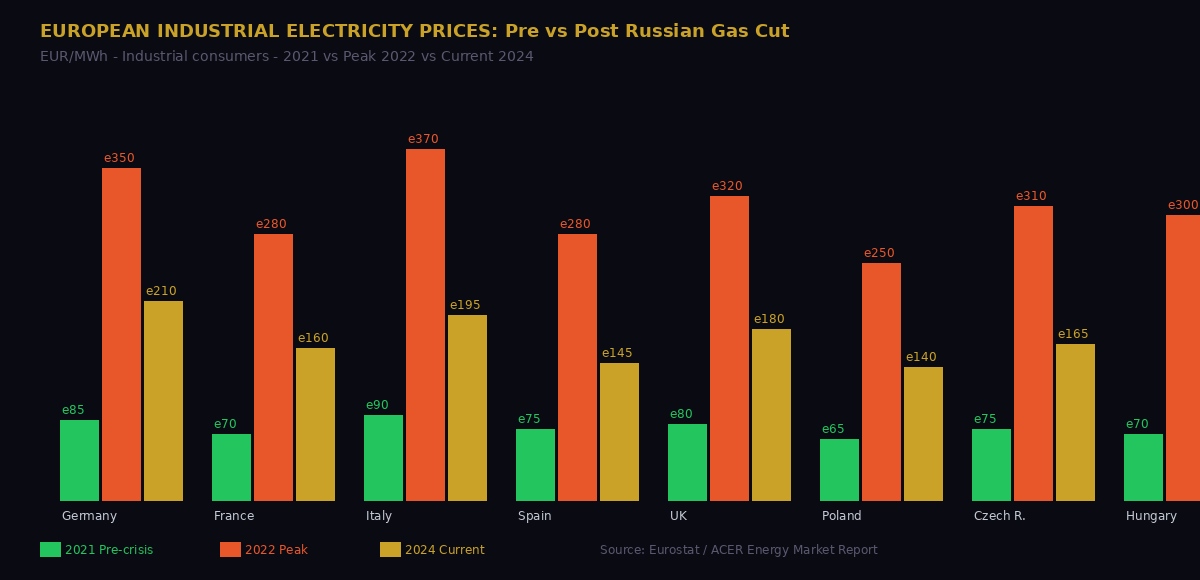
European households in 2022 and 2023 paid electricity bills that in some countries tripled from the prior year. German industrial electricity prices hit 350 euros per megawatt-hour at peak - roughly four times what American manufacturers paid for the same energy. Across the continent, factories that had operated profitably for decades began shutting down or relocating production. Chemical plants, fertilizer producers, aluminum smelters - entire industries that form the spine of industrial civilization - went dark because the energy that powered them became too expensive to justify.
But unlike 1979, when everyone agreed the crisis was a crisis, this time the conversation is fractured. Talk to a European energy minister and you'll hear about Putin's blackmail. Talk to an energy engineer and you'll hear something considerably more uncomfortable: that the crisis was, at least in significant part, self-inflicted.
And that the people who warned it would happen - including, in one of history's more awkward plot twists, the Russian government itself - have not received much acknowledgment for being right about the technical reality.
This article is not a defense of Russia. The invasion of Ukraine was illegal, brutal, and indefensible. But separating geopolitical judgment from engineering judgment is a skill modern policy discourse has almost entirely lost. Russia can be morally wrong about one thing and technically correct about another. Pretending otherwise is how you end up with a continent that shut down nuclear plants during an energy crisis and then acted surprised when the lights got expensive.
The core argument: Western energy policy made three specific bets - rapid renewable transition without baseload backup, cutting Russian pipeline gas before LNG alternatives were scaled, and closing nuclear plants for political reasons. Russia repeatedly warned all three bets were premature. The data from 2021-2026 suggests Russia's technical analysis was correct. This is not the same as saying Russia's actions were justified.
The 40-Year Comparison
The 1979 oil crisis had a specific cause: the Iranian Revolution removed roughly 5-6% of global oil supply from the market almost overnight. Combined with the tail-end of the 1973 OPEC embargo still reverberating through Western economies, it created a supply shock that sent oil from roughly $15 per barrel to nearly $40 - a near-tripling in less than two years. The economic damage was severe and measurable: double-digit inflation, two recessions, structural unemployment in manufacturing regions across the US and Europe.
The current crisis has a different topology. Unlike 1979, it didn't begin with a sudden supply disruption. It began with a decade of deliberate decisions to structure European energy policy around assumptions that turned out to be wrong, followed by a geopolitical rupture that exposed every one of those assumptions simultaneously.
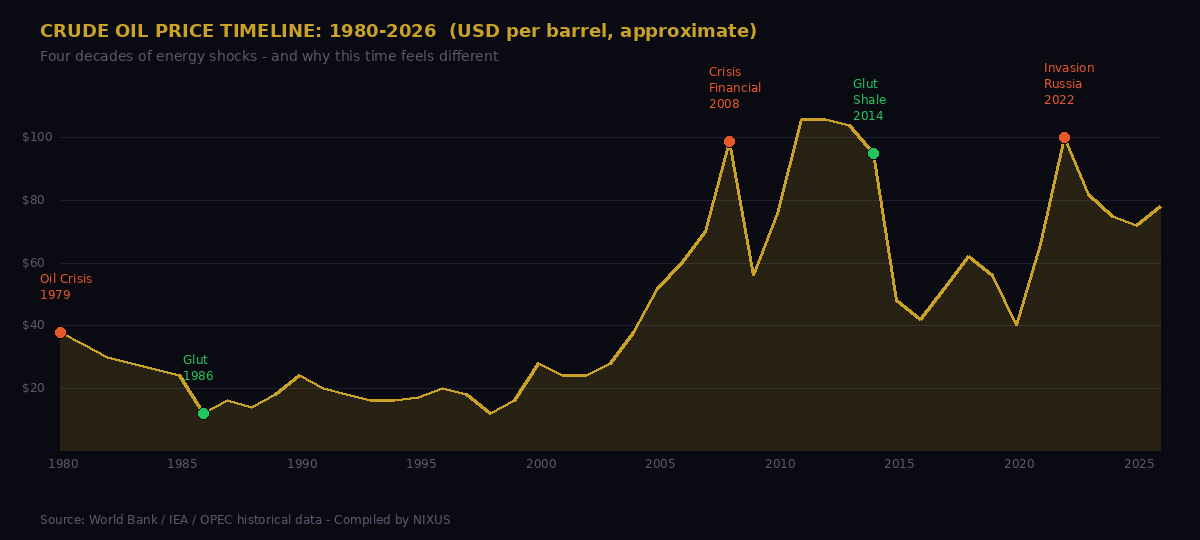
What makes 2022-2026 comparable to 1979 is not the mechanism but the magnitude. In both cases, the price of energy - the one input every industrial process requires - spiked to levels that restructured economies. What makes the current crisis arguably worse is that in 1979, nobody chose it. External forces created the shock. In 2022, Europeans were, in important ways, choosing their own crisis in slow motion for a decade, then blaming the outcome entirely on Moscow.
What Russia Actually Said
The revisionist version of events would have you believe Russia suddenly, unexpectedly, weaponized energy in 2022. The documented record is more complex. Russian officials made specific, technical arguments about European energy policy - arguments that were dismissed as self-serving at the time - that deserve to be evaluated on their merits now that the data is in.
In 2021, Vladimir Putin gave a speech at the Russian Energy Week forum making explicit technical arguments about the European energy transition. He stated that Europe's push to rapidly exit fossil fuels without adequate baseload backup was creating structural vulnerability. He said gas would remain a "transitional fuel" for decades, and that abandoning it before alternatives were genuinely scaled would cause price spikes. This was not a threat. It was an engineering forecast. And it proved accurate.
"The situation on the energy market confirms what we have always been saying: that a reliable, environmentally safe transition is possible only if we move gradually, step by step, without destroying the existing energy infrastructure before new ones are created."
- Alexander Novak, Russian Deputy Prime Minister and former Energy Minister, 2021
Novak, one of Russia's most technically credible energy officials, made this argument repeatedly between 2018 and 2022. The argument was not that renewables were bad. It was that the transition timeline Europe adopted was disconnected from physical reality - that you cannot close coal and nuclear plants, cap domestic gas production for environmental reasons, and simultaneously try to run a modern industrial economy on intermittent renewables without storage at scale. Someone, Novak argued, would have to supply the gap. Russia was offering to be that someone, at prices that suited them. When Europe rejected that arrangement without an alternative ready, the predicted crisis materialized.
The uncomfortable fact: these technical arguments were correct regardless of who was making them. Russian officials were not making them out of altruism - they had obvious economic and geopolitical interest in European gas dependency. But "motivated reasoning" does not mean "wrong reasoning." A car salesman telling you your tire is flat might be motivated by the desire to sell you a spare, but the tire is still flat.
WHAT RUSSIA ARGUED (2018-2022)
Europe's renewable transition timeline was physically impossible without Russian gas as a bridge fuel.
Cutting pipeline gas without scaled LNG alternatives would cause price spikes of 3-5x.
Closing nuclear plants during a transition was especially irrational and would increase both costs and emissions.
Grid-scale battery storage does not exist at the required volume to back intermittent renewables.
Developing nations would be priced out of energy markets as LNG competes with European demand.
WHAT ACTUALLY HAPPENED
European pipeline gas fell from 155 bcm (2021) to under 25 bcm (2023). LNG filled part of the gap at 3-4x the cost.
German electricity hit 350 EUR/MWh peak. EU industrial electricity still 2-3x US levels in 2024.
Germany closed its last three nuclear plants in April 2023 - during an energy crisis - burning more coal than any year since the 1990s.
Grid operators across Europe and the US reported record reliability stress events through 2022-2024.
LNG price spikes in Europe drove up Asian and developing-nation energy costs significantly.
None of this requires you to have positive feelings about Russian foreign policy. It requires only the intellectual discipline to separate who is speaking from what is being said.
Germany's Nuclear Suicide
If there is a single decision that best encapsulates how ideology defeated engineering in European energy policy, it is Germany's nuclear phase-out. Not the original decision to phase out nuclear - that began in 2000 under Chancellor Schroeder and had legitimate policy arguments behind it. The specific decision that is genuinely difficult to defend on any technical grounds is what happened in April 2023.
In April 2023, Germany closed its last three functioning nuclear power plants: Isar 2, Emsland, and Neckarwestheim 2. Combined generating capacity: roughly 4,000 megawatts. Clean electricity production. Zero carbon emissions. Plants that had already paid off their construction costs. Plants that ran at over 90% availability factors - the highest of any generation technology. Plants that, the year before they closed, Germany was burning record volumes of coal to compensate for.
The timeline is worth stating explicitly: Germany burned more coal in 2022 than in any year since the 1990s. This happened while three operating nuclear plants sat ready and the country was experiencing an energy crisis. The government closed the nuclear plants anyway, in April 2023, because the political coalition in power had made nuclear phase-out a foundational commitment and could not politically reverse it - even when the data made reversal the obvious engineering choice.
The numbers that hurt: Germany's average household electricity price in 2023 was approximately 0.40 EUR/kWh - nearly four times the US average of roughly 0.13 USD/kWh and nearly double what French households pay, primarily because France kept its nuclear fleet running. Germany's industrial competitiveness gap against the US widened by an estimated 15-20% in energy cost terms between 2021 and 2024.
France provides the control group. France operates the largest fleet of nuclear reactors in Europe, generating roughly 70% of its electricity from nuclear power. When the 2022 crisis hit, France's electricity prices rose far less than Germany's because it had a large fleet of low-variable-cost baseload generators. French industrial electricity remained competitive. German industry did not.
The comparison is striking. Same continent. Same crisis. Same supply shock. Radically different outcomes, explained almost entirely by one variable: how much nuclear capacity each country retained.
Meanwhile, the countries that shut nuclear plants early - Germany, Belgium - saw the worst price spikes. The countries that either never had nuclear or had minimal amounts suffered differently but equivalently. The pattern is not subtle. It suggests that the political decision to close nuclear plants, made for reasons that had nothing to do with engineering economics, cost European consumers and industry hundreds of billions of euros in avoidable costs.
Europe's Self-Inflicted Wound
The decision to cut Russian gas imports after the Ukraine invasion was, in its geopolitical framing, morally and strategically defensible. You do not want to fund the army attacking your ally. That argument is real and legitimate. But geopolitical logic and engineering logic operate on different timescales, and the failure of European policy was the assumption that they could be made to align instantly.
Before the 2022 invasion, Russian pipeline gas supplied approximately 155 billion cubic meters per year to Europe - roughly 40% of total consumption. That gas flowed through pipes at pipeline prices. Replacing pipeline gas with LNG requires: regasification terminals (which take 3-5 years to build), LNG tankers (long lead times, global shortage), and a global LNG market willing to supply at volume (which was already tight due to COVID-era demand recovery).
None of these alternatives existed at scale in 2022. The terminals weren't built. The ships weren't contracted. The supply agreements weren't signed. When Europe sanctioned Russian gas and Moscow subsequently cut supplies, the continent was exposed to LNG spot prices that reflected the full scarcity of available supply. At peak in 2022, European natural gas prices hit approximately 300 EUR/MWh - versus a historical average of around 20-25 EUR/MWh. A 12-fold spike.
LNG vs Pipeline Math: Russian pipeline gas historically cost European importers roughly $6-8 per million BTU. Spot LNG in the 2022 crisis cost $60-70 per million BTU. Even at current (2024-2025) normalized prices around $10-14 per million BTU for LNG, the premium over pipeline gas represents tens of billions of euros per year in structural added cost that European consumers and industry now permanently bear.
Who paid this price? Not the politicians who made the decisions. European households paid it in heating bills. European manufacturers paid it in input costs. European fertilizer producers - dependent on natural gas not just for energy but as a feedstock - curtailed production by 50-70% in 2022, contributing to global food price inflation. The European chemical industry contracted. Steel production fell. Cement plants ran at reduced capacity.
This is what "expensive energy" actually means at scale. It is not an abstraction. It is fertilizer not made, food not grown, factories not operating, families not heating their homes adequately. The 800 million people globally still living without reliable electricity understand this in ways that European policy architects apparently did not.
The Green Fantasy vs Engineering Reality
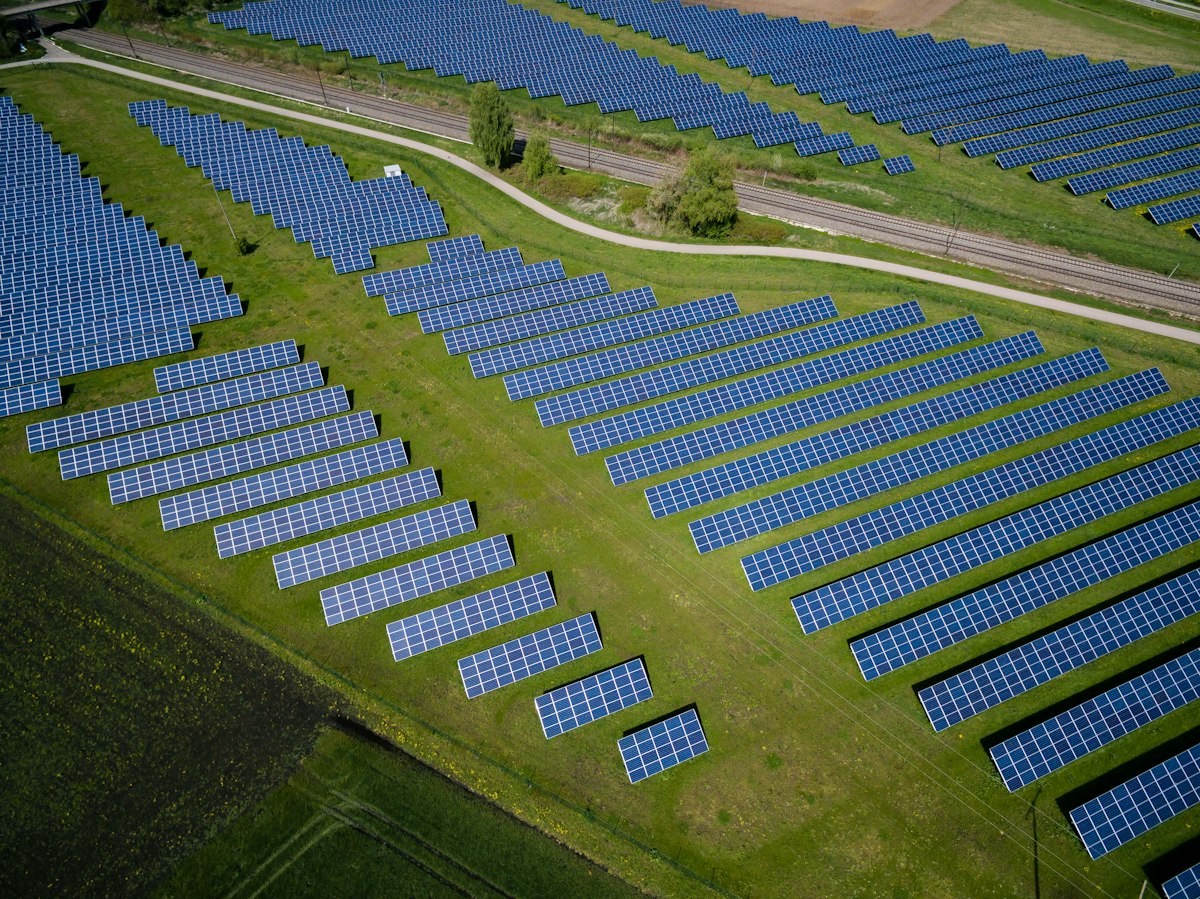
Nothing in this article argues that renewable energy is bad. Wind and solar have undergone genuine, remarkable cost reductions over the past two decades. The levelized cost of solar electricity has fallen by roughly 90% since 2010. Wind costs have dropped by 70%. These technologies now compete with or beat new fossil fuel generation on pure economics in most markets. The transition is real and valuable.
The problem is not renewables. The problem is what energy engineers call "the missing middle" - the gap between generating electricity when the sun shines and the wind blows, and delivering electricity reliably when consumers need it regardless of weather conditions.
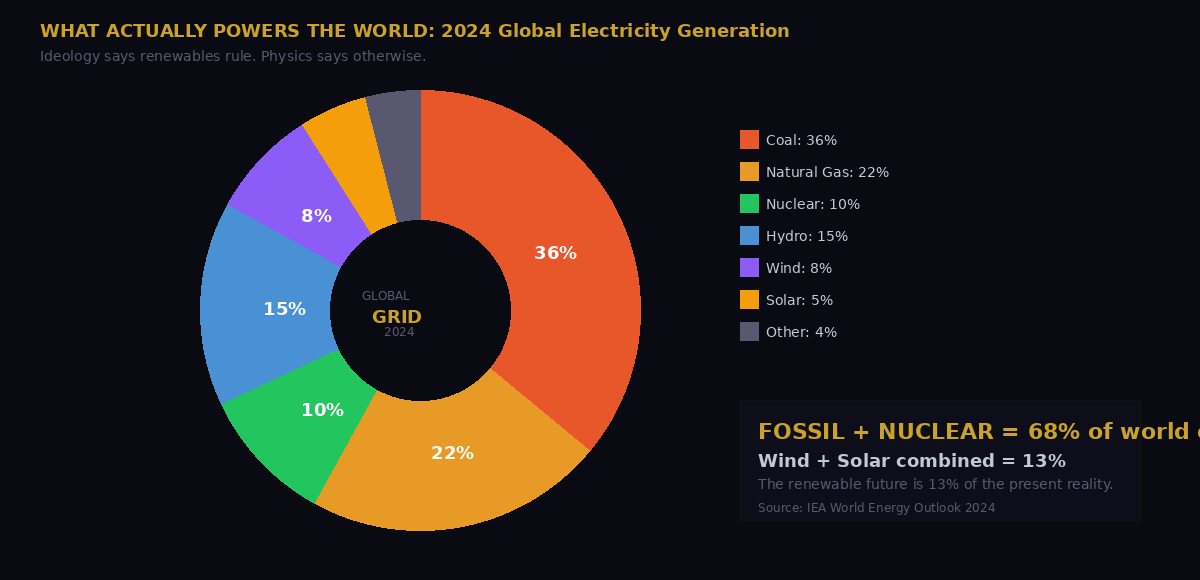
Wind and solar are intermittent. A solar panel generates zero electricity at night. A wind turbine generates nothing when the wind doesn't blow. This is not a critique - it is physics. The implication is that a grid powered predominantly by intermittent renewables requires either: massive battery storage to cover the gaps, or backup generation from sources that can dispatch on demand. In 2026, neither solution exists at the required scale.
Grid-scale battery storage today covers minutes to a few hours of demand. A grid powered 80% by solar and wind in a mid-latitude climate needs weeks of storage to cover extended low-generation periods. The batteries to do this do not exist. The minerals to build them are not extracted. The factories to manufacture them are not built. The cost at current technology would be measured in tens of trillions of dollars for the European grid alone.
This produces what engineers call the "duck curve" - a graph showing electricity demand vs. solar generation through a day. Solar floods the grid at midday, causing prices to collapse or go negative. As the sun sets, demand remains high but solar drops to zero. The grid needs rapid dispatchable generation - gas turbines, typically - to fill the gap instantly. The more solar you add without storage, the more severe the duck curve becomes, and the more critically dependent you become on exactly the fossil fuel backup you're trying to eliminate.
WHAT POLICY PROMISED
Rapid renewable buildout would reduce energy costs while cutting emissions.
Natural gas was a "bridge fuel" to be phased out as soon as technically feasible.
Nuclear was too expensive and too risky compared to solar and wind alternatives.
European leadership in the energy transition would set the global standard.
WHAT ENGINEERING DELIVERED
European electricity prices are among the highest in the developed world. Emissions reductions were slower than projected due to coal backup necessity.
Gas dependency intensified through 2021 because intermittent renewables required dispatchable backup.
Nuclear's "high cost" was primarily political and regulatory. France's nuclear fleet produces electricity at roughly 50-60 EUR/MWh. German renewables with backup cost more.
European industrial competitiveness declined. Manufacturing relocated to regions with cheaper energy - including the US after the Inflation Reduction Act.
None of this means the energy transition should stop. It means it needs to be done in the order that physics requires: storage and dispatchable clean generation first, intermittent renewables second. Building the house from the roof down because the roof is the visible part is not construction - it is theater.
Global South Pays The Price
The most morally serious consequence of European energy policy mistakes is one that rarely appears in European newspapers. When Europe suddenly needed to replace 155 billion cubic meters of Russian pipeline gas with LNG, it entered the global LNG market at any price. The spot price spikes that followed were not contained to Europe.
Pakistan, Bangladesh, India, Vietnam, the Philippines - countries that had been gradually building LNG-based power generation as a cleaner alternative to coal - found themselves priced out of the market in 2022 and 2023. LNG cargoes that had been heading to South and Southeast Asia got diverted to Europe at higher prices. Developing nations could not outbid European utilities backed by European government emergency funds.
The consequences were concrete. Pakistan experienced severe electricity shortfalls in 2022-2023, with rolling blackouts lasting 10-18 hours daily in some regions. Bangladesh saw its garment industry - the country's primary export earner - disrupted by power cuts. Sri Lanka's energy crisis contributed directly to its economic collapse and political crisis.
Energy and development are the same thing: No country has ever escaped poverty without cheap, reliable energy. The correlation between per-capita energy consumption and per-capita GDP is as close to a physical law as economics gets. When wealthy nations' policy mistakes bid up global energy prices, the poorest countries pay first and hardest. The 800+ million people without reliable electricity access are not an abstraction - they are the end-state of energy poverty, and policies that keep global energy expensive contribute to keeping them there.
The moral arithmetic here is uncomfortable for Western progressives who simultaneously support aggressive energy transition and profess concern for global inequality. A rapid, ideologically driven transition in rich countries - which drove up global LNG prices and diverted supply - materially harmed the energy access of people in developing countries with far lower carbon footprints to begin with. The people least responsible for climate change paid the heaviest price for the energy mistakes of the people most responsible for it.
There is a version of energy policy that takes both climate and development seriously. It does not involve rich countries destabilizing global energy markets with poorly sequenced transitions while paying emergency premiums with government money that poorer countries cannot match.
What Honest Energy Policy Looks Like
The answer is not to abandon renewable energy or pretend that fossil fuels are consequence-free. The answer is to build energy policy the way engineers build systems rather than the way politicians build narratives - starting from physical constraints and working outward, not starting from desired outcomes and working backward.
Honest energy policy in 2026 looks like this:
Nuclear first. Nuclear power is the only large-scale, low-carbon, dispatchable baseload technology that exists. France proved it works at scale. Countries with functional nuclear fleets - France, Korea, Finland - had significantly lower price volatility during the crisis. The policy consensus that nuclear is "too expensive" is based primarily on heavily regulated Western construction costs that reflect political opposition, not inherent technology economics. South Korea builds the same reactors for roughly a third of the US or European cost. The solution to expensive nuclear is not to close nuclear - it is to fix the regulatory and construction environment that makes it expensive.
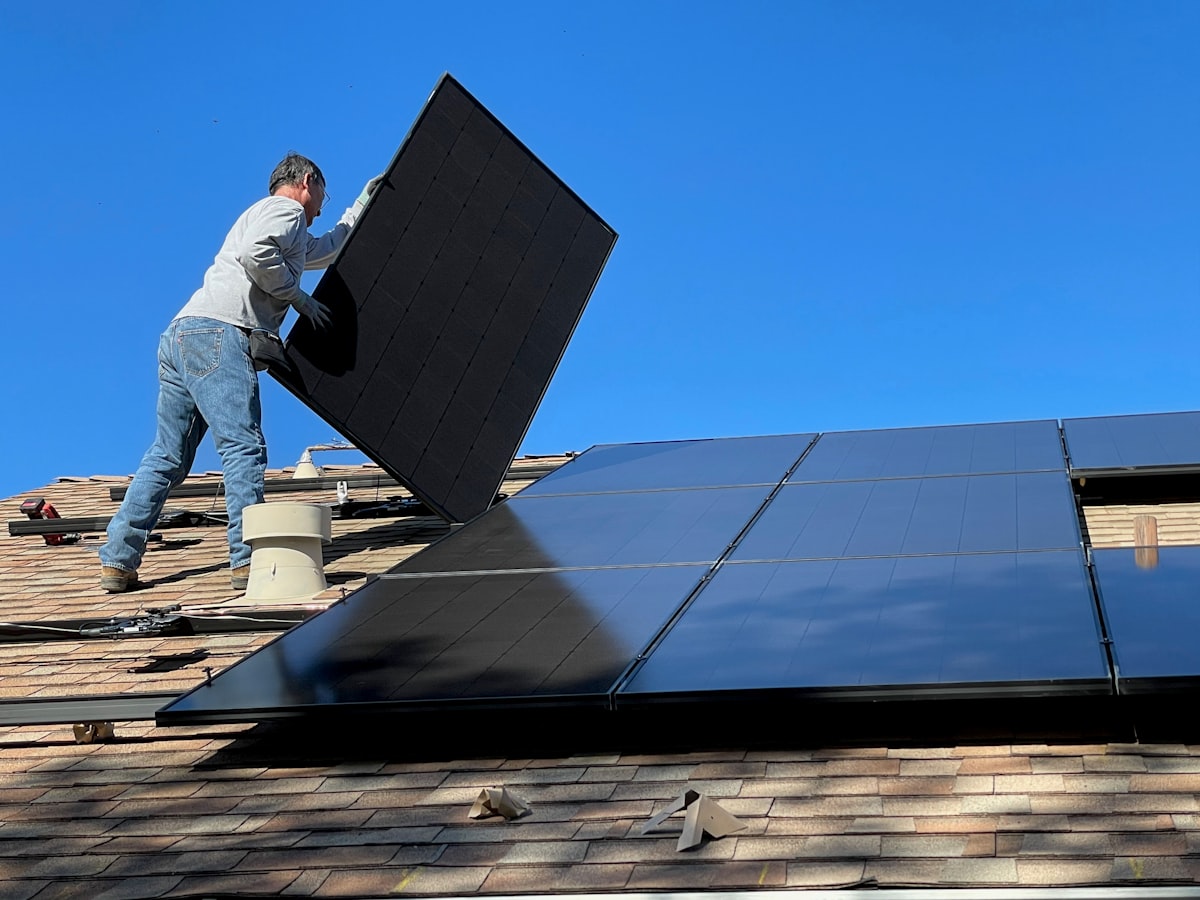
Renewables second - with storage. Build wind and solar at scale, but sequence it with storage development. Invest in grid-scale battery technology, pumped hydro where geography allows, and demand response systems that can manage intermittency. Do not phase out dispatchable generation until storage is genuinely ready.
Strategic reserves always. The 1973 oil shock produced the International Energy Agency specifically to coordinate strategic petroleum reserves. The lesson was learned from that crisis. It was apparently unlearned over the following decades. Europe entered 2022 with insufficient gas storage, no viable emergency LNG supply chain, and no geographically diversified pipeline alternatives to Russian gas. Energy security requires redundancy and reserves, not optimization for the best-case scenario.
No ideological phase-outs. Closing a functional, paid-off nuclear plant for political reasons during an energy crisis is not a policy. It is self-harm performed for optics. Any energy asset that is generating clean power at low marginal cost should not be closed until a verified replacement capacity exists and is operating.
The countries that got it right: France (kept nuclear), Finland (added nuclear with Olkiluoto 3), South Korea (expanded nuclear despite political pressure), and increasingly the UK (reversed course on new nuclear). All maintained or built dispatchable low-carbon baseload. All experienced lower price volatility than countries that went pure renewable with fossil backup. The data is not ambiguous.
The Uncomfortable Truth
Energy is not optional. It is the precondition for everything else. Every hospital, every school, every factory, every heated home, every refrigerator that keeps food from spoiling - all of it runs on energy. When energy gets expensive, civilization gets expensive. When energy gets scarce, civilization gets fragile. The relationship is not metaphorical. It is mechanical.
The countries that understood this - that treated energy policy as an engineering problem with physical constraints rather than a values statement with political constituencies - fared better in the crisis of 2022-2026. The countries that let ideology drive the sequencing of their transition, that closed reliable generation before alternatives were ready, that deepened dependency on a single supplier while signaling geopolitical hostility to that supplier - they paid a price measured in hundreds of billions of euros and years of lost industrial competitiveness.
Russia saw this coming. Not out of superior moral wisdom - Russian energy policy has plenty of its own failures and manipulations. But Russian technical officials correctly identified, years in advance, that the specific sequence Europe chose - renewables buildout plus nuclear closure plus Russian gas dependency with no viable alternative - was physically incoherent. They said so in public statements, in diplomatic meetings, and in market actions that, in retrospect, were warnings as much as threats.
Acknowledging this does not require you to think Russia's invasion of Ukraine was acceptable. It does not require you to think Russian officials had Europe's interests at heart. It requires only the intellectual discipline to evaluate technical claims on their technical merits rather than on the political valence of who is making them.
The West's energy crisis was not only Putin's doing. It was the predictable result of policy choices that engineers understood were incoherent and that politicians made anyway because the politics were easier than the physics. The engineers who said so were ignored. The Russians who said so were dismissed as self-interested. The data from 2021-2026 is now a record of what happens when you design energy policy for headlines instead of megawatt-hours.
What changes now: Several European nations have reversed course on nuclear. The UK has approved new reactors. Poland is building its first nuclear plant. Belgium extended its existing plants after initially announcing closure. France is expanding its fleet. The ideological phase of energy policy appears to be breaking down under the weight of actual energy prices. The question is whether the lesson will stick, or whether - as happened after 1979 - complacency will set in the moment prices stabilize and the next generation of policymakers repeats the same mistakes.
The 1979 oil shock taught a generation that energy security requires diversity, redundancy, and respect for physical constraints. That lesson held for about twenty years before it was quietly filed away. The 2022 crisis is teaching the same lesson again, at similar cost. Whether anyone is actually listening this time is a question that will be answered by the energy policy decisions made in the next ten years - the decisions about how fast to close what, how much to store, how much baseload to build before phasing out the old baseload that currently exists.
Energy transitions are not narratives. They are systems. Systems don't run on ideology. They run on physics. The sooner energy policy reflects that, the fewer people will spend their winters choosing between heating and eating.
Russia was right about the technical constraints. That's the uncomfortable truth. What you do with it is up to you.
Sources and data: IEA World Energy Outlook 2024 | Eurostat Energy Statistics 2022-2024 | ACER European Energy Market Report | Bruegel European natural gas imports tracker | World Bank commodity price data | German Federal Network Agency (Bundesnetzagentur) electricity market reports | European Commission REPowerEU impact assessments | Oxford Institute for Energy Studies gas market analyses.