Eid Explodes Over Dubai as Iran War Swallows Two Holy Days
Air defense missiles lit up Dubai's skyline on the morning of Eid al-Fitr as mosques called the first prayer of Islam's holiest day. Three thousand miles away, Israeli jets struck Tehran at the same moment Iranians were setting new year tables for Nowruz. The war has entered a new phase - one that doesn't stop for celebrations.

Dubai, UAE - A city that has tried to stay neutral finds itself in the middle of the war's fallout. (Pexels)
Friday, March 20, 2026 was supposed to be a day of joy across two of the most significant calendars in the Middle East. For 1.8 billion Muslims, it was Eid al-Fitr - the feast that breaks Ramadan's month-long fast. For millions of Iranians and their diaspora worldwide, it was Nowruz, the Persian New Year, a 3,000-year-old spring festival of fire and renewal.
The Iran War had other plans.
Before dawn in Dubai, heavy explosions shook apartment towers and hotel corridors as air defense systems activated overhead. The UAE's military had intercepted incoming fire above the city, according to AP News reporting from inside the UAE. Mosques were mid-prayer when the booms came. Families who had stayed up through the night to spot the Eid moon found themselves watching missiles instead of stars.
Simultaneously, Israeli jets were striking Tehran. Activists inside Iran's capital reported strikes across the city as families sat down to their haft-seen tables - the traditional Nowruz spread of seven symbolic items representing hope, rebirth, and spring. Air raid sirens mixed with the sound of fireworks that Iranians historically light at Nowruz. The sirens were louder.
The Eid Morning No One Planned For

Mosques across Dubai were calling the Eid morning prayer when air defense missiles fired overhead. (Pexels)
Dubai is not a combatant in this war. The United Arab Emirates has tried carefully to position itself as a neutral commercial hub - home to global shipping corridors, free trade zones, and millions of foreign workers from both sides of the conflict's ethnic and religious lines. That neutrality has become increasingly untenable.
The UAE said Friday it disrupted what it called "a terrorist network funded and operated by Lebanon's Hezbollah and Iran," arresting its operatives in a pre-dawn raid. It accused the men of laundering money while "operating within the country under a fictitious commercial cover" that sought to carry out schemes threatening the country's financial stability. State news agency WAM published images of five unnamed detainees.
What the UAE did not say - but what residents and flight trackers confirmed - was that air defense systems had been firing over Dubai itself in the pre-dawn hours. The intercepts produced the kinds of heavy, sequential booms that have become the soundtrack of the war across the Gulf. Eid prayers continued in the mosques below.
For the roughly 3.3 million Muslims in Dubai who had been fasting through Ramadan, Eid al-Fitr is a celebration of discipline completed - a day of feasting, new clothes, gifts, and family gatherings. The UAE had declared it a public holiday. Malls had run special Eid promotions. Hotel brunches were booked weeks in advance. The city had prepared for joy, and found itself defending airspace instead.
Iran has previously warned it considers Gulf Arab states complicit in the American-Israeli campaign for allowing U.S. forces to operate from bases on their territory. The UAE hosts a major American naval and air force presence. That calculation has made the Emirates a target - not the primary front, but a peripheral zone where Iran's missile and drone campaign regularly tests the limits of Gulf air defenses.
"The countries that are exposed to that supply disruption are not so much in Europe, or in the Americas, they're actually really in the Asia region."
- Michael Williamson, United Nations Economic and Social Commission for Asia and the Pacific (Source: AP)
Nowruz 1404: Tehran Bombed on the New Year

Israeli strikes hit Tehran neighborhoods as Iranians were setting up Nowruz celebrations. (Pexels/illustrative)
The Persian New Year does not start with a bang. Traditionally, Nowruz begins at the exact astronomical moment of the spring equinox - this year, March 20 at approximately 5:01 AM Tehran time. Families gather at decorated tables. Children receive gifts. The elderly bless the young. Fire is lit to honor the ancient Zoroastrian practice of jumping over flames to burn away the old year's bad luck.
Israel's military timed its strikes for the morning of Nowruz, according to AP reporting from the region. The symbolism was not accidental. Netanyahu has said publicly that he hopes the Iranian people will rise up against the Islamic Republic and that the war is meant to give them the opening to do so. Striking on Nowruz - the most deeply cultural and non-political of Iranian holidays, one that predates Islam by centuries and is beloved even by those who hate the theocracy - was either a miscalculation or an intentional signal that the campaign has moved beyond military targets.
The move prompted criticism even from analysts broadly sympathetic to the war's stated nuclear-disarmament goals. Jon Alterman of the Center for Strategic and International Studies, who studies the region, has noted that Iran's government is built from "overlapping institutions" that have so far survived punishing waves of strikes - and that targeted decapitation has rarely produced the regime collapse strategists hope for.
Since February 28, when the U.S. and Israel launched the war and killed Supreme Leader Ali Khamenei in the opening salvo, Israel has killed one senior Iranian leader after another. But Iran - now led by Khamenei's son Mojtaba, described by analysts as "even less compromising" than his father - has continued to fire ballistic missiles, drones, and rocket barrages at Israel and Gulf Arab neighbors. Eleven people have been killed in Israel by Iranian missiles. Millions more have been driven to shelters repeatedly, with sirens firing across Haifa, the Galilee, and the Lebanese border on Thursday alone.
Netanyahu said in a televised address Thursday that Iran no longer has the ability to enrich uranium or make ballistic missiles. He provided no evidence for either claim. Iran's Revolutionary Guard fired more than a dozen missiles at Israel the same day.
Oil at $119: The Energy War Inside the War
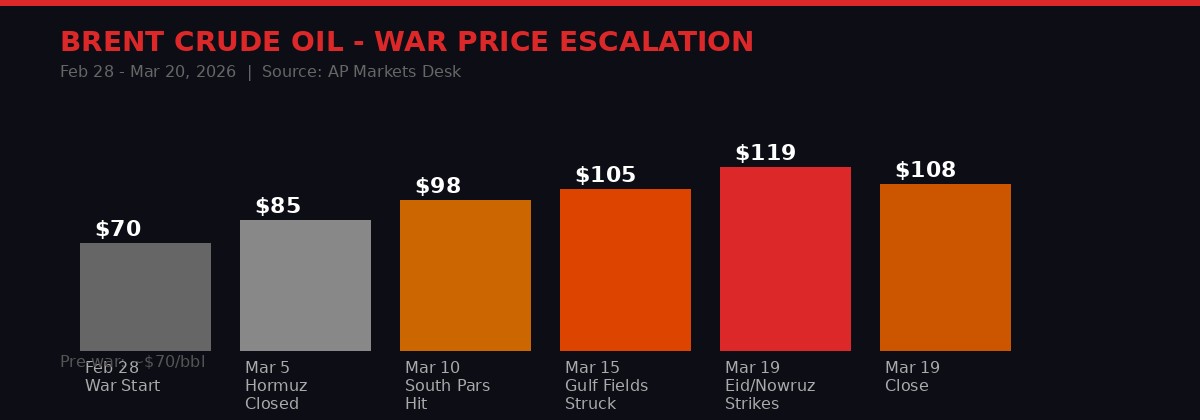
Brent crude has surged more than 70% since the war began Feb. 28. Source: AP Markets, compiled by BLACKWIRE.
The morning of March 19 opened with a financial shock that sent markets into a spiral worldwide. Brent crude, the international oil benchmark, briefly pierced $119 per barrel - up from roughly $70 before the war began. That is a 70% surge in 20 days.
The immediate trigger was Iran's intensified attacks on oil and gas infrastructure across the Persian Gulf. After Israel struck Iran's offshore South Pars gas field - the world's largest natural gas deposit - Tehran responded by hitting energy targets belonging to its neighbors with methodical precision.
Saudi Arabia confirmed its SAMREF refinery at Yanbu, on the Red Sea, was struck. Riyadh had been routing oil west specifically to bypass the choked Strait of Hormuz - and Iran hit that workaround too. Qatar reported Iranian missiles caused "extensive damage" to the Ras Laffan liquefied natural gas facility, reducing its export capacity by 17% and costing approximately $20 billion annually in lost revenue. The damage will take up to five years to repair, Qatar said - even as production had already been halted by earlier attacks. Refineries in Kuwait and gas operations in Abu Dhabi were also targeted.
Two vessels were set ablaze in Gulf waters - one off the UAE coast, another off Qatar. A ship fire in a conflict zone where tankers cannot easily get assistance is its own category of crisis. Crew evacuations, spill risks, and insurance write-offs follow each casualty.
Stock markets responded as expected. Japan's Nikkei fell 3.4%. Germany's DAX shed 2.8%. South Korea's KOSPI dropped 2.7%. Wall Street was somewhat more insulated - the S&P 500 closed down only 0.3% after recovering from an early 1% drop - partly because U.S. companies have less direct exposure to Middle Eastern oil than Asian and European counterparts.
Oil pulled back from its $119 intraday peak to settle at $108.65 by end of day Thursday, then eased further. The relief was partial and fragile. "Markets want to see less risk for oil and gas fields around the Gulf and a clearance of the Strait of Hormuz," AP reported. No one can promise either of those things right now.
"The countries that are exposed to that supply disruption are not so much in Europe, or in the Americas, they're actually really in the Asia region."
- Ramnath Iyer, Institute for Energy Economics and Financial Analysis (Source: AP)
Asia on the Edge: Japan, Korea, Vietnam Running Out of Time
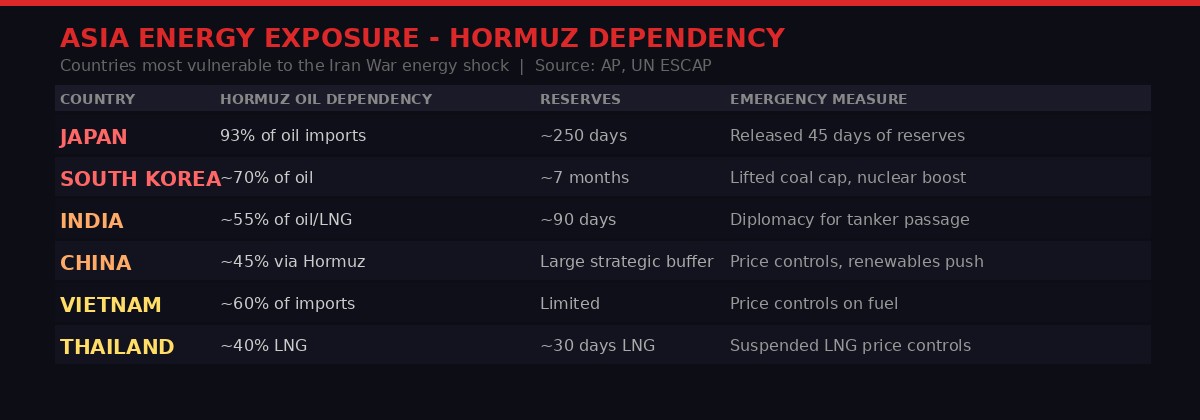
Asia's major economies are the most exposed to the Hormuz energy shock. Source: AP, UN ESCAP, compiled by BLACKWIRE.
The Iran War is a Middle Eastern conflict with an Asian energy crisis baked in. The numbers are stark: roughly one-fifth of all global oil supply moves through the Strait of Hormuz. Since February 28, that flow has been reduced to a trickle - only about 90 vessels total have transited the strait in three weeks, compared to 100-135 per day before the war, according to maritime data firm Lloyd's List Intelligence.
Japan relies on Hormuz for 93% of its oil imports. The government has already released 45 days of combined reserves - 15 days from private-sector stocks and 30 days from national reserves. Japan still has approximately 250 days of total reserves remaining, but analysts are sounding alarms. A liter of regular gasoline was selling at 175 yen by Thursday - up from 144 yen just a month ago. The specter of the 1970s oil shock, which produced shortages and queues across Japanese cities, is now being invoked explicitly in parliamentary debates.
South Korea imports 70% of its oil and 20% of its LNG from the Middle East. Long lines have formed at cheaper petrol stations. Delivery workers and truck drivers are absorbing costs they cannot pass on. Greenhouse farmers are watching heating bills consume their margins. Seoul has lifted a national cap on coal-fired power generation, begun boosting nuclear output, and is actively considering resuming Russian crude and naphtha imports - a sanction-busting workaround that would put South Korea in a diplomatically uncomfortable position.
Vietnam's manufacturing export sector is being squeezed from both sides - higher input costs from fuel and higher freight costs from insurance surcharges on Gulf-adjacent shipping. State media reported steel, textile, and footwear manufacturers are pausing orders or seeking price increases. The government warned of possible jet fuel shortages in April and urged airlines to plan for cuts. For a country whose industrial competitiveness is built on cheap and reliable inputs, this is a structural threat, not just a temporary disruption.
Thailand generates more than half its electricity from LNG, and roughly 40% of that LNG comes from the Middle East. The government has suspended certain LNG price controls and is looking at emergency supply deals. India has used diplomatic back-channels - foreign minister Jaishankar confirmed to the Financial Times that two Indian LPG tankers were able to pass through Hormuz after "talks with Iran." Iraq is attempting something similar. Iran appears to be selectively allowing passage for countries it wants to court diplomatically - effectively using shipping access as a lever.
China, despite being the largest buyer of Iranian oil by volume globally, is in a comparatively stronger position. It has large strategic reserves, a domestic power mix that has reached 30% renewables, and the political will to buy Iranian crude under Western sanctions. Chinese airlines are raising fares on international routes to offset fuel costs, but there is no imminent crisis. Beijing's calculated non-alignment - refusing to condemn Iran, maintaining trade ties, quietly benefiting from cheap discounted Iranian crude - is paying a practical dividend.
$200 Billion and No Authorization: Congress Confronts the Bill
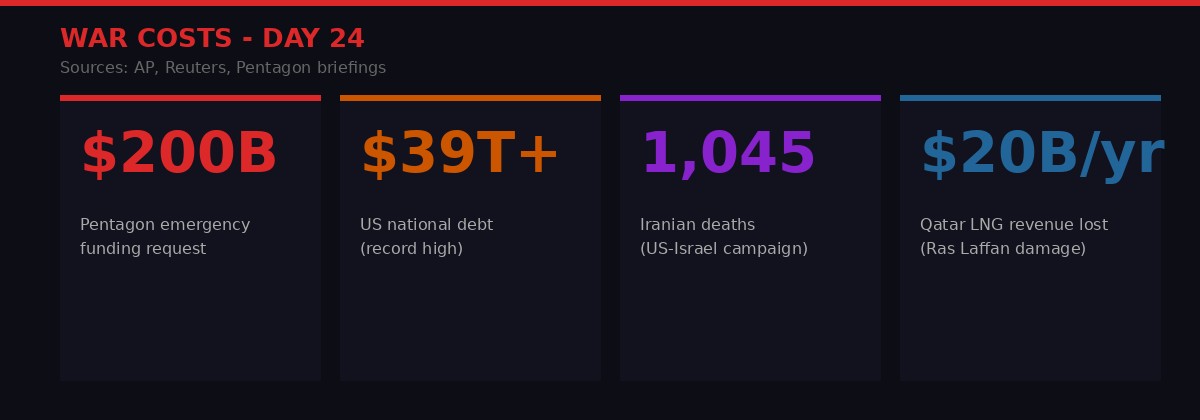
The Iran War's financial toll is escalating. Source: AP, Reuters, compiled by BLACKWIRE.
The Pentagon sent a $200 billion supplemental funding request to the White House this week, a figure that, if approved, would rank among the largest single wartime appropriations in modern American history, according to a senior administration official who spoke to AP on condition of anonymity.
Defense Secretary Pete Hegseth did not directly confirm the number at a press conference Thursday, but he did not deny it either. Asked about the cost of the war, Hegseth said: "It takes money to kill bad guys." He added that the department would be "going back to Congress and our folks there to ensure that we're properly funded."
The figure comes on top of extra defense funding the Pentagon already received in Trump's tax-and-spending bill last year. The U.S. national debt has already surpassed $39 trillion - a record. The emergency request now lands in a Congress that is fractured over the war itself.
The war has no formal congressional authorization. Most Democrats have opposed it from the start. But the resistance is now coming from within Republican ranks as well. Conservative fiscal hawks - who spent years demanding spending cuts to entitlements - are looking at a $200 billion war appropriation with visible unease. Rep. Ken Calvert of California, the Republican chair of the House subcommittee overseeing defense spending, acknowledged the need for supplemental munitions funding but was careful to frame it narrowly: "Right now, this is about our national security."
Rep. Betty McCollum, the ranking Democrat on the same subcommittee, was blunter: "This is not going to be a rubber stamp for the president of the United States." McCollum noted that Congress is still waiting for the White House to explain how the Pentagon is spending the $150 billion it already received through Trump's tax bill - money the Defense Department has yet to account for publicly.
The political math is becoming complicated. Trump launched the war February 28 without a formal War Powers Act notification to Congress, and lawmakers have not been given a defined mission statement, exit criteria, or casualty projection. The U.S. has killed 1,045 people in Iran, according to AP's running tally. American casualties have not been officially announced, though a U.S. intelligence official resigned this week claiming, in public statements, that Israel "pushed Trump into the war."
"I misled no one. And I didn't have to convince President Trump about the need to prevent Iran from developing its nuclear program."
- Israeli Prime Minister Benjamin Netanyahu, press conference, March 19, 2026 (Source: AP)
The Decapitation That Didn't Work: Mojtaba Doubles Down

The strategy of eliminating Iran's leadership has not broken the regime's ability to fight. (Pexels/illustrative)
The central strategic bet of the Israel-U.S. campaign has been that killing Iran's leaders will cause the Islamic Republic to collapse or capitulate. Day 24 is generating serious questions about that theory.
Israel killed Supreme Leader Ali Khamenei in the opening salvo on February 28. His replacement, son Mojtaba Khamenei, was not widely expected to take the position - he had deliberately maintained a lower public profile for years. But he stepped into the role and, by analyst accounts, has been harder-line than his father. Where Ali Khamenei occasionally spoke of diplomatic off-ramps in previous confrontations with the West, Mojtaba's public posture since taking power has been one of unconditional defiance.
Netanyahu has killed one senior Iranian figure after another in the weeks since. Iran's military commanders, intelligence chiefs, and IRGC leadership have been systematically targeted. Netanyahu declared Thursday that Iran's air defenses are "useless," its navy is "at the bottom of the sea," and its air force is "nearly destroyed." He said he hopes Iranians will rise up and topple the government.
There has been no sign of that uprising. The closest thing to domestic unrest was the mass protests in January 2026 - which Iranian authorities crushed before the war began. Since the war's start, Iran's internal security apparatus has, if anything, tightened its grip. Domestic dissent in a country under external military attack tends to consolidate around the government rather than against it - a pattern seen in Iraq, Libya, and Syria in previous decades.
Iran's response on the ground has been relentless. Thousands of drones and ballistic missiles have been launched at Israel, American military bases and embassies across the region, and the energy infrastructure of Gulf Arab states. Eleven people have been killed in Israel. Sirens have sounded across northern Israel - from Haifa to the Galilee to the Lebanese border - almost continuously. Hezbollah, significantly weakened in 2024, has resumed drone and rocket fire on Israel as well.
Jon Alterman of CSIS framed the problem directly: "Even dictators need to rely on entire networks that support them." The history of targeted killing against non-state actors - Nasrallah, Sinwar, Bin Laden, Baghdadi - is mixed at best, and applying the same logic against a state with 87 million people, functioning bureaucracies, and decades-deep institutional structures is a different order of problem entirely.
Ellie Geranmayeh of the European Council on Foreign Relations summarized Iran's counter-strategy: "The Iranians are banking on basically out-stomaching him, and exhausting him and his allies to the point where they would basically have a diplomatic off-ramp." Iran's leadership believes Trump - who once said he wanted to be a dealmaker, not a warrior - will eventually blink if the cost gets high enough.
What Day 25 Looks Like From Here

The Strait of Hormuz remains the choke point that could decide the war's economic outcome. (Pexels)
The immediate picture heading into Friday, March 20: oil is still above $108 after briefly hitting $119. Israel struck Tehran on Nowruz morning. Dubai's air defenses fired on Eid. Qatar's LNG facility will need five years to fully repair. The Pentagon wants $200 billion more. Congress has not authorized the war. And Mojtaba Khamenei is still in power, still issuing orders, still firing missiles.
Netanyahu secured one concession from Trump: no further Israeli strikes on Iran's South Pars gas field. That agreement was reached after Gulf allies called Trump directly and made clear that Iranian retaliation against Gulf energy facilities was a direct consequence of the South Pars attack. The call worked - at least for now. It also revealed a fault line in the coalition. The Gulf states are not interested in a prolonged war that destroys the infrastructure they built over decades. Saudi Arabia, Qatar, and the UAE want this to end, and they are now willing to say so to Trump directly.
Japan, meanwhile, has dispatched its foreign minister to meet with Trump about securing the Strait of Hormuz. Japan relies on Hormuz for 93% of its oil and it is not in a position to stay neutral diplomatically when the waterway is effectively closed. The Trump administration is trying to assemble a coalition of willing navies to reopen the strait by force - a mission that would require sustained operations against Iran's maritime assets in waters where Iran has the home-field advantage in mine warfare and anti-ship missiles.
The UN Security Council held an emergency closed session Thursday. Gulf countries emphasized the need for Iran to halt attacks on them. Iran has not halted anything. The Security Council, hamstrung by veto politics, produced no resolution. It rarely does in active conflicts involving permanent member interests.
For the people setting their haft-seen tables under the sound of air raid sirens in Tehran, or saying Eid prayers under interceptor trails in Dubai, the geopolitical abstractions are secondary. The war arrived in their holiest moments and made itself impossible to ignore. That is either a sign that the conflict is expanding beyond anyone's ability to contain, or a signal that both sides believe time is on their side.
History suggests both cannot be right.
Timeline: The Iran War, Days 1-24
Get BLACKWIRE reports first.
Breaking news, investigations, and analysis - straight to your phone.
Join @blackwirenews on Telegram