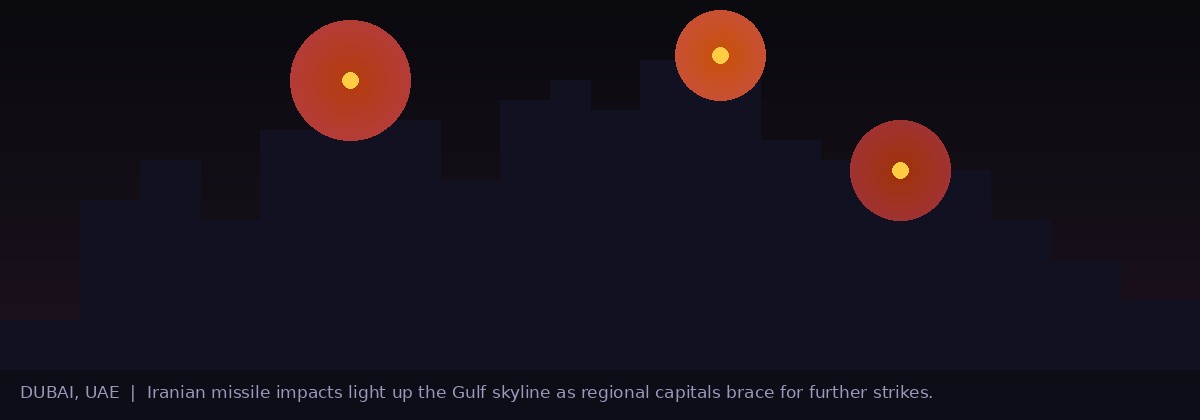
The missiles came at 11:17 PM local time on the night of March 9. They came in low, following the creek inland from the Gulf, and three of them hit within a kilometer of each other near the financial district. The explosions were visible from residential towers up to 15 kilometers away. Thousands of people filmed them.
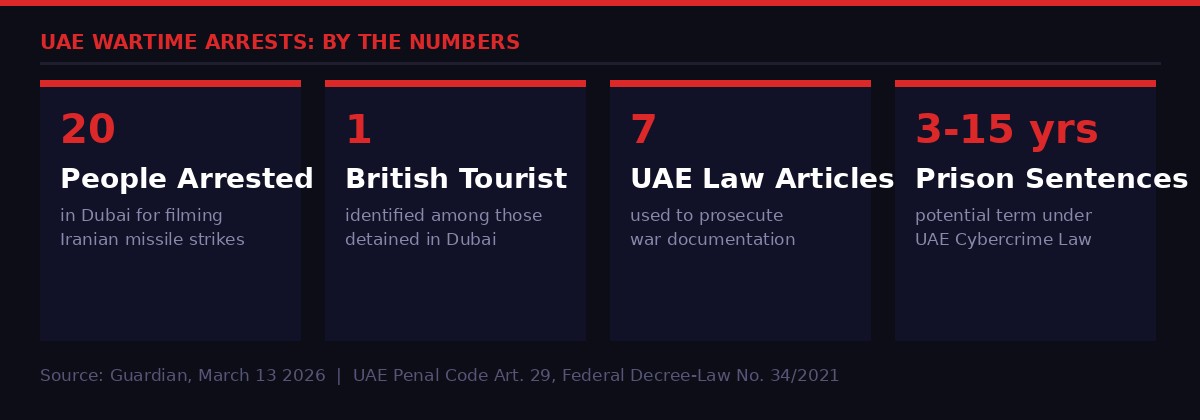
Twelve days later, twenty of those people are in a Dubai detention facility facing charges under the UAE's Federal Decree-Law No. 34 of 2021, better known as the Cybercrime Law. The offense: distributing content "prejudicial to national security" and "spreading panic among the public." [The Guardian, March 13, 2026]
Among the twenty is a British national - a tourist on holiday - whose name has not been released pending diplomatic notification. The UK Foreign Commonwealth and Development Office confirmed Thursday that it was "aware of the case and providing consular assistance." A press release on the FCDO's travel advisory page was quietly updated to warn UK nationals in the UAE against "filming, recording, or distributing images of military incidents or infrastructure."
The arrests mark a sharp escalation in UAE authorities' attempts to control the visual record of the Iran war inside their own borders. They also expose a fundamental tension that wartime states rarely acknowledge directly: the footage that documents civilian suffering and urban warfare is exactly the footage that governments under attack most want to suppress.
The Night the Cameras Came Out
Dubai has never been bombed before. That context matters for understanding why so many people filmed what they saw. The city is home to roughly 3.5 million residents, the vast majority of them foreign nationals - expats from South Asia, the Philippines, Europe, North America, and Africa who have built careers in a city that marketed itself, explicitly, as the stable Gulf alternative to everything combustible in the region.
When Iranian missiles began crossing UAE airspace in the first week of March 2026 - initially targeting US military assets at Al Dhafra Air Base before the threat envelope widened to include port infrastructure near Jebel Ali - the reaction from residents was, by documented social media evidence, a mixture of shock, disbelief, and the deeply modern reflex to reach for a phone.
The footage that circulated on X (formerly Twitter), TikTok, Instagram, and Telegram in those first nights was remarkable in its scope and quality. Apartment buildings with unobstructed Gulf views became inadvertent observation platforms. Amateur video captured missile contrails, interceptions by the UAE's Patriot and THAAD batteries, fireball impacts, and - most consequentially - scenes of civilian casualties near the March 9 financial district strike.
That last category was what triggered the crackdown. Sources familiar with UAE security service communications, speaking to the Guardian's correspondent in Abu Dhabi, said the Interior Ministry had been monitoring social media for "sensitive content" from the first night of attacks, but that the March 9 strike - which killed three people and left sections of the financial district burning for four hours - produced footage that the government could not tolerate circulating internationally. [The Guardian, March 13, 2026]
Within 48 hours, coordinated content removal requests went to Meta, X, and TikTok citing UAE national security law. When that proved insufficient - the content kept spreading, re-posted from servers outside UAE jurisdiction - authorities moved to the source. They arrested the people who had filmed it.
The Law That Makes Witnessing a Crime
The UAE's legal toolkit for suppressing wartime documentation is not improvised. It has been built methodically over the past fifteen years, with each iteration expanding the definition of prosecutable expression.
Federal Decree-Law No. 34 of 2021 - the Cybercrime Law - is the primary instrument. Article 29 prohibits distributing "information, news, data, or statistics... with the aim of... prejudicing public order or religious values or public morals or private life." The penalty: imprisonment of not less than one year and a fine not less than 250,000 dirhams (approximately $68,000).
UAE Legal Framework: Applicable Articles
Federal Decree-Law No. 34/2021 (Cybercrime Law), Art. 29: Prohibition on distributing content prejudicial to national security, public order, or public morals via information technology. Penalty: 1-15 years imprisonment, fines of 250,000-3,000,000 AED.
Penal Code, Art. 197: Spreading rumors, false news, or propaganda that would disturb public security or harm the state's reputation. Penalty: up to 5 years imprisonment.
Media Law (Federal Law No. 15/1988), Art. 71: Publication of material that harms national unity or endangers state security. Administrative penalties plus criminal referral.
Counter-Terrorism Law (Federal Decree-Law No. 7/2014), Art. 26: Financing, inciting, or facilitating "acts of terror" through media or communications - broadly interpreted to include content that "glorifies" or "publicizes" attacks on UAE territory.
The charges filed against the twenty detainees span all four of these legal instruments, according to documents reviewed by the Guardian. The breadth of the legal basis is deliberate: it makes bail more difficult to obtain, allows authorities to hold suspects for longer during investigation, and signals to other residents the severity with which the UAE treats this category of offense.
UAE authorities have form here. Human Rights Watch documented twelve cases between 2020 and 2024 in which UAE residents were jailed for social media posts deemed critical of the government or destabilizing to public order. Sentences ranged from six months to eleven years. In several cases, foreign nationals were jailed and then deported after serving partial sentences. [HRW, UAE Country Report 2025]
What is new about the current wave of arrests is their scale and their specific targeting of war documentation - footage of an active military conflict on UAE soil - rather than the political criticism that previous cases involved. Press freedom organizations are describing it as a qualitative shift.
"The UAE has effectively made it illegal to be a witness to the war being fought on its own territory. This is not about protecting operational security - the Iranian government already knows where its missiles landed. This is about controlling the domestic and international perception of the conflict's civilian toll." - Reporters Without Borders (RSF) Middle East desk statement, March 12, 2026
Dubai's Impossible Position
To understand the arrests, it helps to understand the bind Dubai is in.
The UAE occupies one of the most paradoxical positions in the current Iran war. It is, simultaneously: a host to US military assets (Al Dhafra Air Base, a critical node in US operations against Iran); a major trading partner with Iran (pre-war, the UAE handled an estimated $4-6 billion in annual trade, much of it through informal re-export channels); a target of Iranian strikes (the first Gulf Arab state to be directly hit in the current conflict); and a financial hub that has spent two decades building a reputation as the politically neutral Switzerland of the Middle East.
All four of those identities are in acute tension right now. The UAE cannot openly side with the US-led coalition without inviting more Iranian attacks on its infrastructure. It cannot maintain neutrality when Iranian missiles are landing in its financial district. It cannot keep trading with Iran while hosting the planes that bomb Iran. And it cannot project the stability its brand requires when its own residents are filming missile strikes from their apartment balconies and the footage is going viral globally.
The arrests are, in part, a domestic messaging exercise. The UAE government's priority is to communicate to its resident population - and to international investors eyeing the exits - that it retains control. That it is not a war zone. That what happened in the financial district on March 9 was an aberration that is being managed, not a new normal that is spiraling.
Footage of burning buildings in the DIFC does not serve that narrative. Neither does footage of emergency services struggling to access casualties, or of apartment towers with shattered windows, or of residents in the streets at midnight, stunned and scared. The UAE has decided that suppressing that footage is worth the diplomatic cost with London and the reputational cost with press freedom organizations.
Whether that calculus holds up over time is an open question. The British government's response has been notably muted - the Foreign Office's "consular assistance" language is the diplomatic equivalent of a shrug. London's significant financial and business ties with Dubai create strong incentives to avoid any confrontation that could be characterized as interfering in UAE internal affairs.
The British Tourist and What His Case Tells Us
The identity of the arrested British national has not been made public. The Guardian reported only that the individual is a male tourist, that he had been in Dubai for four days when he was arrested on March 11, and that the footage he filmed and shared showed the aftermath of the March 9 strike including "scenes of civilian harm." [The Guardian, March 13, 2026]
His case is significant beyond the individual circumstances for two reasons.
First, it illustrates the jurisdictional reach of UAE cybercrime law. The individual did not need to be a journalist, a political activist, or a known critic of the UAE government. He was a tourist who filmed something extraordinary that was happening around him and posted it to social media. That act - normalized in virtually every other country on earth - is a criminal offense in the UAE under current wartime conditions.
Second, it puts the UK government in an uncomfortable position. London has, over the past decade, been the destination of choice for wealthy UAE nationals seeking to park assets and buy property. The UAE has been a significant purchaser of UK defense equipment. The relationship is close enough that official criticism of UAE human rights practices has been consistently muted - unlike, say, UK government language about Saudi Arabia, which at least occasionally rises above pure diplomatic boilerplate.
The Committee to Protect Journalists issued a statement Thursday calling for the immediate release of all twenty detainees and labeling the UAE's actions a "direct assault on the documented record of the conflict." [CPJ statement, March 12, 2026] Amnesty International noted that several of the nineteen non-British detainees appear to be workers from South and Southeast Asia - a population with significantly less diplomatic protection than a British national and historically far more vulnerable to prolonged detention in Gulf states.
The disparity in attention between the British tourist and the other nineteen people arrested is itself a story about who gets protected and who does not when states move to suppress the record of their wars.
When Evidence Becomes a Crime: The Global Pattern
Dubai's crackdown is not happening in a vacuum. It is part of a pattern that has accelerated sharply since the Iran war began, and that reflects a broader shift in how authoritarian and semi-authoritarian governments manage the visual record of armed conflict.
Russia established the template in Ukraine. The Russian government criminalized the term "war" to describe its own operations and prosecuted citizens for holding blank signs or posting social media content showing Russian military casualties. The legal mechanism was different - a separate censorship law rather than a cybercrime statute - but the underlying logic was identical: control the image of the conflict to control the political cost of the conflict.
In the current Iran war, Iran itself has been aggressively suppressing internal documentation of strike damage and casualty figures. Iranian authorities arrested at least fourteen people in Tehran and Isfahan in February for filming strike impacts and posting footage abroad. [BBC Persian, multiple reports, February-March 2026] The IRGC has imposed strict media blackouts in areas near military facilities that have been struck.
What makes the Dubai case different - and more troubling in some ways - is that the UAE is nominally a country with a functioning tourist economy and a global financial hub identity. It has positioned itself as open, cosmopolitan, and internationally connected. Its entire value proposition to foreign residents and visitors has been built on the idea that it is not like the rest of the region.
The decision to arrest a British tourist for filming a missile strike is a signal that this positioning has limits. Those limits are: when the government's grip on its own narrative is threatened, the cosmopolitan veneer comes off and the authoritarian substrate shows. Every Gulf state, Dubai included, has always had that substrate. The Iran war is just making it visible.
"This is not a new capability. The UAE has always had these laws. What's new is the willingness to use them against tourists, against ordinary residents, against anyone with a phone. That tells you something about how threatened the government feels by the footage that exists of what has happened in their city." - Regional press freedom researcher (name withheld at source request), speaking to BLACKWIRE
What the Footage Shows - and Why That Matters
The content of the suppressed footage is not purely a press freedom issue. It is also a war crimes evidence issue.
International humanitarian law requires combatants to take all feasible precautions to avoid civilian casualties. When attacks cause civilian harm, the documentation of that harm is material evidence for any future accountability process. The International Criminal Court, the UN Human Rights Council, and domestic courts have all relied extensively on citizen-generated video in prosecutions and investigations of armed conflict violations.
In the current Iran war, the question of civilian harm in UAE territory is legally significant. The strikes near Dubai's financial district on March 9 hit in close proximity to civilian residential buildings. Three people died. An unknown number were injured. Whether those strikes constitute violations of IHL by Iran depends in part on the evidence record of what was struck and what the civilian presence was at the time of impact.
By arresting the people who created that evidence record and pressuring platforms to remove the footage, UAE authorities are - whether deliberately or as a side effect of their domestic messaging priorities - degrading the evidentiary foundation for any future accountability process. The footage that documented civilian harm on UAE soil is the same footage that would be relevant in any legal proceeding against Iran over those strikes.
This is the bitter irony at the heart of the Dubai arrests: the UAE, which has every legal and political interest in preserving evidence of Iranian attacks on its territory, has instead moved to destroy it. The motivation is understandable in political terms - the government does not want images of chaos and casualties defining the city's international image - but the legal and accountability consequences are real.
UN Special Rapporteur on the promotion of truth, justice, reparation and guarantees of non-recurrence Fabian Salvioli issued a formal statement Thursday calling on UAE authorities to "release all individuals detained for documenting the effects of hostilities" and noting that the documentation of conflict impacts is "protected under international human rights law as an essential precondition for future accountability." [UN OHCHR, statement March 13, 2026]
The Diplomatic Fallout and What Comes Next
Nineteen states have accredited nationals among the twenty arrested. The diplomatic machinery is grinding through formal protest channels - notes verbales being filed, consular officials being granted access, governments waiting to see whether charges will be formally pressed or whether this is a deterrence exercise that ends in deportation.
Deportation, for most of the non-British detainees, would be a severe consequence in itself. Workers from South Asia who are employed in Dubai on sponsored visas face losing their livelihoods and being blacklisted from future Gulf employment if deported for criminal offenses. The power asymmetry between UAE authorities and these workers is near-absolute.
For the British national, the situation is different and will attract more sustained attention. UK parliamentarians have already raised the case in the House of Commons. The Foreign Affairs Committee is expected to call FCDO officials to testify on what diplomatic representations have been made to Abu Dhabi. The story is generating significant coverage in UK media.
The UAE's calculation appears to be that the diplomatic friction is manageable. The US - the UAE's primary security guarantor and the country most loudly demanding press freedom globally - is itself in a complicated position on this case. The US is currently operating from UAE territory for the Iran war. Publicly pressuring the UAE over war documentation arrests risks disrupting that operational relationship. The Biden administration would have been noisier about this. The Trump administration, which has shown limited interest in press freedom cases generally and significant interest in maintaining Gulf state cooperation for the Iran campaign, will likely apply pressure privately at best.
What does change - and this is the slow-burn consequence the UAE may be underestimating - is the city's reputation as a safe destination for expatriates. The expat community that powers Dubai's economy is fundamentally transient. People choose Dubai for the career opportunity and the lifestyle. When the calculus shifts - when the city can be bombed and you can be arrested for filming it - people start doing different math about where to live.
Real estate inquiries from expatriates reportedly dropped sharply in the week after the March 9 strike, according to property industry sources cited by the Financial Times. [FT, March 12, 2026] The arrests will not help that trend. The message they send to the global professional class that Dubai has spent two decades courting is precisely the opposite of everything the city's brand has promised: that this is a place with rules you did not know existed, enforced selectively, in ways that can reach you without warning even as a tourist.
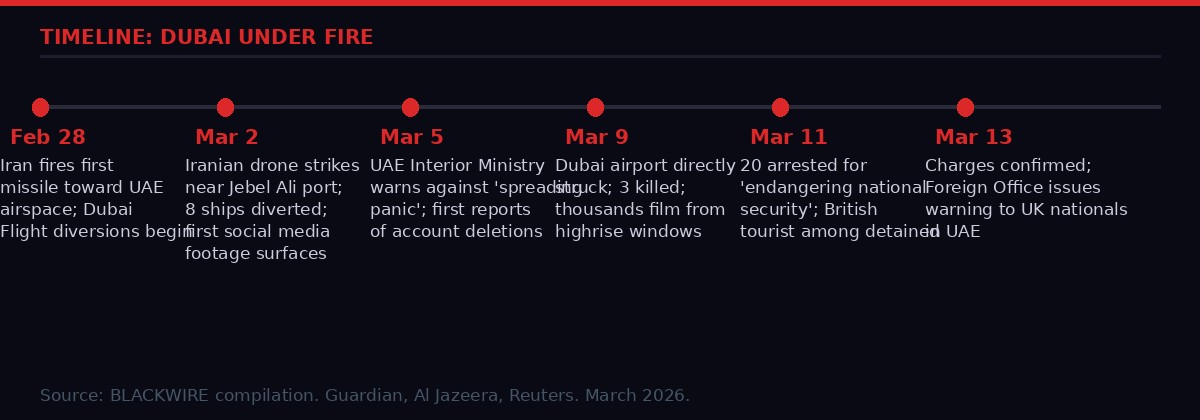
Timeline: Dubai's War and the Crackdown on Its Witnesses
■ Sequence of Events
The Verdict on What This War Is Doing to Openness
The Dubai arrests are a microcosm of something larger that is happening across the geography of the Iran war: the systematic dismantling of the evidentiary record of a conflict while that conflict is still in progress.
Iran is doing it. Iraq is doing it. The UAE is doing it. In different ways, for different political reasons, each state touched by this war is working to suppress, control, or destroy the visual and documentary record of what is actually happening on the ground.
The practical effect is that we are in the middle of a major regional war and the authoritative record of what it looks like - who is dying, where, how, at whose hand - is being actively contested and erased in real time. Future historians, prosecutors, and policymakers will work with a degraded archive. The evidence of this war is being harvested for government control rather than preserved for accountability.
This is not unprecedented. Wartime censorship is as old as war itself. But the Dubai case carries a specific sting because the city has spent so long presenting itself as different - as the place that operates by global rules, that welcomes the world, that runs on openness and information flow. The arrests reveal the limit of that promise.
It turns out Dubai will be open for business right up until the moment business means someone filming a burning building, and posting it online, and the government does not want you to.
For the British tourist sitting in a Dubai detention facility on March 13, 2026, the distance between those two versions of the city is the length of a corridor.
Get BLACKWIRE reports first.
Breaking news, investigations, and analysis - straight to your phone.
Join @blackwirenews on TelegramSources: The Guardian (March 13, 2026) - British tourist among 20 charged in Dubai; Reporters Without Borders (RSF) Middle East desk statement March 12, 2026; Committee to Protect Journalists (CPJ) statement March 12, 2026; UN OHCHR Special Rapporteur statement March 13, 2026; Human Rights Watch UAE Country Report 2025; BBC Persian service reports on Iranian wartime censorship February-March 2026; UAE Federal Decree-Law No. 34/2021 (Cybercrime Law); UAE Penal Code Article 197; UAE Counter-Terrorism Law Federal Decree-Law No. 7/2014; Financial Times expatriate property inquiry report March 12, 2026; Al Jazeera Iran war coverage March 13, 2026; AP World News wire March 13, 2026.