The DOJ Is Deleting the Epstein Files. Here's What Disappeared - and Who It Protects.
65,500 pages removed from federal servers. 47,000 individual files gone. The Department of Justice promised America the truth about Jeffrey Epstein. Then it started erasing it.
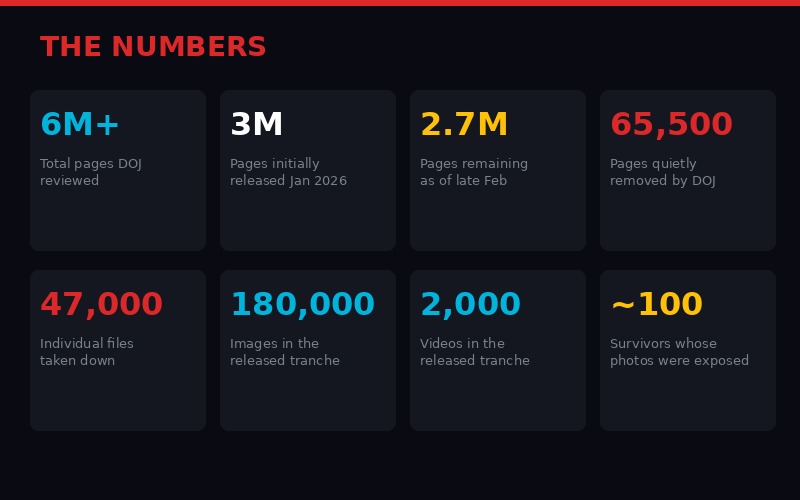
On March 3, 2026, CBS News published findings from a forensic analysis of the DOJ's Epstein file repository. The numbers are staggering: more than 47,000 files comprising approximately 65,500 pages have been quietly removed from the Department's public servers since the initial January release. Links that once led to evidence now return "page not found." The DOJ's own claim of releasing "more than 3 million pages" no longer matches reality. The actual count, as of late February, sits at roughly 2.7 million.
This is the story of how the largest document release in American criminal history is being edited in real time - who benefits, what vanished, and the 30-year trail of money, power, and impunity that led to this moment.
01 // The Promise and the Betrayal
In November 2025, the U.S. House of Representatives passed the Epstein Files Transparency Act. The Senate approved it unanimously. President Donald Trump signed it into law the next day. It was, on paper, the most aggressive legislative demand for transparency in a criminal case since the JFK Records Act of 1992.
The law compelled the Department of Justice to release nearly all files related to Jeffrey Epstein's criminal investigation, his network, and the FBI's Sentinel case management records - over 300 gigabytes of data.
On January 30, 2026, the DOJ complied. Sort of. Deputy Attorney General Todd Blanche announced the release of "more than 3 million pages," including 180,000 images and 2,000 videos. Combined with previously released materials, the total was reported as 3.5 million pages. Blanche also acknowledged that the DOJ had reviewed approximately 6 million total pages - meaning that even the "massive" release constituted less than half of what exists.
The rest, he said, was withheld to "protect survivors and ongoing investigations."
Lawmakers from both parties erupted. They had access to the unredacted files. What they saw didn't match the stated justification. Senator Chuck Grassley called the redactions "inconsistent at best and suspicious at worst." Representative Tim Burchett said the DOJ was "protecting powerful men, not survivors."
Then, silently, files began to disappear.
What CBS Found
CBS News analysts Taylor Johnston, Elliott Ramos, and Julia Ingram tracked the DOJ's file repository systematically. They found that as of late February 2026:
- 47,000 individual files had been removed from public access
- Those files comprised approximately 65,500 pages
- Links to removed files now return "page not found" errors on the DOJ website
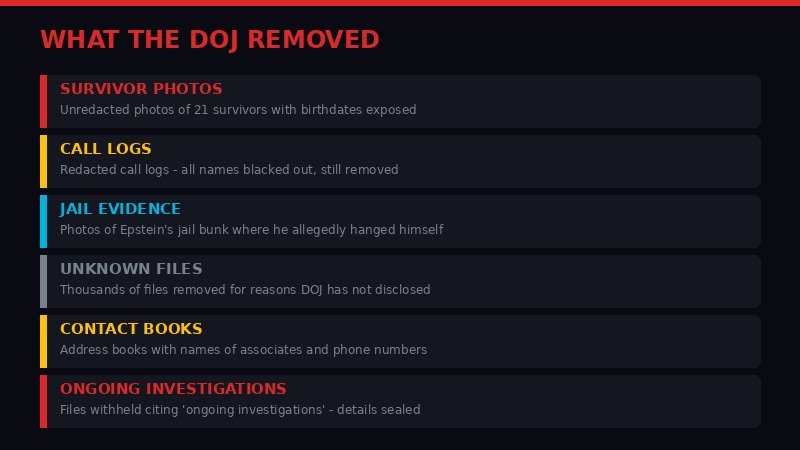
- Some removed documents contained explicit images of survivors, including one file with unredacted photos of 21 survivors along with most of their birthdates
- Other removals had no clear justification - including fully redacted call logs (where all names were already blacked out) and photos of Epstein's jail bunk where investigators say he hanged himself
The DOJ appears to be putting some removed files back up. The repository is, in CBS's characterization, "in flux." The total page count continues to fluctuate. What was billed as a definitive release is being edited after publication - and the editing criteria are opaque.
"The massive tranche of files the Department of Justice currently maintains is more than 65,000 pages shorter than what the agency initially released." - CBS News analysis, March 3, 2026
02 // The Man: From Brooklyn to Billionaire Access

Jeffrey Edward Epstein was born January 20, 1953 in Brooklyn, New York. His father was a groundskeeper for the Parks Department. His mother was a school aide. He grew up in Sea Gate, a gated community in Coney Island. Classmates called him "Eppy" - quiet, nerdy, good at math.
He skipped two grades, graduated high school at 16, attended Cooper Union and then NYU's Courant Institute for mathematical physiology. He finished neither. He never earned a degree.
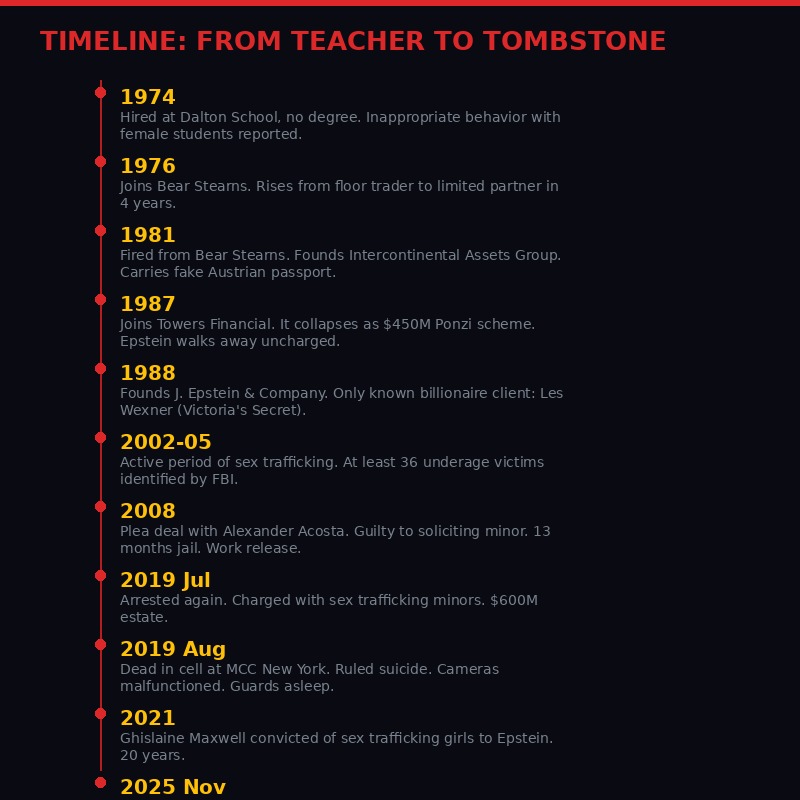
In 1974, at 21, he was hired to teach calculus and physics at the Dalton School on Manhattan's Upper East Side - one of the most elite private schools in America. Former students would later report he showed "inappropriate behavior toward underage female students," including showing up at student parties. He was fired in 1976 for "poor performance."
At a parent-teacher conference, he'd impressed a Wall Street executive with his math knowledge. That connection got him into Bear Stearns, where he rose from floor trader to limited partner in four years. He was fired in 1981 for a Regulation D violation.
He founded Intercontinental Assets Group, which he described as a "high-level bounty hunter" operation recovering embezzled funds. During the 1980s, he traveled extensively between the U.S., Europe, and the Middle East. He carried an Austrian passport with his photo but a false name, listing his residence as Saudi Arabia. One of his clients was Adnan Khashoggi, the Saudi arms dealer at the center of the Iran-Contra affair.
In 2017, Alexander Acosta - the U.S. Attorney who would later cut Epstein's plea deal - told Trump's transition team: "I was told Epstein 'belonged to intelligence' and to 'leave it alone.'"
03 // The Ponzi, the Billionaire, and the Fortune Nobody Can Explain
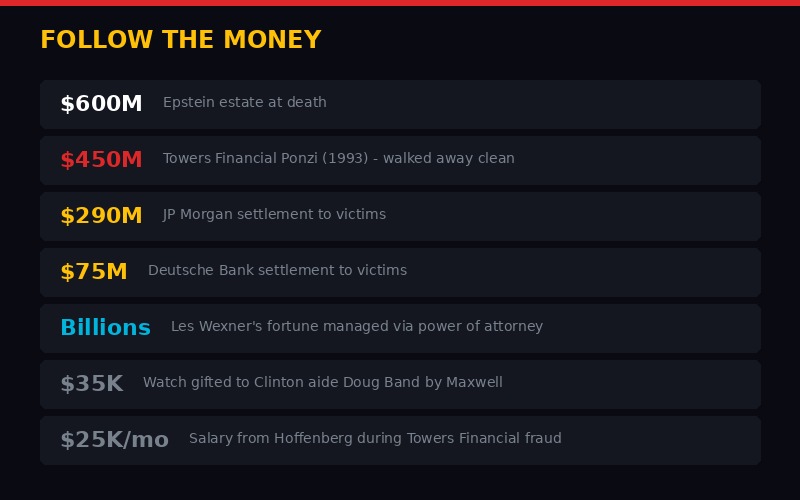
In 1987, Steven Hoffenberg hired Epstein as a consultant at Towers Financial Corporation. Hoffenberg paid him $25,000 a month and set him up in offices at the Villard Houses in Manhattan. Together they attempted hostile takeovers of Pan American World Airways and Emery Air Freight. Both failed.
In 1993, Towers imploded. It was a $450 million Ponzi scheme - one of the largest in American history at the time. Hoffenberg went to prison. He claimed in court documents that Epstein was "intimately involved." Epstein was never charged. He'd left the company by 1989.
The only publicly confirmed billionaire client of Epstein's subsequent firm, J. Epstein & Company, was Les Wexner - the founder of L Brands and Victoria's Secret. In 1991, Wexner granted Epstein full power of attorney over his entire financial life: hiring, firing, buying, selling, signing checks, borrowing money. The keys to a retail empire, handed to a man with no degree and a trail of scandals.
At his death, Epstein's estate was valued at $600 million. Nobody has been able to coherently explain how a college dropout with one known client accumulated that fortune.
The Settlement Machine
After Epstein's death, the money kept flowing - but in a different direction:
- $290 million - JP Morgan settlement to Epstein victims (2023). The bank had kept Epstein as a client for years after his 2008 conviction.
- $75 million - Deutsche Bank settlement to victims. Same story: maintained the relationship despite knowing his criminal history.
- Hundreds of millions - Paid from Epstein's own estate in individual victim settlements.
Two of the largest banks in the world profited from a convicted sex offender's accounts, paid settlements, and nobody went to prison for it.
04 // The Network: 150+ Names, Four Categories of Power
The Epstein files contain over six million pages documenting relationships with some of the most powerful people in the world. The released portion - roughly 3.5 million pages with redactions - names politicians, presidents, prime ministers, tech billionaires, royalty, scientists, celebrities, and financial titans.
Being named in the files does not establish wrongdoing. Many were professional contacts, dinner companions, or academic acquaintances. But the scale of the network itself tells a story about how power protects power.
Politics and Government
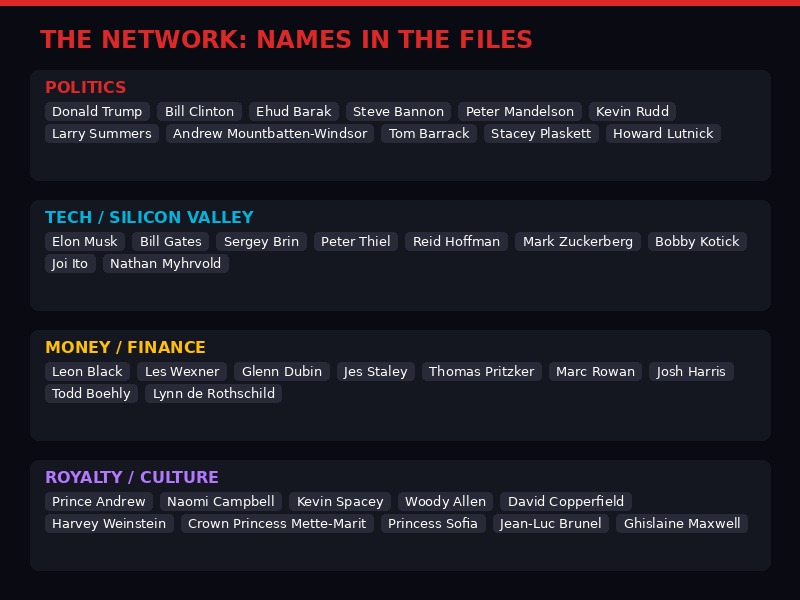
- Donald Trump - Socialized with Epstein in the 1980s-90s New York elite circle. Trump and wife Melania appear frequently in the files.
- Bill Clinton - Flew on Epstein's plane. Epstein visited the White House. Photo shows them shaking hands with Ghislaine Maxwell in the background (1993).
- Ehud Barak - Former Israeli PM. Frequent visitor to Epstein's properties. Israeli government installed security equipment in an Epstein-linked building he frequented.
- Steve Bannon - Exchanged thousands of texts with Epstein on influencing European coalitions, China pressure, and Middle East ties. Used Epstein's Paris apartment and plane.
- Peter Mandelson - British politician. Arrested in connection with the files. Appears to have sent UK government secrets to Epstein, including PM Gordon Brown's pseudonym and secure email address.
- Thorbjorn Jagland - Former Norwegian PM. Charged with aggravated corruption stemming from Epstein ties.
- Tom Barrack - Now U.S. Ambassador to Turkey. Friends with both Trump and Epstein. Extensive business ties. Epstein repeatedly asked Barrack to use Signal - a channel outside the released files.
- Larry Summers - Former Treasury Secretary. Photographed with Epstein on a private plane alongside Woody Allen.
- Howard Lutnick - Now U.S. Secretary of Commerce. Named in the files.
- Kevin Rudd - Former Australian PM. Named in the files.
- Stacey Plaskett - U.S. Virgin Islands delegate. Named in connection with Epstein's operations on the islands.
- William Burns - CIA Director. Named in the files in connection with meetings.
Tech and Silicon Valley
- Elon Musk - Named in the files. Connection documented.
- Bill Gates - Met with Epstein multiple times after the 2008 conviction. Flew on Epstein's plane.
- Sergey Brin - Google co-founder. Named in association.
- Peter Thiel - Palantir founder. Epstein nudged Ehud Barak to work with Thiel's company.
- Reid Hoffman - LinkedIn founder. Named in the files. Previously apologized for association.
- Mark Zuckerberg - Meta CEO. Named in the files.
- Bobby Kotick - Former Activision CEO. Named in the files.
- Joi Ito - Former MIT Media Lab director. Resigned over Epstein funding ties.
Finance and Money
- Leon Black - Apollo Global Management. Paid Epstein $158 million in fees. Named extensively.
- Les Wexner - Victoria's Secret. Gave Epstein full power of attorney. Only confirmed billionaire client.
- Glenn Dubin - Hedge fund manager. Wife Eva was Epstein's girlfriend for 11 years before their marriage.
- Jes Staley - Former Barclays CEO. Lost his job over Epstein ties. Over 1,200 emails exchanged.
- Thomas Pritzker - Hyatt Hotels. Named in the files.
- Marc Rowan - Apollo Global. Named in the files.
- Josh Harris - Apollo co-founder. Named in the files.
- Lynn Forester de Rothschild - Named in connection with introductions and social events.
Royalty, Culture, and Celebrity
- Prince Andrew - Arrested and questioned in connection with the files (Feb 2026). Previously settled Virginia Giuffre's lawsuit for an undisclosed sum.
- Crown Princess Mette-Marit of Norway - Named in the files. Met Epstein after his conviction.
- Princess Sofia of Sweden - Named in the files.
- Naomi Campbell - Supermodel. Named in association.
- Kevin Spacey - Actor. Named in connection with flights and social events.
- Woody Allen - Guest at Epstein's townhouse from 2010 onward. Wrote a letter for Epstein's 63rd birthday.
- David Copperfield - Illusionist. Named in the files.
- Harvey Weinstein - Convicted sex offender. Named alongside Epstein in the files.
- Ghislaine Maxwell - Epstein's primary accomplice. Convicted in 2021. 20 years. The central node connecting Epstein to his network.
- Jean-Luc Brunel - French modeling agent. Charged with rape. Died in French prison in 2022. His agency was a pipeline.

05 // The Crimes: What We Know Happened
Between 2002 and 2005, FBI investigators identified at least 36 girls between the ages of 14 and 17 who reported sexual abuse by Epstein at his Palm Beach mansion. The investigation began after a parent reported that Epstein had paid her 14-year-old stepdaughter to strip and massage him.
In 2007, federal prosecutors prepared a 32-count draft indictment against Epstein and two employees for enticement of minors and sex trafficking. The draft described Epstein as "an extremely high flight risk and a continued danger to the community."
Instead of prosecution, U.S. Attorney Alexander Acosta cut a plea deal. Epstein pleaded guilty to state charges of soliciting a minor for prostitution. He received 18 months in prison, served 13 with work release - meaning he left jail six days a week to work from his office in downtown West Palm Beach. He registered as a sex offender.
The deal included a clause granting immunity to any potential co-conspirators. It was negotiated largely in secret, without informing the victims - a violation of the Crime Victims' Rights Act, as a federal judge later ruled.
"I was told Epstein 'belonged to intelligence' and to 'leave it alone.'" - Alexander Acosta to Trump transition team, 2017
Acosta became Trump's Secretary of Labor in 2017. He resigned in 2019 after the plea deal came under renewed scrutiny.
The 2019 Arrest and Death
On July 6, 2019, Epstein was arrested again at Teterboro Airport, charged with sex trafficking minors in New York and Florida. Investigators found a locked safe in his townhouse containing compact discs labeled with names - including "Young [Name] + [Name]" - along with nude photographs.
On August 10, 2019, Epstein was found dead in his cell at the Metropolitan Correctional Center in New York. His death was ruled a suicide by hanging. Both guards assigned to his unit had fallen asleep and falsified records. The security cameras outside his cell malfunctioned.
The MCC was subsequently closed in 2021, citing "failing infrastructure." Epstein was its most famous inmate.
06 // The Global Reach: Eight Countries, Three Continents
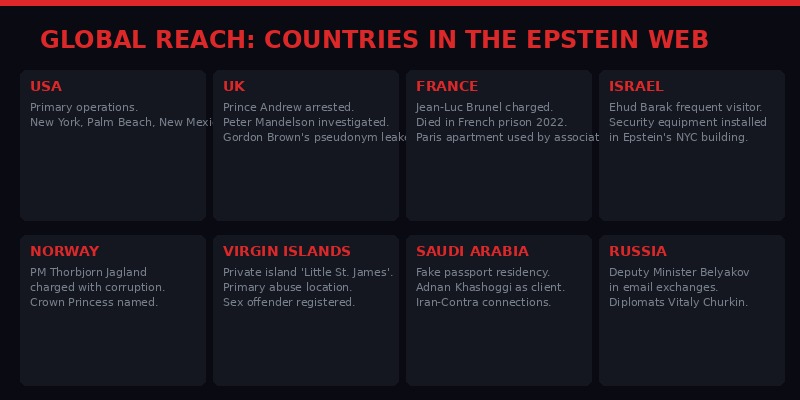
Epstein's operations were not confined to Palm Beach and Manhattan. The files reveal a network spanning at least eight countries across three continents:
United States: The primary theater. Properties in New York (the townhouse at 9 East 71st Street - one of the largest private residences in Manhattan, gifted by Les Wexner), Palm Beach, the Zorro Ranch in New Mexico (7,500 acres), and Little St. James in the U.S. Virgin Islands - his private island, which locals called "Pedophile Island."
United Kingdom: Ghislaine Maxwell operated extensively from London. Prince Andrew was arrested and questioned. Peter Mandelson, a senior Labour politician and close ally of Tony Blair, was arrested in connection with the files. One email appears to reveal that Mandelson sent classified UK government information to Epstein, including Prime Minister Gordon Brown's pseudonym "John Pond" and his secure email address.
France: Jean-Luc Brunel ran MC2, a modeling agency that served as a pipeline for young women. He was charged with rape in France, then found dead in his cell in a French prison in 2022 - the second key Epstein associate to die in custody.
Israel: Former PM Ehud Barak was a frequent visitor. In 2016, the Israeli government installed security equipment in a Manhattan building managed by Epstein, used by associates and underage models. Barak frequented the building for extended stays.
Norway: Former Prime Minister Thorbjorn Jagland has been charged with aggravated corruption. Crown Princess Mette-Marit's connections to Epstein were documented. Former diplomat Terje Rod-Larsen is named extensively.
Saudi Arabia: Epstein's fake Austrian passport listed Saudi residency. His client Adnan Khashoggi was at the center of Iran-Contra arms dealing. The Saudi connection runs deep into the 1980s intelligence world.
U.S. Virgin Islands: Little St. James Island was the operational center. Epstein was registered as a sex offender there. The territory's government eventually sued his estate.
Russia: Deputy Minister of Economic Development Sergei Belyakov appears in email exchanges. Former UN Ambassador Vitaly Churkin is named in the files.
07 // The Criminal Scorecard: Who Paid and Who Walked
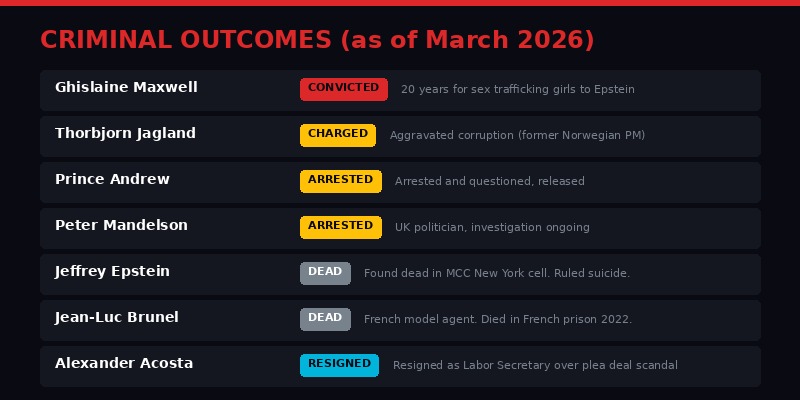
As of March 2026, the criminal outcomes from the Epstein case are:
Convicted: Ghislaine Maxwell (20 years, sex trafficking). That's it. One conviction for an enterprise that operated for decades across multiple countries with the knowledge of some of the most powerful institutions in the world.
Charged: Thorbjorn Jagland (aggravated corruption, Norway).
Arrested and questioned: Prince Andrew (released). Peter Mandelson (investigation ongoing).
Dead before trial: Jeffrey Epstein (2019). Jean-Luc Brunel (2022). Both in custody. Both by hanging. Both with convenient surveillance failures.
Resigned under pressure: Alexander Acosta (Labor Secretary). Joi Ito (MIT Media Lab). Jes Staley (Barclays CEO). Peter Attia (CBS News contributor).
Settled financially: JP Morgan ($290M). Deutsche Bank ($75M). Epstein's estate (hundreds of millions).
Never charged despite being named: Everyone else on the list. Hundreds of names. Billions in combined net worth. Zero additional indictments in the United States.
The Math That Matters
36+ identified minor victims. One conviction. Two dead suspects. Two arrests abroad. Hundreds of named associates. The FBI's own 86-page memo identified 24 women who reported being abused as minors and 14 as adults. One woman told prosecutors that Epstein had her give massages to two men, one of whom raped her. The FBI has not commented on whether those men were investigated.
08 // The Intelligence Question
The single most explosive detail in the Epstein saga is not in the files at all. It's in what Alexander Acosta said to the Trump transition team in 2017: that he was told Epstein "belonged to intelligence" and should be left alone.
Consider the evidence:
- A college dropout with no credentials hired to teach at Manhattan's most elite school
- A fake Austrian passport with a false name listing Saudi residency in the 1980s
- A client list including Adnan Khashoggi, the Saudi middleman in Iran-Contra
- Introduction to the financial world through defense contractors
- An unexplained fortune of $600 million with one known client
- A townhouse in Manhattan - one of the largest private residences in the city - filled with hidden cameras and surveillance equipment
- Security cameras outside his cell that "malfunctioned" on the night of his death
- A plea deal that granted immunity to unnamed co-conspirators
- Files now being removed from public servers by the institution that released them
None of this proves Epstein was an intelligence asset. But it describes a pattern that intelligence agencies use: identify someone with access to powerful people, enable their activities, document everything, use the documentation as leverage.
Whether Epstein was working for the CIA, Mossad, MI6, or simply himself remains an open question. What is not open to question is that he operated for decades with a level of protection that normal criminals do not receive.
09 // Why the DOJ Is Removing Files Now
The DOJ has offered two justifications for removing files:
1. Survivor protection. Some removed documents contained explicit images or personal information of survivors - including one file with unredacted photos of 21 survivors and most of their birthdates. This is a legitimate reason. Exposing survivors' identities is revictimization. Nobody disputes this.
2. Ongoing investigations. The DOJ says some files are withheld to protect ongoing criminal investigations. This is harder to evaluate. What investigations? Against whom? How long have they been "ongoing"? The public has no way to verify this claim.
But CBS's analysis reveals a third category that the DOJ has not explained: files that contained no survivor information and no apparent investigative sensitivity. Fully redacted call logs. Photos of a jail bunk. Documents where the removal makes no protective sense.
Lawmakers who have access to the unredacted files have been explicit: some redactions protect powerful men, not survivors.
"Some of those removed documents contained explicit images or survivor information. But the reasons for other files' removal is unclear, such as a call log with all names redacted and images of Epstein's jail bunk." - CBS News analysis, March 3, 2026
10 // The Unasked Question
The Epstein story is not really about Jeffrey Epstein. He is dead. He was the mechanism, not the machine.
The real questions are:
Who knew? The files show that powerful people continued associating with Epstein after his 2008 conviction. Bill Gates met him multiple times. Steve Bannon exchanged thousands of texts. Les Wexner maintained ties. These were not naive connections. These were informed choices by people who knew exactly what Epstein had been convicted of.
Who enabled? JP Morgan and Deutsche Bank kept Epstein as a client after his conviction. They moved his money. They profited. They paid settlements but admitted no wrongdoing. The financial infrastructure that enabled a convicted sex offender to continue operating is not in the files - it's in the banking system.
Who is being protected now? The DOJ reviewed 6 million pages. It released less than half. It's now removing files from even that partial release. The agency charged with pursuing justice is actively reducing the public's access to evidence.
The Epstein Files Transparency Act was supposed to end the speculation. Instead, it has confirmed the worst suspicion: that the system knows more than it is willing to say, and is capable of erasing what it has already shown.
65,500 pages have vanished. 47,000 files are gone. The DOJ calls it "protection." Critics call it a coverup. The survivors call it what they have been calling it for twenty years: betrayal.
The files are still online. For now. The question is which ones will be there tomorrow.
Get BLACKWIRE reports first.
Breaking news, investigations, and analysis - straight to your phone.
Join @blackwirenews on Telegram