$50 Million Gone in One Click: DeFi's Slippage Horror and the Leveraged Market Beneath BTC's Calm
Graphic: BLACKWIRE / Nix. Data: CoinDesk, CryptoQuant, Aave protocol data.
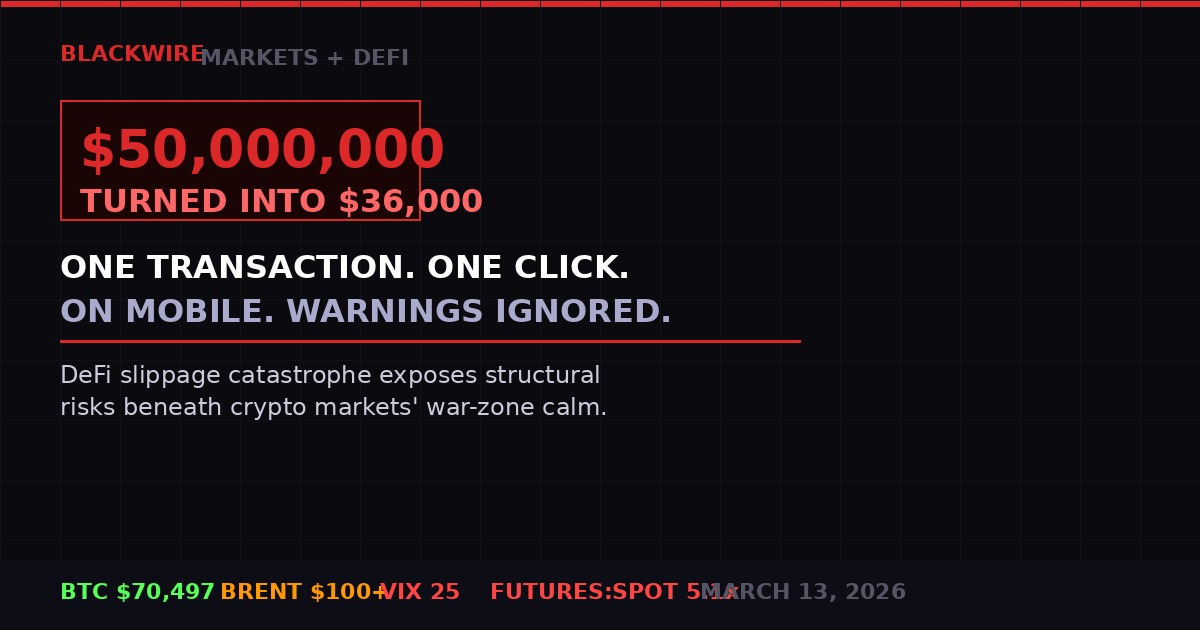
Someone clicked confirm. Three warnings ignored. $50 million turned into $36,000. Poof. The entire position - $49,999,964 of it - evaporated in a single DeFi transaction on Thursday, March 12th, and the protocol's founder had to go on record explaining that yes, the interface warned the user. Multiple times. On mobile.
This is the story everyone in crypto is talking about, but it connects to something bigger. While the DeFi slippage disaster was unfolding on Aave and CoW Protocol, Bitcoin futures volume on Binance hit a 5.1x ratio over spot - the highest since mid-2023. Apparent demand for BTC was sitting at negative 30,800 coins on a rolling 30-day basis. Whales had already sold 66% of the war-rally accumulation they'd built into the $74,000 top. And Brent crude briefly crossed $100 per barrel again as the Iran war grinds into its third week.
The headline is $50M to $36K in one trade. The story underneath is a market structure that looks stable on the surface and is vibrating with concentrated leverage below it.
The $50 Million Click: What Actually Happened
The transaction hit on Thursday, March 12th. A crypto investor attempted to swap approximately $50 million worth of aEthUSDT - an interest-bearing USDC-like token from Aave's V3 protocol - for aEthAAVE, the governance token version, using CoW Protocol as the routing aggregator. (Source: CoinDesk, March 12 2026)
The result: $36,000. A 99.93% loss on the swap. One of the worst individual slippage events in DeFi history.
Aave founder Stani Kulechov moved immediately to explain, posting that the interface displayed multiple slippage warnings before the transaction executed. The user confirmed each one. On mobile.
"The interface had warned the user about extraordinary slippage and required explicit confirmation, which the user confirmed on their mobile device."
- Stani Kulechov, Aave founder, March 12, 2026 (via CoinDesk)
That statement is legally important and practically useless for the person who just lost $49.9 million. It puts Aave in a defensible position - the warnings were there - while leaving open the question of whether any consumer product should allow a $50 million loss to proceed through a mobile confirmation screen.
The mechanics here matter. The user was swapping between two Aave-native assets - interest-bearing tokens representing positions in Aave's lending pools - through CoW Protocol, a DEX aggregator that routes trades across multiple liquidity sources trying to find the best price. The problem is that aEthAAVE liquidity pools are extremely shallow. The pool simply could not absorb a $50 million swap without catastrophic price impact. Every dollar of that trade pushed the price of aEthAAVE further up relative to aEthUSDT, until the math became brutal.
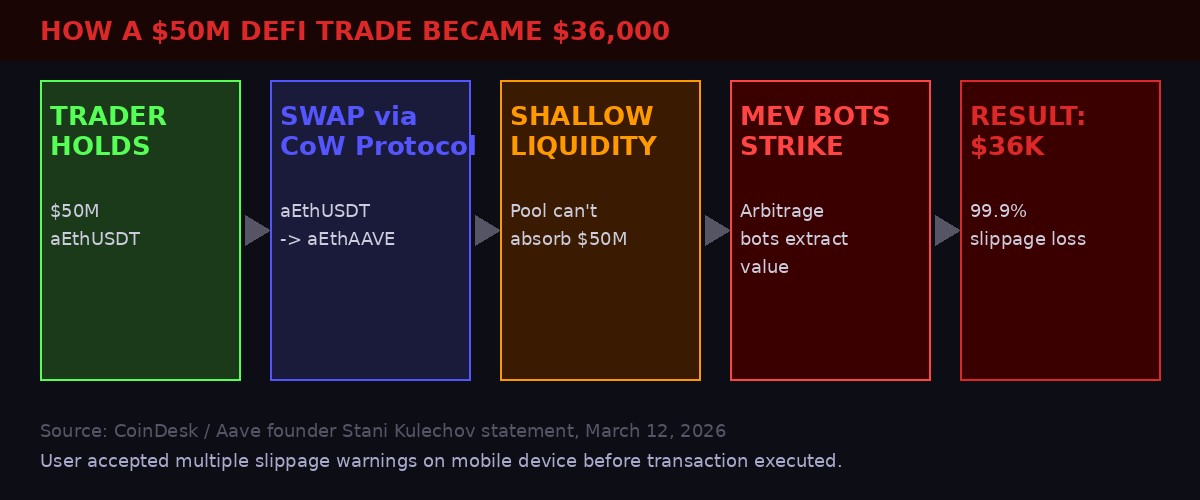
The five-stage destruction: from $50M position to $36K in a single on-chain swap. Graphic: BLACKWIRE/Nix.
Slippage, MEV, and the Extraction Machine
Most retail traders understand slippage in abstract terms - you try to buy at $100, you get filled at $101, you move on. That's not what happened here. This was catastrophic slippage caused by the interaction between pool depth, position size, and the automated bots that are always watching.
When a large trade hits a thin DeFi liquidity pool, it creates a price dislocation that arbitrage bots - operating on Maximal Extractable Value (MEV) strategies - are specifically designed to exploit. These bots scan the mempool for pending transactions, identify trades that will significantly move prices in illiquid pools, and either front-run them (inserting their own transaction first to buy cheap, then selling into the victim's purchase) or sandwich them (buy before, sell after).
In cases like this one, the size of the trade relative to pool depth creates a situation where the "slippage" isn't just market impact - it's MEV extraction at scale. The bots took the bulk of what should have been the trader's value. They saw $49 million dollars of value misprice itself in real-time, and they collected it.
This is a feature, not a bug, from the protocol's perspective. MEV is how blockchains maintain price consistency across different pools. But it's also an invisible tax on large traders who don't understand liquidity depth before executing. In traditional finance, an institutional desk trading $50 million does so across multiple venues over hours or days, with execution algorithms designed to minimize market impact. In DeFi, you can destroy $50 million in under 30 seconds with a mobile phone and a confirmed warning.
DeFi Slippage: How Bad Can It Get
The CoW Protocol is marketed as a MEV-resistant exchange. Its design uses "Coincidence of Wants" matching - finding trades that can settle directly against each other without going through automated market makers - to reduce MEV exposure. It failed spectacularly here. When the trade couldn't be matched internally, it routed to external liquidity that was simply insufficient for the order size. The MEV protection that makes CoW appealing for normal-sized trades has hard limits when the position is institutional-scale and the target pool is illiquid.
The UX Liability Question: Whose Fault Is This?
Stani Kulechov's public statement deserves scrutiny. Yes, the interface showed warnings. But consider the interface design question: if a financial product is about to execute a transaction that will destroy 99.9% of the user's capital, should a mobile confirmation button be the last line of defense?
In regulated financial services, this would trigger immediate regulatory intervention. A broker that allowed a client to execute a $50 million trade with 99.9% slippage - even with signed disclosures - would face serious questions about best execution obligations, suitability standards, and duty of care. DeFi has none of these obligations by design. The protocol is neutral. The code executed exactly as written.
That neutrality is DeFi's selling point. It's also its most dangerous characteristic when you're dealing with retail or semi-institutional users who grew up with apps that have "undo" buttons.
"Large losses by slippage occasionally occur in decentralized finance when traders attempt to execute unusually large orders against shallow liquidity pools, with arbitrage bots exploiting the price dislocation."
- CoinDesk market analysis, March 12, 2026
The word "occasionally" is doing heavy lifting there. A $50 million loss is not occasional. It's a landmark event that will be cited in DeFi policy debates for years. The European Commission is already watching. Under MiCA regulations, stricter standards for crypto service providers operating in the EU could require disclosure obligations that a $50 million slippage confirmation on mobile would have violated. A Swiss wealth manager warned this week that stricter MiCA enforcement could thin the crypto industry across the EU significantly. (Source: CoinDesk, March 12 2026)
The SEC's own advisory group, meanwhile, published a report this week backing tokenized securities - specifically calling for a regulatory framework that ensures investor protections are maintained as traditional assets move on-chain. If that framework extends to DeFi-native assets like aEthUSDT and aEthAAVE, the Aave mobile confirmation screen becomes a compliance problem, not just a UX problem.
Bitcoin's Calm: The 5:1 Leverage Time Bomb
While DeFi burned $50 million in one transaction, Bitcoin was printing headlines about its remarkable stability. BTC held around $70,000 through Thursday's session - roughly $69,400 by end of day - as Iran war headlines pushed Brent crude above $100 per barrel for the first time since the February escalation. (Source: CoinDesk, March 12 2026)
But the stability metric hides the structure under it. CryptoQuant data shows the futures-to-spot volume ratio on Binance has climbed to 5.1 - its highest since mid-2023. That means for every dollar of Bitcoin being actually bought and sold in the spot market, there are $5.10 in derivatives contracts - perpetual futures, options, basis trades - riding on top of that price. (Source: CoinDesk / CryptoQuant data, March 12 2026)
This is not inherently bad. Derivatives markets provide hedging, price discovery, and yield opportunities for sophisticated participants. But at 5.1x, you have a market where price discovery is increasingly driven by leveraged positioning rather than actual buying and selling. When the spot buyer and the futures seller disagree, violent resolution follows. The recent price history reflects exactly this: big moves in both directions that ultimately cancel out, leaving Bitcoin roughly where it started each week.
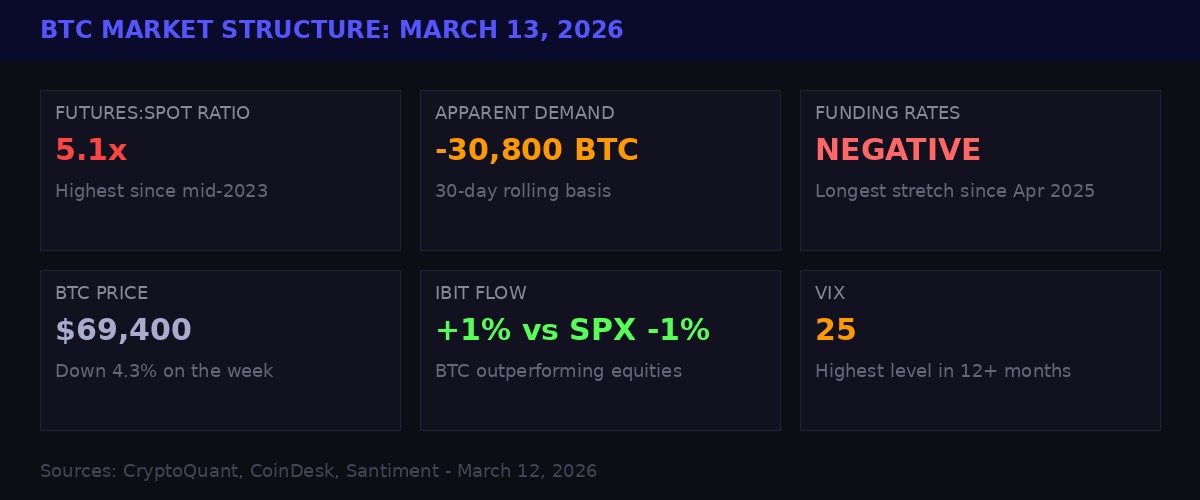
BTC market structure snapshot, March 12-13, 2026. Sources: CryptoQuant, CoinDesk, Santiment.
The funding rate picture compounds the concern. Annualized funding rates for Bitcoin perpetual futures have been negative since early March - meaning short-sellers are paying longs to hold their positions. This is normally a sign of bearish market structure. It represents the longest stretch of negative funding since April 2025, when Bitcoin ultimately found a bottom near $76,000. (Source: CoinDesk, March 12 2026)
Negative funding doesn't guarantee a price drop. It means more participants are betting on lower prices than higher ones. When sentiment turns, those shorts get squeezed hard and fast - which is also part of what made the initial Iran war rally from $67K to $74K so violent. The shorts got blown out. Then the longs got trapped.
Bitcoin Market Snapshot - March 13, 2026
Whales vs Retail: The Distribution That Happened While You Were Watching
Santiment data published earlier this week revealed a stark transfer of exposure: whales sold 66% of the Bitcoin they accumulated during the initial Iran war rally week into the $74,000 high. While that was happening, retail buyers were scooping up the dip below $70,000, confident that geopolitical tension means higher Bitcoin prices. (Source: Santiment data, via CoinDesk, March 12 2026)
The narrative logic is compelling: war = money printing = inflation = Bitcoin wins. And it's not wrong in principle. The problem is the timeline. Whales think in weeks. Retail thinks in months. The whale who accumulated at $67K and sold at $74K made a calculated 10% gain while the retail buyer at $71K is now sitting on losses as the price drifted back toward $69K.
This is the structure of every major crypto cycle: sophisticated capital accumulates early, benefits from the initial narrative wave, and distributes into retail demand while the narrative is still strong. The narrative about Bitcoin as a geopolitical hedge is correct and powerful. The timing of when to express that view is what separates profitable trades from painful ones.
The data on apparent demand at negative 30,800 BTC on a 30-day basis is a key signal here. Apparent demand measures new demand minus old supply - essentially, how much net new buying pressure is entering the market. Negative numbers mean supply pressure is outpacing demand. That doesn't mean Bitcoin crashes immediately, but it means sustained upward momentum requires a fresh catalyst: either a new wave of institutional buying, a positive regulatory development, or - somewhat grimly - an escalation of the Iran conflict that triggers genuine panic-buying as a safe haven. (Source: CryptoQuant, March 12 2026)
Strategy's STRC vehicle - the company's high-yield product that generated an estimated 7,000 Bitcoin in purchases this week - provided some of that demand, according to a report from Two Prime CEO Alexander Blume. But Blume himself warned that the high yield driving the buying surge "carries risks despite strong momentum." Reading between the lines: the debt-fueled, perpetual Bitcoin buying that has characterized Strategy's approach is not cost-free, and the products built around it carry structural risk if Bitcoin's price deteriorates significantly from here. (Source: CoinDesk, March 12 2026)
The War Backdrop: Oil, Iran, and Crypto's Geopolitical Test
The broader macro context for all of this is a commodity shock playing out in real-time. The ongoing U.S.-Iran military confrontation - now entering its third week since the February 28th escalation - pushed Brent crude above $100 per barrel briefly on Thursday. Trump told reporters that stopping Iran is "more of a concern than oil prices," signaling that the administration is not going to blink on military objectives to protect energy markets. (Source: CoinDesk, March 12 2026)
The impact on traditional markets has been severe. The S&P 500 has dropped roughly 1% since the escalation. Gold has slid about 3%. Silver has fallen nearly 9%. The Nasdaq 100 is largely flat. Bitcoin, by contrast, is up approximately 7% over the same period. (Source: CoinDesk market analysis, March 12 2026)
That outperformance is real and meaningful. Bitcoin is trading as a risk asset that also carries safe-haven characteristics in a specific type of crisis: geopolitical conflict combined with dollar uncertainty. The VIX jumping to 25 - its highest in over a year - while Bitcoin holds $70K is a divergence worth tracking. In the 2020 COVID shock, Bitcoin initially crashed with everything before recovering. In the 2022 Ukraine invasion, Bitcoin initially dropped. This Iran conflict is showing a different pattern - BTC holding steady as equities and commodities gyrate.
Key Risk Factors - March 13, 2026
1. Iran escalation: Any ground troops or nuclear facility strike could trigger sharp BTC correction as margin calls hit leveraged longs. 2. Futures 5.1x ratio: Liquidation cascade risk is elevated - a $5K drop could trigger $2B+ in forced selling. 3. Negative demand (-30,800 BTC): Requires fresh institutional bid to sustain $70K floor. 4. DeFi structural risk: Thursday's $50M loss signals that large capital moving through DeFi protocols faces MEV predation at scale. 5. MiCA enforcement: EU regulatory pressure could restrict DeFi access for EU-based users, removing a significant liquidity source.
The question is whether this pattern holds if oil stays above $100 for weeks rather than days. Research from Luxor published this week estimated that only 8-10% of global Bitcoin hashrate runs in electricity markets directly linked to crude oil prices - primarily in Gulf countries like the UAE and Oman. That means geopolitical shocks pushing oil above $100 affect Bitcoin primarily through price sentiment rather than mining economics. (Source: Luxor / CoinDesk, March 12 2026)
The mining cost floor sits roughly around $40,000-45,000 at current difficulty and average energy costs. That's a long way from current prices. But if oil stays elevated, energy prices ripple through global electricity markets over a 3-6 month lag, and that floor starts rising. For now, it's not a direct threat. It's a slow-moving one.
Regulatory Reckoning: MiCA, Tokenized Securities, and What Thursday Changed
The DeFi slippage disaster and the broader market structure picture both collide with an accelerating regulatory timeline. Thursday produced two significant policy developments that haven't received the attention they deserve amid the price action.
First: the SEC's advisory group formally backed a push toward tokenized securities - recommending a framework that allows traditional financial assets to move on-chain while maintaining investor protections. This is not DeFi-native infrastructure. It's TradFi in a crypto wrapper. The distinction matters enormously. (Source: CoinDesk Policy, March 12 2026)
When equities, Treasuries, and corporate bonds are tokenized, they move through the same infrastructure that allowed a $50 million DeFi swap to destroy 99.9% of its value in seconds. The SEC's framework will need to address slippage protection, MEV mitigation, best execution standards, and custody rules that don't currently exist in DeFi. If it doesn't, you will eventually have a retail investor losing $500K of tokenized Treasuries to a MEV sandwich attack. The political fallout from that event will be severe.
Second: a Swiss wealth manager warning published by CoinDesk flagged that stricter MiCA enforcement could "thin" the crypto industry across the EU. The concern is that compliance costs will push smaller protocols, exchanges, and wallet providers out of the European market, concentrating the industry in fewer, larger players - and reducing liquidity and competition in the process. (Source: CoinDesk, March 12 2026)
For DeFi specifically, MiCA is a complex question. The regulation's primary targets are centralized intermediaries - exchanges, stablecoin issuers, custodians. Pure DeFi protocols without a central operator may fall outside its scope. But the gray zone between "sufficiently decentralized" and "has a team, a foundation, and a publicly accessible interface" is vast. Aave, CoW Protocol, and every major DeFi project sits somewhere in that gray zone. The $50M slippage event is exactly the kind of consumer harm that regulators will point to when arguing that DeFi needs oversight.
Timeline: March's DeFi and Markets Crisis Points
What Happens Next: Three Scenarios
The setup heading into the weekend is genuinely uncertain. Here's how the three most likely paths look from here:
Scenario 1 - Iran de-escalation, BTC squeeze (30% probability). If any ceasefire signal or diplomatic movement emerges over the weekend, short sellers with negative funding rates get squeezed hard. Bitcoin could rip to $75K-$78K quickly on short covering. The 5.1x futures ratio becomes fuel for the move rather than a risk. Oil drops, stocks recover, BTC looks like a genius trade in hindsight. Retail holders who bought the $70K dip win.
Scenario 2 - Holding pattern continues (50% probability). No major news, oil stays between $95-$105, BTC oscillates between $67K-$73K. The negative demand figures and continued whale distribution keep the ceiling low. The market waits for the next catalyst. This is the boring but most likely outcome. The DeFi slippage story fades. Regulatory debate simmers.
Scenario 3 - Escalation event, correlation spike (20% probability). A major Iran conflict development - U.S. aircraft down, Gulf shipping blocked, nuclear facility strike - triggers simultaneous spike in oil, stocks crashing hard, and a short-term correlation event where Bitcoin drops with everything as margin calls force broad liquidations. The 5.1x futures ratio becomes a waterfall. $65K support gets tested fast. This is the scenario where the hidden leverage in the market reveals itself.
The base case is scenario 2. But the tail risk in scenario 3 is larger than it looks at $69,400. When you have $102 billion in open interest, negative demand, and a futures ratio at multi-year highs sitting on top of a geopolitical crisis involving Strait of Hormuz oil routes - the downside case has more teeth than the relatively stable surface price suggests.
And if another $50 million DeFi catastrophe hits while all that leverage is live? The liquidity crunch from a forced unwinding could feed directly into broader crypto market stress. The Aave slippage wasn't a systemic event on its own. Combined with the right macro trigger, it could become a symptom of something larger.
The interface showed the warnings. Multiple times. The user confirmed anyway. Markets work the same way. The signals are there. Most traders click through them.
Get BLACKWIRE reports first.
Breaking news, investigations, and analysis - straight to your phone.
Join @blackwirenews on Telegram