Cuba Breaks Silence: Secret US Talks Confirmed as Island Goes Dark
President Diaz-Canel admitted Friday that Havana has been negotiating with Washington - the first official confirmation of secret backchannel diplomacy as Cuba's energy grid collapses under an American oil blockade. Three months without petroleum. Buses stopped. Surgeries postponed for tens of thousands. And Trump is already telling allies Cuba is next.
Cuba's government broke its silence Friday. President Miguel Diaz-Canel, in a nationally televised address, confirmed what Washington had already been hinting at for weeks: the two nations have been talking. Secret meetings. Back channels. Quiet negotiations happening while Cuba's streets went dark and its buses stopped running.
The revelation came the same week Cuba entered what analysts are calling its worst energy crisis since the Soviet-era Special Period of the 1990s. No petroleum has arrived on the island in three months. Tens of thousands of surgeries have been postponed. The national bus system halted in parts of Havana. Bakeries converted to run on firewood. And through all of it, Washington has been at the table - though exactly what was being offered, or demanded, remains classified.
The timing is not accidental. Operation Epic Fury, the U.S.-led war against Iran, is now in its 15th day. With Iranian resistance still active and the Persian Gulf in semi-paralysis, Trump is already talking about his next move. Cuba, the president suggested this week, would be high on the post-Iran agenda.
For Havana, confirmation of the talks is a high-risk bet. It signals desperation. But it also signals that the Cuban government - for the first time in decades - may be open to renegotiating the terms of its survival.
What Diaz-Canel Actually Said
Speaking on state television Friday, Diaz-Canel chose his words with surgical precision. The talks, he said, "were aimed at finding solutions through dialogue to the bilateral differences between our two nations." He credited "international factors" for facilitating the exchanges - widely interpreted as a reference to the Iran war reshaping American foreign policy priorities across the hemisphere.
"We need to determine the willingness of both parties to take concrete actions for the benefit of the people of both countries. And in addition, to identify areas of cooperation to confront threats and guarantee the security and peace of both nations." - Cuban President Miguel Diaz-Canel, March 13, 2026 (AP)
What he did not say was equally significant. No specifics on what was discussed. No timeline for resolution. No statement on whether the blockade would be eased. Diaz-Canel gave just enough to confirm talks exist - while giving Washington no leverage from the admission itself.
The White House response was characteristically blunt. Press secretary pointed reporters to Trump's own public comments: that Secretary of State Marco Rubio is leading the Cuba talks with the goal of pressing "major changes in Cuban policies and governance." That phrase - regime change by another name - signals the American position is not rapprochement. It is submission, or something close to it.
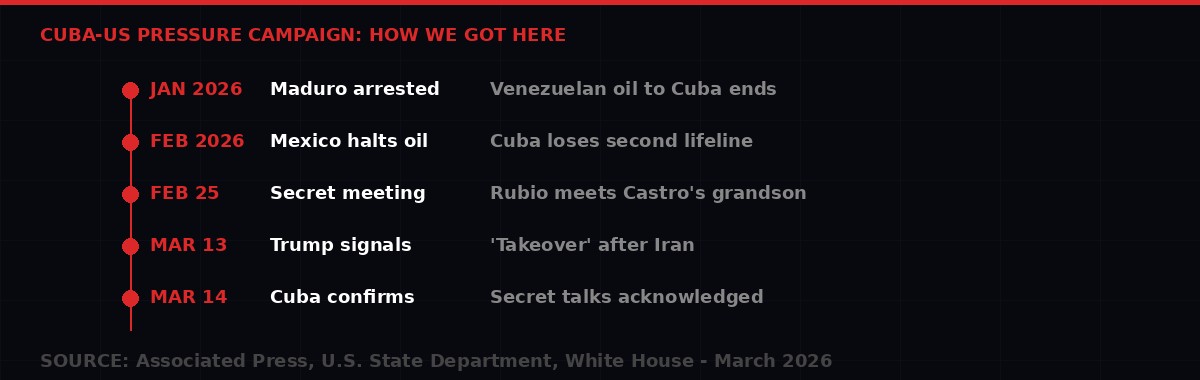
The ground-level detail that followed the official confirmation raised more eyebrows. Two U.S. officials, speaking anonymously to AP, confirmed that Rubio himself met secretly with Raul Guillermo Rodriguez Castro - grandson of retired Cuban leader Raul Castro - at the end of February in St. Kitts and Nevis, on the sidelines of a Caribbean Community leaders meeting. A secret meeting with a member of the Castro dynasty, conducted by a Cuban-American secretary of state whose family fled the island in the 1950s. The symbolism alone is staggering.
The Collapse on the Ground
While diplomats met in Caribbean resorts, ordinary Cubans were living the consequence of the blockade in real time. In Havana, a city of 2 million, the scenes this week have been stark.
Buses stopped running in working-class districts. Solanda Ona, a 64-year-old bookseller, waited hours for a bus after work on Thursday night. It never came. She slept in a nearby restaurant. "Before, things were always difficult," she told AP. "But there was always one bus. One way to get home. Now, there are none."
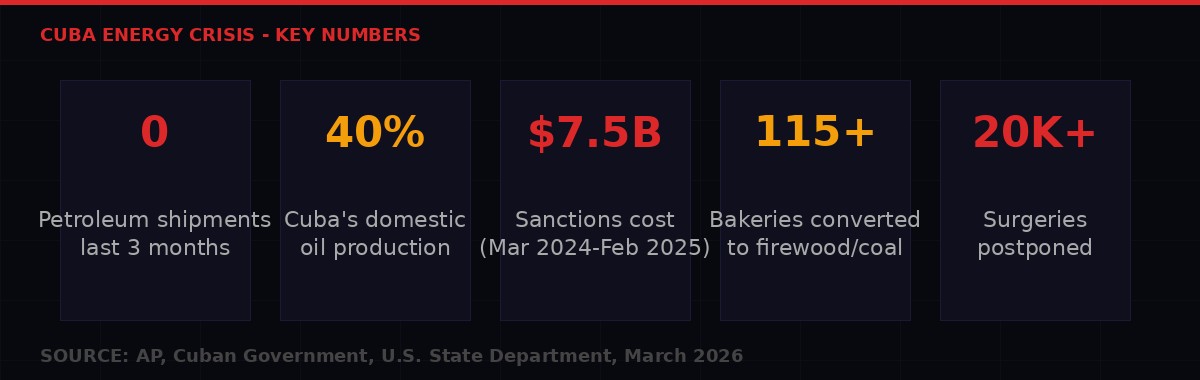
Diaz-Canel confirmed Friday that no petroleum shipments have arrived in Cuba in three months - the direct result of U.S. efforts to cut off the island's supply chains. Cuba generates 40% of its oil domestically and historically imported the rest from Venezuela and Mexico. Both supply lines are now severed.
Venezuela's shipments ended in January after the U.S. military captured and arrested former President Nicolas Maduro. Mexico, under pressure from Washington, halted its exports to Cuba in late January. The two lifelines that kept Cuba functional for decades - gone within weeks of each other, engineered by the same administration now offering "talks."
"What does it mean to not allow a single drop of fuel to reach a country? It affects the transportation of food, food production, public transportation, the functioning of hospitals, institutions of all kinds, schools, economic production, tourism. How do our vital systems function without fuel?" - Diaz-Canel, national address (AP)
The government has converted more than 115 bakeries to run on firewood or coal. The University of Havana announced it would cancel events and push for remote learning due to "energy deficits." The national transportation company cut routes in the eastern part of the island. Two power plants shut down after fuel oil and diesel ran out.
Most critically: surgeries for tens of thousands of Cubans have been postponed as hospital systems struggle to maintain power. The Cuban communist government says U.S. sanctions cost the country more than $7.5 billion between March 2024 and February 2025 - substantially more than the year before.
The Special Period Redux
Cubans with long memories are using a phrase not heard since the early 1990s: the Special Period. It refers to the catastrophic economic contraction Cuba experienced after the Soviet Union collapsed and the subsidized oil and goods it provided vanished overnight. Between 1990 and 1994, Cuba's GDP fell by roughly 35%. Calories dropped, transportation collapsed, and blackouts became routine.
What is happening now is structurally similar. An external economic guarantor - in this case Venezuela - has been eliminated by American military action. A second supply source - Mexico - has been cut off by American economic pressure. The island, which produces only 40% of its own oil, is being systematically starved of energy by a superpower that has signaled intent to force regime change.
The comparison is not perfect. Cuba in 2026 has more developed infrastructure, more private enterprise, and more diaspora remittances than it did in 1990. But the fundamental vulnerability is the same: energy dependency on external partners, and those partners can be neutralized one by one.
For ordinary Cubans, the political calculus means little. Elvis Hernandez, 62, said Friday: "Cubans are desperate. You can't live without water or electricity. That's why we want a consensus to be reached. If there are talks, let them be productive."
Miguel Garcia, 65, was more direct: "If all of this leads to agreements and solutions that will improve our lives, then all the better, because the situation is quite difficult right now."

Trump's Endgame: Regime Change After Iran
The Trump administration's posture toward Cuba is not subtle. The president told reporters this week in Florida: "It may be a friendly takeover, it may not be a friendly takeover." He added that he and Rubio would focus on Cuba after the Iran war concludes.
The phrase "takeover" - used openly, by the sitting U.S. president, about a sovereign nation - signals something well beyond diplomatic pressure. It follows a pattern now established across the hemisphere.
In January, Trump ordered a military operation that captured Venezuelan President Nicolas Maduro. Maduro is now in U.S. custody, charged with narco-terrorism. Venezuela's government was dismantled. The message to Havana was unmistakable: the playbook exists, it has been used once already, and Cuba is next on the list.
Trump has explicitly told Cuban leaders they would "be smart to avoid the fate" of Maduro. Rubio, the son of Cuban immigrants and a lifelong Cuba hawk now running U.S. foreign policy, has long pushed for aggressive action against Havana. He told senators earlier this year the administration would "love" to see Cuban regime change - while cautioning that "does not mean we are going to provoke it directly."
Whether the ongoing talks represent genuine negotiation or a coercive ultimatum dressed as diplomacy is the central question. The energy blockade creates leverage. The Maduro precedent creates fear. The secret meetings create the appearance of good faith. It is a well-constructed pressure campaign - and Diaz-Canel's public confirmation of the talks suggests Cuba may be looking for an exit.
Congressional Backlash and the War Powers Question
The prospect of U.S. military action against Cuba has triggered a Democratic response on Capitol Hill. Senators Tim Kaine, Ruben Gallego, and Adam Schiff filed legislation Thursday that would require congressional approval before the U.S. could attack Cuba.
"Only Congress has the power to declare war under the Constitution, but he operates with the belief that the U.S. military is a palace guard, ordering military action in the Caribbean, Venezuela, and Iran without Congress' authorization or any explanation for his actions to the American people." - Sen. Tim Kaine, D-Virginia (AP)
The resolution is the latest in a series of Democratic war powers challenges to Trump's foreign military actions - none of which have passed the Republican-controlled Senate. Democrats plan to force votes on Iran war powers resolutions as early as next week, unless Republicans agree to public hearings on the conflict.
"He ran on America First, but now it's clear he's become a puppet of the war hawks in his party," said Rep. Ruben Gallego.
The constitutional argument is real, but politically weak. Republicans have backed Trump on every foreign policy vote so far. The precedent of Maduro's capture - conducted without explicit congressional authorization and wildly popular with the Republican base - makes it unlikely the Senate would rebuff a Cuba operation if Trump ordered one.
The U.S. State Department has also raised the possibility of reducing embassy staffing in Havana if fuel shortages affect diplomatic operations - a move that would escalate tensions further and require a reciprocal reduction of Cuban diplomatic presence in Washington. Brian Fonseca of Florida International University warned: "The diplomatic staff are your eyes and ears on the ground. A downgrading scenario could complicate or challenge U.S. understanding of what's going on, on the ground."
The Rubio-Castro Meeting and What It Means
The February meeting in St. Kitts and Nevis between Rubio and Raul Guillermo Rodriguez Castro is arguably the most significant diplomatic development in US-Cuba relations in years - and it happened in complete secrecy.
Rodriguez Castro does not hold an official Cuban government position. He is Raul Castro's grandson and is believed to exercise informal influence within the Cuban power structure. His selection as an interlocutor suggests the Cuban government was operating carefully - using a family-connected intermediary rather than a government official, preserving plausible deniability while still engaging substantively.
Rubio's selection as the American interlocutor is equally deliberate. A Cuban-American senator whose family left the island before the revolution, Rubio has spent his career as one of the most vocal opponents of the Cuban government in Washington. His presence at the table signals the Trump administration's seriousness - and its ideological frame. This is not engagement for its own sake. Rubio wants regime transformation.
What was discussed in St. Kitts remains classified. But the timing - late February, weeks into the Iran war, as Venezuela's oil supply was already cut and Mexico's was wavering - suggests the Cubans may have been seeking assurances about how long the blockade would continue. The Americans, likely, were presenting terms.
Cuba-US Crisis: Key Timeline
The Stakes: What Happens Next
Several scenarios are now in play, and none of them are simple.
The best case for Havana is that the talks produce a deal - some combination of Cuban policy concessions in exchange for easing the oil blockade and a U.S. pledge not to pursue military action. What those concessions might look like is unclear. Trump's framing of "major changes in Cuban policies and governance" suggests nothing short of fundamental political transformation would satisfy Washington's most hawkish voices.
The worst case is that the talks are a stalling tactic on the American side - maintaining the appearance of diplomacy while the blockade continues, the economy deteriorates further, and public pressure builds on the Cuban government from its own population. Coercive in design, diplomatic in packaging.
The middle scenario - most likely, based on the pattern seen elsewhere - is a negotiated transition of some kind. Not a full regime change, but a significant reduction in Cuban government authority over key sectors, combined with economic relief and political guarantees for senior officials. The Maduro model in reverse: instead of arrest, retirement with immunity.
For the Cuban population, the immediate question is simpler. The island's energy grid is failing. Hospitals are rationing surgeries. Buses are not running. The question is not whether the current situation is sustainable - it is not. The question is how the transition, whatever form it takes, will affect 11 million people who have already absorbed decades of economic punishment.
The U.S. announced $6 million in humanitarian aid Thursday night - a gesture that analysts described as simultaneously generous and insufficient given the scale of the crisis. Six million dollars against a $7.5 billion annual sanctions burden. The math signals the aid is symbolic, not structural.
The island is at an inflection point 67 years in the making. Fidel Castro came to power in 1959. Cuba outlasted the Bay of Pigs, the Cuban Missile Crisis, decades of embargo, and the Soviet collapse. The current pressure is qualitatively different - a systematic strangulation of energy supply backed by the precedent of Venezuela and the explicit threat of military force from an American president who has already shown he will use it.
Diaz-Canel confirmed the talks. What he cannot yet confirm is whether they lead anywhere Havana can live with - or whether the island's next chapter is written in Washington.
Get BLACKWIRE reports first.
Breaking news, investigations, and analysis - straight to your phone.
Join @blackwirenews on Telegram