
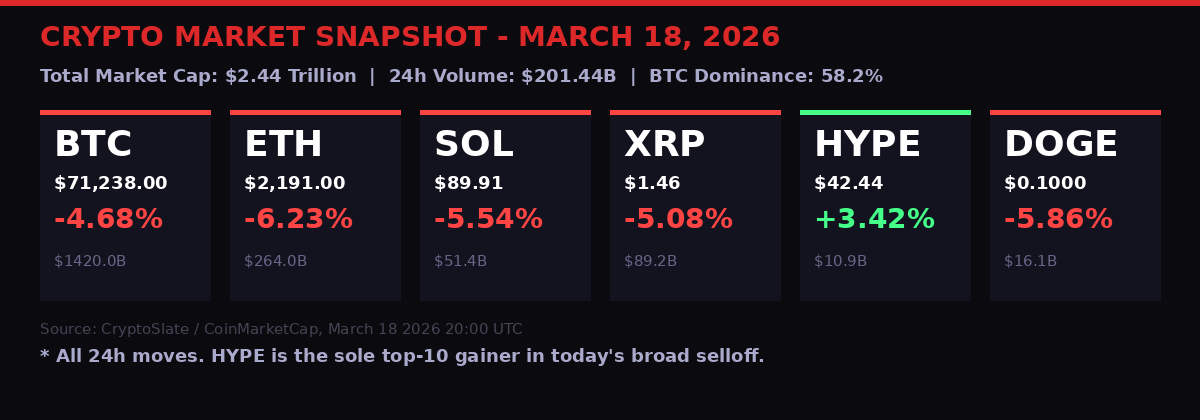
The Post-FOMC Dump - What Happened and Why Markets Don't Care About "Hold"

The Federal Open Market Committee held rates steady at its March 2026 meeting, as expected. No surprise. No pivot. No new signals. The Fed funds rate stays parked in the 4.25-4.50% range, exactly where it has sat since December 2024. Jerome Powell's press conference carried no new information. Markets took one look at that and sold everything.
This is a pattern that traders learned the hard way in 2024 and 2025: "hold" is not neutral. When inflation remains elevated, geopolitical pressures are building, and every macro indicator points to sustained high rates, a hold is effectively a hawkish signal. The market was pricing in at least one cut this year. Powell gave zero comfort on that front.
Bitcoin had been hovering near $74,000 going into Wednesday's session - close to resistance it tried to clear three times this month. The moment the FOMC statement dropped with no dovish language, sellers stepped in fast. BTC fell through $73,000, then $72,000, and settled around $71,238 by evening European time. That's a $2,800 intraday drop from the morning's range.
The total crypto market cap peeled back by roughly $120 billion in a matter of hours - from approximately $2.56 trillion to $2.44 trillion. On a percentage basis that's modest. In raw dollar terms it represents an enormous single-session capital exit. Most of it was leveraged long liquidations - traders who had bet on a post-FOMC breakout got stopped out hard.
On-chain data shows that the decline was orderly rather than panic-driven. There were no mass exchange inflows suggesting retail capitulation. Whale wallets above 1,000 BTC held steady. This looks more like a scheduled deleveraging event than a structural breakdown - similar to what happened on the January 2026 FOMC, where BTC sold off 6% and then recovered within five trading sessions (source: Delphi Digital, March 6 analysis).
The key number to watch going forward: $69,500. That's the critical support level where the previous breakout began in late February. A close below that level changes the technical picture significantly.
SEC's Historic U-Turn: Crypto Tokens Are Now "Digital Commodities"

While markets processed the Fed's non-move, the bigger structural story of March 18 came from the SEC. The commission published a formal statement declaring that most crypto tokens are "digital commodities" - not securities - reversing years of enforcement-first regulatory doctrine that had defined the Gensler era (source: CryptoSlate, March 18 2026).
This is seismic. For the past five years, the SEC treated virtually every token as a potential security under the Howey Test framework. That approach led to dozens of enforcement actions, billions in fines, exchange delistings, and a chilling effect on the entire US crypto industry. Coinbase faced an existential lawsuit. Ripple fought for three years in court. Hundreds of smaller projects quietly moved offshore rather than face regulatory uncertainty.
Now, with one official policy statement, the SEC has flipped the default: most tokens are commodities, not securities, and therefore fall under CFTC jurisdiction rather than SEC oversight.
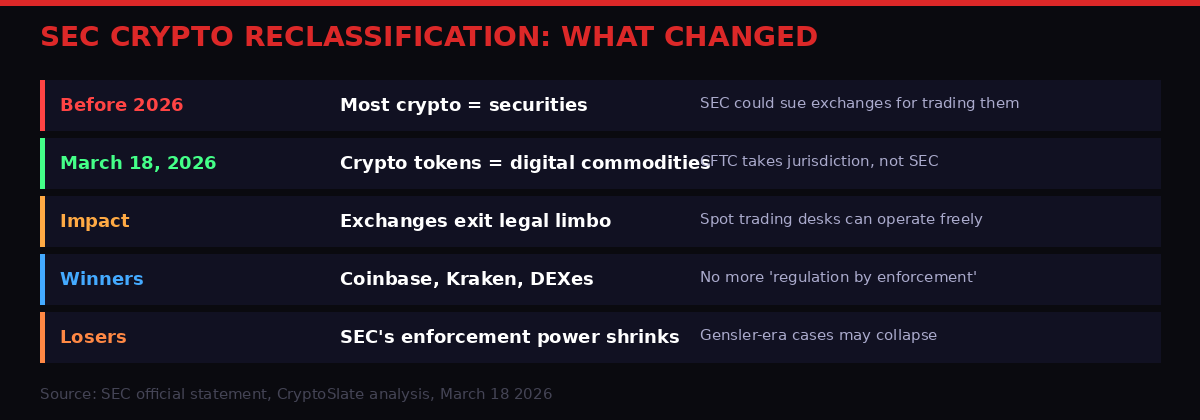
The practical implications are enormous. Exchange legal teams across the US are already reviewing their delistings. Tokens that were removed from Coinbase and Kraken to avoid securities liability could now be relisted. DeFi protocols that built offshore structures specifically to avoid SEC reach may now be able to return to the US market.
Legal observers noted that the timing is politically calculated. The Trump administration has been explicitly pro-crypto since taking office, and the new SEC chair - appointed in February 2026 - has been on record as favoring a "commodities-first" approach to digital assets. The statement is consistent with that direction, even if the formal legal weight of a policy statement versus a rulemaking process remains to be tested in court.
"This is the outcome the industry has been fighting for since 2017. The SEC just admitted what most legal scholars already knew - that applying the Howey Test to utility tokens and decentralized protocols was a category error from the start."
- Dragonfly General Partner Rob Hadick, in a March 10 podcast discussion (Unchained, ep. 1058)
The question now is implementation. A policy statement is not a rule. It can be reversed by the next administration. Congress is still working on a formal Digital Assets Clarity Act that would codify these distinctions in statute. Until that passes, the industry is operating on a promise, not a law.
But for now, the immediate effect is a massive reduction in legal uncertainty. Companies that had been sitting on US market expansion plans are now being forced to reassess their timelines. The $79.45 billion stablecoin market and the $6.53 billion Chainlink ecosystem are watching closely - both have significant exposure to whether their tokens are classified as commodities or securities.
Hyperliquid: The One Thing That Went Up

In a session that saw Bitcoin down 4.7%, Ethereum down 6.2%, and most altcoins off between 4% and 10%, one asset stood completely apart: Hyperliquid's HYPE token, up 3.42% on the day.
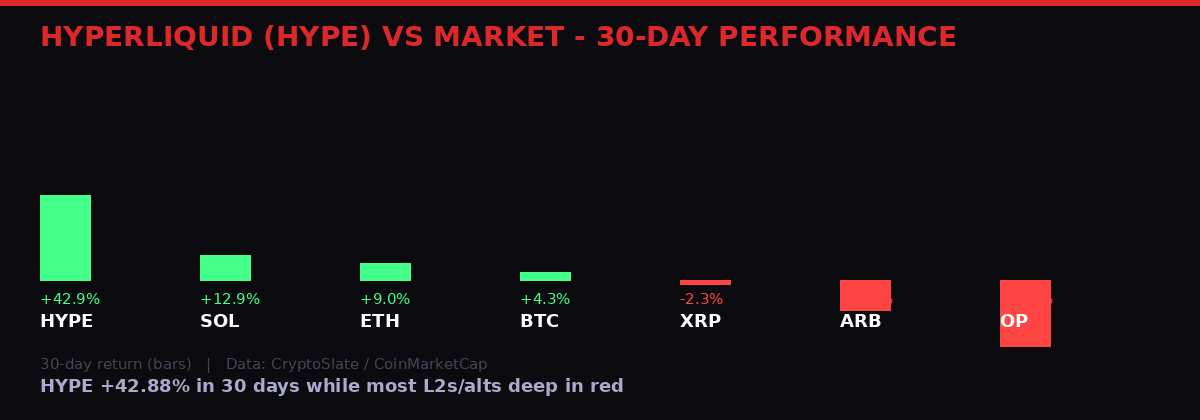
That number looks modest in isolation. In context, it's extraordinary. HYPE was the only major asset in the top 100 posting gains on Wednesday. Everything else bled. HYPE compounded on a 7-day gain of 17.26% and a 30-day gain of 42.88%, making it one of the strongest performing large-cap assets of the quarter.
The market cap has now crossed $10.9 billion, putting HYPE firmly in the top 10 by capitalization (source: CryptoSlate, March 18 2026).
What's driving this? Three structural factors converge.
First, Hyperliquid runs a native perpetual futures DEX that has been consistently printing record volume. Daily perp trading volumes have exceeded $5 billion on strong sessions, competing directly with centralized exchanges like Binance and Bybit for derivatives market share. Each unit of volume benefits HYPE token holders through fee revenue and buybacks.
Second, the platform's move into tokenized futures - bringing real-world asset exposure on-chain - has attracted institutional attention. BLACKWIRE's March 7 report covered Hyperliquid's $1.2 billion tokenized futures launch, which gave TradFi-adjacent traders access to equity and commodity futures on a fully decentralized platform. That product is generating consistent fee flow.
Third, and perhaps most importantly, Hyperliquid represents the thesis that has been winning this cycle: DeFi infrastructure with actual revenue. Not protocol tokens backed by governance rights and speculation, but platforms generating real cash flows that accrue directly to token holders. In a market where traders are increasingly skeptical of yield promises without substance, HYPE's verified on-chain revenue makes it stand out.
The comparison to Ethereum is instructive. ETH is down 6.23% today and down 11.28% over 30 days. HYPE is up 42.88% over the same period. Both are smart contract platforms. The difference is that Hyperliquid's fees actually flow to holders in a transparent, auditable way, while ETH's value accrual thesis has become increasingly contested as L2s route more activity off the mainnet.
The bear case: HYPE is highly concentrated. A relatively small float and aggressive insider and early investor positions mean that the current price could see sharp corrections if conviction falters. The token also has real exchange competition risk - Binance and Coinbase are both investing heavily in their on-chain derivatives products. If the incumbents close the gap, Hyperliquid's premium may compress fast.
OpenSea Kills Its Token Launch - The NFT Market Is In Free Fall

On March 17, just one day before this report, OpenSea CEO Devin Finzer posted on X that the platform was postponing its SEA token generation event indefinitely. The TGE had been scheduled for March 30, attached to a major event. No new date was given (source: Unchained Daily, March 17 2026).
The numbers tell the story without any narrative needed. NFT market capitalization has fallen roughly 50% since its mid-January 2026 peak, currently sitting at approximately $1.6 billion. OpenSea's monthly volumes have slipped below $500 million - a fraction of the platform's 2021-2022 dominance, when monthly volumes regularly exceeded $4 billion.
Finzer's statement acknowledged the delay bluntly: "A delay is a delay. I'm not going to dress it up, and I know how it lands." He cited challenging market conditions without providing specific metrics.
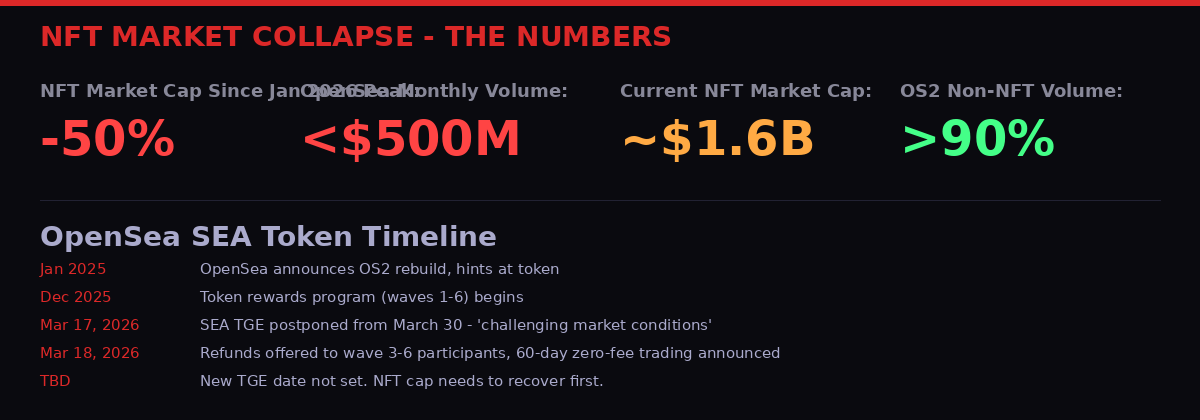
To soften the blow, OpenSea offered fee refunds for participants in rewards waves three through six, and announced zero-percent token trading fees for 60 days starting March 31. These are retroactive concessions designed to retain community goodwill while the platform waits for conditions to improve.
But the deeper issue is structural. OpenSea's OS2 rebuild has quietly transformed the platform from an NFT marketplace into a general crypto trading hub. More than 90% of its trading volume now comes from standard cryptocurrency swaps rather than NFT transactions. The platform is, in effect, pivoting away from the market that made it famous.
This shift has significant implications. The SEA token was designed with NFT trader rewards at its core - six waves of rewards for NFT transaction volume. If NFT trading has been replaced by swap volume as the platform's primary activity, the entire tokenomics model needs to be rethought. A token designed to reward activity that barely exists anymore is not a token that will find strong market demand.
The broader NFT market's collapse is not OpenSea-specific. Market cap at $1.6 billion today compares to a peak of roughly $40 billion in January 2022. That is a 96% decline from cycle peak. The current $1.6B represents a floor that has held - mostly because the remaining projects are genuinely profitable ecosystems rather than speculative flips. But for a token launch to succeed, the platform needs momentum, not a survival story.
Competitor Blur has been aggressively expanding in the professional trader space. Magic Eden has made inroads with gaming NFTs and cross-chain volume. OpenSea's window to dominate a recovering NFT cycle is not guaranteed to remain open. The SEA token delay may cost the platform its best opportunity to remonetize the loyalty it built during the 2021-2022 bull run.
Corporate Crypto Treasuries - Strategy Holds 738,750 BTC, and It Keeps Buying

As spot prices fell Wednesday, the long-term structural thesis for Bitcoin got another data point that bulls can point to: corporate treasury accumulation is accelerating, not slowing.
Michael Saylor's Strategy - formerly MicroStrategy - now holds approximately 738,750 bitcoin. The firm's most recent purchase used proceeds from its STRC perpetual preferred shares, a funding vehicle introduced in July 2025 that pays 11.5% annualized dividend and has become the central mechanism for continued accumulation. In March alone, Strategy made multiple purchases totaling close to 20,000 BTC at an average price near $72,000 (source: Unchained, March 10 2026).
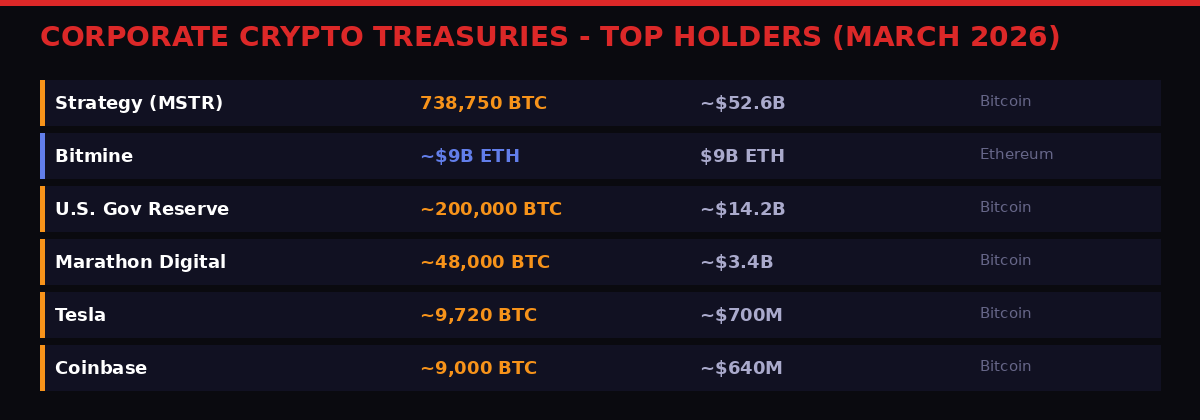
The emerging competitor in the corporate treasury space is not another Bitcoin maximalist. Bitmine, chaired by Tom Lee - the perennial Bitcoin bull and Fundstrat co-founder - has been accumulating Ethereum instead. Bitmine holds approximately $9 billion in ETH, with roughly $6 billion already staked. That staking yield generates passive income in a way that Bitcoin's proof-of-work design doesn't permit (source: Unchained, March 10 2026).
This creates a fascinating divergence in corporate treasury philosophy. Strategy bets on Bitcoin as the ultimate store of value - censorship-resistant, fixed supply, increasingly scarce. Bitmine bets on Ethereum as a productive asset - a platform that generates yield through staking while also benefiting from network activity growth. Both theses can be correct simultaneously, but the market will ultimately price them very differently in a rate environment where staking yields compete with treasuries.
At $71K, Strategy's treasury is worth approximately $52.6 billion. Every $1,000 move in BTC represents a $738 million swing in their portfolio. At the current STRC funding cost of 11.5%, Strategy needs Bitcoin to compound at roughly 6-8% per year just to break even on its leverage. That math works when BTC is in a structural bull market. It becomes uncomfortable if BTC settles into a $50-70K range for an extended period.
The broader signal, however, is clear: institutional and corporate confidence in Bitcoin as a balance sheet asset has never been higher. The diversification into ETH by Bitmine suggests that the narrative is evolving beyond "Bitcoin only" to a multi-asset digital treasury strategy. That broadening of the institutional base is structurally positive for the sector even if day-to-day price action remains choppy.
The Macro Backdrop: Real Rates, Geopolitics, and Why This Selloff Differs From January

Wednesday's dump doesn't exist in isolation. It's the third FOMC-related selloff crypto has experienced in the past 12 months. Each time the Fed holds without a clear dovish signal, digital assets sell off. Each time, the recovery has been faster and the subsequent rally has reached higher highs. That pattern has been Bitcoin's entire post-2023 playbook.
The key macro variable analysts are watching is real rates - the fed funds rate minus actual inflation. Right now, real rates are still positive. That means capital sitting in Treasury bonds earns a real return, making risk assets compete harder for allocation. When real rates were deeply negative in 2020-2021, everything crypto touched went vertical. The 2022-2023 cycle reset was directly driven by rate normalization. Bitcoin's current $71K price represents an equilibrium where real rates are positive but declining, and institutional demand is absorbing the competition from bonds.
Bitcoin actually performed a rare function during the Iran conflict escalation earlier this month - it held its ground while traditional safe havens faltered. STIX Investments analyst Will Clemente noted in a March 6 Unchained episode that Bitcoin "finally acted like a hedge" during geopolitical stress. That behavior shift, if it persists, dramatically changes Bitcoin's portfolio value proposition.
The Iran situation remains a background risk. Oil prices above $108 per barrel maintain stagflationary pressure. If energy prices stay elevated, they feed directly into core CPI, making it harder for the Fed to justify cuts. That macro ceiling is real - and it's why analysts at Dragonfly Capital have been warning that the altcoin recovery thesis depends critically on the Fed cutting before Q3 2026.
The FOMC meeting that concluded Wednesday included updated Summary of Economic Projections. Markets were watching the "dot plot" for any change in the distribution of rate expectations among committee members. The lack of any significant shift toward more cuts - combined with upward revisions to 2026 inflation projections - is what triggered the selling. Traders had been pricing in two cuts by year-end. The updated dots suggest one cut is the realistic ceiling, and even that may not materialize if CPI stays sticky.
L2 Bloodbath and the Altcoin Reckoning

If the broader selloff was brutal, the Layer 2 token market was carnage. Wednesday's session exposed a structural weakness that has been building for months: L2 tokens are losing the narrative war, and their on-chain metrics aren't compensating.
Optimism (OP) fell 6.08% Wednesday and is down 33.14% over the past 30 days. Its market cap has dropped to $269 million - down from above $1 billion at cycle peak. zkSync (ZK) dropped 7%, also posting a 30-day loss exceeding 11%. Movement (MOVE) fell 7.4%. StarkNet (STRK) declined 6.8%. Arbitrum (ARB) lost 5.6%.
The pattern is clear. L2 tokens were sold as a "cheaper Ethereum exposure" narrative during 2023-2024. But as the ecosystem has matured, it's become obvious that activity on L2s doesn't necessarily flow back to L2 token holders in a meaningful way. Gas fees on L2s are near zero, which benefits users but starves token treasuries. The utility token model - where token value depends on protocol demand - requires either genuine fee revenue or aggressive buyback programs. Most L2s have neither.
This is the "Ethereum L2 paradox" that analysts at Dragonfly have identified: the better Ethereum's L2 ecosystem performs in terms of user activity, the less value may accrue to L2 governance tokens. Users are choosing based on UX and cost. They have little reason to hold or buy L2 tokens just because they transact on the network.
Contrast this with Hyperliquid's +42.88% 30-day performance. HYPE succeeds precisely because it is not a governance token - it's an exchange token with verifiable fee revenue sharing. The market is clearly distinguishing between tokens with real cash flow and tokens backed mainly by governance rights and future promises.
The broader altcoin picture tells a similar story. FET (Artificial Superintelligence Alliance) is up 39.49% over 7 days amid an AI narrative revival. Bittensor (TAO) surged 32.87% in the same period as AI agents and decentralized ML training became high-conviction themes. These are not pure speculative assets - they represent real infrastructure for AI computation and training. The market is rewarding substance over story.
Timeline: The Week That Defined Crypto's Current Cycle
What Comes Next: The Three Scenarios

The FOMC is done. The SEC statement is out. The dust is settling. Here's what happens next across three scenarios, with honest probability assessments:
Scenario A: Slow Grind Recovery (50% probability)
Bitcoin holds $69,500 - the breakout level from late February - and consolidates between $70,000 and $75,000 for the next three to four weeks. The SEC commodities decision begins to show concrete effects as exchanges relist previously delisted tokens. Institutional buying on dips continues, with Strategy likely adding another purchase if BTC falls below $70,000. ETH stabilizes near $2,100 supported by Bitmine accumulation. HYPE continues outperforming. Altcoins with real revenue (FET, TAO, HYPE) diverge positively from governance-token L2s. This is the path of least resistance.
Scenario B: Sharp Breakdown then Rapid Recovery (30% probability)
Bitcoin loses $69,500 support on a daily close, triggering stop-losses to $65,000-$66,000. This happens if CPI data coming in the next three weeks surprises to the upside, killing any remaining rate-cut hopes. The decline is sharp but short - two to three weeks - before institutional accumulation absorbs the supply. Strategy buys aggressively. Bitmine adds ETH. ETF inflows resume. Recovery back above $72,000 sets up for a stronger Q2. The key question: does leveraged retail capitulate cleanly enough to set up the next leg?
Scenario C: Extended Range, Altcoin Rotation (20% probability)
Bitcoin oscillates between $68,000 and $76,000 for two to three months without a decisive breakout. This would be frustrating for BTC holders but potentially positive for specific altcoins. AI tokens (FET, TAO, RENDER) continue outperforming on narrative momentum. Hyperliquid adds product features and maintains volume dominance. L2 tokens continue bleeding. The Digital Assets Clarity Act passes a Senate committee vote, adding a structural positive that isn't reflected in current price action. BTC breakout gets delayed to Q3 2026 as macro picture remains mixed.
The SEC commodities decision is a wildcard that doesn't fit neatly into any price scenario. Its effects will be structural and slow-moving rather than immediate. Expect the first concrete impact to show up in exchange listings and institutional compliance frameworks over the next 60-90 days - not in tomorrow's candle.
One thing is clear from today: the market has graduated from simply following Bitcoin as a monolithic risk-on/risk-off asset. The divergence between HYPE and the broader market, the idiosyncratic strength in AI tokens, and the continued L2 underperformance suggest that this cycle rewards building and revenue over narrative and governance. The traders who understand that distinction are the ones making money in March 2026.
Get BLACKWIRE reports first.
Breaking news, investigations, and analysis - straight to your phone.
Join @blackwirenews on Telegram