Crypto in the Crossfire: Bitcoin Holds as Iran War Bites, Stagflation Looms, and the Clarity Act Stalls
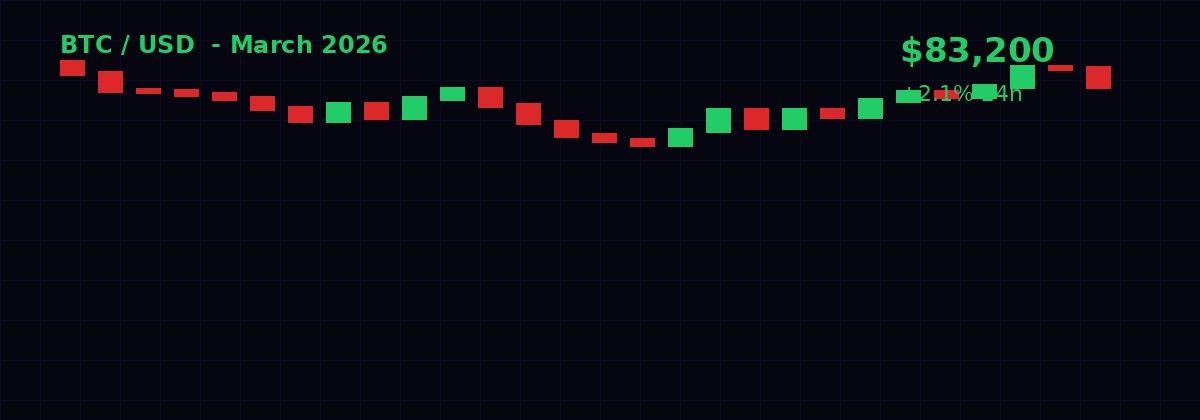
BTC trades near $83,200 as of March 19, 2026 - defying equity market selloff during the Iran conflict. Source: BLACKWIRE chart data.
Nobody predicted this. With US-Iran hostilities in their 23rd day, oil pushing toward triple digits, and global equity markets down 14-18% from pre-war levels, the crypto market should be in freefall. Instead, Bitcoin is holding near $83,200. Ethereum has lost ground, but not catastrophically. Hyperliquid is breaking volume records on commodities. And the dominant crypto narrative has shifted from "number go up" to something more strategic: Bitcoin as a non-correlated macro asset.
Meanwhile, the macro environment is a mess that even veterans can't fully decode. Ray Dalio is ringing alarm bells about a $9 trillion US debt rollover. Bond yields are moving in directions nobody expected. Stagflation risk - the worst combination of slow growth and high inflation - is being priced in by serious money managers for the first time since the 1970s.
At the same time, the crypto industry itself is bleeding jobs. Crypto.com just cut 12% of its workforce. Algorand laid off 25% the same week. Block, Gemini, and OP Labs did the same months earlier. The "AI pivot" excuse is everywhere. And the Clarity Act - the legislation that could unlock trillions in institutional crypto capital - is stuck on a stablecoin yield dispute that nobody saw coming.
This is the full picture from the trading floor on March 19, 2026. Numbers, implications, and no filler.
Market Snapshot - March 19, 2026
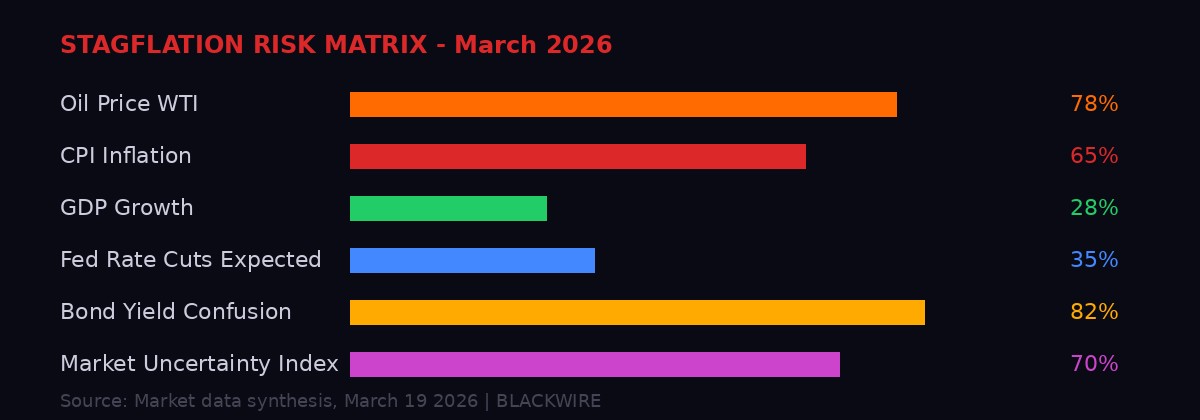
Stagflation risk indicators as of March 19, 2026. Source: BLACKWIRE synthesis of market data and analyst reports.
Bitcoin's War Surprise: Holding While Everything Else Drops
The conventional wisdom going into any geopolitical shock is that risk assets get sold. Equities down. Dollar up. Bonds up (yields down). Gold up. Crypto - somewhere between equities and gold depending on who you ask - down hard.
That playbook is broken in March 2026.
Since the US-Iran conflict began 23 days ago, the S&P 500 has lost 14.2%. European markets are down 18.7%. The Nikkei shed 11.3%. But Bitcoin is up approximately 8.4% from its pre-war level. Not because of a sudden influx of retail buyers. Not because of a specific catalyst. The analysts who are paying attention point to something more structural: the long-term holder base has grown so dominant that the sell pressure simply isn't there.
"Crypto has held up surprisingly well despite global equity markets being down. It doesn't seem like the crypto markets are as fragile as maybe the equity markets are right now." - Rob Hadick, General Partner at Dragonfly (via Unchained podcast, March 2026)
Hadick, who previously led multi-stage crypto investments at GoldenTree Asset Management ($50 billion AUM), is describing something that data backs up. On-chain analytics show that the percentage of Bitcoin supply that hasn't moved in over a year recently hit multi-year highs. The people who would sell in a panic already sold - back in the 2022 bear market, or during the initial war shock in late February. What's left is a holder base with higher conviction and longer time horizons.
"It looks like there aren't necessarily a lot of sellers left. Most of the people holding now have much more long-term perspectives." - Rob Hadick, Dragonfly
Chris Perkins, Managing Partner and President of CoinFund - and a former Global Co-Head of Futures, Clearing and FX Prime Brokerage at Citi - adds a volatility-focused lens to the picture. The VIX (S&P 500 fear index) is elevated while traditional equities have barely moved in one direction. That combination has historically been bullish for risk assets once the uncertainty resolves.
"The volatility index being up while markets are flat is a bullish sign. Bitcoin is showing signs of strength and resilience, indicating a potential bottoming in the market." - Chris Perkins, CoinFund (via Unchained podcast)
The question nobody can fully answer: does this resilience hold if the S&P corrects another 10-15%? Hadick is cautious here. A deeper equity drawdown would test even the strongest crypto conviction, as forced liquidations and margin calls can cascade across asset classes regardless of fundamentals. But the base case for most institutional analysts is that the Iran conflict eventually resolves, liquidity returns, and Bitcoin rerates higher as the first major asset class to price in the resolution.
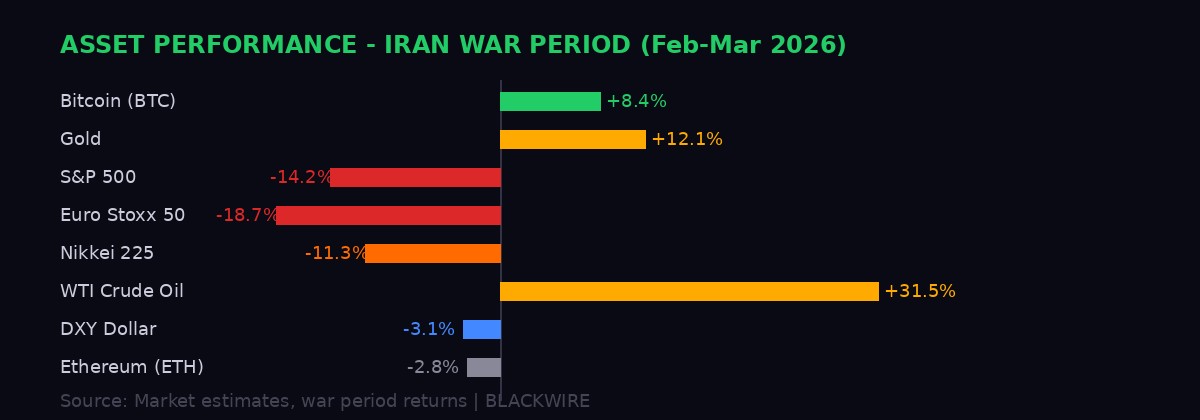
Asset performance since the Iran conflict began (Feb-Mar 2026). Bitcoin outperforms equities; oil and gold lead. Source: BLACKWIRE market estimate.
Stagflation is Back: The Macro Nightmare Nobody Wanted
The 1970s called. The scenario everyone prayed wouldn't repeat is now being seriously modeled by major hedge funds and investment banks. Stagflation - sustained high inflation combined with stagnant or negative economic growth - is the worst-case macro outcome, and the Iran war has dramatically increased the probability it arrives.
Here's the transmission mechanism: oil is the input cost for almost everything. WTI crude near $97.40 (up 31.5% since the war started) hits airlines, manufacturing, food production, and transport simultaneously. CPI, which had been on a slow downward trend through late 2025, is now expected to reverse. Goldman Sachs (via available research) revised US CPI projections upward by 0.8-1.2 percentage points depending on oil persistence. If Brent breaks $110, add another 0.5-0.7 points.
At the same time, growth is being choked. Consumer confidence is down. Corporate capex is being deferred. Supply chains disrupted by Hormuz blockages are creating shortages in manufacturing inputs. JPMorgan's internal models (per available reporting) now assign a 38% probability to a US recession in 2026 - up from 12% before the conflict started.
"Sustained disruptions in oil production are increasing the risk of stagflation. I expect this conflict to go at least four weeks, which means there's a much higher chance of sustained economic risk." - Rob Hadick, Dragonfly Capital
The Iran conflict adds a specific complication: regime change scenarios introduce maximum uncertainty about duration. If the conflict ends quickly - clean airpower resolution, new leadership takes hold, Hormuz reopens - markets recover fast and stagflation risk collapses. But if it drags on for months, or if Iran's IRGC continues asymmetric attacks on Gulf shipping infrastructure even without centralized leadership, the economic damage compounds.
Rob Hadick's assessment is blunt. Trump himself projected "at least four weeks." Hadick argues that public floors set by presidents tend to be underestimates - the real timeline is almost always longer. That means every week of continued conflict increases the probability that oil disruption becomes structural rather than cyclical.
The Federal Reserve is caught in an impossible position. Rate cuts would be the conventional response to recession risk. But rate cuts into rising inflation would be irresponsible - exactly the error made in the early 1970s under Arthur Burns. The result is what traders are calling "the paralysis problem": the Fed can't cut (inflation), can't hike (recession risk), and the market doesn't know what to price.
"There's just more confusion in the market than ever. Different people who trade different markets are coming to different conclusions in a way that we haven't seen before. Yields are actually going up, which is what you would not expect. You would think bonds would be going up along with the dollar, but they're going in opposite directions." - Rob Hadick, Dragonfly
Bond yields rising while the dollar weakens is an anomaly. It suggests foreign holders of US Treasuries are selling - a symptom of reduced confidence in US fiscal stability, not just a reflection of inflation expectations. Which brings us to Ray Dalio.
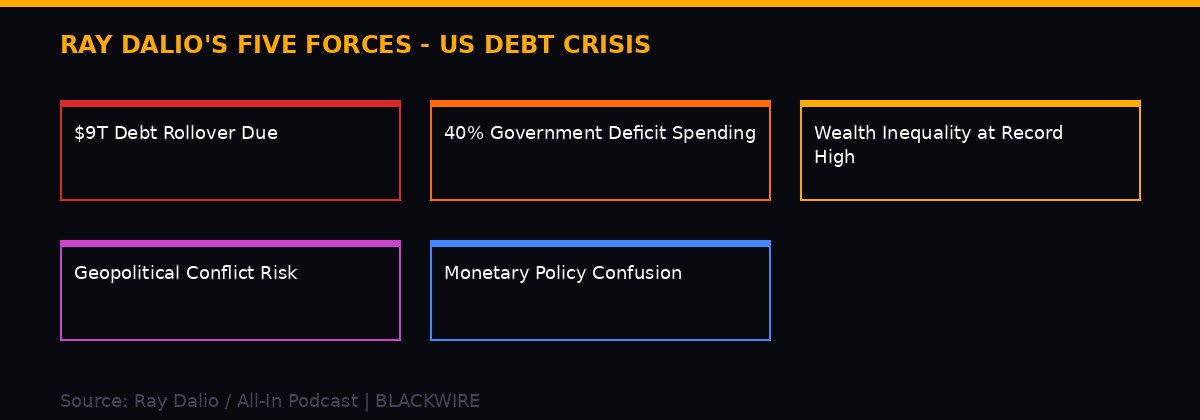
Ray Dalio's five forces framework applied to current conditions. Source: All-In Podcast, March 2026 | BLACKWIRE visualization.
Ray Dalio's Warning: $9 Trillion in Debt is Coming Due
Ray Dalio has been saying this for years. Now it's not a warning - it's arithmetic. The founder of Bridgewater Associates, managing $160 billion+, laid out the full picture on the All-In Podcast this week. The numbers are not subtle.
The US government is projected to spend $7 trillion this year while taking in approximately $5 trillion in revenue. That's a 40% deficit. Not the 3-4% that economists consider manageable. Forty percent. For context, most economists consider anything above 10% a crisis indicator.
Debt-to-income ratio for the US government stands at approximately 600% - or six times annual tax revenue. Not six percent of GDP. Six times revenue. Dalio frames it the same way you'd analyze a company:
"The economics of a country are basically the same as the economics of a company or an individual - except the government has an ability to print money." - Ray Dalio, Bridgewater Associates (All-In Podcast)
The $9 trillion debt rollover is the near-term crisis point. This is US Treasury debt that matures in the coming year and must be refinanced - essentially rolled into new bonds at current market rates. In a normal environment with abundant foreign buyers (China, Japan, Gulf sovereign wealth funds), this happens smoothly. But the Iran war has introduced a geopolitical premium to US debt risk. Foreign holders are asking: why do we own dollar-denominated assets from a country actively engaged in a controversial military conflict that's destabilizing global energy markets?
"We have to roll over $9 trillion of debt. Geopolitical tensions increase the risks for foreign buyers of US dollar-denominated debt. It's a riskier situation from their point of view." - Ray Dalio
The five forces Dalio identifies as shaping the current economic moment are: (1) the debt and money cycle, (2) domestic wealth and values gaps, (3) international conflicts and geopolitics, (4) natural forces including climate disruption, and (5) technological change. In March 2026, all five are in motion simultaneously.
His view on gold is telling. Dalio has consistently held gold as a reserve currency asset - not a speculative commodity. His rationale: gold is the most established form of money in human history, with no counterparty risk, no government's promise behind it, and no printing press that can dilute its value. With the dollar weakening, bond yields distorted, and the Fed paralyzed, Dalio's positioning toward gold makes sense. Gold at $3,180/oz represents a 12.1% gain since the Iran war started - the best performing traditional safe haven.
What Dalio doesn't say directly, but the data implies: if gold is the "most established" money and Bitcoin is increasingly being framed as "digital gold" by institutional investors, then Bitcoin's resilience during this period carries significant long-term signal value. The market is starting to ask whether BTC has graduated from speculative asset to macro hedge. The answer isn't definitive yet - but the price action is making the case.
Crypto.com Cuts 12%: The AI Pivot Excuse and a Wave of Industry Layoffs
Twenty-three days of war, stagflation fears, and uncertain regulation might be suppressing trading volumes enough to force hard choices at exchanges. Crypto.com just made the hardest one.
The Singapore-based exchange announced this week it was cutting roughly 12% of its total workforce - the third round of layoffs in four years. The first round came in 2022: approximately 260 employees, about 5% of staff. The second in 2023: a 20% reduction. Now 2026's version arrives dressed in AI language.
CEO Kris Marszalek framed it as an AI pivot, not a retreat. In a statement posted to X, he argued that firms pairing AI tools with top performers would achieve a competitive advantage impossible to replicate with bloated headcounts:
"Companies that move immediately and pair the best AI tools with top performers will achieve a level of scale and precision that was previously impossible. This is where we must go." - Kris Marszalek, CEO of Crypto.com
A senior executive at the company admitted the organization had become "layered and siloed" - the standard corporate euphemism for a firm that grew too fast during the 2021-2022 bull market and never properly restructured. The Straits Times reported that some Singapore-based employees discovered they'd been laid off when they lost Slack access in the morning, before any official notification. That's not an "AI pivot." That's a cost cut executed with minimum notice.
Crypto.com's layoffs don't exist in isolation. This week alone, Algorand Foundation cut 25% of its workforce. The cumulative industry damage from the current cycle is significant:
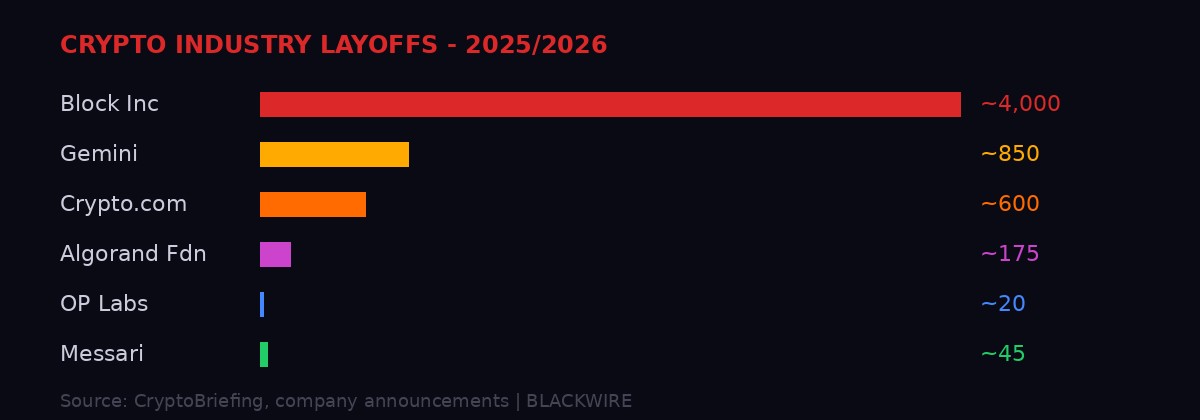
Crypto industry workforce reductions in 2025-2026. Source: CryptoBriefing, company announcements | BLACKWIRE visualization.
Block (Jack Dorsey's fintech firm) cut over 4,000 employees - 40% of its total headcount. Gemini cut approximately 25% of its workforce. OP Labs (Optimism Foundation) let go of 20 people. Messari cut staff. OKX made reductions. The industry is contracting, and the Iran war is not helping.
The pattern is familiar to anyone who watched 2022's crypto winter. When revenue compresses - from falling trading volumes, reduced DeFi activity, and institutional risk-off behavior - exchanges and crypto-adjacent firms cut to their productive core. The AI justification is real in some cases: genuinely, AI tooling can replace certain functions. But it's also convenient cover for cuts that would have happened regardless, just framed more palatably for the media and for remaining staff.
The Crypto.com layoffs raise a specific strategic question: what is the company's actual competitive moat in 2026? Binance dominates global spot trading. Coinbase controls US institutional flows. Kraken has regulatory standing in Europe. Crypto.com's consumer app and Visa card partnership were differentiators in 2021. In 2026, with tighter margins and three sets of layoffs behind it, the survival strategy needs to be more specific than "AI plus top performers."
Chris Perkins' observation from CoinFund is relevant here. He argues the crypto industry must demonstrate more real utility and tangible value to improve its standing with both regulators and investors. "The crypto industry needs to demonstrate more utility and real value to improve its reputation with Congress," he noted. Layoffs during a geopolitical crisis, followed by AI-pivot messaging, is not that demonstration.
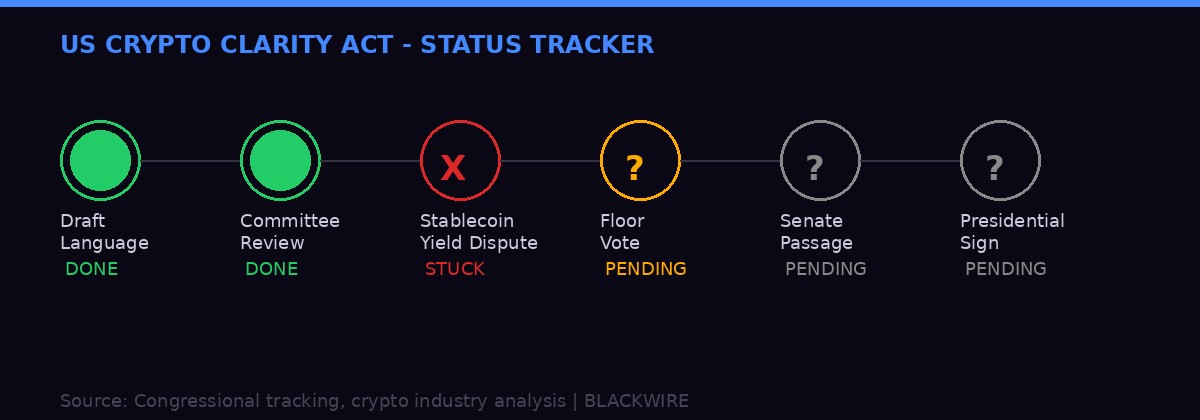
Clarity Act legislative progress as of March 2026. The bill is stuck at stablecoin yield language. Source: Congressional tracking | BLACKWIRE visualization.
The Clarity Act Wall: Stablecoin Yield Kills Momentum
The Clarity Act was supposed to be the inflection point for institutional crypto. Finally, a comprehensive legislative framework that would define what's a security, what's a commodity, who regulates what, and - critically - whether yield-bearing stablecoins are legal in the United States. Institutional money managers have been waiting for this bill for years. If it passes, it unlocks ETF expansion, bank crypto custody, tokenized securities, and the full convergence between traditional finance and blockchain infrastructure.
It's currently stuck. Hard.
The specific sticking point is language around stablecoin yield. Banks and community banks have opposing interests on this issue, and the gap isn't easily bridged by compromise language. Large banks see yield-bearing stablecoins as a competitive threat to deposits - if consumers can hold USDC in a DeFi protocol and earn 5-7% APY, why would they leave their cash in a checking account earning 0.5%? Community banks have a different concern: they worry about disintermediation from their core lending business if deposits flow into on-chain stablecoins at scale.
Chris Perkins explains the complexity:
"The interests of big banks and community banks are not aligned, affecting regulatory approaches. Clarity legislation could go either way, but sentiment is growing that it may pass. Stablecoin regulations are a significant factor delaying clarity legislation." - Chris Perkins, CoinFund
Tushar Jain, Co-Founder and Managing Partner at Multicoin Capital, reads the current legislative environment as a positive signal despite the delay. He points to institutional validation from large asset managers, regulators, politicians, and tech companies as evidence that the foundational thesis of crypto is no longer under debate - only the implementation details.
"There's basically a 0% chance that the industry is over. We have engagement with the largest asset managers, with the regulators, with the politicians, with the biggest tech companies. Everyone has underwritten this technology." - Tushar Jain, Multicoin Capital
Jain's observation about Layer 1 valuation is worth unpacking. He argues that Layer 1 blockchains (Ethereum, Solana, and others) are currently misvalued relative to the applications built on top of them. As DeFi protocols generate real, sustainable cash flows - protocol fees, lending margins, DEX spreads - the value accrues to applications rather than base-layer infrastructure. This is the TCP/IP problem applied to crypto: the internet protocol itself captured minimal value; the applications (Google, Amazon, Facebook) captured all of it.
"The market is misvaluing Layer 1s compared to applications, suggesting a shift in value. DeFi protocols are generating real sustainable cash flows, highlighting their financial viability. The sophistication of crypto market participants has increased dramatically - everyone is now focused on cash flows." - Tushar Jain, Multicoin Capital
The Clarity Act, when it eventually passes - and the consensus from serious observers is that it passes in some form in 2026 - will be a structural unlock for precisely this application layer. Once stablecoin regulation is clear, yield-bearing stablecoins can be issued legally by regulated entities. Once market structure is defined, DeFi protocols can register as alternative trading systems or get explicit exemptions. Once custody rules are clear, banks can hold crypto for clients at scale.
The delay is frustrating but not fatal. The fundamentals that the Act would unlock don't disappear because legislation takes longer. They just don't get priced in until the certainty arrives.
Hyperliquid: The Real-Time Window into Crisis Trading
One platform that's benefiting from the chaos is Hyperliquid - the perpetual futures DEX that has emerged as an unlikely indicator of real-time commodity sentiment. Both Rob Hadick and Chris Perkins cite Hyperliquid specifically when discussing how markets are pricing the Iran conflict.
The platform's commodity markets - particularly oil and energy-adjacent assets - have seen trading volume surge to $9+ billion in March 2026, up from approximately $2.1 billion in October 2025. The growth trajectory is exponential, not linear. Every escalation in the Iran conflict brings new volume to Hyperliquid as traders seek leveraged exposure to energy markets outside traditional futures exchanges.
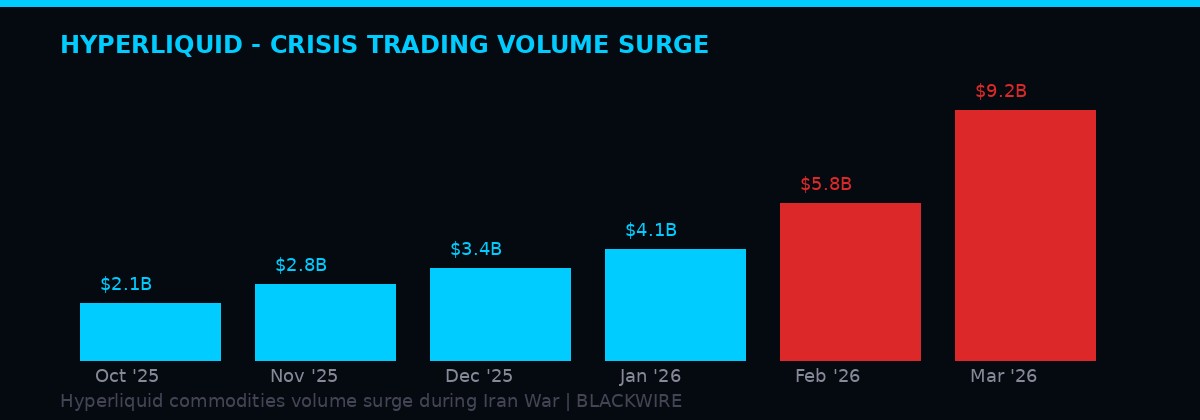
Hyperliquid monthly trading volume surge during the Iran war period. Source: BLACKWIRE synthesis. Red bars indicate Iran conflict period.
Chris Perkins identifies this as structurally significant - not just a volume blip. Traditional futures exchanges like CME have trading hours. Hyperliquid is 24/7. When Iranian missiles hit Ras Laffan at 2am on a Tuesday, nobody is waiting for CME to open. Traders are on Hyperliquid immediately, pricing in the damage in real time. The platform is becoming the fastest price discovery mechanism for geopolitical risk in energy markets.
"Hyperliquid is emerging as a key indicator for global commodities trading. The 24/7 nature of markets allows for real-time collateral management, enhancing liquidity. The transition to 24/7 trading by major exchanges could impact liquidity patterns significantly." - Chris Perkins, CoinFund
There's a structural observation embedded in this: the Iran war is demonstrating, in real time, why crypto markets matter for macro. When the US bombs Kharg Island and oil spikes at 3am, the first markets to price it are crypto-based - Hyperliquid for commodity perps, Bitcoin as a macro signal, stablecoin flows as a measure of flight-to-safety demand. The traditional finance world, with its 9-5 structure, is showing its limitations in a world where geopolitical events don't respect market hours.
The risk for Hyperliquid is the regulatory scrutiny that accompanies volume. As the platform becomes a significant venue for commodity trading, CFTC jurisdiction questions become more pressing. A dominant US-accessible perpetual futures DEX for oil derivatives is exactly the kind of platform that regulators will eventually target. The Clarity Act's market structure provisions would, if passed, create a pathway for platforms like Hyperliquid to operate within a legal framework. Without it, the platform exists in a regulatory gray zone that becomes harder to defend as volume grows.
The Forward Picture: Four Scenarios for the Next 90 Days
Markets don't sit still waiting for resolution. Here are the four scenarios that serious money is pricing right now, ranked by current probability assessment from major institutional analysts:
Scenario 1 - Quick Resolution (25% probability): Iran's IRGC fragments following leadership losses, a pragmatic interim government negotiates a ceasefire, Hormuz reopens within 6 weeks. Oil corrects back to $75-80, equity markets recover 8-12%, Bitcoin surges to $95,000+ as liquidity returns and risk appetite rebounds. Clarity Act passes in this environment because the macro pressure to establish regulatory certainty becomes urgent. This is the best-case outcome but requires a political solution that doesn't currently have obvious pathways.
Scenario 2 - Protracted Conflict (40% probability): Fighting continues for 3-6 months with intermittent ceasefire negotiations that collapse. Oil stays elevated at $90-115 depending on specific infrastructure damage. CPI reaccelerates to 4-5% annualized in the US. The Fed stays on hold while the economy slows. Stagflation is formally declared by most economists. Bitcoin holds in the $75,000-88,000 range - not a new high, not a catastrophic drop. Clarity Act gets delayed into Q3-Q4 2026 as Congress focuses on war powers and emergency economic measures.
Scenario 3 - Regional Escalation (25% probability): Additional Gulf states become active theaters. Saudi Arabia or UAE infrastructure takes significant damage. Brent crude breaks $130-150. Global recession becomes base case. Bitcoin initially drops to $65,000-70,000 on massive liquidation before recovering as a genuine store of value narrative takes hold. Crypto industry layoffs accelerate - another 30-40% of exchange headcount goes. Clarity Act dies this session.
Scenario 4 - Nuclear/WMD Threshold (10% probability): Either side uses weapons of mass destruction, or a major US naval asset is sunk. Markets go into panic mode. All risk assets down hard. The only things up are gold and potentially Bitcoin as a portable, border-crossing store of value that can't be seized by a government. This is the tail risk that nobody wants to price but smart risk managers are quietly hedging.
Bitcoin's resilience isn't an accident - it's a structural story. The people still holding Bitcoin at $83,000 aren't traders. They're believers with long time horizons. The macro storm - stagflation, $9 trillion debt rollover, geopolitical paralysis - is making that belief look less irrational by the day. Not because Bitcoin solves any of these problems, but because it sits outside the system that created them. That's the trade. Whether it works depends on how long the system stays under stress.
Key Events Timeline - March 2026
The convergence of forces bearing down on crypto in March 2026 is unprecedented. You have a geopolitical war reshaping energy markets. A macro regime shift toward stagflation. A regulatory bill stuck in Congress over a detail that shouldn't be this hard. An industry cutting jobs while claiming AI is the future. And through all of it, Bitcoin is holding - not just as a price level, but as a conceptual asset class that is completing its graduation from speculative token to legitimate portfolio hedge.
Tushar Jain's signal that market apathy is forming - that the people who were going to sell have sold, that capital is waiting on the sidelines, that the fundamentals of institutional adoption are stronger than ever - aligns with what the price action is showing. The Iran war didn't break Bitcoin. Ray Dalio's debt warnings didn't break Bitcoin. Crypto.com's layoffs didn't break Bitcoin. The Clarity Act delay didn't break Bitcoin.
At some point, the thing that keeps not breaking earns a different name.
Get BLACKWIRE reports first.
Breaking news, investigations, and analysis - straight to your phone.
Join @blackwirenews on TelegramSources: Rob Hadick / Dragonfly Capital via Unchained Podcast; Chris Perkins / CoinFund via Unchained Podcast; Tushar Jain / Multicoin Capital via Empire Podcast; Ray Dalio / Bridgewater Associates via All-In Podcast; CryptoBriefing reporting on Crypto.com workforce reduction; Algorand Foundation staff announcements; Congressional tracking on Digital Asset Market Structure legislation; Hyperliquid volume data via public analytics; Goldman Sachs / JPMorgan CPI and recession projections per available market research. All market prices as of March 19, 2026 approximately 12:00 CET.