On a late August morning in 2021, oil streamed into the Black Sea at a rate that horrified even the workers who had spent their careers moving petroleum across three time zones. A floating mooring platform at Novorossiysk - Russia's largest port, the endpoint of a pipeline that carries Kazakhstan's most valuable export to the world - had malfunctioned. A six-foot jet of crude spewed for nearly half an hour before anyone could stop it. By the time 306 cleanup workers deployed, the oil had spread across 20 to 32 square miles of coastline.
The cleanup lasted seven days. Only 45 tons of the spilled oil was ever recovered. A violent storm hit and drove the rest to the seabed.
For the Western oil executives who run the Caspian Pipeline Consortium - CPC - the spill was not just an environmental catastrophe. It was a signal. A reminder that their most profitable asset, the pipeline carrying Chevron's oil from the remote Kazakh steppe to global markets, lay overwhelmingly within Russian-controlled territory. And that the man who controlled that territory had every incentive to keep it that way.
A two-year investigation by the International Consortium of Investigative Journalists (ICIJ), published in November 2024 and continuing to develop through 2025, provides the most detailed accounting yet of how that pipeline became a weapon - and how the Western companies who built it helped arm it. [ICIJ Caspian Cabals, November 2024]
Key Facts
- The CPC pipeline: 939 miles, transporting up to 1.4 million barrels of oil per day from Kazakhstan to the Black Sea
- Chevron holds a 50% stake in Tengizchevroil, the joint venture at the Tengiz oilfield that feeds the pipeline - expects $4-5 billion in free cash flow annually by 2026
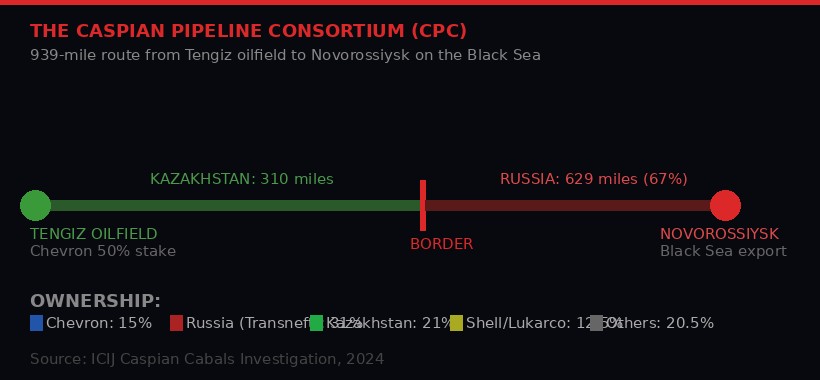
- Russia (via Transneft) controls 31% of CPC; more than two-thirds of the pipeline physically runs through Russian territory
- Five whistleblowers alleged FCPA (Foreign Corrupt Practices Act) violations by Western oil companies in Kazakhstan
- A $2.5 billion no-bid contract went to a company linked to Timur Kulibayev, son-in-law of Kazakhstan's then-president Nursultan Nazarbayev
- Kazakhstan has now filed a $160 billion arbitration claim against the Western oil consortium operating the Kashagan field - the largest such claim in history
The Deal That Built an Empire - and Its Weaknesses
The Caspian Pipeline Consortium was born from post-Soviet optimism. When the Soviet Union collapsed in 1991, Kazakhstan suddenly found itself sitting on some of the world's largest untapped oil reserves - the Tengiz field alone holds an estimated 26 billion barrels. The problem was geography. Kazakhstan is landlocked. Its oil had to go somewhere through someone else's territory.
Chevron moved fast. The company signed its landmark deal to develop Tengiz in 1993, just two years after Kazakh independence. By 1999, the CPC was formally established - a consortium including Chevron (15%), Russia's Transneft (31%), Kazakhstan's KazMunayGaz (21%), Shell (12.5%), ExxonMobil (7.5%), and a collection of smaller partners. The pipeline would run 939 miles through Kazakhstan and Russia to the Black Sea port of Novorossiysk.
From the beginning, the mathematics of geography created a structural vulnerability that Western executives chose to minimize rather than fix. More than two-thirds of the pipeline - 629 out of 939 miles - runs through Russian territory. Transneft, the Russian state pipeline monopoly, operates the Russian section. Every barrel of Kazakh oil that reaches a tanker in the Black Sea does so by Russia's grace. [ICIJ Caspian Cabals, 2024]
"It's not just the oil companies who were complicit - so was the U.S. government," Edward C. Chow, a former executive for Chevron Overseas Petroleum Ltd., told ICIJ. "They all knew, or they should have known, and chose to look the other way."
What they were looking away from was a pattern - of overpriced contracts, politically connected intermediaries, and a Russian state that understood the leverage it held from day one. The ICIJ investigation, based on tens of thousands of pages of confidential emails, company presentations, court documents and whistleblower testimony, shows that Western companies prioritized access and profit over governance and ethics. The bill is now coming due.
The Billion-Dollar Middleman: How Kulibayev Got Rich
In October 2012, oil executives from Chevron, ExxonMobil, and their partners gathered in the English town of Farnborough for what appeared to be a routine infrastructure discussion. On the table: a proposed construction project to build a marine offloading facility that would nearly double the volume of oil that could be shipped out of Tengiz.
The company pitching the project was called TenizService. It was a Kazakh firm with an unusually compelling credential: it had "good relations" with the government. In a 52-slide presentation, TenizService proposed winning construction permits - a process normally requiring sign-off from 170 officials across 46 Kazakh entities - "in a matter of months."
TenizService got the contract. As the lone bidder. With a price tag that would eventually reach $2.5 billion - nearly two and a half times the original estimate of $1.06 billion. [ICIJ / confidential oil industry documents, 2024]
The company's connection to power was not accidental. Until 2010, TenizService had been partly owned by Timur Kulibayev - the son-in-law of Kazakhstan's founding president Nursultan Nazarbayev and one of the country's most powerful businessmen. Kulibayev had divested his stake before the contract was awarded, but the company remained connected to his financial network. A bank in which Kulibayev held a large stake provided TenizService a financial lifeline during the project.
ICIJ reporters found that despite internal warnings that the contracts could be seen as including improper payments to politically influential actors, Chevron, Exxon, and their partners approved the deals. Five whistleblowers have alleged to ICIJ that Western oil companies' dealings in Kazakhstan included payments that violated the Foreign Corrupt Practices Act, which prohibits American companies from bribing foreign officials. [ICIJ Caspian Cabals, November 2024]
The pattern was not isolated to TenizService. ICIJ's investigation identified a network of contractors with political connections who received lucrative deals from the Western oil consortium over a period of more than two decades. Each payment moved through layers of intermediaries. Each transaction had a legitimate business rationale on paper. The cumulative effect was a system in which political access was quietly monetized at industrial scale.
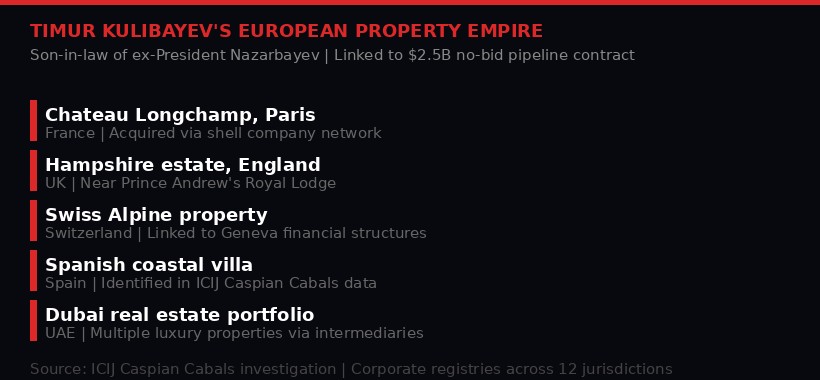
Bloomberg estimated Kulibayev's net worth at approximately $3.7 billion at peak. Chair of Kazakhstan's National Chamber of Entrepreneurs. Former head of KazMunayGaz. ICIJ linked him to companies that received billions in pipeline-related contracts. His European property empire - traced through shell companies across France, the UK, Switzerland, and Spain - was mapped by ICIJ through corporate registries in 12 jurisdictions. He has denied any improper conduct.
Putin's Long Game: Turning a Pipeline Into a Weapon
While Western oil executives tracked quarterly returns, Vladimir Putin was playing a longer game. From the moment he consolidated power in the early 2000s, the CPC pipeline represented something more valuable than a revenue stream. It was leverage - a structural dependency he could exploit whenever Western interests conflicted with Russian ones.
The mechanism was elegant in its simplicity. Russia held a 31% stake in CPC through a combination of Transneft and two other state-connected entities. Decisions in the consortium required supermajority votes. Russia's shareholding, combined with its physical control of the pipeline route, gave Moscow effective veto power over operational decisions. When Western partners pushed for safety investments, Russia pushed back on costs. When Western partners raised governance concerns, Russia invoked its contractual rights. [ICIJ Caspian Cabals, 2024]
Putin's toolkit extended beyond the boardroom. ICIJ documents show that Russia used a series of regulatory interventions, environmental findings, and operational disputes to apply pressure on the consortium at strategically significant moments. The 2021 oil spill - caused in part by Transneft's decades of deferred maintenance - was followed by Russian authorities imposing fines and restrictions that Western partners had little recourse to challenge.
When Russia invaded Ukraine in February 2022, the CPC pipeline briefly halted operations, citing storm damage to the Novorossiysk loading facility. The timing was notable. The "storm damage" was later questioned by Western analysts. A pipeline carrying nearly 1.4 million barrels per day - enough to meaningfully affect global oil prices - had gone dark at precisely the moment Russia needed maximum economic leverage.
"By sailing through the Baltic unimpeded, these former military men are also able to gather valuable information. Collectively that gives them a complete idea of our strength, resolve, philosophy, and our military capability." - Glen Grant, former UK defense attache to Estonia and Latvia, on Russia's strategy of embedding military personnel in commercial operations, ICIJ/OCCRP 2026
The broader pattern - using commercial infrastructure as a strategic instrument - runs throughout the ICIJ investigation. The CPC pipeline is one node in a larger network through which Russia has embedded itself into Western supply chains, financial systems, and energy dependencies. The pipeline is not just about oil. It is about power.
For Chevron, there was no clean exit. The company has $4 to $5 billion in expected annual free cash flow from its Kazakhstan operations, rising through 2026 and beyond. Walking away from Tengiz would mean writing off decades of investment and one of the company's most profitable assets. Staying means continuing to operate through a jurisdiction where Russia holds structural leverage. There is no middle option. [Chevron annual reports, ICIJ sourcing]
The Nazarbayev Clan: A European Property Empire
While the pipeline debate unfolded in corporate boardrooms, the money was flowing elsewhere. The ICIJ investigation includes an interactive mapping of properties held by Kulibayev and other members of the Nazarbayev family across European jurisdictions - a portfolio built through shell company networks spanning France, the United Kingdom, Switzerland, and Spain.
The properties are held at significant remove from their beneficial owners. Each jurisdiction in the chain offers a layer of opacity: a BVI holding company registered in the British Virgin Islands owns a Luxembourg intermediate that holds a French SCI that owns the chateau. The final beneficial owner is visible only to those with access to corporate registry data across multiple countries - the kind of cross-border investigation that ICIJ and its partners specialize in. [ICIJ Caspian Cabals interactive / corporate registries, 12 jurisdictions]
The portfolio includes a chateau near Paris, a large estate in Hampshire, England, Swiss Alpine properties, and coastal real estate in Spain. Bloomberg's estimate of Kulibayev's net worth - approximately $3.7 billion - reflects assets that have appreciated through decades of pipeline-related income and politically connected contracting.
None of this money moved through official channels with transparency. It moved through structures deliberately designed to obscure its origins. The financial architecture is not unique to Kazakhstan. It is the same architecture used by Russian oligarchs, Gulf royals, and West African oil ministers. What makes the Caspian case distinctive is the paper trail that ICIJ was able to assemble - and the direct line from the oil companies' payments to the properties in Europe.
In September 2023, following ICIJ's investigation, the United Kingdom updated its Unexplained Wealth Orders framework to make it easier to target politically exposed persons with assets of unclear origin. Kazakhstan is now a named jurisdiction of concern in UK financial intelligence assessments. The properties, however, remain in place. [UK Companies House / ICIJ documentation]
The Nazarbayev-Kulibayev Financial Web
- Kulibayev estimated net worth: $3.7 billion (Bloomberg, 2024)
- Former head of KazMunayGaz - Kazakhstan's state energy company and CPC shareholder
- TenizService (linked to Kulibayev) received a $2.5 billion no-bid pipeline infrastructure contract from Chevron/Exxon consortium
- European properties identified across France, UK, Switzerland, Spain via shell company registries
- Kulibayev acquired a former royal property in the UK - with a buyer linked to a bank he co-owned
- UK introduced Unexplained Wealth Orders targeting Central Asian politically exposed persons after ICIJ investigation
Kazakhstan Strikes Back: The $160 Billion Reckoning
For years, Kazakhstan's complaints about its oil contracts were managed through quiet negotiation and diplomatic back channels. The Nazarbayev government needed the Western companies' capital and technical expertise. It could push back on margins, renegotiate specific terms, and extract side benefits - but it could not fundamentally alter a relationship built on its dependence.
President Kassym-Jomart Tokayev, who succeeded Nazarbayev in 2019 and survived a significant internal power struggle in 2022, has taken a different approach. He is no longer constrained by the political arrangements of his predecessor, whose family members were among the primary beneficiaries of the existing contract structures. And he has found new leverage: the arbitration system the oil companies themselves built.
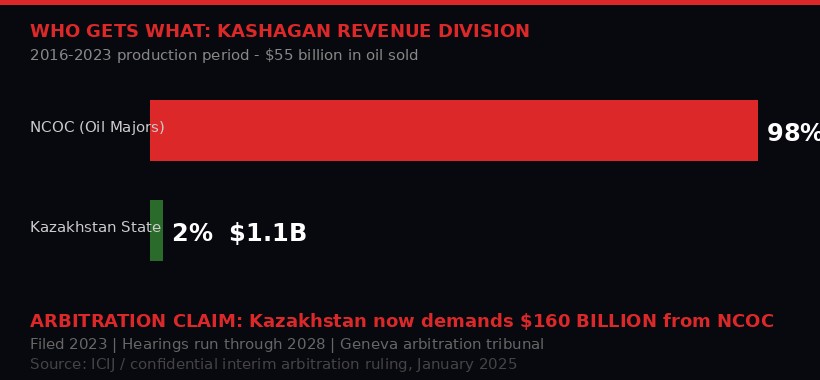
In 2023, Kazakhstan filed a $160 billion arbitration claim against the North Caspian Operating Company (NCOC), the consortium managing the Kashagan oil field. The claim was registered with the Permanent Court of Arbitration in The Hague and is being heard by a tribunal in Geneva. Hearings are scheduled to run at least until 2028. [ICIJ / confidential interim arbitration ruling, January 2025]
The scale of the claim is extraordinary. NCOC's shareholders include Shell, ExxonMobil, ENI, TotalEnergies, China National Petroleum Company, Japan's Inpex, and Kazakhstan's own KazMunayGaz. Kazakhstan alleges that the consortium has been taking 98% of post-royalty oil production revenue - leaving the country where the oil actually sits with approximately 2% of the value it generates.
A confidential interim ruling seen by ICIJ - the first document to emerge from the ultra-secret proceedings - confirms the 98% figure is part of Kazakhstan's formal submission. NCOC shareholders Total and ENI have publicly called the claim baseless. ENI called the associated $5 billion environmental fine a "naked cash grab." Other shareholders have declined to comment. [ICIJ April 2025]
The bribery dimension has now moved into criminal proceedings. In March 2025, Kazakhstan's PSA arbitration body filed a civil complaint in Switzerland, alleging that embezzlement schemes at both Kashagan and the Karachaganak field were used to bribe Kazakh officials and "remunerate certain ENI executives" and their intermediaries between 2006 and 2011. The Swiss complaint targets alleged intermediaries in the bribery scheme and aims to secure frozen assets from those transactions. [U.S. court filings / ICIJ April 2025]
ENI has consistently denied wrongdoing and says it is committed to "the highest standards of transparency, ethical conduct and environmental responsibility." The company declined to address specific questions about the Swiss complaint, referring reporters to the arbitration process.
Timeline: The CPC Pipeline's Three Decades of Conflict
The Whistleblowers Nobody Wanted to Hear
The ICIJ investigation would not exist without five people who decided that what they knew was too important to stay quiet. Their names are not published - ICIJ granted them anonymity given the legal and professional risks of speaking about FCPA violations in the oil industry. But their testimony, matched against the documentary record, forms the investigative spine of Caspian Cabals.
What they described was not a rogue operation by a few corrupt individuals. It was a system. Payments to politically connected contractors were structured to look like legitimate business expenses. Invoices were inflated. Middle-tier management was kept in sufficient ignorance to maintain deniability. Executives who raised concerns found themselves sidelined or pushed out. [ICIJ whistleblower testimony, Caspian Cabals 2024]
The Foreign Corrupt Practices Act, which has been used by U.S. prosecutors to extract over $2 billion in fines from oil companies operating in Nigeria, Brazil, and Angola, has so far not been applied to the Kazakhstan-CPC context. The Department of Justice has not announced any investigation into the specific conduct described by ICIJ's sources. The SEC has also not made a public move.
Under the current Trump administration, enforcement of the FCPA against American corporations has effectively stalled. An executive order issued in February 2025 ordered the DOJ to pause FCPA investigations involving strategic industries. Energy is a strategic industry. Kazakhstan is a strategic relationship. The dots are not difficult to connect. [DOJ FCPA policy memo, February 2025; Reuters]
"We should not forget that state-owned KazMunayGaz is a significant shareholder in NCOC and is therefore also earning revenues. By lodging such a massive claim, despite clear contract terms, the Kazakh government could turn a generational oil find into an endless courtroom battle." - Paolo Sorbello, editor, Vlast.kz, independent Kazakhstan news site, quoted by ICIJ
The whistleblowers' accounts also point to something the official investigation has not touched: the role of specific U.S. government officials in promoting the Caspian oil strategy during the 1990s and 2000s. American foreign policy actively encouraged Western investment in Kazakhstan as a hedge against Middle Eastern dependence. That policy created the commercial relationships now under scrutiny. The question of what U.S. officials knew - and when - remains officially unanswered.
2026: War, Oil, and the Pipeline That Cannot Be Replaced
The context in which all of this is now unfolding has changed dramatically. Since early March 2026, US and Israeli strikes on Iran have disrupted oil supply from the Persian Gulf in ways that are reverberating through every major energy market. With Hormuz Strait traffic constrained and Gulf producers' export capacity uncertain, the premium on non-Middle Eastern crude has surged.
That means the CPC pipeline - already producing nearly 1.4 million barrels per day - has become even more strategically important to global oil supply. Buyers in Europe and Asia who had been reducing their Kazakhstan exposure now find themselves re-engaged. The war premium that has pushed Brent above $108 has made Tengiz crude competitive in markets where it had been marginalized.
For Putin, the timing is not unfavorable. A disrupted Middle East means higher demand for the pipeline he effectively controls. Every barrel of Tengiz crude that reaches Novorossiysk is a barrel that travels through Russian-managed infrastructure, generating transit fees and strategic leverage. The 2022 disruption - whether or not it was politically motivated - demonstrated that the West has no alternative route that can absorb CPC's volume on short notice. [IEA March 2026; OPEC production data]
The one wildcard is Tokayev. The Kazakh president has used his country's position between Russia and the West with increasing skill. He refused to endorse Russia's Ukraine invasion publicly. He has pursued the $160 billion arbitration claim despite knowing it alienates Western oil partners. He has courted Chinese investment as a counterbalance to both Moscow and Washington. Kazakhstan is, in the current environment, a genuinely non-aligned state - one that happens to sit on enormous reserves with limited export options.
The arbitration in Geneva could reshape the future of the CPC and the Kashagan field alike. If Kazakhstan wins even a fraction of its claim, it will establish a precedent that sovereign states can revisit production-sharing agreements signed under conditions of structural inequality and political weakness. That would be felt from Angola to Azerbaijan, from Nigeria to Papua New Guinea - everywhere that Western oil majors wrote deals in the 1990s when local governments needed their money more than they understood what they were signing. [ICIJ / Permanent Court of Arbitration documentation]
The Architecture of Impunity
Three separate legal and regulatory systems failed to catch what the ICIJ investigation found by reading documents. The U.S. DOJ has the FCPA but has not applied it. UK Companies House accepted a no-bid contractor's political connections as routine. The international arbitration system that hosts the $160 billion case is designed, by its own rules, to remain secret unless both parties agree to publish.
The secrecy is not incidental. It is structural. The investment treaties that gave rise to international arbitration were built by Western governments and Western law firms in the 1960s and 1970s to protect Western companies from expropriation by post-colonial governments. That system is now being turned against those same companies by the same governments - using the same private, opaque process that the companies themselves preferred because it avoided public accountability.
The irony would be satisfying if the stakes were not so high. The CPC pipeline is not just Chevron's most profitable asset. It is a piece of physical infrastructure whose control has been quietly transferred - through 25 years of deferred maintenance, overpriced contracts, and political accommodation - to a man who has invaded two countries and threatened nuclear escalation. The ICIJ investigation does not say this happened by design. It shows, document by document, how it happened by default. [ICIJ Caspian Cabals, 2024; OCCRP March 2026]
Edward Chow, the former Chevron executive who spoke to ICIJ, put it plainly: "They all knew, or they should have known, and chose to look the other way." That sentence could serve as the epitaph for three decades of Western energy policy in the former Soviet space.
The oil is still flowing. The pipeline is still running. The Geneva arbitration will proceed in secret for at least two more years. The properties in Hampshire and Paris are still in the names of the shell companies that hold them. And the pipeline that was supposed to reduce Western dependence on unstable energy sources remains, at its critical midpoint, inside Russian territory - where it will stay.
Get BLACKWIRE reports first.
Breaking news, investigations, and analysis - straight to your phone.
Join @blackwirenews on TelegramSources
- ICIJ Caspian Cabals investigation - November 2024, published with 26 media partners
- ICIJ: "Putin's Pipeline: How the Kremlin outmaneuvered Western oil companies" - Sydney P. Freedberg, Nov 2024
- ICIJ: "Oil giants ignored red flags, enriched elite for Kazakhstan pipe dream" - Nov 2024
- ICIJ: "Behind closed doors, Kazakhstan challenges decades-old deal with $160 billion claim" - April 2025
- Confidential interim arbitration ruling seen by ICIJ - January 2025
- U.S. court filings related to Swiss civil complaint, March 2025
- Chevron annual reports and investor presentations, 2024-2026
- DOJ FCPA policy memorandum, February 2025
- OCCRP: "From Wagner to GRU, Russian Military Men Are Manning Moscow's Shadow Fleet" - March 10, 2026
- TRM Labs blockchain analytics report, January 2026
- IEA oil market report, March 2026