Coinbase Launches Mag 7 Stock Futures. Morgan Stanley Seeds Bitcoin ETF. The Lines Are Gone.
Friday, March 20, 2026 - 8:30 PM CET | BLACKWIRE
Coinbase gave non-US traders 24/7 leveraged access to Apple, Nvidia, and Tesla today. Morgan Stanley named its Bitcoin ETF MSBT and seeded it with $1 million. Ripple's survey of 1,000+ global finance leaders shows 74% calling stablecoins a cash-flow necessity. These three events on a single Friday tell you everything about where markets are heading - and how fast.

Wall Street and crypto are merging faster than regulators can write the rules. (Pexels)
Coinbase Becomes the Everything Exchange

Coinbase's new stock perpetual futures let non-US traders short Tesla at 3am. No broker required. (Pexels)
Coinbase dropped a product today that would have been unthinkable two years ago: perpetual futures contracts on the Magnificent 7 stocks, available 24 hours a day, 7 days a week, cash-settled in USDC. According to the company's blog post, eligible non-US retail and institutional traders can now take leveraged positions on Apple, Microsoft, Alphabet, Amazon, Nvidia, Meta, and Tesla without touching a traditional brokerage account.
Single-stock contracts go up to 10x leverage. ETF products - SPY tracking the S&P 500 and QQQ tracking the Nasdaq 100 - allow up to 20x. All contracts are cash-settled in USDC, Circle's dollar-pegged stablecoin. No expiry dates. No market hours. The New York Stock Exchange closes at 4pm Eastern. Coinbase never does.
This is not a gimmick. Demand for round-the-clock equity exposure has been building for years. Every time the Fed speaks after hours, every time a geopolitical shock hits at 2am, equity traders sitting on spot positions have zero recourse until the market opens. Crypto traders have always had the advantage of a market that never sleeps. Coinbase just brought that advantage to stocks.
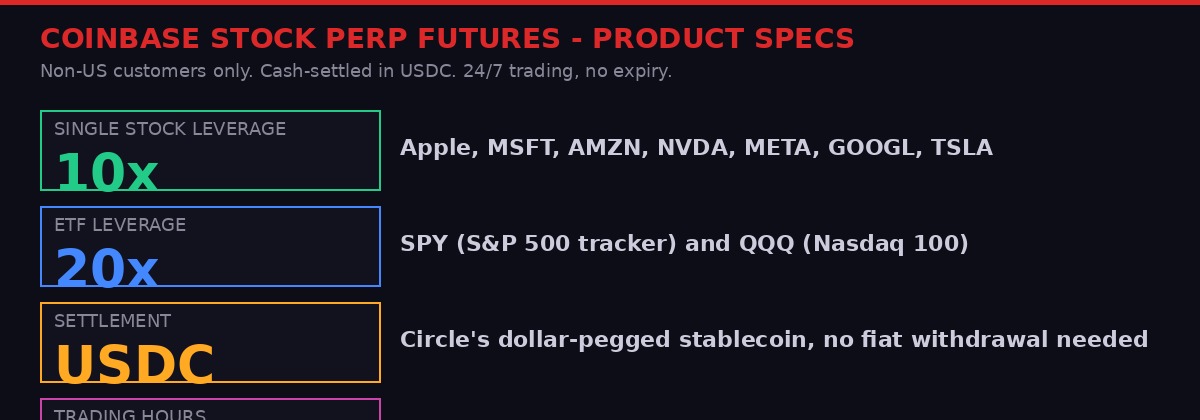
Coinbase's new product specs: 10x on Mag 7 single stocks, 20x on S&P/Nasdaq ETF products, USDC settlement.
The company frames this as part of its "Everything Exchange" strategy - a deliberate push to expand beyond crypto into any tradable asset class. The move puts Coinbase in direct competition with Hyperliquid, the decentralized perpetuals platform that introduced S&P 500 perpetual futures contracts just two days ago on March 18. Hyperliquid has also been running oil-linked futures contracts since the Iran conflict began in late February, with volume exploding as traders sought 24/7 oil exposure during the war shock.
The difference between Coinbase and Hyperliquid on this product: Coinbase is a regulated, centralized exchange with compliance infrastructure. Hyperliquid is a DEX with no KYC. For institutions and high-net-worth traders who need regulatory cover, Coinbase's version is the one they can actually use without legal risk. For retail degens who want raw access with no questions asked, Hyperliquid was there first.
Why This Changes Everything for Non-US Traders
The product is explicitly blocked for US customers, which is where US securities regulation draws its lines. But for the other 8 billion people on the planet, access to leveraged Apple and Nvidia exposure through a crypto wallet just became real. A trader in Singapore, Lagos, or Buenos Aires can now short Tesla at 10x leverage using USDC collateral. No US brokerage account required. No stock market hours. No settlement delays.
The cross-margining is significant too: Coinbase said the product uses the same risk engine supporting its crypto derivatives markets, with cross-margining across perpetual futures and spot positions. That means a trader holding Bitcoin on Coinbase can use that as collateral across the stock futures too. Crypto and equities finally share a margin account.
"Demand for round-the-clock equity exposure has been growing rapidly, and most of the offerings have been concentrated on decentralized platforms." - Coinbase blog, March 20, 2026
Morgan Stanley Names Its Bitcoin ETF: MSBT

Morgan Stanley's Bitcoin ETF filing puts another Wall Street giant in the spot BTC race. (Pexels)
Morgan Stanley disclosed the ticker for its planned spot Bitcoin ETF in an amended SEC filing on Friday morning: MSBT. The bank also revealed key fund mechanics - a 10,000-share creation unit structure, and a $1 million seed investment at launch. It bought two shares earlier this month for audit purposes, standard practice for bootstrapping an ETF.
BNY Mellon handles the fund's cash and administrative functions. Coinbase - yes, the same exchange that just launched stock perp futures hours later - serves as prime broker and custodian of the Bitcoin holdings. That's not a coincidence. Coinbase has aggressively built custody relationships with every major institutional player entering the Bitcoin ETF market.
If approved, MSBT joins 11 existing spot Bitcoin ETFs, headlined by BlackRock's IBIT, which have collectively attracted over $56 billion in inflows since launching in January 2024. That number - $56 billion in two years - is the real headline. It's proof that institutional demand for regulated Bitcoin exposure is not hype. It's real capital allocation at scale.
Spot Bitcoin ETF Market - Current State (March 2026)
Morgan Stanley entered the Bitcoin ETF race in January 2026 alongside its Solana ETF filing. The Solana application has been quiet since. The Bitcoin ETF is moving forward. That sequencing tells you something: Bitcoin institutional infrastructure is solidifying, while altcoin ETFs remain in a regulatory holding pattern even as the political climate for crypto improves.
The bank's push into crypto mirrors a broader pattern across Wall Street. Goldman Sachs expanded its crypto trading desk. Fidelity launched its own BTC ETF alongside BlackRock at the 2024 launch. JPMorgan quietly increased its crypto derivatives exposure. The institutions that spent years calling Bitcoin a fraud are now filing SEC paperwork to own it in regulated wrappers. The cognitive dissonance has been resolved - by the market.
The Stablecoin Corporate Treasury Play

Stablecoins are no longer a crypto novelty. 74% of global finance leaders say they improve cash-flow efficiency. (Pexels)
The third data point in today's Wall Street convergence story comes from Ripple's 2026 Digital Asset Survey - surveying over 1,000 global finance leaders at banks, asset managers, fintechs, and corporates. The results are not subtle.
74% of respondents said stablecoins can improve cash-flow efficiency and unlock working capital. This is not a crypto-native audience saying that. These are CFOs, treasury directors, and heads of financial operations at established institutions. When 74% of that group says stablecoins solve a real treasury problem, the use case is no longer theoretical.
70% said finance leaders must offer some kind of digital asset solution to stay competitive. That number represents an existential calculus - institutions that don't develop digital asset capabilities risk being priced out of deals, losing clients to more agile competitors, and falling behind on settlement infrastructure that's becoming standard.
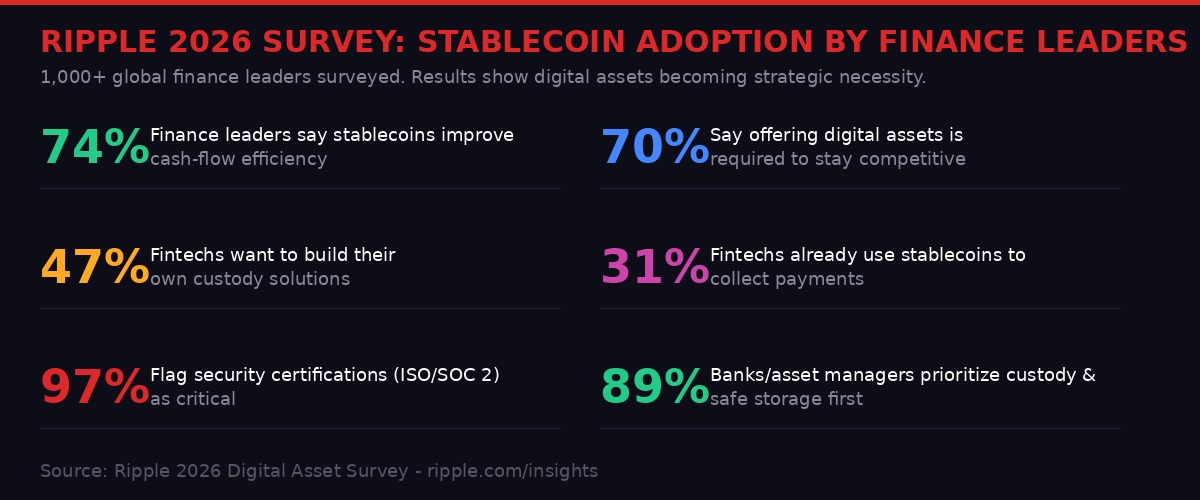
Ripple's 2026 survey of 1,000+ finance leaders shows stablecoins going mainstream as treasury tools, not just payment rails.
Fintechs are leading on adoption. 31% already use stablecoins to collect customer payments. 29% accept stablecoins directly from clients. 47% want to build their own custody solutions rather than relying on third-party infrastructure. Banks and asset managers are moving slightly slower - they want tokenized assets and third-party custody first. But the direction is identical.
The survey also surfaces what's holding people back: 97% flagged security certifications like ISO 27001 and SOC 2 as critical requirements for digital asset partners. That's a moat for established custodians and infrastructure providers, and it explains why Coinbase, BNY Mellon, and Fireblocks have been racing to acquire these certifications over the past two years.
"Digital assets are becoming a strategic necessity, and the infrastructure decisions made today are expected to shape competitive edge tomorrow." - Ripple 2026 Digital Asset Survey
The Macro Context: Why This Week Matters

Bond markets are crumbling. Rate hike odds are back. Bitcoin is still standing. The macro picture in March 2026 is as complex as it gets. (Pexels)
These three institutional moves are happening inside a brutal macro environment. The Iran conflict that began in late February sent oil up 50% in three weeks. WTI crude hit over $100 before partially retreating to $96. February CPI came in at 2.4% headline, 2.5% core - before the oil shock was reflected in the data. March inflation numbers, expected in April, are going to be ugly.
The consequences are showing up in rate markets. CME FedWatch data shows the odds of a Fed rate hike at the April meeting at 12%. One week ago that number was zero. Six weeks ago the market was pricing rate cuts. That reversal is the fastest repricing of Fed expectations in years, and it's hitting bonds hard.
The 10-year US Treasury yield hit 4.38% on Friday, up 10 basis points in a single session, and up from under 4% at the start of March. UK 10-year gilt yields punched above 5% for the first time since 2008. The global bond selloff is synchronised - dollar, sterling, euro sovereign debt all selling simultaneously as inflation fears spread across every major economy.
Gold, which everyone called the obvious war-time safe haven, has cratered. From its January peak of $5,600 per ounce, gold is now at $4,660 - a 17% collapse from the top. Silver went from $95 to $69.50. The precious metals trade was already crowded before the war. When everyone is long, the air comes out fast.
Bitcoin has not done that. Holding near $70,000 since the war began, Bitcoin is outperforming gold, silver, the S&P 500, and the Nasdaq over the past three weeks. Andre Dragosch, European Head of Research at Bitwise, put it plainly:
"Bitcoin has once again acted as the canary in the macro coal mine. At current levels, bitcoin is already pricing a recession, while many traditional assets are not." - Andre Dragosch, Bitwise European Head of Research, via CoinDesk
The Crypto Clarity Act moving toward a Senate hearing, Coinbase launching stock futures, Morgan Stanley filing a Bitcoin ETF - all of this is happening while the S&P 500 is on track for its fourth consecutive weekly decline. The institutions aren't running away from crypto during the macro storm. They're building infrastructure into it.
DeFi Gets a Reality Check: Gauntlet's $380M Exit

DeFi's TVL dynamics remain heavily incentive-driven. Gauntlet lost $380M in a week when OKX's pre-deposit campaign ended. (Pexels)
While the institutional narrative gets cleaner, DeFi is reminding everyone of its cyclical reality. Gauntlet, one of DeFi's leading risk management platforms, saw its total value locked collapse 22.84% in seven days - a $380 million drop from $1.72 billion to $1.325 billion, according to DeFiLlama data.
The cause is mechanical rather than catastrophic. OKX ran a pre-deposit campaign on Katana, a DeFi-focused blockchain, that ended this week. Pre-deposit campaigns pull in capital from yield-hunters who park funds ahead of a protocol launch, then extract that capital when the campaign closes or an airdrop drops. Gauntlet's TVL chart shows a textbook spike around March 2 that reversed just as steeply when OKX's campaign concluded.
The asset flows are predominantly stablecoin-based, Gauntlet noted. The firm manages three vaults - USDC, BTC, and WETH. The USDC vault currently yields 4.86% APY. BTC and WETH vaults sit at 2-2.3%. Meanwhile, Solana-based protocols like Jito are offering 5.69% on SOL staking. Capital goes where yield goes. When Gauntlet can't compete on APY with liquid staking, the stablecoin hot money rotates out.
Gauntlet has been here before. In October 2025, a single $775 million deposit hit its USDT vaults - a 40x TVL increase - and the system absorbed and rebalanced it within ten days. That kind of operational stability is exactly what the 97% of finance leaders citing security certifications are looking for. Gauntlet's institutional-grade risk frameworks are designed precisely for these volatility scenarios.
What this week's $380 million exit illustrates is that DeFi TVL is still heavily incentive-driven. The underlying protocols are real, the technology works, the risk management is improving. But the capital flows remain event-driven and mercenary. Sustainable TVL in DeFi requires deep integration with real yield sources - not just airdrop farming and campaign chasing.
The Crypto Clarity Act: Washington Gets Closer

The Crypto Clarity Act is moving through the Senate Banking Committee. Brian Armstrong's flexibility on stablecoin yield may be the unlock. (Pexels)
Congressional crypto legislation is closer to a Senate hearing than it has been in months. The Digital Asset Market Clarity Act - the crypto industry's top legislative priority - is working through Republican members of the Senate Banking Committee after White House officials participated in a Thursday meeting on updated legislative language.
The main sticking point has been stablecoin yield: banks want to control how stablecoin rewards programs are structured, arguing that yield on stablecoins functions like interest on bank deposits and should be regulated accordingly. Crypto firms, led by Coinbase, want to preserve stablecoin rewards programs that operate more like credit card cash-back - a product structure that doesn't fall under bank deposit rules.
Senator Cynthia Lummis said this week that Coinbase CEO Brian Armstrong, whose opposition to an earlier draft derailed a previous Senate hearing attempt, has become "more flexible" in recent negotiations. Armstrong's shift - combined with potential unrelated housing legislation sweeteners for community bankers - may give negotiators the deal structure they need to advance the bill before the end of April.
Democrats still want two things: a prohibition on senior officials and lawmakers profiting from personal crypto positions (aimed directly at Trump's crypto investments), and CFTC appointments to vacant Democratic seats before the agency adopts new crypto rules. Both are White House concessions, not congressional ones. That makes them the final holdouts on an otherwise converging bill.
Separately, Nevada handed prediction market platform Kalshi a 14-day restraining order on Friday, barring it from offering sports, entertainment, and election event contracts in the state. The First Judicial District Court of Nevada issued the order after a federal appeals court sent the case back to state regulators. Kalshi argues federal CFTC authority preempts state gaming law. CFTC Chairman Mike Selig has publicly backed Kalshi's federal jurisdiction argument. The April 3 hearing in Nevada will be a test of how hard states can push back against federally-licensed prediction markets.
What the Week's Events Tell You About 2026
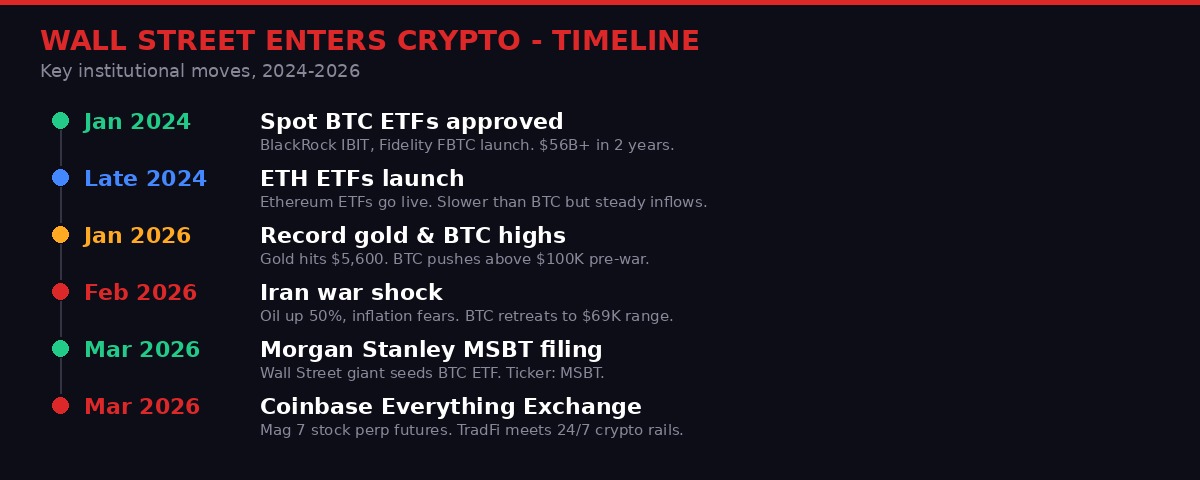
Two years of institutional moves: from the first spot BTC ETFs to Coinbase stock futures and Morgan Stanley's MSBT. The convergence accelerated.
Step back from the individual stories and Friday March 20, 2026 looks like a snapshot of where financial infrastructure is headed. Not where it might eventually go. Where it is right now, this week, today.
Coinbase launched 24/7 leveraged stock trading on a crypto exchange. Morgan Stanley filed a Bitcoin ETF with $1 million seed capital. Ripple surveyed 1,000 finance leaders and found 74% treating stablecoins as a serious treasury tool. These are not experimental pilots. Coinbase's product is live. Morgan Stanley's filing is public record. Ripple's numbers come from the people who actually run corporate treasury operations.
The macro environment is doing its own work. The bond market is selling off globally. Rate hike bets are back on the table for the first time in years. Gold collapsed 17% from its war-time high. The S&P 500 is down more than 5% over four consecutive weekly losses. In that environment, Bitcoin is the only major asset holding its value - up slightly from where it was when the Iran conflict began.
The implications for traders are specific. If Bitcoin continues to act as a macro hedge against inflation and bond market stress, institutional inflows into products like Morgan Stanley's MSBT will compound. Every week the S&P 500 falls while Bitcoin holds, the relative performance argument for BTC allocation gets stronger. Every rate hike bet that comes in makes traditional fixed income less attractive versus yield-generating DeFi protocols.
The Coinbase stock futures product opens a different kind of opportunity. Non-US traders now have a single platform where they can hold Bitcoin, short Tesla at 10x leverage, earn stablecoin yield, and trade Nasdaq futures - all in one account, 24 hours a day. That's a fundamentally different value proposition than anything traditional finance offers internationally. For Coinbase's non-US revenue, this is a significant move.
The stablecoin corporate treasury trend identified in Ripple's survey has compounding effects too. As more corporates park working capital in stablecoins for yield and settlement efficiency, the total stablecoin market cap grows. As the market cap grows, demand for on-chain dollar liquidity increases. As that demand increases, DeFi protocols offering stablecoin yields attract more institutional capital. The feedback loop is just starting.
The legislative piece is the wildcard. A passed Crypto Clarity Act would give every institution sitting on the sidelines the regulatory certainty they need to deploy capital at scale. It's not just about Bitcoin ETFs. It's about tokenized assets, on-chain settlements, DeFi integration with traditional banking rails. The bill is not law yet. But it's closer than it has ever been.
The lines between crypto and traditional finance are not blurring. They are gone. What's left is a negotiation over who controls the infrastructure, who gets the fees, and whose rules govern the combined system. That negotiation is happening in SEC filings, Senate committee rooms, and Coinbase product launches - simultaneously, this week, in March 2026.
Week in Numbers - March 20, 2026
Bitcoin Coinbase Morgan Stanley Stock Futures Stablecoins DeFi Crypto Legislation Macro Bonds Gauntlet
Get BLACKWIRE reports first.
Breaking news, investigations, and analysis - straight to your phone.
Join @blackwirenews on Telegram