The President's Nominees: How a Sanctioned Belarusian Oligarch Hid Billions Inside Cyprus
Yury Chyzh used a corporate service firm tied to the family of Cyprus's former EU president to maintain hidden ownership of companies that moved $4.3 billion - all while appearing on EU sanctions lists for bankrolling Lukashenko's regime.
The letter arrived in August 2024, notarized in Moscow and addressed to the Cyprus Registrar of Companies. The man who wrote it, Yury Chyzh, was a convicted Belarusian businessman with a history of EU sanctions, a fraud conviction, and a bankruptcy proceeding that had wiped out one of Belarus's largest pharmaceutical empires on paper - while leaving the actual assets oddly intact.
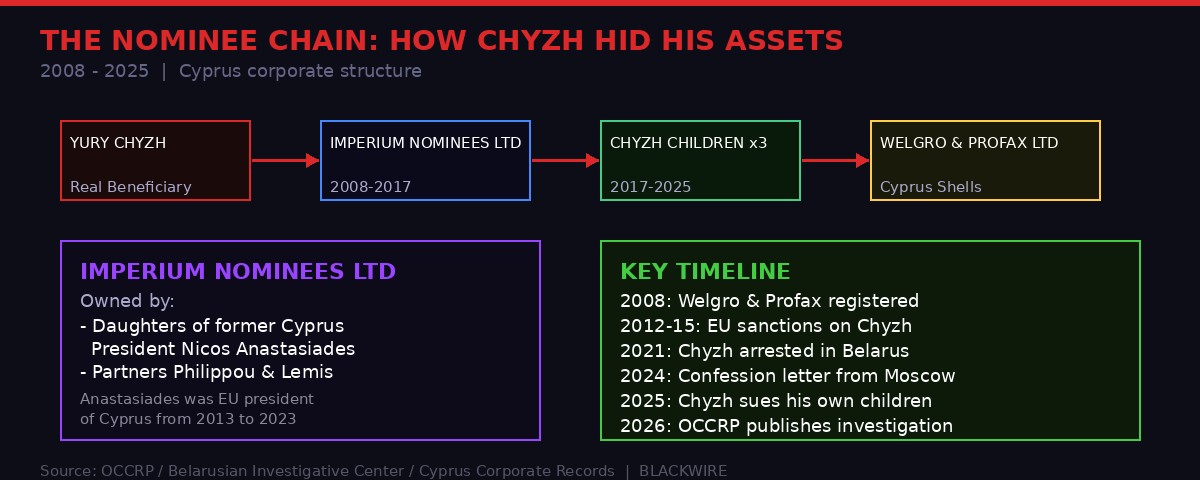
What the letter contained was extraordinary: a written admission that Chyzh had spent years using "nominee" figureheads to secretly control two Cypriot shell companies. He named his own children - one of whom was 12 years old when the scheme began - as the successive paper owners of Welgro Services Limited and Profax Investments Limited.
But buried inside that confession was a detail even more damaging than the admission itself. The nominee service company Chyzh used before his children - Imperium Nominees Limited - was owned by the daughters and former business partners of Nicos Anastasiades, Cyprus's president from 2013 to 2023, during the country's entire tenure as an EU member state with full sanctions-enforcement obligations.
This investigation, reported by the OCCRP, the Belarusian Investigative Center, and civil society group Rabochy Ruch, connects the dots between a Lukashenko-linked oligarch, a network of Cypriot shell companies, and one of the most politically connected law firms on the island - while the EU's own sanctions regime stood silent.
Who Is Yury Chyzh?
Yury Chyzh is not a minor figure in the Belarusian financial world. He built one of the country's largest private business conglomerates, Triple Group, which spanned construction, pharmaceuticals, chemicals, and energy. At the peak of his influence, he was considered one of the oligarchs closest to President Aleksandr Lukashenko - the authoritarian ruler who has held power in Belarus since 1994 and whose regime has been widely described by human rights organizations as "Europe's last dictatorship."
That relationship cost Chyzh in the West. Between 2012 and 2015, the European Union placed him on its sanctions list for financially supporting the Lukashenko regime - the same regime that has beaten, imprisoned, and exiled tens of thousands of Belarusian opposition figures, journalists, and protesters.
The sanctions were supposed to freeze his assets and block his access to the European financial system. But corporate records now show that throughout that period, Chyzh maintained quiet control over two Cypriot shell companies through Imperium Nominees - a service provider whose parent firm bore the name of a sitting EU president's family.
In 2021, Chyzh's relationship with Lukashenko curdled. He was arrested on charges of fraud and money laundering - a common fate for Belarusian oligarchs who fall out of political favor. He was convicted in 2023. The following year, after a long legal battle, his sentence appears to have been softened: he filed his confession letter to Cyprus from a Moscow address, suggesting he had either been released or was operating under unusual conditions for a convicted felon.
The Nominee Machine: Imperium and the Anastasiades Connection
At the center of the scheme sits a common Cypriot mechanism: the nominee ownership structure. Corporate service providers - firms that exist specifically to appear on official paperwork in place of the real owner - are a legal but frequently exploited feature of Cyprus company law.
What made this particular arrangement worth investigating was the identity of the nominee provider. Imperium Nominees Limited, which held Chyzh's companies on his behalf, was owned by a constellation of figures directly tied to the Anastasiades political family. Corporate records show that Anastasiades himself held shares in Imperium - along with shares in the law firm bearing his name - until he transferred them to his daughter Elsa and his business partners Philippou and Lemis just before assuming the presidency in February 2013.
His other daughter, Ino, was added as a shareholder in 2015. From that point on, both daughters, Philippou, and Lemis held shares in both Imperium Nominees and in the Nicos Chr. Anastasiades and Partners law firm that serviced Chyzh's companies.
The former president told OCCRP's Cypriot partner center CIReN that he was "unaware and therefore unable to answer" questions about Chyzh's use of the firm. He has previously told Cyprus's parliament that after transferring his shares, he had "absolutely no relationship or connection with the firm that bears my name."
The managing partners of the law firm - Philippou and Lemis - took a harder line. "We definitely deny all allegations of unlawful or improper conduct on the part of our firm," Philippou wrote when contacted. He did not respond to questions about how often sanctions lists were checked against companies receiving corporate services.
"I have always owned these companies through trustees and nominee beneficiaries... They did not have the financial or other capabilities to establish the companies." - Yury Chyzh, in a notarized letter to the Cyprus Registrar of Companies, August 2024
What Chyzh's letter makes clear - in writing, notarized, submitted to a government registry - is that the entire ownership structure was a fiction. The companies on paper were controlled by Imperium, then by his children. In reality, he was always the beneficiary. The letter was sent, investigators believe, as a legal maneuver to reclaim control of assets threatened by Belarus's bankruptcy proceedings - not as a voluntary act of transparency.
$4.3 Billion: The Petroleum Pipeline Nobody Discussed
The scale of what moved through this structure is staggering - and for years, largely unremarked upon.
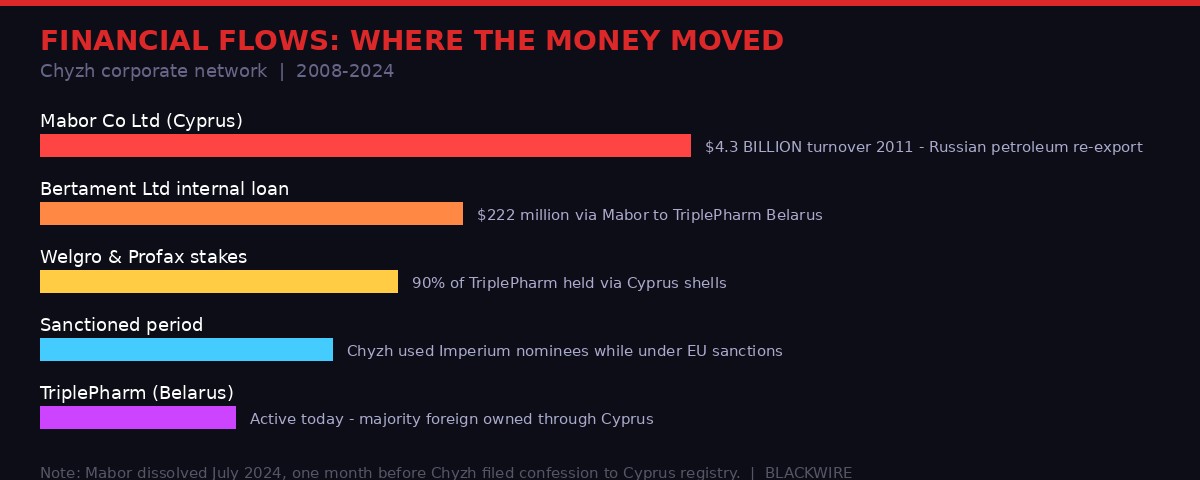
A Cyprus-registered company called Mabor Co Ltd, which financial filings describe as a "related party" to Chyzh's Bertament Limited (itself a subsidiary of Profax, one of his Cyprus shells), recorded $4.3 billion in turnover in 2011 alone. That money came from re-exporting Russian petroleum products from Belarus to international markets - a trade that generated enormous revenues for everyone in the chain, including Belarus's state apparatus and by extension Lukashenko's regime.
Mabor also made a $222 million loan to Bertament Limited in 2011 - a transaction that flowed money from one part of the Chyzh network to another, likely using the related-party label to obscure what was effectively a self-dealing transfer.
Philippou signed documents for Mabor's fund transfers. He told OCCRP he remembered the company name but declined to comment on specifics. He did not explain why he was signing financial documents for a company ostensibly owned by nominees he managed.
In January 2012, Bertament Limited signed a contract for a 16-day stay for a group of Belarusians at a Russian ski resort. The $25,000 invoice was issued to Philippou personally. The guestlist included Chyzh, two businessmen currently sanctioned by the EU, and several athletes, beauty queens, and Lukashenko's personal priest. The holiday coincided with a trip Lukashenko made to the same resort for a meeting with then-Russian president Dmitry Medvedev.
Mabor was dissolved in July 2024 - precisely one month before Chyzh filed his confession letter to the Cyprus Registrar, acknowledging his beneficial ownership of Profax, the parent of Bertament. The timing suggests a deliberate cleanup of paper trails immediately before the formal disclosure.
The Sanctions Gap: What EU Enforcement Missed
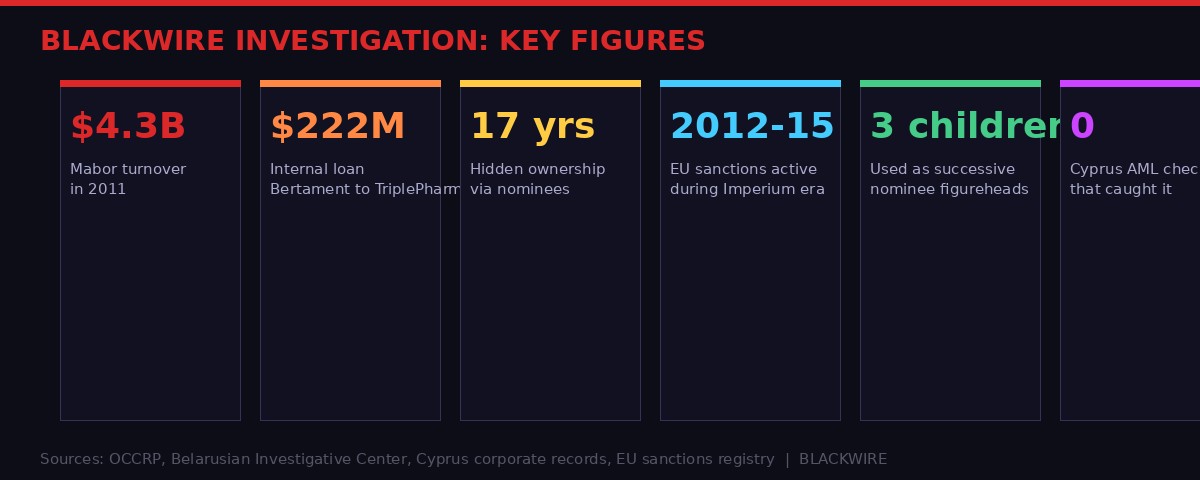
The European Union sanctioned Yury Chyzh between 2012 and 2015 specifically for bankrolling the Lukashenko regime. EU sanctions are supposed to freeze the assets of listed individuals and prevent EU-based entities - including Cyprus-registered companies and Cyprus-licensed corporate service providers - from providing services to them.
But the nominee structure Chyzh used predated the sanctions. Welgro Services Limited and Profax Investments Limited were registered in 2008 - four years before the first EU restrictions hit Chyzh's name. And by design, the nominee system meant his name never appeared on the official records of those companies. From the outside, they looked like ordinary Cypriot firms with anonymous local owners.
Anti-money-laundering experts have long identified this as Cyprus's core vulnerability. The island built its economic model as a gateway for Eastern European - and particularly Russian and post-Soviet - capital flowing into the EU. Nominee structures, dormant companies, and opaque beneficial ownership chains were not bugs in that system. They were features.
"The entire premise of the nominee system is to make the real owner invisible," said Graham Barrow, a British anti-money-laundering expert, in a separate context about UK corporate registry reform. "The question isn't whether it was used for laundering. The question is why it was ever legal to begin with."
Cyprus has faced repeated criticism for its lax enforcement of beneficial ownership disclosure. In 2013 - the same year Anastasiades took office - the island's banking system nearly collapsed and required a controversial EU bailout, in part because of the billions in opaque foreign deposits held by Russian and Eastern European elites who had used the island as a financial laundromat for decades.
The irony is sharp: as Anastasiades navigated the bailout crisis that exposed Cyprus's offshore banking culture, the family firm bearing his name continued to service a Belarusian oligarch on EU sanctions lists.
Children as Cover: The Nominee Succession
By 2017, Imperium Nominees' role in the Chyzh structure was replaced by something even more striking: his own children.
In the August 2024 letter, Chyzh explains the succession plainly. His three children were added "in succession" as nominal beneficiaries of Welgro and Profax from 2017. He is explicit that they "have always performed only intermediary functions, acting on my behalf and under my instructions." He describes himself as having "always been and remain the real beneficiary."
The mathematical reality makes the fiction obvious. Chyzh's children were born in 1988, 1990, and 1996. When Welgro and Profax were first registered in 2008, the eldest was 20, the middle was 18, and the youngest was 12 years old. None of them, Chyzh writes, "had the financial or other capabilities to establish the companies."
Using family members as nominees is a well-documented technique in financial crime investigations. It creates a layer of plausible deniability - if a regulator questions ownership, the nominee produces documentation and the beneficial owner stays hidden. It also reduces the risk of the nominee turning against the beneficial owner, since family loyalty is presumed.
The arrangement unraveled not because of regulatory detection, but because of internal conflict. In September 2025, Chyzh filed a lawsuit in a Belarusian court against his own two Cyprus companies - Welgro and Profax - in an effort to reclaim control of his assets. His three children were called as third parties on the side of the companies being sued. A father suing his children for control of a corporate empire, built on paperwork that named them as owners they never were.
The UK's Stock-Footage CEO: A Parallel Anatomy
The Chyzh-Cyprus story sits inside a broader pattern of sanctioned actors exploiting Western corporate registry systems as laundry infrastructure. A separate but contemporaneous OCCRP investigation, published in February 2026, documents a strikingly similar architecture deployed by Iranian financier Babak Zanjani.
Zanjani - who was convicted of embezzlement by Iran's own courts, sentenced to death, had his sentence commuted, and was released in 2024 - used two UK-registered cryptocurrency exchanges, Zedcex and Zedxion, to move funds on behalf of the Islamic Revolutionary Guard Corps (IRGC). The exchanges processed over $94 billion in transactions while filing paperwork with the UK's Companies House claiming to be "dormant."
The director of both exchanges was listed as "Elizabeth Newman" - a woman who, OCCRP found, does not appear to exist. Her image in promotional materials was traced to stock footage of a model captioned "pretty black woman talking to camera" on Shutterstock. Other supposed employees were also portrayed using stock images.
Both the Chyzh and Zanjani cases reveal the same structural vulnerability: Western corporate registries operate largely on trust. Cyprus's nominee system and the UK's Companies House both accepted paperwork at face value. Neither system required verification of the people nominally controlling billions in assets. Both systems have announced reforms - Cyprus under EU beneficial ownership directives, and the UK under the Economic Crime and Corporate Transparency Act 2023 - but in both cases, the regulatory tightening came long after the damage was done.
"Since its registration in August 2022, Zedcex has processed over $94 billion in total transactions according to the US Treasury - a fortune moved through a company that, according to UK company records, has reported doing no business at all." - OCCRP, February 2026
Timeline of the Chyzh Network
Cyprus: Gateway for Eastern Europe's Dark Money
Cyprus did not become a offshore haven by accident. Its low corporate tax rates, English-speaking legal system, EU membership, and historically light-touch beneficial ownership enforcement made it the preferred routing point for capital from the former Soviet Union and Eastern Europe moving into legitimate Western markets.
According to a 2022 analysis by the Tax Justice Network, Cyprus ranked among the top ten jurisdictions globally for enabling corporate secrecy. The island facilitated the offshore tax and secrecy needs of the world's largest economies despite being a tiny island nation - a statistical anomaly explained almost entirely by the scale of Russian and post-Soviet capital that moved through its corporate registry.
The European Commission has repeatedly pushed Cyprus to tighten its anti-money-laundering framework. The EU's 6th Anti-Money Laundering Directive, implemented across member states in 2021, required comprehensive beneficial ownership registries that were accessible to journalists, civil society, and law enforcement. Cyprus's implementation has been criticized as slow and incomplete.
The Chyzh case - where a Belarusian oligarch under active EU sanctions maintained hidden beneficial ownership through a nominee structure during the entire presidency of the man whose family ran that nominee service - illustrates exactly what inadequate AML implementation looks like in practice. Not a dramatic heist. A slow, quiet, paperwork-based circumvention that worked perfectly for more than a decade.
Chyzh was under EU sanctions because he was funding authoritarianism. His money - generated from petroleum re-exports, from pharmaceutical revenues, from a corporate empire built in Lukashenko's shadow - continued to flow through European-registered entities throughout that period. The EU sanctioned him. The EU's own member state provided the vehicles through which he evaded those sanctions.
What Happens Next
The immediate legal picture is murky. Chyzh remains a convicted man in Belarus, though his operational freedom appears greater than his sentence would suggest. The lawsuit he filed against his own Cyprus companies is ongoing. His three children are formally named as legal adversaries in a case about who actually controls assets their father built and hid behind their names.
Welgro Services Limited and Profax Investments Limited remain active in Cyprus, according to corporate documents. TriplePharm - the Belarusian pharmaceutical company 90 percent owned by those Cyprus shells - is also listed as active, its foreign ownership structure unchanged despite years of bankruptcy proceedings.
The Anastasiades family and law firm have denied any wrongdoing. Former president Anastasiades has pointed to the transfer of his shares before taking office as proof of separation. Whether Cypriot authorities, the European Commission, or any anti-money-laundering body investigates the nominee chain's operation during the sanctions period remains to be seen.
The broader implications reach further. If the family firm of an EU president can serve as a nominee vehicle for a Lukashenko-linked oligarch during the exact years that person is under EU sanctions - while the EU remains unaware - then the sanctions regime is not a wall. It is a speed bump. One that a good corporate lawyer and a compliant nominee service can navigate without breaking sweat.
The lesson of the Chyzh case is not that a Belarusian oligarch found a way around EU sanctions. That happens constantly. The lesson is who enabled it - and where the structure was built. Inside the EU. Using the family business of a sitting EU president. On the books of a corporate registry that asked no questions. For seventeen years.
The confession letter Chyzh sent to Cyprus in August 2024 was not an act of contrition. It was a legal necessity - a move to reclaim assets he believed were slipping from his control. But in writing down what he had done, and notarizing it, he handed investigators the clearest possible documentation of how the system works. Follow the paper. Check the nominees. Ask who owns the people who appear to own the companies.
The money always leaves a trail. It just takes someone willing to read it.
Get BLACKWIRE reports first.
Breaking news, investigations, and analysis - straight to your phone.
Join @blackwirenews on TelegramSources & methodology: This report is based on documents obtained by OCCRP, the Belarusian Investigative Center, and civil society group Rabochy Ruch, published March 6, 2026. Sources include Chyzh's August 2024 notarized letter to the Cyprus Registrar of Companies, Cypriot corporate records, EU sanctions registry data, Belarusian court filings, and financial reports filed by Mabor Co Ltd, Bertament Limited, Welgro Services Limited, and Profax Investments Limited. BLACKWIRE independently reviewed publicly available corporate registration data. All named individuals were given opportunity to respond by OCCRP prior to publication. Responses received are cited above.