China Breaks the Silence: 26 Warplanes Circle Taiwan as the US Bleeds in the Gulf
After two weeks of suspiciously quiet skies, Beijing surged 26 military aircraft toward Taiwan on Saturday - the largest single-day sortie in weeks. American air power is burning through fuel and crew rest in the Iran theater. Japan just quietly deployed long-range missiles aimed at the mainland. The question nobody in Washington wants to answer out loud: is China timing a move?
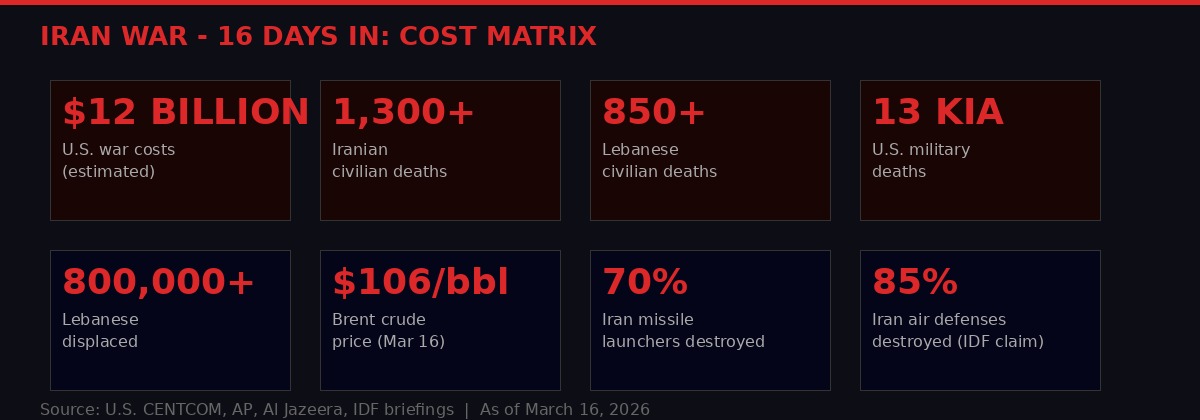
Iran War Day 16 cost matrix - $12 billion spent, 13 U.S. military dead, Brent crude at $106. Source: BLACKWIRE / public data.
The Taiwan Strait has been quiet for sixteen straight days. Too quiet.
Between February 27 and March 5, Taiwan's Defense Ministry did not report a single Chinese military aircraft in its Air Defense Identification Zone. Zero. For a week. That doesn't happen. In the same seven-day period last year, 92 Chinese military flights were tracked.
Then on Saturday, March 15, the silence broke hard. Taiwan's Defense Ministry detected 26 Chinese military aircraft around the island in a single day. Sixteen of them entered the northern, central and southwestern ADIZ sectors. Seven naval ships were simultaneously spotted in surrounding waters. (AP, March 16, 2026)
That same weekend, U.S. President Donald Trump was on Air Force One demanding that seven unnamed countries send warships to the Strait of Hormuz because Iran is firing drones at Dubai's airport. American KC-135 refueling tankers are running round-the-clock missions over Iraq. Six airmen came home in flag-draped caskets last week. The U.S. military is not, right now, in an optimal posture to respond to a second crisis in the Pacific.
Nobody in Beijing is saying anything out loud. They don't need to.
The Two Weeks That Don't Add Up
The drop in Chinese military flights started before the full blackout. In the two weeks between February 27 and March 14, Taiwan tallied just seven detected Chinese military aircraft in its ADIZ. Ninety-two flew during the equivalent period in 2025. The numbers are not a rounding error.
Three explanations circulated among analysts, and none of them are mutually exclusive.
The first: China's National People's Congress met in early March, and Beijing has historically dialed back military provocations during its own major political events. That explains some of the reduction. But as K. Tristan Tang, a nonresident fellow at the National Bureau of Asian Research based in Taipei, noted in an analysis shared with AP, the legislature "alone would not be the only or primary reason for sorties dropping to zero."
The second: Trump is scheduled to visit Beijing from March 31 to April 2. Trade talks between the two countries opened Monday in Paris, paving the way for a Trump-Xi summit. China may be reducing tension signals - at least visible ones - in the lead-up to what could be the most consequential diplomatic meeting of the year. If Xi wants maximum leverage at that summit, destabilizing Taiwan before Trump arrives would be a strange move. Unless the point is to show that China can flip the signal on and off at will.
The third explanation is the one that keeps former defense officials awake: China may have been running a different kind of exercise entirely, one that doesn't require visible ADIZ incursions. Underground command-and-control drills. Subsurface operations. Cyber and electronic warfare rehearsals. The absence of visible aircraft does not mean the People's Liberation Army stopped preparing. It may mean it started preparing differently.
"There are so many theories and the lack of understanding of China's intentions is what's disconcerting. You fill the void with uncertainty, and uncertainty increases risk." - Drew Thompson, former U.S. Defense Department official, now at S. Rajaratnam School of International Studies, Singapore. (AP, March 2026)
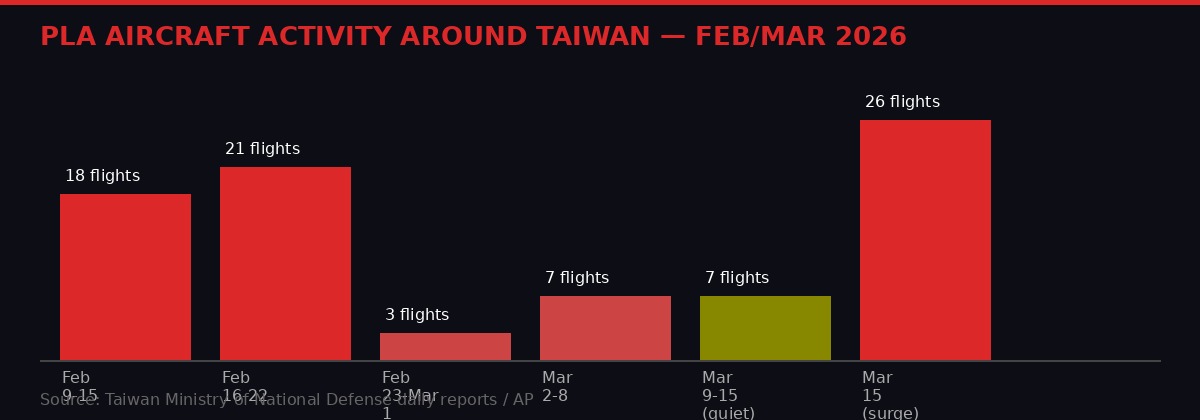
PLA aircraft ADIZ incursions near Taiwan, Feb-March 2026. The near-zero period followed by Saturday's 26-aircraft surge is visible in the data. Source: Taiwan MND / BLACKWIRE analysis.
What 26 Warplanes Actually Means
Numbers matter here. Twenty-six aircraft in a single day represents more than a routine patrol. Taiwan's Defense Ministry classifies incursions by northern, central and southwestern ADIZ sectors. Saturday's deployment hit all three simultaneously, which indicates coordination across multiple commands - not a patrol, not a training flight gone wide, but a deliberate multi-vector approach.
Seven naval vessels accompanying the aerial surge adds another layer. Taiwan's Defense Minister Wellington Koo had noted earlier in the quiet period that China's navy remained consistently active even as flights fell. The naval component never went away. The aircraft returned.
What this configuration mimics, at scale, is the opening movement of a blockade or invasion scenario - probing air defense responses in multiple sectors simultaneously while positioning surface vessels. Taiwan's military did not change its defensive posture during the quiet period, and it has not changed it after Saturday's surge. Publicly, at least.
The pattern is exactly what U.S. and Taiwanese war planners have gamed out for years: a period of apparent de-escalation, followed by a rapid ramp-up, designed to test response times and exhaust standing forces before a more decisive action. Nobody is claiming that's what this is. What analysts are saying is that the data fits that pattern, and that is uncomfortable enough.
Taiwan Strait - Key Numbers (March 16, 2026)
- 26 - PLA military aircraft detected near Taiwan on March 15
- 16 - Aircraft that entered Taiwan's ADIZ (northern, central, southwestern)
- 7 - PLA Navy vessels spotted in surrounding waters
- 0 - PLA aircraft detected in Taiwan ADIZ for 7 straight days (Feb 27-Mar 5)
- 92 - Chinese military flights detected in same two-week period in 2025
- 7 - Total ADIZ flights detected Feb 27-Mar 14, 2026 (vs 92 same period 2025)
- 23 million - Taiwan's civilian population
- March 31-Apr 2 - Trump's scheduled Beijing visit (White House confirmed)
America's Attention Is Elsewhere - And Beijing Knows It
U.S. military capacity is not infinite. That is not a revelation; it is a budget line item and a planning constraint that every defense ministry on earth tracks in real time. What changed two weeks ago is that American air and naval assets are now committed to a live shooting war in the Gulf, and the political bandwidth in Washington is consumed by the Strait of Hormuz crisis.
Thirteen U.S. military personnel have been killed since the Iran war began on March 1. Six of them died Thursday when a KC-135 Stratotanker - the backbone of in-flight refueling for every operation in the theater - crashed in western Iraq while supporting strike operations. Three of the dead were from MacDill Air Force Base in Tampa, three from an Ohio Air National Guard base in Columbus. Tech Sgt. Ashley B. Pruitt, 34, from Bardstown, Kentucky, left behind a 3-year-old daughter and a stepson. Maj. John Alex Klinner, 33, had just been promoted and had been in-theater less than a week. He left three children under two years old. (AP, March 15, 2026)
The KC-135 fleet, 376 aircraft strong according to the Congressional Research Service, is old - the airframe has been in service more than 60 years - and it is the linchpin of extended operations. Every long-range strike mission against Iran depends on these planes. Every combat air patrol in the Gulf needs them. When one goes down, the ripple effect across the sortie schedule is immediate. And when the crews flying them are tired, running back-to-back missions without adequate rest, accidents happen.
Trump, flying home from Mar-a-Lago aboard Air Force One on Sunday, demanded that seven unnamed countries heavily reliant on Middle East oil send warships to police the Strait of Hormuz. The response from allies has been, diplomatically speaking, tepid. British Prime Minister Keir Starmer said Monday that the UK is exploring "mine-hunting drones" but signaled it will not dispatch a warship. German Foreign Minister Johann Wadephul said before meeting EU colleagues in Brussels that clarity was needed on what the "military aims" of the U.S.-Israel campaign actually are. France has a blueprint for naval escorts but retired Vice Admiral Pascal Ausseur told AP that sending warships into Hormuz right now would be "suicidal." (AP, March 16, 2026)
The political price Trump is paying domestically is mounting. A top adviser confirmed the war has cost approximately $12 billion so far. Brent crude sits at $106 a barrel. Stock markets have been declining. Even some of Trump's own supporters in the MAGA media orbit are questioning the endgame. Democrats, according to Kelly Dietrich, CEO of the National Democratic Training Committee, believe they are "well-positioned" for November's midterms on the back of the war's economic fallout. (AP, March 16, 2026)
A president fighting a war he cannot clearly explain, facing allies who won't commit, watching his poll numbers drop and his party's midterm prospects erode - that president is not well-positioned to open a second front in the Pacific. Beijing reads the same newspapers. It watches the same data.
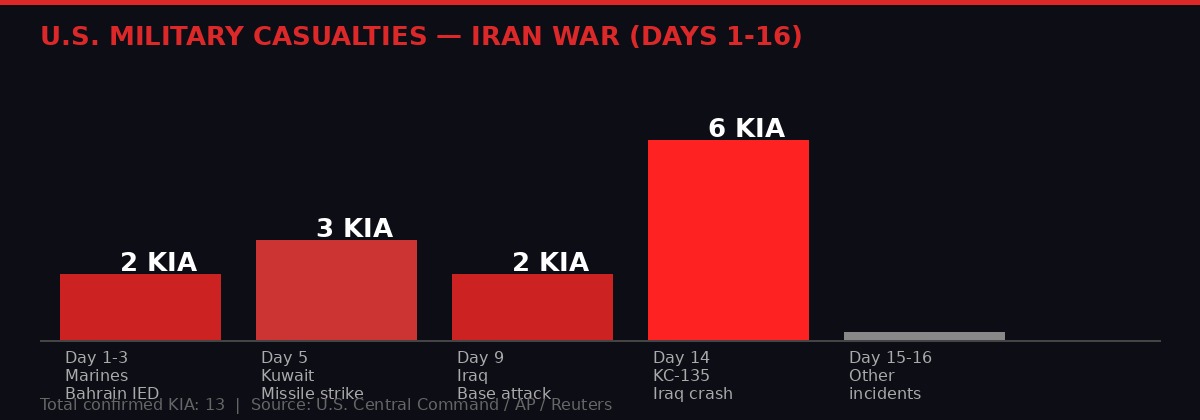
U.S. military deaths in the Iran war by incident, Days 1-16. Thirteen confirmed KIA. The KC-135 crash on Day 14 is the single largest loss event so far. Source: U.S. CENTCOM / AP / BLACKWIRE.
Japan's Answer: Long-Range Missiles Pointed at the Mainland
Japan is not waiting for Washington to sort out its priorities. In the early hours of Monday, March 16, army vehicles carried launchers and equipment for Japan's upgraded Type-12 land-to-ship missiles into Camp Kengun in Kumamoto Prefecture, southwestern Japan. Dozens of protesters stood outside the gate in the dark, shouting "Stop long-range missile deployment!" and holding banners. Kumamoto Governor Takashi Kimura told reporters Monday he was "extremely disappointed" that the prefecture learned about the deployment from media reports rather than the defense ministry. (AP, March 16, 2026)
The Type-12 in its upgraded configuration has a range of approximately 1,000 kilometers - around 620 miles. That range puts mainland China within reach from southwestern Japan for the first time. The original Type-12 had a range of 200 kilometers, enough to target ships in coastal waters. The upgraded version is a different category of weapon: a strike system capable of holding Chinese military installations, ports, and logistics nodes at risk without requiring Japan's forces to leave their own territory.
The deployment is scheduled to be complete by March 31. Launchers will follow later this year at Camp Fuji near Tokyo. Japan's Defense Ministry accelerated the deployment schedule by a full year, according to reporting from Tokyo. Defense Minister Shinjiro Koizumi confirmed last month that midrange surface-to-air missile systems will be deployed on Yonaguni Island - Japan's westernmost territory, east of Taiwan - by 2031. PAC-3 interceptors are already positioned on Okinawa, Ishigaki, and Miyako islands, strung along the island chain that forms the first line of geographic resistance to any PLA move toward Taiwan.
Prime Minister Sanae Takaichi stated shortly after taking office that any Chinese military action against Taiwan could constitute grounds for Japan's own military response. That statement represented a significant departure from Japan's postwar defensive posture. Takaichi has not walked it back.
Japan's calculus is straightforward: if China moves on Taiwan, Japan cannot stay out of the conflict. The island chains are too close, the sea lanes are too vital, and the precedent of Chinese military control over Taiwan's airspace and surrounding waters would be existentially threatening to Tokyo's security. Deploying missiles that can strike the mainland is not preparation for an offensive - it is the establishment of a deterrent, and a signal that Japan intends to raise the cost of any PLA action considerably. Whether Beijing receives that signal as stabilizing or escalatory is the operative question.
"Trump sees China as an economic negotiation, not as a security challenge." - Drew Thompson, former U.S. Defense Department official, S. Rajaratnam School of International Studies (AP, March 2026)
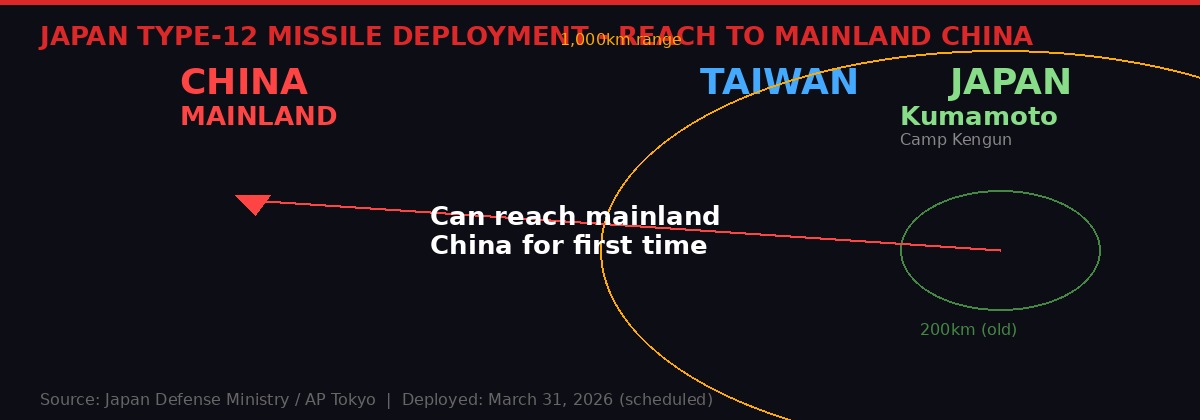
Japan's upgraded Type-12 missile range schematic. The 1,000km range - a 5x increase from the original - puts mainland China within reach from Camp Kengun, Kumamoto, for the first time. Source: Japan Defense Ministry / BLACKWIRE graphic.
The Summit and the Sword: Trump Travels to Beijing in Two Weeks
The Trump-Xi summit - scheduled March 31 to April 2 in Beijing, confirmed by the White House but not yet officially acknowledged by China - sits in the center of every calculation in this story. U.S.-China trade talks opened Monday in Paris, described by AP as laying the groundwork for the summit. Beijing has not publicly confirmed the visit.
The timing is almost too neat. China's PLA reduced military provocations around Taiwan in the weeks before a major diplomatic engagement with Washington. That is consistent with past behavior - Beijing has quieted its military posturing before sensitive diplomatic moments before. Then, with two weeks remaining before the summit, the aircraft returned at scale.
One reading: China is reminding Trump what he has at stake in the conversation. Show up in Beijing with no leverage because you're bogged down in a Gulf war, and Xi holds all the cards. The PLA's Saturday surge was a recalibration of the bargaining position - a demonstration that China has not become more accommodating just because the U.S. asked nicely.
A second reading is more alarming: the quiet period was preparation. China used two weeks of apparent restraint to reset its operational cycle, run internal drills away from surveillance satellites' optimal detection windows, and confirm its force readiness. The surge on Saturday was not a signal - it was a check. The PLA is ready and it just proved it to itself.
A third reading, favored by analysts who focus on Chinese domestic politics: the NPC just closed, the leadership is consolidated, and Xi has been given fresh authority on the five-year economic plan. He is coming to the table with Trump from a position of relative domestic stability. The aircraft were a reminder - to Taiwan's military, to the U.S. intelligence community, to the broader Indo-Pacific defense architecture - that the pressure campaign has not stopped. It merely paused.
None of these readings are mutually exclusive. They can all be simultaneously true.
The Gulf Connection: Iran's War as Strategic Cover
Iran's current campaign against U.S. and allied interests is providing a real-time test of American strategic capacity. The results are not encouraging from a deterrence-theory standpoint.
On Monday morning, Gulf Arab states including the UAE, Saudi Arabia, Kuwait and Bahrain reported new missile and drone attacks. Iran called for the evacuation of three major UAE ports - the first time Tehran has explicitly threatened a neighboring country's non-U.S. assets during this conflict. Dubai International Airport briefly suspended operations after a drone struck a fuel tank. Brent crude sits above $106 per barrel as Al Jazeera reports. Japan, as of Monday, began releasing strategic oil reserves in response to the energy crisis created by the effective closure of the Strait of Hormuz. (Al Jazeera, March 16, 2026)
In Lebanon, Israel sent additional ground troops into the country on Monday for what its military called a "limited and targeted operation," responding to what it described as hundreds of Hezbollah Radwan unit fighters approaching the border. An Israeli airstrike on Qantara killed four people, including two children. A second airstrike hit medics who arrived at the scene of the first, killing two paramedics from the Islamic Health Society. Lebanon's displacement crisis has now reached more than 800,000 people - nearly one in seven residents of the country. (AP Live, March 16, 2026)
The IDF reported Monday that its forces have now destroyed an estimated 70 percent of Iran's missile launchers and 85 percent of Iran's air defense infrastructure over 7,600 strikes in the first two weeks of the war. Iran's Foreign Minister Abbas Araghchi said Monday from Tehran that the Strait of Hormuz "is only closed to our enemies, to those who carried out unjust aggression against our country and to their allies." He added: "From our perspective it is open." That framing - a selective closure rather than a universal blockade - is legally and diplomatically significant. It is also not being accepted at face value by anyone whose tankers are sitting idle.
What all of this creates, for Beijing's strategic planners, is a constellation of pressures pulling American political and military attention away from the Pacific. A shooting war in the Gulf. A ground operation expanding in Lebanon. A Hormuz closure straining the global economy. A domestically weakened president with declining approval numbers who is, in two weeks, flying to Beijing to negotiate. Whatever move China is or is not planning, the environment is as favorable to Beijing as it has been in years.
Timeline: China's Military Posture Around Taiwan, Feb-March 2026
What Comes Next
The immediate question for the next two weeks is what happens in Beijing on March 31. Trump is walking into that summit with a list of demands - primarily economic, focused on trade and tariffs - against a backdrop of an ongoing shooting war, an oil price shock hitting American consumers, and a military that is actively stretched. Xi is hosting him with the full awareness that his own military just ran 26 aircraft around Taiwan without any meaningful American response.
The summit's agenda, as publicly framed, is economic. The Trump administration has sought to treat China as a trade problem to be solved with deals, not a security problem to be managed with alliances and force posture. Former official Drew Thompson told AP flatly that "Trump sees China as an economic negotiation, not as a security challenge." That framing - shared by much of the Trump team - may be the most consequential strategic miscalculation of the current period.
Meanwhile, Japan is not waiting for Washington to recalibrate. The Type-12 deployment is the most visible symbol yet of a broader Japanese strategic shift: accepting, finally, that the country cannot rely on U.S. extended deterrence alone. Japan's 2022 national security strategy, which explicitly endorsed counter-strike capability for the first time in the postwar era, is now being translated into deployed hardware. The missiles in Kumamoto are the physical manifestation of a country that has decided the risk of action is lower than the risk of continued restraint.
For Taiwan, the pattern of the last two weeks is both alarming and familiar. Alarming because of the clear correlation between a distracted United States and an emboldened PLA sortie tempo. Familiar because this is the water in which Taiwan has swum for 76 years: perpetually managing the gap between the threat Beijing poses and the protection Washington provides, never fully certain where the line falls.
The sixteen days of the Iran war have answered one question unambiguously: American military and political capital is finite. Iran has found a way to consume a significant portion of it. The people watching most carefully from the most consequential vantage point are in Beijing. They are not saying anything. They sent 26 aircraft instead.
Key Players and Positions (March 16, 2026)
- Xi Jinping: Preparing for Trump summit March 31; PLA activity around Taiwan surges on March 15 - no statement from Beijing
- Donald Trump: Demanding 7 countries send warships to Hormuz; Iran war cost $12bn; traveling to Beijing in 15 days
- Wellington Koo (Taiwan Defense Minister): Has not changed defensive posture; noted PLA navy remained active throughout quiet period
- Sanae Takaichi (Japan PM): Stated Chinese military action on Taiwan could trigger Japanese response; deployed Type-12 missiles March 16
- Abbas Araghchi (Iran FM): Hormuz "open to non-enemies"; UAE ports threatened for first time - March 16
- Keir Starmer (UK PM): UK will not send warships to Hormuz; exploring mine-hunting drone deployment
- Johann Wadephul (German FM): Calling for clarity on U.S.-Israeli "military aims" before next phase
The Strait of Hormuz will reopen when the guns go quiet in the Gulf. The Taiwan Strait question has a longer fuse. But fuses burn whether you're watching them or not.
Thirteen American airmen and sailors are dead after sixteen days in the Gulf. Japan is deploying missiles in the dark. China is flying 26 aircraft at an island of 23 million people while the president who is supposed to deter such moves is trying to figure out how to get tankers through a different strait entirely. This is what strategic overextension looks like before it becomes catastrophic. You only see it clearly in retrospect - or if you're paying attention to the Pacific while everyone else is watching the Gulf burn.
Get BLACKWIRE reports first.
Breaking news, investigations, and analysis - straight to your phone.
Join @blackwirenews on Telegram