The AI Cold War Hardens: China Bans Western Agents While ByteDance Routes Around Nvidia
On the same week Beijing ordered government workers to strip Western AI agent software from office computers, ByteDance quietly activated a 36,000-Blackwell-GPU cluster in Malaysia - built specifically to route around US export controls. This is not a coincidence. It is a doctrine.
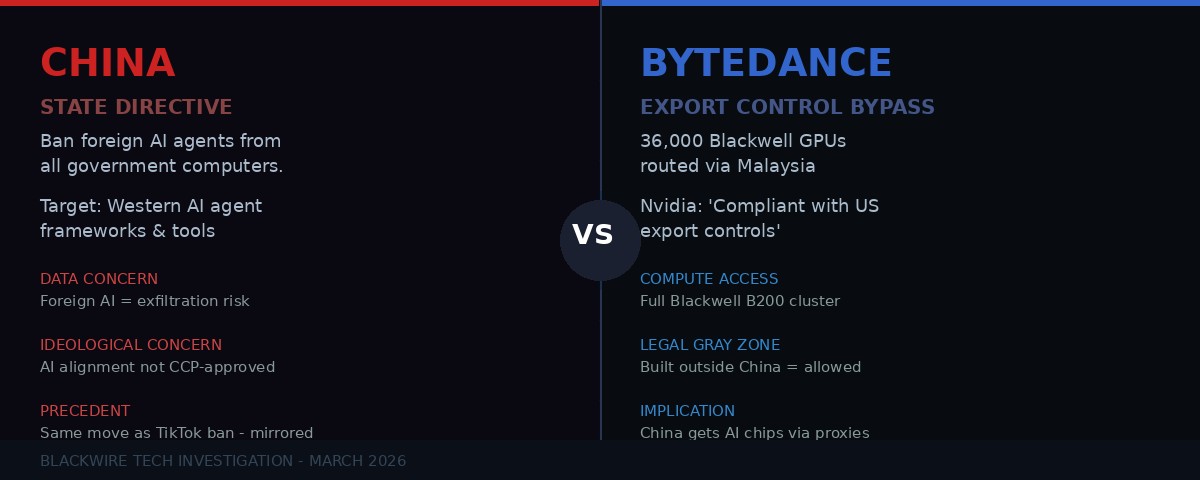
The dual move: Beijing locks out Western AI while Chinese firms find hardware routes through Southeast Asia. Credit: BLACKWIRE Research
Two things happened in the same week that, taken separately, look like routine tech policy. Taken together, they are the clearest signal yet that the AI Cold War has moved from rhetoric into operational doctrine.
First: China's central government issued a directive warning state enterprises and government agencies not to install Western AI agent software on office computers. The ban specifically targeted agentic AI frameworks - tools that do not just answer questions but autonomously take actions on behalf of users. According to reporting by Tom's Hardware, multiple Chinese government bodies moved to tighten restrictions on foreign AI agents in the same week, citing unspecified security concerns.
Second: Nvidia confirmed to the same publication that ByteDance - the TikTok parent - had legally accessed a cluster of 36,000 Blackwell B200 GPUs through a Malaysian cloud operator. The cluster sits outside Chinese territory, which under the current US Commerce Department framework means it falls outside the export control restriction. Nvidia's position: "permissible as long as clusters are built in compliance with US export controls outside China."
These two moves - one defensive, one offensive - define the new shape of the technology arms race. China is hardening its AI perimeter against foreign software while its own companies sprint to close the compute gap through legal gray zones and proxy infrastructure. The United States, meanwhile, is discovering that its export control architecture was designed for a world in which geography and geopolitics aligned more cleanly than they do in 2026.
The Ban: What China Is Actually Afraid Of
The Chinese government's concern about Western AI agents is not irrational. It reflects a hard-nosed threat assessment that mirrors exactly what US intelligence agencies worry about with Chinese tech in American infrastructure.
AI agents - unlike traditional software - are fundamentally different in their threat profile. A word processor or spreadsheet application processes your data locally and returns an output. An AI agent, by contrast, is designed to have persistent access to files, systems, and networks. It takes actions. It calls external APIs. It maintains context across sessions. In a government or enterprise environment, this means a sufficiently capable Western AI agent installed on a civil servant's computer is, from Beijing's perspective, a potential intelligence collection platform operating behind the firewall.
The concern runs deeper than data exfiltration in the traditional sense. Agentic AI systems can be updated remotely. Their behavior can change with model updates pushed from servers outside Chinese jurisdiction. A government ministry worker using a US-developed AI agent framework has, in effect, given a foreign company persistent, updateable access to their work environment. That is not a risk any government's security apparatus would accept lightly - and China's is more alert to this category of threat than most.
There is also an ideological dimension that Western analysts sometimes underweight. Chinese state security is not only concerned about military secrets or diplomatic cables. It is deeply concerned about the framing, values, and political assumptions baked into AI systems developed under Western governance frameworks. An AI agent trained on Western data, optimized for Western preferences, and answering to companies headquartered in the United States represents a vector for what Beijing calls "ideological infiltration" - the slow erosion of CCP-approved information norms through constant interaction with foreign-built software.
Why Agentic AI Is a Different Threat Class
- Persistent access: Agents maintain context, files, and system access across sessions - unlike single-query chatbots
- Remote update: Behavior can change with server-side model pushes without user awareness
- Action capability: Agents call APIs, execute code, send messages - they are not passive
- Data aggregation: Agents trained on user behavior build detailed profiles over time
- Foreign jurisdiction: Model servers, training data, and update infrastructure sit outside Chinese control
This is the same reasoning that led the US government to pursue a TikTok ban - the argument that a Chinese-controlled application with persistent access to American users' data and behavior represents a national security liability regardless of whether any specific act of data collection can be proven. China is now applying the same logic to agentic AI frameworks built by US companies, and it is hard to argue the reasoning is structurally wrong.
The practical implementation of the ban is ongoing. Tom's Hardware reported that "multiple government bodies moved to rein in the AI agent" after the central government directive. This is not a clean overnight enforcement - it is the beginning of a bureaucratic purge process that will take months to filter through the layers of state enterprise and agency IT infrastructure. But the direction is unambiguous: Western AI agents are being treated as a hostile technology in China's government sector, effective immediately.
The Loophole: How ByteDance Got 36,000 Blackwell GPUs
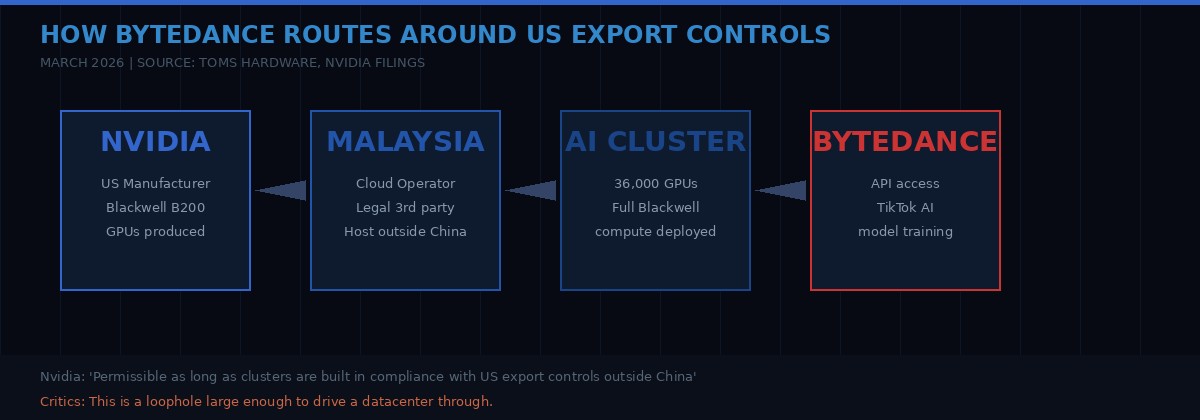
ByteDance's compute access pathway: US-manufactured Blackwell B200 GPUs deployed via Malaysian cloud operator, outside Chinese territory. Source: Tom's Hardware, Nvidia filings.
While one arm of the Chinese government was locking out Western software, another arm of the Chinese tech industry was engineering one of the most creative end-runs around American export controls since the controls were first tightened in October 2022.
The details, confirmed by Nvidia and reported by Tom's Hardware on March 13, are remarkable in their simplicity. ByteDance did not smuggle chips. It did not use shell companies in a legally questionable manner. It simply built - or contracted the building of - a massive GPU cluster on Malaysian soil, operated by a Malaysian cloud provider, and accessed it as a service.
The cluster contains 36,000 Blackwell B200 GPUs. For reference, Blackwell B200 is Nvidia's current flagship AI training chip, the successor to the H100 that powered the first wave of large language model training. A cluster of 36,000 B200s is not a startup's test environment - it is a facility capable of training frontier AI models, running inference at scale for hundreds of millions of users, and pushing ByteDance's AI capabilities forward at a pace that the US export control regime was explicitly designed to prevent.
Nvidia's public position is that the arrangement is legal. The US restrictions apply to exports that end up in China or are used for Chinese military applications. A cluster built and operated in Malaysia, by a Malaysian company, is technically outside the scope of the controls - even if the primary beneficiary of the compute is ByteDance, whose parent company is Chinese and whose servers ultimately serve Chinese government data requests under Chinese law.
"Nvidia says it is permissible for ByteDance to use AI clusters outside of China to develop its AI prowess as long as these clusters are built in compliance with the US export controls." - Tom's Hardware, March 13, 2026
Critics of the current control framework have been pointing to exactly this vulnerability for years. The US Commerce Department's October 2022 export restrictions were written around a relatively simple model: advanced chips cannot go to China. The regulations have been updated multiple times since then, with increasingly sophisticated attempts to close geographic and technical loopholes. But the fundamental logic - that physical location determines permissibility - was always going to create pressure toward offshore proxy arrangements.
Malaysia has emerged as the primary pressure valve. The country has significant existing semiconductor and tech infrastructure, a business-friendly regulatory environment, and no formal alignment with either US or Chinese tech governance frameworks. It is, in effect, neutral territory - and that neutrality is precisely what makes it useful as a routing point for Chinese companies seeking Western compute they cannot legally obtain at home.
ByteDance is not alone. Multiple Chinese AI companies have been exploring similar arrangements across Southeast Asia, including Singapore, Indonesia, and Vietnam. The pattern is clear: as US controls tighten, Chinese tech money flows to nearby jurisdictions that are too economically intertwined with Beijing to antagonize, too diplomatically cautious to fully align with Washington, and technically capable enough to host serious AI infrastructure.
The Export Control Architecture Is Cracking
The ByteDance Malaysia cluster is a symptom of a structural problem in the US approach to AI chip export controls, not an anomaly. Understanding why requires a brief look at how we got here.
The October 2022 restrictions were the first serious attempt by any government to use chip export controls as a tool of AI competition policy. The logic was compelling: modern AI capability scales with compute. The US and Taiwan manufacture the world's most advanced semiconductors through TSMC. If advanced chips cannot reach Chinese AI developers, China's AI development falls behind. The technology gap becomes a strategic asset.
That logic holds in principle. In practice, its implementation has a set of assumptions baked in that are not holding. The primary assumption is that geography is a reliable proxy for risk. If a chip ends up in Malaysia, it is not in China, and therefore it is not a problem. But in a world of networked cloud services, the physical location of a GPU cluster has limited bearing on who benefits from the compute it produces. A ByteDance engineer in Beijing accessing a model training cluster in Kuala Lumpur via API is, from a capability standpoint, functionally equivalent to that engineer having the cluster in Beijing. The atoms are in Malaysia. The bits are everywhere.
The core problem with the current framework: US export controls restrict the movement of physical hardware. They cannot easily restrict the movement of AI capabilities built using that hardware from legal jurisdictions. Restricting hardware without restricting the outputs of that hardware is like restricting the sale of printing presses while allowing the global distribution of everything printed on them.
The Commerce Department is aware of this gap. There have been multiple rounds of updated guidance attempting to tighten the geographic and end-use provisions of the controls, including requirements for cloud providers to implement Know Your Customer protocols that would identify when Chinese entities are the ultimate users of restricted compute. But enforcement is difficult, the legal frameworks are novel, and the pace of regulatory update has consistently lagged behind the pace of creative circumvention.
There is also a domestic politics dimension. Nvidia earns substantial revenue from chips that ultimately - through one or more intermediaries - end up powering Chinese AI development. The company has a financial interest in interpretations of the rules that permit its sales, and it has the lobbying infrastructure to influence how those interpretations develop. This is not corruption - it is the normal functioning of regulated industries - but it creates persistent upward pressure on the permissibility boundaries that is not matched by an equally organized constituency arguing for tighter controls.
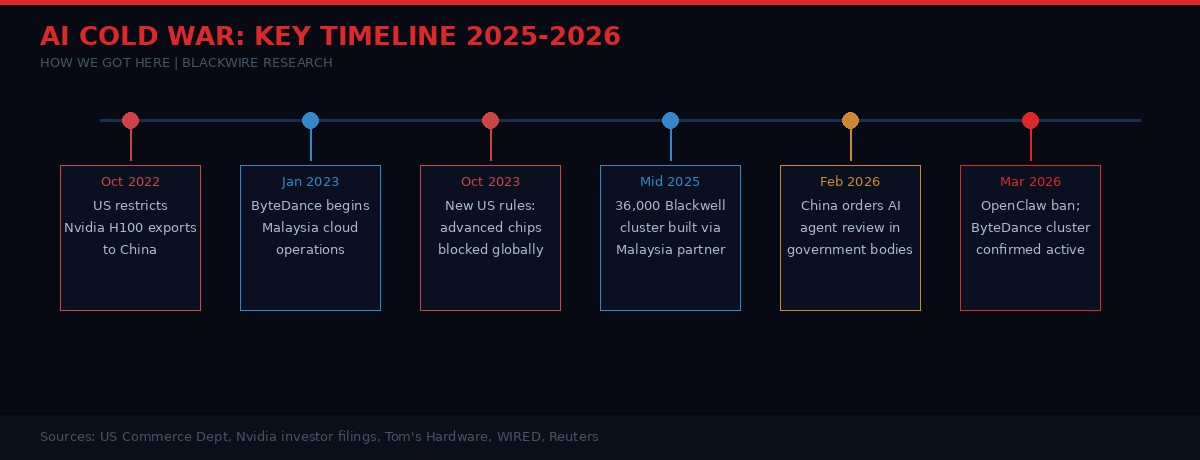
The escalation arc: from October 2022 chip restrictions to the 2026 agent ban and Malaysia cluster workaround. Source: BLACKWIRE Research
Meta's Stumble and the Myth of Western AI Dominance
While China moves aggressively on both defense and offense in the AI hardware and software wars, the West is dealing with its own internal turbulence. Meta - the company that has staked billions on open-source AI as both a business strategy and an ideology - is running behind schedule on its most important model in years.
The New York Times reported on March 12 that Meta has postponed its next major AI model, internally codenamed "Avocado," from a planned March release to at least May. The reason: performance falls short of rivals. Specifically, Avocado was tested against current offerings from Google (Gemini 2 Ultra) and Anthropic (Claude 3.7) and was found to be underperforming on multiple benchmarks considered critical by the enterprise customers Meta is targeting.
The delay is embarrassing but not existential. Model development timelines slip. The more revealing detail is what Meta has done in response: the company recently hired Alexandr Wang, the founder and former CEO of Scale AI, to revamp its AI development approach. Scale AI is the data labeling and AI evaluation company that, arguably more than any single lab, understands how to make frontier models perform well on the metrics that matter to enterprise buyers.
Wang's hire signals that Meta's internal team - despite enormous resources and talent - was not cracking the problem of model quality on its own. Bringing in the architect of Scale's evaluation and data infrastructure is an admission that the company needs external expertise to compete at the frontier. It is also a significant strategic acquisition: Wang's relationships, methodologies, and institutional knowledge from Scale give Meta a blueprint for the evaluation-driven approach to model improvement that has driven OpenAI and Anthropic's consistency.
"Meta's spent billions trying to catch up, and Avocado will be its first major release since hiring Scale's Alexandr Wang to revamp its efforts." - The Verge, March 12, 2026
The Avocado delay matters for the AI Cold War context because it punctures a narrative that has been useful but increasingly inaccurate: that Western AI companies are consistently ahead of their Chinese counterparts, and that the gap is widening. The reality is more complex. In reasoning models, DeepSeek's R2 and Kimi k1.5 have been competitive with Western frontier offerings. In multimodal capabilities, Chinese labs are within striking distance. The compute disadvantage imposed by export controls is real, but Chinese labs have been remarkably efficient at squeezing competitive performance from constrained hardware - and the ByteDance Malaysia cluster is about to remove that constraint for one of the most well-funded players in the game.
The Second-Order Effects: Supply Chains, Cables, and the Physical Internet
The AI Cold War is not just playing out in software and chip policy. It is reshaping the physical infrastructure of the internet and the global tech supply chain in ways that will take years to fully understand.
One of the most concrete examples: Meta's 2Africa undersea cable project - a 45,000-kilometer cable system that was designed to connect Africa, Europe, and Asia with dramatically improved bandwidth - has been delayed by the Iran conflict, according to Tom's Hardware reporting from March 13. The war in the Persian Gulf has created operational disruptions along cable routing corridors, adding cost and uncertainty to a project that was already navigating complex international agreements.
Undersea cables are the physical substrate of the internet. Roughly 95% of international data traffic flows through them. They are also, as the deliberate severing of cables in the Baltic Sea in late 2024 demonstrated, increasingly targets in geopolitical conflicts. Meta's 2Africa cable was designed in part to reduce dependence on routes through the Middle East - but the construction and deployment timeline is now uncertain. Every month of delay is a month during which African connectivity improvements are deferred and Meta's global infrastructure plans remain unexecuted.
The broader supply chain story is equally turbulent. PC shipments are forecast to fall by 10-12% in 2026, with IDC, Omdia, and Gartner all citing the same two causes: US tariffs on Asian electronics components, and a global memory shortage that has driven RAM prices sharply higher. The memory shortage is driven in part by the same AI training boom that is making GPUs scarce - DRAM and HBM are being absorbed by AI infrastructure at a rate that has outpaced manufacturing capacity expansion.
The second-order effect here is significant. Cheaper consumer PCs have been one of the primary vectors for global digital inclusion over the past two decades. Schools in developing countries, small businesses, freelancers in emerging markets - all depend on affordable commodity hardware. As the AI arms race between the US and China consumes ever-larger shares of global chip manufacturing capacity, the supply available for consumer devices shrinks and prices rise. The AI Cold War has a cost that will be paid not by the competing superpowers but by the billions of people who just need a functional laptop at a price they can afford.
Supply Chain Stress Points - March 2026
- PC shipments: IDC forecasts -11.3% YoY in 2026; Gartner and Omdia agree (-10% to -12%)
- Cause 1: US tariffs on Asian electronics components adding 8-15% to component costs
- Cause 2: DRAM shortage - AI training consuming HBM/DRAM capacity at record rates
- Market value: PC market value UP 1.6% despite volume drop - prices rising to compensate
- 2Africa cable: Meta's 45,000km Africa-Europe cable delayed by Iran conflict disruption
- RMA impact: Silicon Power now hedging warranty replacement policies against ongoing shortages
The Scorecard: Where the AI Race Actually Stands
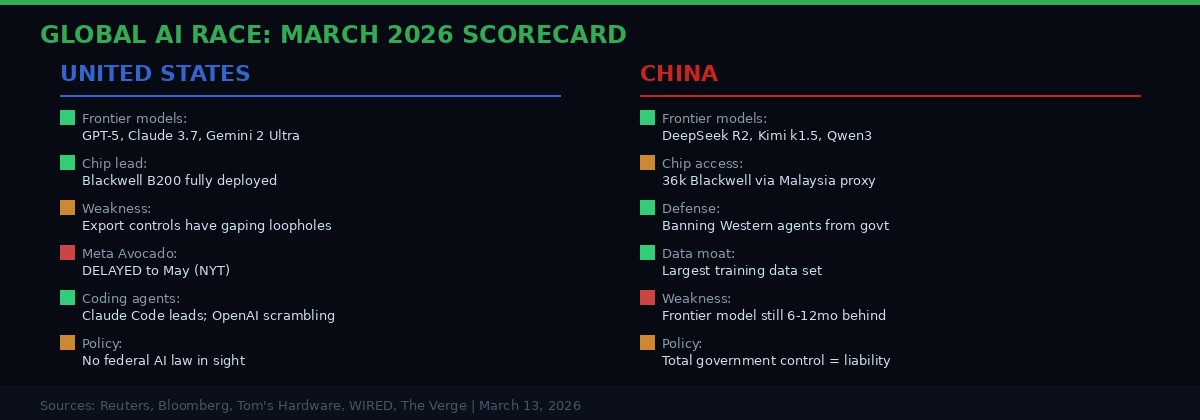
Where the US and China actually stand in the AI race as of March 2026. Green = advantage, amber = parity or gap closing, red = behind. Source: BLACKWIRE analysis.
Cutting through the noise of announcements, delays, and regulatory moves: what does the state of the AI race actually look like in March 2026?
The United States still leads at the frontier. GPT-5, Claude 3.7, and Gemini 2 Ultra represent capabilities that Chinese labs have not yet fully matched, particularly in complex reasoning, coding, and long-context tasks. The chip manufacturing lead is real - TSMC's process technology and Nvidia's architecture remain ahead of what China can domestically produce. The talent ecosystem, centered on the Bay Area but globally distributed, continues to generate breakthroughs at a pace Chinese labs are working hard to replicate.
But the lead is narrowing faster than most Western analysts expected three years ago. DeepSeek's R2 model, released in early 2026, demonstrated that Chinese labs could produce frontier-competitive reasoning models at a fraction of the training compute Western competitors used - an efficiency gap that has real strategic implications. Kimi k1.5 from Moonshot AI pushed multimodal capability benchmarks. Qwen3 from Alibaba has been competitive in multilingual tasks that matter for deploying AI at global scale.
The ByteDance Malaysia cluster changes the compute equation. Until now, Chinese labs have been developing world-class models despite hardware constraints - a kind of forced efficiency that has produced remarkable results. With 36,000 Blackwell B200s available through legitimate cloud access, ByteDance removes that constraint. The question shifts from "can they do it under pressure?" to "what do they build when the constraint is gone?"
The answer, if history is any guide, will not be a polite update to TikTok's recommendation system. ByteDance's AI ambitions are frontier-scale. The company has one of the world's largest datasets of human behavioral signals, accumulated through TikTok's billion-plus users. It has been building AI infrastructure aggressively and quietly for years. The Malaysia cluster is the compute unlock that could allow it to train models that compete directly with OpenAI and Google at the top end of the capability stack.
That is the scenario the US export control regime was designed to prevent. Whether the regime's architects have the legal and political tools to close the Malaysia loophole before it is fully exploited is one of the defining policy questions of 2026.
What Comes Next: The Doctrine Hardens
The two moves this week - China's agent ban and ByteDance's compute activation - are best understood not as isolated events but as evidence that both sides have moved from reactive to proactive in the AI Cold War.
China is not waiting to see what Western AI companies will do in its markets. It is proactively locking them out of the most sensitive parts of its economy, building a defensive perimeter around government and state enterprise operations that will serve as the foundation for a broader push toward domestic AI self-sufficiency. The ban on Western AI agents from government computers is the first step in a process that will eventually extend to financial services, healthcare, critical infrastructure, and the military - each sector being hardened incrementally, each hardening step creating more demand for Chinese-built alternatives and less leverage for Western tech companies.
The United States' export control architecture, meanwhile, is being tested by the Malaysia loophole in real time. The Commerce Department has several tools available: it could extend the controls to include cloud services built primarily for Chinese beneficial users; it could require Nvidia to implement end-user verification that looks through corporate structures to identify Chinese state-linked beneficiaries; it could designate specific Malaysian cloud operators as acting in violation of the controls' intent. Each of these options has legal complexity, diplomatic costs, and industry opposition to navigate.
The harder question is strategic. The US has been approaching AI competition as primarily a hardware problem - control the chips, control the capability. China's performance on limited hardware, combined with the Malaysia workaround, suggests that hardware constraints alone are not sufficient. The competition is increasingly happening in data, algorithms, applications, and the ecosystems built around AI - domains where hardware export controls have limited reach.
A more comprehensive approach would include: export controls on AI training services (not just hardware), restrictions on American companies providing AI training data to entities linked to the Chinese government, investment restrictions on US capital flowing into Chinese AI development, and coordinated policy with allies in Europe and Asia to prevent geographic arbitrage. Some of these measures are under discussion in Congress and at the Commerce Department. None are close to implementation.
In the meantime, the AI Cold War is being fought by two asymmetric opponents. China is playing defense at home and offense on hardware access. The United States is defending its frontier model lead while watching its hardware containment strategy develop holes. Neither side is winning cleanly. Both sides are committed.
The week of March 10-14, 2026 will be remembered as the moment when that commitment became visible in operational actions rather than policy speeches. The directive that cleared Western AI agents from Chinese government offices, and the cluster of 36,000 Blackwell GPUs humming in Malaysian server rooms - these are not abstractions. They are the infrastructure of a competition that is going to shape the next decade of technological history, whether or not the people writing that history want to acknowledge it.
Get BLACKWIRE reports first.
Breaking news, investigations, and analysis - straight to your phone.
Join @blackwirenews on TelegramSources
- Tom's Hardware (March 13, 2026): "China bans OpenClaw from government computers and issues security guidelines amid adoption frenzy"
- Tom's Hardware (March 13, 2026): "China's ByteDance to access 36,000 Blackwell GPU cluster through Malaysia cloud operator"
- Tom's Hardware (March 13, 2026): "Iran conflict delays Meta's 2Africa undersea cable project"
- Tom's Hardware (March 13, 2026): "2026 PC shipment forecast slashed amid memory shortages"
- The Verge (March 12, 2026): "Meta's Avocado AI needs more time to ripen" (citing New York Times reporting)
- Nvidia public statement: Confirmation that ByteDance Malaysia cluster arrangement is permissible under US export control rules
- IDC, Omdia, Gartner (March 2026): PC shipment forecasts for 2026, projecting 10-12% decline
- WIRED (March 2026): Background on ByteDance AI compute constraints and ambitions