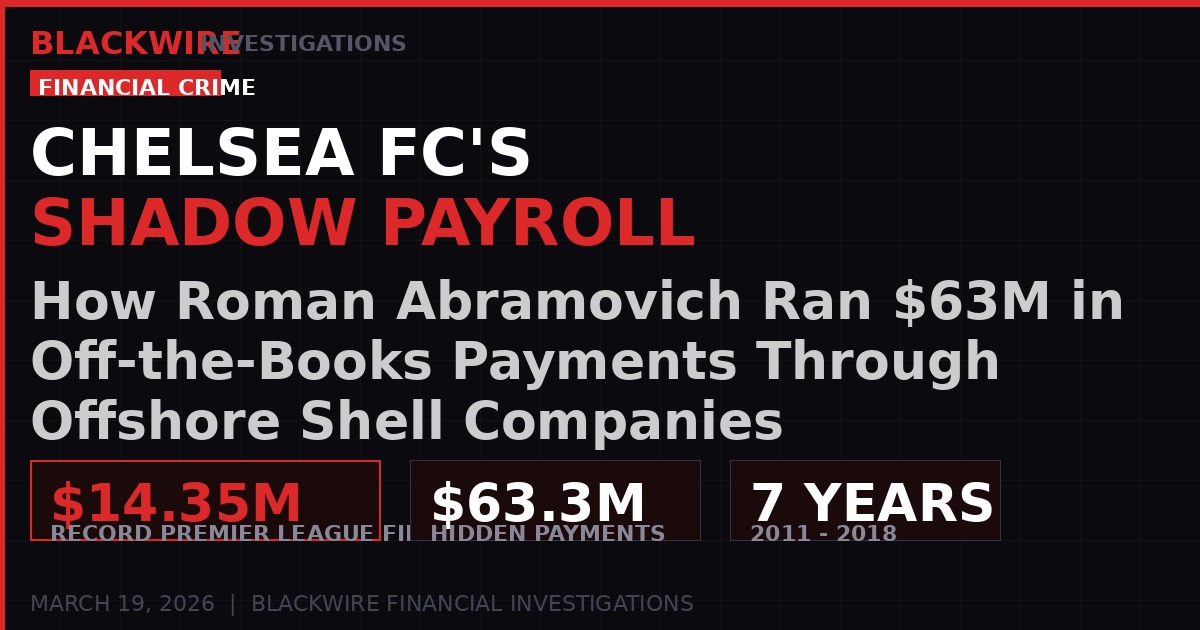
BLACKWIRE investigation: Chelsea FC fined a record $14.35 million for Abramovich-era hidden payments. | BLACKWIRE Graphic
The fine arrived on a Monday in March 2026. The Premier League called it the largest financial penalty ever levied in English football. Chelsea FC called it a "settlement." The redacted sanctions document published by the league told a more specific story: seven years of deliberate concealment, offshore shells, and a shadow payroll that moved $63.3 million beyond the sight of regulators.
Roman Abramovich, the Russian billionaire who bought Chelsea in 2003 and transformed it into a continental powerhouse, had built something alongside the trophy cabinet. A financial architecture designed to pay the people who made success possible - agents, scouts, intermediaries, fixers - while ensuring those payments never appeared on Chelsea's books, never counted against the Financial Fair Play spending limits that the league's regulators would one day scrutinise.
The Premier League's findings, published March 17, 2026, confirm what investigators at the Organized Crime and Corruption Reporting Project (OCCRP) first exposed in 2023 through the Cyprus Confidential leaks: Chelsea's off-the-pitch machine ran on offshore money, and the people who ran the club knew it.
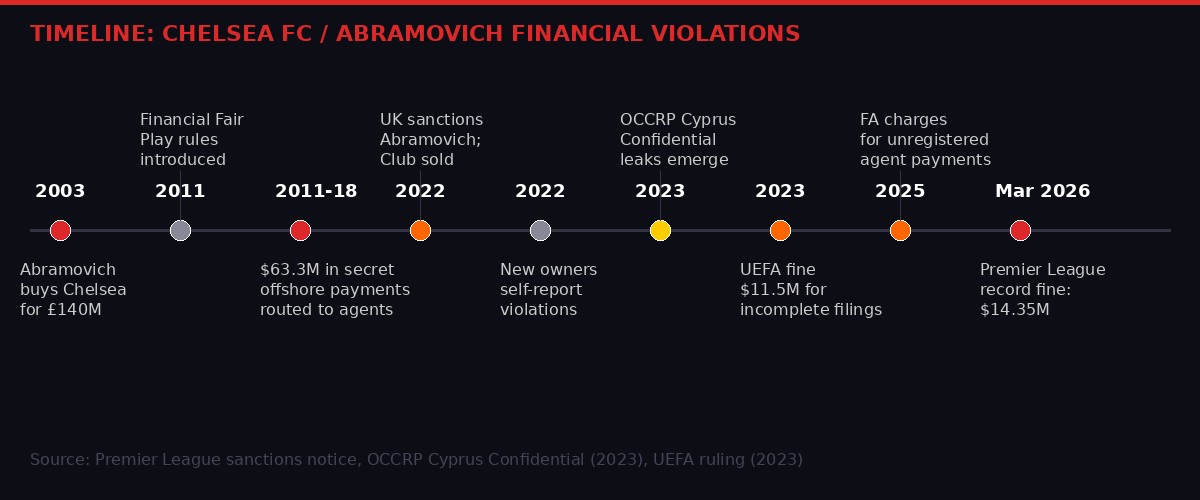
Timeline: Chelsea FC's financial violations from 2003 to the March 2026 Premier League fine. | BLACKWIRE Graphic
The Architecture of Concealment
Financial Fair Play rules entered English and European football in 2011. The intention was clear: prevent the richest owners from simply buying success by pumping unlimited cash into clubs. Under FFP, a club's spending on wages and transfers had to stay within defined limits relative to its revenues. Overspend, and you faced fines, points deductions, or exclusion from European competitions.
Roman Abramovich had a problem. By 2011, Chelsea had already spent hundreds of millions of pounds under his ownership. The club routinely made some of the biggest signings in world football. Players like Didier Drogba, Frank Lampard, and John Terry had delivered five Premier League titles and two Champions League trophies. The appetite for spending was not going to stop. But the regulatory framework meant it had to, at least on paper.
What the Premier League investigation found, documented across a redacted sanctions notice published this week, is that between 2011 and 2018 - precisely the period during which FFP rules were being established and enforced - the club and its associated parties made 47.5 million British pounds ($63.3 million) in payments that never appeared in Chelsea's official financial records.
These payments did not disappear. They moved through shell companies registered in the British Virgin Islands, entities with no public profile, no discernible business activities, and no formal connection to Chelsea Football Club. The BVI is not chosen randomly. It is a jurisdiction built on financial opacity. Companies registered there face minimal disclosure requirements. Ownership can be layered through nominees. The money moves, but the trail grows cold quickly.
The Premier League concluded that the payments were made using funds controlled by or associated with Abramovich, and that they were executed with "the knowledge and approval of former senior officers and directors" of the club. The ruling describes the conduct as involving "deception and concealment in relation to financial matters." That is the league's language. It is not subtle.
"If a club were to hide outgoings like wages or amortization of transfers by paying those sums through other entities, it is conceivable that they could be in breach of the FFP rules. You would effectively be circumventing your regulatory requirements, which limit your ability to spend." - Samuel Cuthbert, sports law barrister, Outer Temple Chambers, speaking to OCCRP in 2023
The Recipients: Who Got the Hidden Money
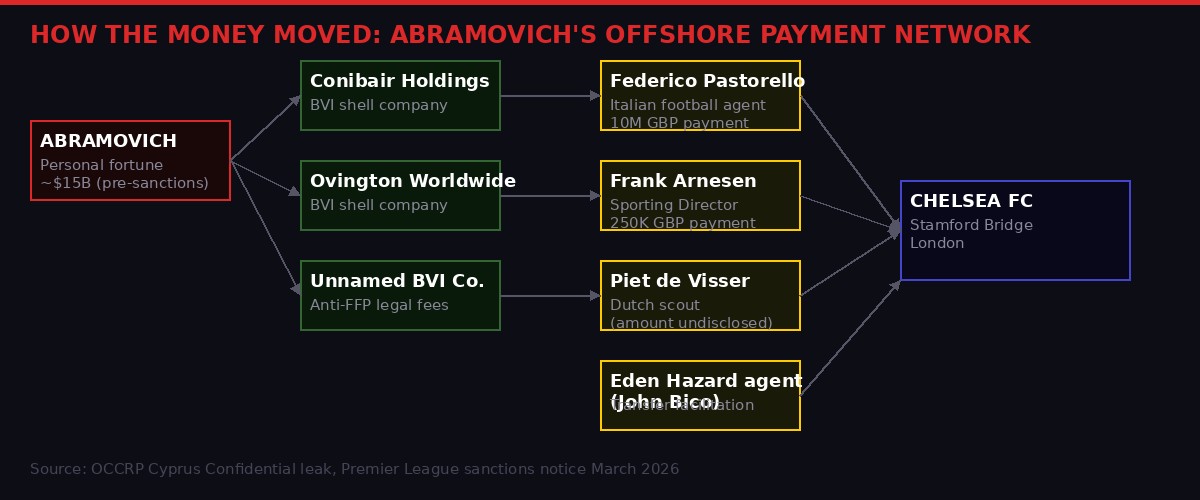
How Abramovich's offshore shell companies moved money to Chelsea-connected intermediaries. | BLACKWIRE Graphic
The Cyprus Confidential leak, obtained by the whistleblower group Distributed Denial of Secrets and shared with OCCRP and its global partners in 2023, gave investigators their first look inside the payment network. The files came from MeritServus, a Cypriot corporate service provider that administered many of Abramovich's offshore vehicles. What they contained was a map of the hidden money and where it went.
The largest single payment identified by OCCRP was 10 million British pounds transferred to Federico Pastorello, an Italian football agent. The money came from Conibair Holdings Limited, a BVI company owned by Abramovich. Conibair's only previously documented business activity was holding Abramovich's private jet. The payment was made on the same Tuesday in July 2017 that Chelsea publicly announced manager Antonio Conte had signed a new two-year contract worth approximately 9.6 million pounds per year.
According to the leaked documents, Conibair purchased a majority stake in an obscure Delaware company called Excellence Investment Fund - EIF, LLC, which Pastorello owned. The company had no public profile and no apparent assets that could justify the 10-million-pound price. Pastorello declined to comment on whether the payment was related to Conte's contract renewal, stating only that Conte was "not our client." There is no suggestion of wrongdoing by Conte himself.
Frank Arnesen, Chelsea's former sporting director, received 250,000 pounds from another Abramovich entity, Ovington Worldwide Limited, for what the contract described as "football consultancy services." Arnesen confirmed the payment but told reporters he had expected it to come from Chelsea directly. "I would have expected the payment to be processed through the accounts of Chelsea, but received it through another entity," he said. "I understood this as such that the third party and Chelsea had agreed upon this."
Piet de Visser, the renowned Dutch scout credited with identifying top talent for Chelsea over many years - including bringing Brazilian winger Willian and Belgian forward Eden Hazard to the club's attention - also received payments through Abramovich's offshore structure. The amounts connected to de Visser were not fully disclosed in the public documents, but his role as a key intermediary in Chelsea's recruitment machine is well established.
John Bico, identified as the agent of Eden Hazard during his time at Chelsea, appears in the leaked files as another recipient of Abramovich-connected offshore funds. Hazard, who joined from Lille in 2012 for approximately 32 million pounds, became one of the defining players of Chelsea's decade under Abramovich - winning two Premier League titles and the Europa League before moving to Real Madrid in 2019 for over 100 million euros.
- Federico Pastorello (Italian agent) - 10 million GBP via Conibair Holdings (BVI), summer 2017
- Frank Arnesen (former sporting director) - 250,000 GBP via Ovington Worldwide (BVI)
- Piet de Visser (Dutch scout) - undisclosed amount, offshore structure
- John Bico (Eden Hazard's agent) - offshore payment, amount undisclosed
- Unnamed recipients - millions more routed through BVI entities not publicly named in redacted PL notice
- Anti-FFP legal fees - paid by an Abramovich BVI firm on behalf of Chelsea, confirmed by the lawyer who brought the legal challenge
Source: OCCRP Cyprus Confidential investigation (2023); Premier League sanctions notice (March 2026)
Financial Fair Play: The Rule That Made It Necessary to Hide
Understanding why Abramovich built this structure requires understanding what FFP was designed to prevent - and how close Chelsea came to breaching it on paper during the peak years of his spending.
UEFA introduced Financial Fair Play rules in 2011 with the stated goal of ensuring clubs lived within their means. The framework required clubs to demonstrate that their expenditure on player wages and transfer fees did not exceed their revenues by more than a defined threshold, typically 30 million euros over a three-year assessment period. Clubs caught overspending faced graduated sanctions: fines, restrictions on squad sizes for European competition, and in extreme cases, exclusion from the Champions League.
Chelsea had been spending at a scale that made compliance difficult. Between 2003 and 2011, Abramovich had injected hundreds of millions of pounds into the club through a combination of direct loans and equity. The club's wage bill was among the highest in Europe. Transfer fees for star players pushed spending to the limit of what could be reported without triggering sanctions.
Kieran Maguire, author of "The Price of Football" and a widely cited expert on football finance, put the problem plainly when the Cyprus Confidential files first emerged: "If there is proof that the club has used third party transactions to circumvent the profitability and sustainability rules, then sanctions would be either financial or a points deduction." He also noted that Chelsea's "huge spending meant it had come close to breaching financial loss limits."
By channelling payments to agents, scouts, and intermediaries through Abramovich's own offshore companies rather than through Chelsea's accounts, the club could continue making the deals that built its squad while keeping those costs off the books that regulators examined. On paper, Chelsea looked more financially prudent than it was in practice. The offshore architecture was not incidental to this system. It was essential to it.
"FFP rules are there to facilitate sustainability, to prevent what is often referred to in these circles as financial doping. Non-adherence with spending caps may make a non-complying club more competitive in transfer markets." - Samuel Cuthbert, sports law barrister, to OCCRP (2023)
The Collapse: Sanctions, Sale, and Self-Reporting
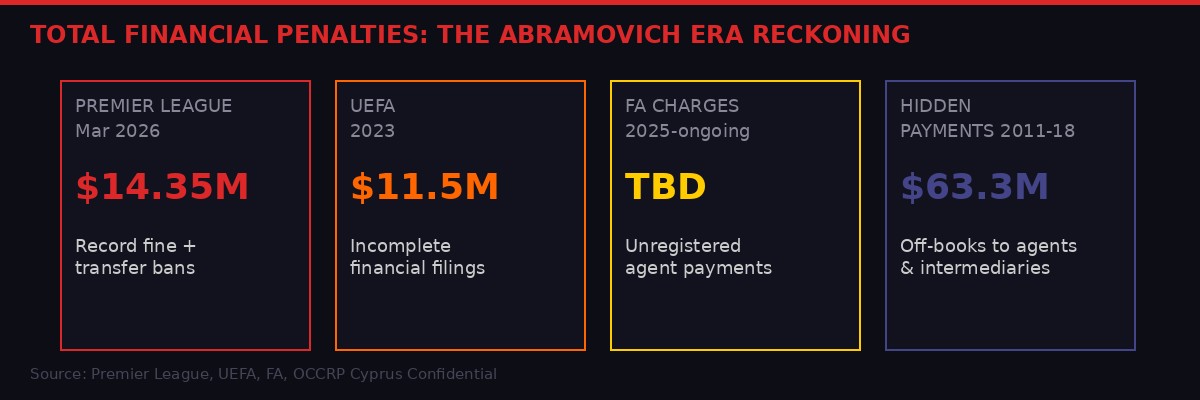
The accumulating financial penalties from Chelsea's Abramovich-era conduct. | BLACKWIRE Graphic
The system might have continued indefinitely. Roman Abramovich was not the kind of owner who invited scrutiny, and Chelsea's success on the pitch made the question of how the club was run easy to ignore. Then Russia invaded Ukraine in February 2022.
The United Kingdom government moved with unusual speed. Abramovich, linked by the British government to Vladimir Putin and the Kremlin's inner circle, was placed under comprehensive financial sanctions in March 2022. His assets in the UK were frozen. Chelsea, as an Abramovich asset, found itself unable to operate commercially - unable to sell tickets, renew sponsorships, or make transfers. The situation was unsustainable within days.
The UK government approved the sale of the club in May 2022. A consortium led by American billionaire Todd Boehly, alongside Clearlake Capital, Mark Walter, and Swiss billionaire Hansjorg Wyss, acquired Chelsea for approximately 4.25 billion pounds - the largest sum ever paid for a sports franchise at the time. As a condition of the purchase, the new ownership group committed to significant charitable contributions from the proceeds.
Upon taking control, the new owners made a decision that would shape the next three years of legal proceedings: they voluntarily self-reported potential historical violations to the Premier League. It was a calculated move. Self-reporting typically results in more lenient treatment from regulators, allows the new owners to position themselves as transparent partners rather than inheritors of a corrupt regime, and avoids the additional reputational damage of having violations discovered independently.
That self-reporting triggered the three-and-a-half-year investigation that concluded this month. The Premier League assembled a forensic picture of how the shadow payment system operated, working from the internal records that Chelsea's new owners provided and the additional context supplied by the Cyprus Confidential leak, which OCCRP published in November 2023.
The fine - 10.75 million pounds, or $14.35 million at current rates - is the largest ever levied by England's top flight. The accompanying sanctions include an immediate nine-month ban on Chelsea's academy making player transfers, and a suspended one-year ban on first-team transfers, the latter contingent on future compliance.
The Parallel Investigations: UEFA, FA, and the Full Picture
The Premier League's sanctions do not exist in isolation. They represent one thread in a broader regulatory reckoning that has been building around Chelsea since the Ukraine sanctions forced the club's sale and opened its books to external examination.
In 2023, UEFA fined Chelsea 10 million euros ($11.5 million) for submitting incomplete financial information to European football's governing body during the 2010s. The UEFA case focused specifically on Chelsea's failure to fully disclose relevant financial data during the periods when the club was participating in European competitions. Given that the same hidden payment network was in operation during those years, the UEFA fine and the Premier League penalty are effectively addressing different regulatory manifestations of the same underlying conduct.
The Football Association - English football's domestic governing body - issued its own charges against Chelsea in September 2025, focused specifically on undisclosed payments to unregistered agents. Under FA rules, all agents involved in player transfers and contract negotiations must be registered with the governing body, and all payments to those agents must be disclosed. The shadow payroll structure, by definition, was designed to avoid precisely that disclosure. The FA disciplinary process remains ongoing as of March 2026.
Beyond the direct financial penalties, the competitive implications of the undisclosed payments are significant. Sports law experts have noted that by keeping costs off Chelsea's books, the scheme allowed the club to appear to operate within FFP limits while actually spending beyond them. The players acquired through this invisible financial architecture - Hazard, Willian, and others whose agent fees and associated costs were routed through Abramovich's offshore entities - helped Chelsea win five Premier League titles between 2005 and 2017 and two Champions League trophies.
Rival clubs that operated within the rules during those same years may have lost out in transfer markets to a competitor that had effectively created a parallel financial system. Manchester City, whose own FFP case resulted in the most complex and expensive sports arbitration in history, faced scrutiny for similar structural reasons. The comparison is not lost on observers.
"Even with the hidden payments, there was no scenario in which Chelsea would have breached the Premier League's Profitability and Sustainability Rules during the seasons in question." - Chelsea FC statement, March 2026 (responding to the Premier League sanction)
Chelsea's response is notable. The club disputes the implication that FFP breaches occurred even had the payments been on-book, and the Premier League's current sanctions do not include a retrospective points deduction. But the question of competitive fairness - of whether other clubs were disadvantaged by Chelsea's ability to spend beyond its apparent limits - remains unanswered by a fine that amounts to less than one month's wage bill for the current squad.
Cyprus Confidential: The Leak That Built the Case
The Premier League investigation that produced March 2026's sanctions would have been significantly harder without a data leak from the other side of Europe. The Cyprus Confidential files, obtained from MeritServus - a Cypriot corporate services firm that administered hundreds of offshore companies for oligarchs and wealthy clients - gave OCCRP and its global partners an inside view of how Abramovich's financial empire actually operated.
MeritServus administered corporate vehicles across multiple jurisdictions. The files obtained by Distributed Denial of Secrets and shared with OCCRP contained contractual documents, correspondence, shareholder records, and transaction logs that revealed the mechanics of payment flows that were designed to be invisible. It was these files that first identified the 10-million-pound payment to Pastorello through Conibair, the 250,000-pound payment to Arnesen through Ovington Worldwide, and the broader pattern of Chelsea-connected payments moving through Abramovich's offshore architecture.
Cyprus occupies a specific and troubling role in Russian oligarch wealth management. The island's membership in the European Union gives it the veneer of regulatory legitimacy, while its historical relationship with Russian capital - dating to the 1990s when Cyprus became the primary conduit for Russian money seeking European legitimacy - makes it a preferred jurisdiction for complex cross-border structures. Cypriot banks and corporate service providers have administered wealth for some of Russia's most politically connected billionaires for three decades.
The Pandora Papers and the Panama Papers had previously exposed elements of this ecosystem. Cyprus Confidential went further, providing granular transaction-level detail that could be correlated against specific events - a contract signing, a transfer announcement, a change in playing staff - and matched to specific offshore entities controlled by specific individuals.
OCCRP's investigation in 2023 connected the leaked documents to Chelsea's financial history, identifying more than a dozen football-related transactions involving Abramovich's offshore firms that raised FFP questions. The Premier League, with access to Chelsea's own internal records following the self-reporting by new ownership, was able to construct the fuller picture that the public sanctions notice now partially describes.
The document is redacted. The names of some recipients, the specific amounts of some transactions, and details of some of the intermediary companies involved remain hidden from public view. The Premier League does not publish the full forensic accounting of how the payments worked. What is public is the conclusion: deliberate, systematic financial deception running across seven years, touching some of the biggest talent acquisitions in the club's history.
The Names Behind the Trophies
Eden Hazard arrived at Stamford Bridge in the summer of 2012 from Lille OSC. He was 21 years old, had just been named Ligue 1 Player of the Year, and cost Chelsea approximately 32 million pounds - a significant fee at the time but not unusual for a player of his profile. Over seven years in west London, Hazard became arguably the most gifted player to wear the Chelsea shirt in the Abramovich era. He won two Premier League titles, a Champions League, two Europa League trophies, and the FA Cup, collecting PFA Player of the Year awards in both 2014 and 2015.
His agent at the time, John Bico, is among those whose payments from Abramovich's offshore companies appear in the Cyprus Confidential files. The disclosed payment amounts linked to the Hazard transaction chain remain partially redacted in public documents, but the existence of off-book transactions in the period surrounding his signing is established by the leak and confirmed by the pattern of the broader investigation.
Willian, the Brazilian winger who joined Chelsea from Anzhi Makhachkala in 2013, represents a different dimension of the same story. The Cyprus Confidential files revealed that Abramovich's companies had loaned tens of millions of dollars to a company ultimately owned by the son of the president of CSKA Moscow. That company provided funds to Anzhi Makhachkala, which then sold Willian to Chelsea. The structure created a financial circuit in which Abramovich's money effectively helped finance the asset - Willian - that Chelsea then purchased, while the chain of transactions was designed to obscure the connections.
Piet de Visser, the Dutch scout whose eye for talent is credited with identifying many of the players who shaped Chelsea's most successful years, occupied a specific role in this network. Scouts are not the glamorous figures of football's transfer market. They are the people who find players before anyone else knows about them, who build relationships with clubs and agents across years of groundwork, and whose value is almost impossible to quantify in contractual terms. De Visser's payments through Abramovich's offshore structure suggest that Chelsea's most trusted talent-identification resource was compensated in a way that kept his role officially invisible.
Antonio Conte - whose contract renewal coincided with the 10-million-pound payment to Pastorello - managed Chelsea from 2016 to 2018, winning the Premier League title in his first season with a record 30 wins. There is no suggestion that Conte had any knowledge of or involvement in the offshore payment structure. His contractual arrangements with Chelsea were straightforward. The timing of the Pastorello payment, and its connection to Pastorello's stated involvement in Chelsea's affairs when Conte was manager, is what drew investigators' attention.
What the Fine Actually Means - and What It Doesn't
A fine of $14.35 million sounds significant. In the context of modern Premier League economics, it is not. Chelsea's current wage bill is estimated at approximately 400 million pounds per year. The fine represents less than two weeks of player wages. The transfer ban on the academy is practically inconvenient but not existentially threatening. The suspended first-team ban creates a compliance incentive for the future without imposing immediate pain.
The new ownership consortium - Boehly, Clearlake Capital, and their partners - did not commit any of the violations that generated the fine. They self-reported the violations. They cooperated with the investigation. The Premier League's decision to settle, rather than pursue a contested disciplinary hearing, reflects the complexity of sanctioning current ownership for the conduct of a previous regime that was removed by government action rather than by market forces.
The more significant question is retrospective accountability. The clubs that lost out to Chelsea in transfer markets during 2011 to 2018, the years when the hidden payment network was operating, received nothing. The competing clubs whose FFP compliance was genuine during those years played against a team that was, by the Premier League's own finding, engaged in deliberate financial deception. No titles have been stripped. No historic sanctions have been imposed.
The FA's ongoing charges for unregistered agent payments represent the most significant remaining legal exposure for Chelsea, in the sense that they could result in additional financial penalties. But the football governance community is watching this case for a broader reason: it tests whether English football's regulatory framework is capable of imposing meaningful accountability for systemic financial fraud by powerful clubs, or whether the final result is a fine that costs less than a midfield signing and a few months of youth transfer restrictions.
Roman Abramovich, now living in Moscow under UK and EU sanctions, faces no personal legal jeopardy from the Premier League process. He has not responded to any of the reporting or regulatory findings. He is, by any practical measure, beyond the reach of English sports law.
The Broader Lesson: Offshore Money in Football
The Chelsea case is not an isolated event in the history of elite football finance. It is one of the most thoroughly documented examples of a practice that has been endemic to top-flight European football since the 1990s - the use of offshore corporate structures to route payments that clubs do not want regulators to see.
FIFA's investigation into third-party ownership in the 2000s and 2010s uncovered similar structures across South American and European football, where agents and investment funds used offshore vehicles to take ownership stakes in players' economic rights, creating financial incentives that regulators struggled to track and govern. UEFA's FFP rules were a response to these patterns, but the Chelsea investigation shows how determined wealthy actors could adapt to circumvent them.
The Panama Papers, the Pandora Papers, and now Cyprus Confidential have each contributed to a growing forensic record of how offshore structures serve the interests of elite sports ownership. The pattern is consistent: payments that would be visible in club accounts are rerouted through BVI, Cayman, or Cypriot entities where disclosure requirements are minimal and beneficial ownership is obscured. The sports governing bodies, working from the accounts that clubs submit to them, cannot see what those accounts are designed to hide.
What changes the equation is leaks. The Cyprus Confidential files gave investigators access to the records of a corporate service provider that administered hundreds of offshore entities. One client's football-related transactions became visible through that breach. The broader question - how many other clubs, in how many other leagues, have similar structures that have not yet been exposed by a leak - remains open.
The Premier League's investigation lasted three and a half years. It required the voluntary cooperation of the current ownership, the documentary evidence from Cyprus Confidential, and the forensic resources of England's most commercially powerful sports institution. Even with all of those advantages, the public record is still redacted. The full picture of who received the money, through which vehicles, and in what amounts, is not fully visible.
Football finance experts have noted that the real deterrent value of the Chelsea sanction will depend on what follows. If the FA's ongoing investigation into unregistered agent payments results in meaningful additional penalties, and if UEFA's precedent-setting 2023 fine is seen as the beginning rather than the end of regulatory action, then the sector may recalibrate. If the total penalty for seven years of deliberate financial deception amounts to a record-setting fine that still costs less than the annual fee of a mid-level midfielder, the deterrent effect is limited.
"The breaches involved deception and concealment in relation to financial matters." - Premier League sanctions notice, March 2026
The Premier League did not mince its language. "Obvious and deliberate" financial breaches. "Deception and concealment." These are not the words of a governing body finding technical violations. They describe a club that knew the rules, understood the implications, and chose to build an alternative financial system to circumvent them - for seven years, at a scale of $63 million in hidden payments, with the knowledge and approval of senior officers.
The record fine is real. Whether it is proportionate to what the investigation found is a question English football will be arguing about for years.
Get BLACKWIRE reports first.
Breaking news, investigations, and analysis - straight to your phone.
Join @blackwirenews on Telegram