
She was nearly 96 years old and she had kept the secret for six decades. Through boycotts and marches, through decades of advocacy, through becoming one of the most celebrated women in American civil rights history, Dolores Huerta had never told anyone what happened to her.
On March 18, 2026, she broke her silence.
In a statement published on Medium, Huerta said that her co-founder in the United Farm Workers movement, Cesar Chavez - the man whose face appears on murals across California, whose name is on schools and highways and a federal holiday - had sexually abused her. Twice. One of those times, she says, was rape.
Her statement came alongside a New York Times investigation that revealed something even harder to process: that Chavez's pattern of abuse extended to girls as young as 12. That he had used his position - as boss, as icon, as the man who could make or break careers in the movement - to exploit the young and vulnerable women who had devoted their lives to the same cause he championed publicly.
"I am nearly 96 years old," Huerta wrote, "and for the last 60 years have kept a secret because I believed that exposing the truth would hurt the farmworker movement I have spent my entire life fighting for."
"My silence ends here."
The statement rippled outward almost immediately. Within hours, elected officials from both major parties were calling for Chavez's name to be stripped from public buildings. The United Farm Workers announced it would not participate in Cesar Chavez Day celebrations on March 31. Multiple commemorative events were cancelled or quietly renamed. The Cesar Chavez Foundation described itself as "deeply shocked and saddened." The League of United Latin American Citizens, one of the country's oldest Latino civil rights organizations, made clear that no person's legacy puts them beyond accountability.
A movement that has spent decades honoring a single man now has to decide what it stands for without him at its center.
The Movement and the Man Behind It

Cesar Chavez spent decades fighting for the rights of farmworkers - many of them Hispanic and Filipino Americans working in brutal conditions across California's agricultural heartland. (Pexels/illustrative)
To understand what Dolores Huerta's statement means, you have to understand who Cesar Chavez was to millions of Americans - especially Latino Americans.
Born in 1927 in Yuma, Arizona, Chavez grew up the child of farmworkers who lost everything in the Depression. By his teens he was working the same fields, experiencing firsthand the exploitation that would shape his life's work. He rose through community organizing in the 1950s under the mentorship of Fred Ross, a community organizer who taught him the slow, unglamorous mechanics of building power from the ground up.
In 1962, Chavez co-founded the National Farm Workers Association alongside Huerta and other advocates. The movement they built was extraordinary by any measure. The grape boycott of the late 1960s captured the national imagination in a way that few labor actions had managed - housewives in suburban Chicago refused to buy grapes in solidarity with Filipino and Mexican farmworkers in California they had never met. Chavez fasted, marched, organized. Robert Kennedy flew out to visit him at the picket line. His tactics were drawn directly from Gandhi and Martin Luther King Jr.
The phrase "si, se puede" - yes, we can - came from this movement. Barack Obama borrowed it as a campaign slogan in 2008. It was printed on kitchen walls and tattooed on arms. The Filipino Tagalog rallying cry "isang bagsak" - one down, all fall - became part of the movement's vocabulary, reflecting the cross-cultural solidarity that gave it its unusual breadth and moral weight.
Chavez died in 1993 at 66. California established a state holiday in his honor. Schools, streets, parks, and a federal monument near his birthplace in Arizona were named for him. A postage stamp was issued. His image became shorthand for something specific in American public life: the idea that an ordinary person from a marginalized community could take on the most powerful agricultural interests in America and win.
The NYT investigation - years in the making - says that image was used as cover for the systematic abuse of the very community he claimed to represent.
What the Women Say
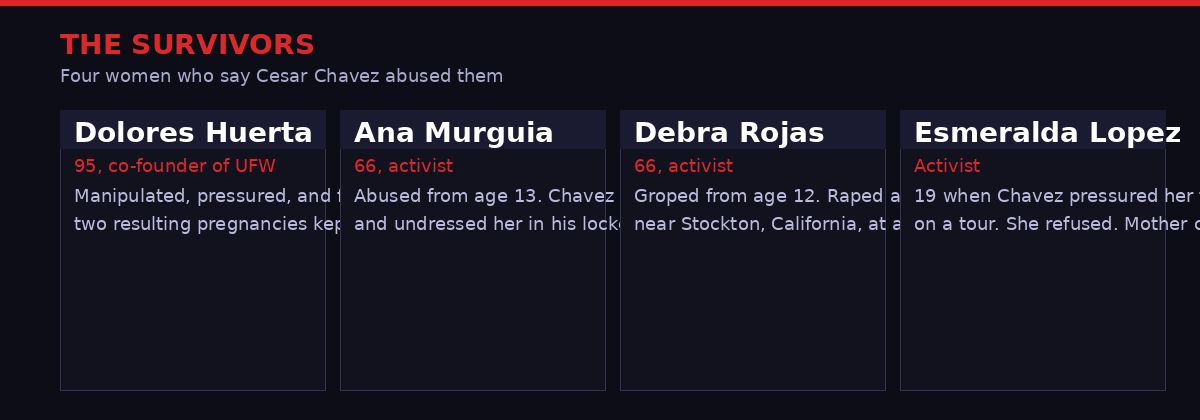
The four women who spoke to the New York Times or issued public statements. Their ages at the time of abuse ranged from 12 to 19. (BLACKWIRE/graphic)
Dolores Huerta's account is the most prominent because she is the most famous. But the NYT investigation did not rest on her testimony alone. Three other women also came forward. Their accounts span a period from roughly 1972 to 1977, when Chavez was in his mid to late 40s.
Ana Murguia, now 66, told the Times she was 13 years old when Chavez - a man she had known since she was 8 - locked his office door and kissed her, removed her clothes, and attempted to have sex with her. She was a child who had grown up inside the movement, who trusted the man at its center. The violation that followed sent her into a spiral that ultimately led her to attempt suicide.
Debra Rojas, also 66, was 12 years old when Chavez first began groping her. At 15, she says he raped her at a motel near Stockton, California. She has carried that knowledge across five decades of adult life.
A fourth woman, Esmeralda Lopez, said she was 19 when Chavez tried to pressure her into sex during a tour, offering to use his influence to have something named in her honor if she complied. She refused. Her mother, a fellow activist who was confided in at the time, provided corroboration of what her daughter had told her then.
Huerta's own story is different in character. She was not a teenager. She was Chavez's co-founder, his professional equal, the person who had helped build the organization from nothing alongside him. She says the first incident involved manipulation and pressure during a trip to San Juan Capistrano. "I didn't feel I could say no because he was someone that I admired, my boss and the leader of the movement I had already devoted years of my life to," she wrote in her statement.
The second incident was unambiguous in the way she describes it. Chavez drove her in a car to an isolated grape field, parked, and raped her. Both encounters, she says, resulted in pregnancies. Both children were quietly arranged to be raised by other families. She told nobody.
"I carried this secret for as long as I did because building the movement and securing farmworker rights was my life's work. I wasn't going to let Cesar or anyone else get in the way. I channeled everything I had into advocating on behalf of millions of farmworkers and others who were suffering and deserved equal rights." - Dolores Huerta, statement published March 18, 2026
The sentence that follows in her statement is the most quietly devastating part of it: "I had experienced abuse and sexual violence before, and I convinced myself these were incidents that I had to endure alone and in secret." She is not saying this was acceptable. She is explaining how a person who has been abused before learns to absorb abuse as a feature of the world, rather than a crime to be reported.
A Timeline: What Was Known and What Was Hidden
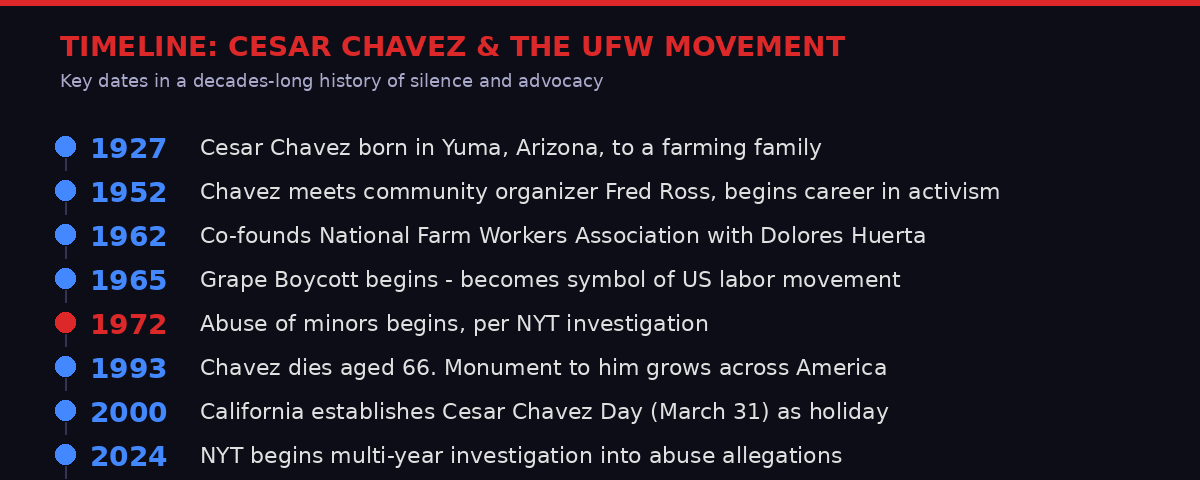
From the founding of the farmworker movement in 1962 to the NYT investigation and Huerta's public statement - six decades of silence mapped onto history. (BLACKWIRE/graphic)
The abuse, according to the NYT investigation, occurred across roughly a decade - from approximately 1972 to 1977. Chavez was in his 40s. The victims were girls and young women as young as 12. All were embedded within the movement he led, connected to it professionally, emotionally, or through family.
This was not a case where rumors had circulated for years and were repeatedly ignored by a complicit institution. By most available accounts, the victims stayed silent for the same reason Huerta did: they believed - and were perhaps correct to believe - that coming forward would damage not just Chavez but millions of people who had nothing to do with his private behavior.
There is something uniquely cruel about that calculation. The victims of powerful men inside social movements face a particular trap that differs from other institutional abuse cases. They are not just protecting their abuser. They are protecting a cause that they themselves believe in, that they themselves have sacrificed for, that they themselves may have given years of their lives to. They are asked, implicitly or explicitly, to weigh their own pain against the welfare of a community that depends on the movement's credibility and survival.
They are made, in short, to be the guardians of a reputation they did not create and did not choose to protect. The burden placed on these women was not just silence about their own suffering - it was active participation in the maintenance of a lie they found morally intolerable.
The UFW stated on March 18 that it had "not received any direct reports" and had "no firsthand knowledge" of the allegations. Whether that is accurate or a carefully constructed legal formulation is not yet clear. What is clear is that the organization also announced the creation of "an external, confidential, independent channel" for people who may have experienced harm. That is a belated but necessary step - though it comes after Chavez has been dead for 33 years and the primary witnesses are in their 60s and 90s.
The Cesar Chavez Foundation said it was "working with leaders in the Farmworker Movement to be responsive to these allegations" and to support those who may have been harmed. The foundation described itself as "deeply shocked and saddened" - language that is sincere or performative depending on what foundation leadership knew and when they knew it, a question that remains unanswered.
The Political Earthquake
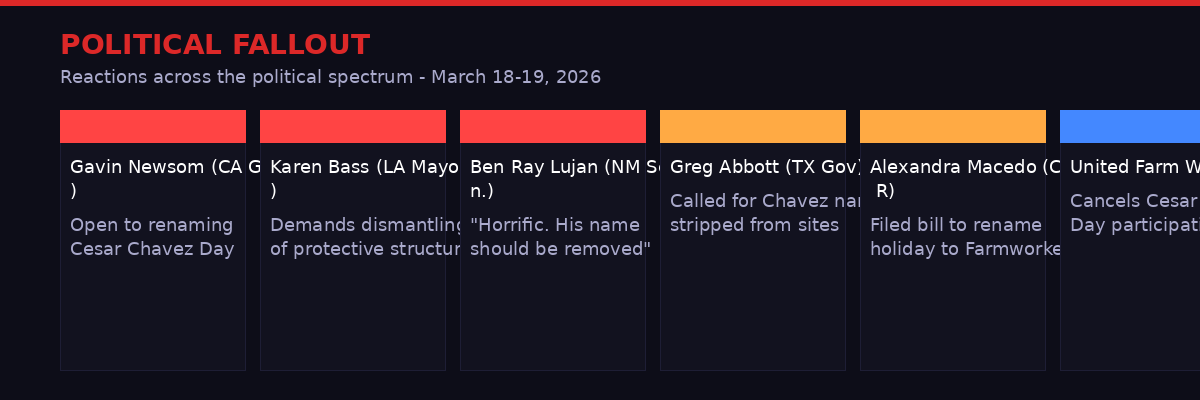
Bipartisan condemnation was swift. From Gavin Newsom to Greg Abbott, elected officials across the political spectrum called for Chavez's name to be removed from public buildings and honors. (BLACKWIRE/graphic)
The political fallout was fast and, in its bipartisan reach, genuinely unusual for 2026. California Governor Gavin Newsom said the farmworker movement "is much bigger than one man," stood with "the courageous women" who came forward, and said he was open to renaming Cesar Chavez Day. That is a significant statement from the governor of a state that has spent decades building civic celebrations around this man's name and image.
Los Angeles Mayor Karen Bass went further. "The sickening reality is that what Dolores, Ana, and Debra endured is not isolated, nor is it of the past," she said, demanding "sustained action to dismantle structures that have hurt women." The structures she is referring to are not just legal or organizational. They are cultural - the patterns of deference and silence that form around powerful men in movements that depend on their public image for credibility and funding.
Republican Assemblywoman Alexandra Macedo of California moved quickly, filing legislation to rename the holiday Farmworker Day - a formulation designed to preserve what the movement stood for without attaching it to the man who led it and abused people within it. Texas Governor Greg Abbott also called for Chavez's name to be stripped from public sites, a position that aligned him, unusually, with progressive California Democrats on a civil rights matter.
New Mexico Senator Ben Ray Lujan was direct in terms that will be quoted for years. "His name should be removed from landmarks, institutions, and honors," he wrote on X. "We cannot celebrate someone who carried out such disturbing harm." Lujan, himself Latino, described the revelations as "horrific" and a "betrayal of the values that Latino leaders have championed for generations."
LULAC, the League of United Latin American Citizens, issued a statement that cut to the principle: "No individual, regardless of stature or legacy, is above accountability when it comes to protecting and upholding the dignity of others." It is a statement that sounds obvious when written out. It is less obvious when the individual in question is the person whose name is on your community's holiday.
Across California and the Southwest, events scheduled for Cesar Chavez Day on March 31 were cancelled or quietly renamed within hours. The UFW said it would not participate in any Cesar Chavez Day celebrations. The speed of the institutional response was striking - though it also raised the question of how long some of these institutions had known, or suspected, something.
The Weight That Survivors in Movements Always Carry

The survivors in the Chavez case faced a dilemma that survivors inside social movements often face: their silence was not just about personal fear, but about protecting something they had helped build. (Pexels/illustrative)
The Cesar Chavez case is not unique in its structure, even if it is unique in its scale and historical weight. There is a recognizable pattern here that repeats across movements and institutions: powerful men who use the moral credibility of a cause as a shield against accountability, and survivors who are placed in the impossible position of having to choose between their own justice and the welfare of a community they care about.
Harvey Weinstein's victims were told, implicitly and explicitly, that speaking out would damage not just him but the Hollywood projects that employed hundreds of other workers. Bill Cosby's accusers faced the weight of his cultural image as a Black ambassador and family entertainer. Catholic Church abuse survivors who stayed silent for decades did so, in many cases, because they had been made to feel that their pain was the community's pain - that speaking would destroy faith institutions that had sustained their families for generations.
What is specific to the Chavez case is the depth and the duration of that burden. Huerta did not stay silent for a year or two. She stayed silent for sixty years. She is now 95 years old. She has spent her entire adult life as one of the most visible advocates for the rights of the powerless in America, while privately carrying an experience of powerlessness she could not share with anyone - not even the people who marched beside her.
The children she gave up - the pregnancies that resulted from those encounters in the 1960s - are another layer of this that has barely been discussed in initial coverage. She chose, twice, to continue those pregnancies rather than terminate them. The children she carried were given to other families. Those children exist in the world. They are adults now, in their 50s and 60s. What do they know? What do they know now? That is a question the initial coverage has not yet confronted, and one that will take time to unravel.
The NYT investigation gave Huerta an opening - the knowledge that the story was going to be published regardless, that she could either be part of it on her own terms or be reported about as a subject. She chose to speak. She chose her own voice over silence. At 95, with nothing left to prove to anyone, that is a form of courage that deserves its own recognition separate from whatever we think about the movement she co-built.
What Happens to the Movement Now
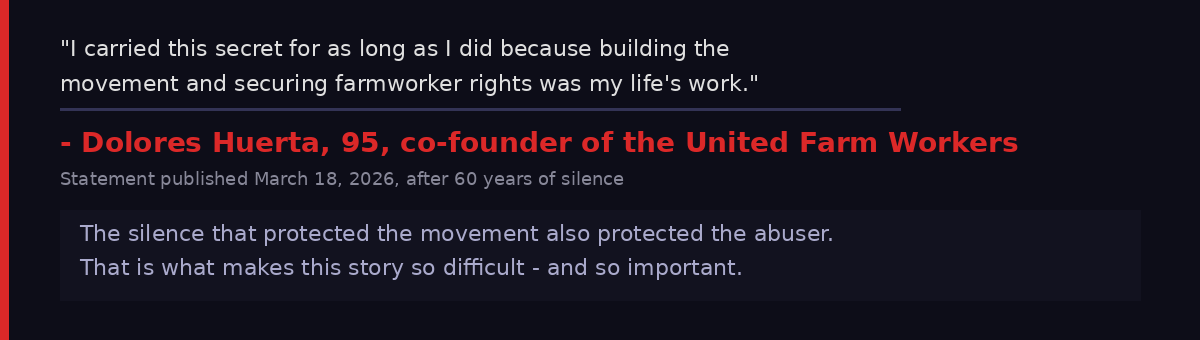
Huerta's statement was published on Medium on March 18, 2026 - the day the NYT investigation dropped. She had carried the secret since the 1960s. (BLACKWIRE/graphic)
The question of what happens to Chavez's image is already being answered at speed. Schools will be renamed. The holiday will almost certainly survive in some modified form. The man's legal legacy - the minimum wages, overtime protections, and organizing rights he helped win for farmworkers - remains intact and continues to matter regardless of what he did in private. The cause was real even when the man behind it was not what he seemed.
The harder question is what the Latino community, and particularly the farmworker communities of California and the Southwest, does with the wreckage of an icon that many of them genuinely loved. Chavez was not a distant historical figure for millions of Latinos. He was a touchstone - proof that people who looked like them, who came from the same kinds of poverty and exploitation and exclusion, could take on the most powerful agricultural interests in America and win. His face on a mural was not decoration. It was a statement about what was possible.
That proof does not vanish with these allegations. The victories remain. The rights won through the grape boycott and the organizing drives of the 1960s and 1970s are still on the books. What changes is the figure attached to those victories - and that, for many people, is not a small thing. Icons are not just names on buildings. They are repositories of collective self-understanding. Replacing one requires renegotiating what a community believes about itself and its history.
Huerta's own framing is instructive. Her statement does not read as a repudiation of the movement or as an invitation to dismantle everything that has been built. It reads as a demand for honesty. She says that "community advocacy was more important than ever" in the wake of the investigation. She is not asking people to abandon the cause. She is asking them to look at it clearly - to stop confusing the movement with one man, to understand that the struggle belongs to the farmworkers and the activists who gave decades of their lives to it, not to a single person whose name it carries.
That is a harder ask than it sounds. Movements need symbols. They run on narrative simplification. Replacing an icon is not just a bureaucratic matter of renaming a holiday. It is an emotional and cultural renegotiation. It will take years, probably decades, to fully work through what this means for how Latino civil rights history is taught, commemorated, and understood.
Dolores Huerta, Finally

At 95, Dolores Huerta is older than the state of Israel and older than the United Nations. Her silence spanned an entire era of American history. Her decision to speak is its own kind of history. (Pexels/illustrative)
There is something that gets lost in the political coverage of stories like this one. The scandal, the political fallout, the renaming debates - these are real and necessary to report. But they can obscure the individual person at the center of it all.
Dolores Huerta is 95 years old. She was abused by her boss and co-founder when she was a younger woman building one of the most important labor movements in American history. She became pregnant twice as a result of those encounters. She gave both children to other families. She then spent the next six decades as one of America's most recognized advocates for human dignity - appearing at rallies, giving speeches, accepting awards, standing next to presidents - while carrying a secret that would have upended everything she had built, and everything she cared about.
Think about what that requires, day after day, year after year, decade after decade. Every time someone praised Cesar Chavez in her presence. Every time a school was named in his honor. Every time someone quoted "si, se puede" and meant it as a tribute to both of them. She had to hold all of that without letting it show. She had to go on advocating, organizing, fighting, while privately carrying a burden that would have broken many people.
Her statement does not read primarily as anger. It reads as relief. "I wasn't going to let Cesar or anyone else get in the way," she wrote - meaning in the way of her work, her mission, the millions of people she was fighting for. She made a calculation that most of us will never have to make. She chose the movement over herself, and now, at the end of her life, she has finally chosen herself.
The question of what she deserves - formal acknowledgment, renewed recognition, something beyond the words of politicians issuing statements - is one the movement and the country will need to work through. But the minimum it owes her is this: to take her statement seriously, to believe her without qualification, and to understand that she waited sixty years not because she was weak, but because she had spent her entire life doing what she had always done - absorbing costs so the cause could continue.
She gave the movement her labor, her voice, her children, her silence, and sixty years of her pain. She is asking for the truth in return. The least we can do is give it to her.
"I have kept this secret long enough. My silence ends here." - Dolores Huerta, March 18, 2026
Get BLACKWIRE reports first.
Breaking news, investigations, and analysis - straight to your phone.
Join @blackwirenews on Telegram