Camp East Montana: Inside America's Largest Immigration Detention Disaster
March 14, 2026 | El Paso, Texas
Measles spreading through crowded tents. Two deaths in six months. A 79-year-old man struggling to breathe. A 55-year-old Cuban man, restrained with handcuffs by security guards, dying of a heart attack. And a $1.3 billion federal contract handed to a company that had never run an immigration facility and didn't even have a functioning website when it won the bid.
This is Camp East Montana, built on a U.S. Army base in El Paso, Texas - and as of March 2026, it remains the largest immigration detention facility in America.
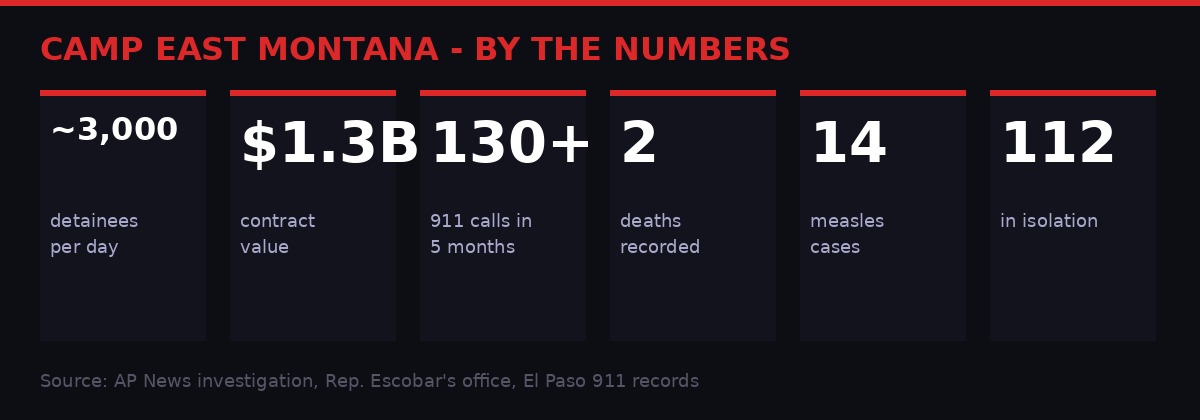
Key figures from AP's investigation into Camp East Montana - Source: AP News, El Paso 911 records, Rep. Escobar's office
What Camp East Montana Actually Is
Six rows of military-style tent encampments at Fort Bliss Army base. Around 3,000 people at any given moment. People from Cuba, Venezuela, Colombia, the Philippines, the Netherlands - men, women, a pregnant woman screaming in pain on a 911 call. All waiting for immigration proceedings that may never come quickly enough.
The camp opened in August 2025, constructed hastily after the Trump administration awarded a contract worth up to $1.3 billion to Acquisition Logistics LLC - a Virginia contractor with no prior experience running an ICE detention facility, according to AP reporting. Before this contract, the company had never won a federal deal worth more than $16 million.
The math here is staggering. A company that had managed contracts in the low tens of millions was suddenly handed nearly $600 million in committed payments - with the potential to run to $1.3 billion - to house thousands of human beings in tents on a military base. No relevant expertise. No track record. No functioning website at the time of award.
"Every day felt like a week. Every week felt like a month. Every month felt like a year." - Owen Ramsingh, former property manager from Columbia, Missouri, deported to the Netherlands in February 2026 after spending weeks at Camp East Montana. Via AP News.
Ramsingh's story cuts to the heart of Camp East Montana's reach. He wasn't fleeing war or poverty in the traditional sense - he was a property manager, a professional, a man with a life. He described the camp as "1,000% worse than a prison." He survived. Not everyone has.
The 911 Calls That Reveal Everything
In the five months following the camp's August 2025 opening, staff placed more than 130 calls to 911, according to data obtained by the Associated Press from the City of El Paso. That averages to nearly one emergency call per day. For a detention facility - not a battlefield, not a hospital emergency ward, but a facility theoretically providing shelter while people await civil immigration proceedings - that number is a damning indictment of how the camp functioned.
The calls paint pictures. A man sobbing after being assaulted by another detainee. A doctor describing a man banging his head against the wall, expressing suicidal thoughts. A nurse reporting a pregnant woman in severe pain, also infected with coronavirus. A 19-year-old who fell from a bunk bed. A 79-year-old struggling to breathe.
At least 20 emergencies were logged as seizures, some resulting in serious head trauma. There were repeated calls about suicide attempts, detainees cutting themselves, people who had lost hope - or the physical capacity to continue.
Two of those emergencies ended in death. On January 3, 2026, a 55-year-old Cuban man attempted to harm himself. Security guards responded by restraining him with handcuffs and physical force. He suffered a heart attack and died. ICE confirmed the sequence of events. The Department of Homeland Security did not dispute the account; they argued the response was appropriate and that the man received medical attention.
A second death was also recorded in the camp's first six months of operation. The full circumstances of the second death have not been made fully public by ICE or DHS. Congressional investigators have continued pressing for details. [AP News]
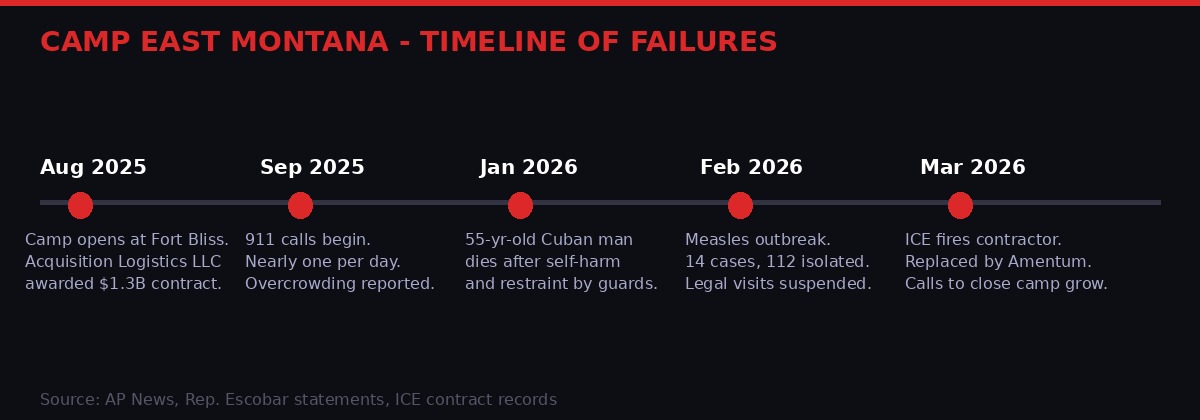
Key events at Camp East Montana from opening in August 2025 through contractor replacement in March 2026
A Measles Outbreak in a Country That Eradicated Measles
Measles was declared eliminated from the United States in 2000. Decades of vaccine programs, public health infrastructure, and basic epidemiological diligence achieved that. Then came the defunding of vaccine programs in Texas and the West, the political war on public health expertise, and the crowding of thousands of unvaccinated people into tent encampments with poor ventilation.
By early March 2026, there were 14 active measles cases at Camp East Montana, with 112 people in isolation. Rep. Veronica Escobar - an El Paso Democrat who has toured the facility seven times - confirmed the numbers and announced the camp was closed to visitors and attorneys until approximately March 19 or 20.
That closure also meant something else: detainees lost in-person access to legal representation. Their attorneys could only meet with them virtually - through screens - during the outbreak lockdown.
"While on one hand it is a good thing that the measles outbreak is being taken seriously, on the other hand I am alarmed that a preventable crisis has created conditions where detainees can only access their lawyers virtually." - Rep. Veronica Escobar (D-TX), statement on Camp East Montana measles outbreak, March 2026
The measles context matters. Texas experienced a major measles resurgence last year, described by AP as spreading through communities after health departments were "starved of funding" needed to run vaccine programs. West Texas was hit especially hard. When you take people from populations with varying vaccination rates, put them in loud and cramped tents with inadequate sanitation, and strip them of access to consistent health care, this is what happens. The outbreak wasn't an accident. It was a predictable outcome of the conditions.
DHS pushed back on reporting about conditions, saying detainees "receive food, water and medical treatment in a facility that is regularly cleaned." They provided no detailed figures and did not directly contest specific 911 call contents or detainee accounts.
Owen Ramsingh and the Human Cost of Policy
When we talk about immigration enforcement, the political rhetoric has a tendency to abstract the people inside the system. It becomes about "flows" and "processing" and "capacity." The 911 calls have a different effect. They're recordings. The voices are real. The fear in them is palpable even on a government record request document.
Owen Ramsingh gave us a face. A former property manager from Columbia, Missouri - a mid-size university town in the American Midwest - who ended up in Camp East Montana before being deported to the Netherlands in February 2026. What exactly brought him there, the specifics of his case, remain his story to tell. What he told AP was the experience.
"1,000% worse than a prison." He wasn't saying this to score political points. He said it to describe what sleep deprivation, noise, inadequate food, and chronic fear do to a human being over days and weeks. Ramsingh had a life in Columbia, Missouri. He lost access to it, and before being deported, he passed through something he described as worse than incarceration.
His case is one of thousands. The people inside Camp East Montana are not primarily criminals. They are civil immigration detainees - people caught in the administrative machinery of a deportation surge, waiting for hearings, waiting for lawyers, waiting for outcomes they often don't control. The distinction between civil and criminal detention matters enormously to how societies should treat people. Inside those tents, that distinction apparently meant very little.
The Contractor Scandal: $600 Million for Negligence
This is where the story becomes not just a humanitarian indictment but a financial one. The government has already committed nearly $600 million under the Acquisition Logistics contract, which was set to run until September 30, 2027.
On March 14, 2026, ICE announced it was terminating Acquisition Logistics as the prime contractor and replacing it with Amentum Services, Inc. - a Chantilly, Virginia company known for its work with the military and intelligence agencies, which had been operating as a subcontractor at Camp East Montana. The switch was published in a federal notice and confirmed by an ICE spokesperson, who did not provide their name. [AP News]
ICE did not publicly explain what triggered the termination. A spokesperson said Amentum's "size, maturity and pedigree" made it "the right partner at the right time" and promised improvements in medical care, case processing, and intake procedures with "well-defined accountability measures."
Rep. Escobar expressed relief at the contractor change but maintained her position: the facility should be closed entirely, and the contractors involved should be investigated "for the fraud they've perpetrated on the American taxpayer."
"Whether the new contractor is an improvement remains to be seen, and I remain deeply concerned about the chronic substandard conditions that exist at Camp East Montana." - Rep. Veronica Escobar (D-TX), statement on contractor replacement, March 2026
The key question that remains unanswered: who approved giving Acquisition Logistics a $1.3 billion contract in the first place? What due diligence was performed? What administration officials signed off on awarding a facility of this scale to a company with no experience operating it? Nearly $600 million has already flowed to a contractor now being replaced for failing at the job it was paid to do. That money doesn't come back.
Protests, Tear Gas, and the Fight Over Accountability
While the quiet bureaucratic disaster at Camp East Montana played out in Texas, a louder reckoning was happening in city streets across the country. Portland, Oregon became the focal point of one critical legal battle.
Federal officers had been using tear gas, pepper spray, and pepper ball munitions against protesters demonstrating outside the ICE field office in Portland. The protesters included people in their 80s. A man famous for wearing a chicken costume. Freelance journalists. None of them were documented as posing violent threats - but they were being gassed.
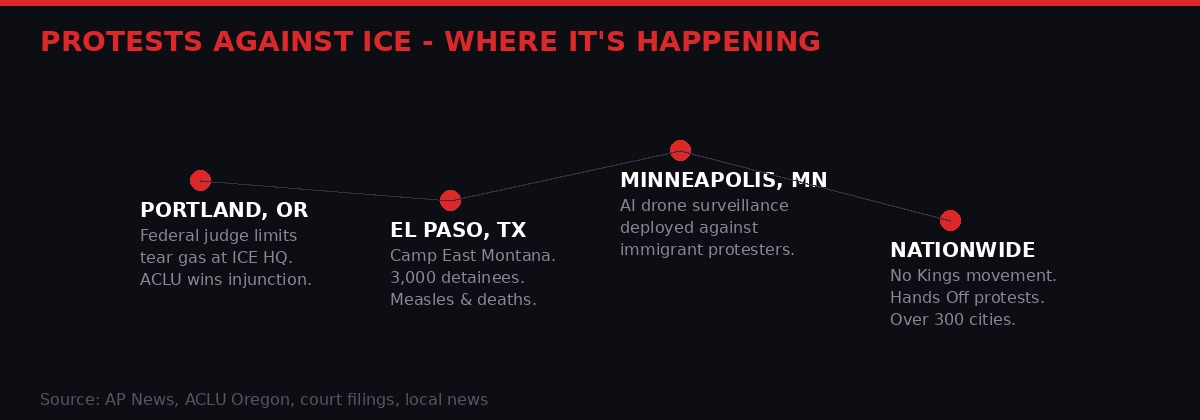
Key cities where ICE detention conditions and enforcement policies have triggered sustained protests in early 2026
The ACLU of Oregon filed suit on behalf of protesters and journalists, and on a Monday in early March 2026, U.S. District Judge Michael Simon issued a preliminary injunction. His language in the ruling was unusually blunt for a federal judge describing law enforcement conduct:
"Plaintiffs provided numerous videos, which were received in evidence and unambiguously show DHS officers spraying OC Spray directly into the faces of peaceful and nonviolent protesters engaged in, at most, passive resistance and discharging tear gas and firing pepper-ball munitions into crowds of peaceful and nonviolent protestors. Defendants' conduct - physically harming protesters and journalists without prior dispersal warnings - is objectively chilling." - U.S. District Judge Michael Simon, preliminary injunction order, Portland ICE protests, March 2026. Via AP News.
Simon's ruling was actually the second such judicial intervention at the Portland ICE facility. A separate federal judge had also restricted tear gas use at the site in response to a lawsuit from residents of an adjacent affordable housing complex - people who were not even protesters but were being caught in the chemical dispersal.
The DHS responded in its standard format: a statement saying it was "authorized to do what is appropriate and necessary in each situation to diffuse violence against our officers in the most appropriate manner possible." The statement did not contest the judge's finding that the protesters were peaceful and nonviolent.
Beyond Portland, aggressive crowd-control tactics against immigration protesters have been documented in Minneapolis, where ICE has deployed drone surveillance and facial recognition technology against demonstrators - a story BLACKWIRE has covered separately. The broader pattern is a federal government pushing hard on both detention capacity and the suppression of dissent around that detention.
What the Numbers Tell Us About the System
Step back from individual stories - from Owen Ramsingh's months of sleeplessness, from the 911 caller describing a head being banged against a wall, from the unnamed Cuban man who died in handcuffs - and the systemic picture is equally disturbing.
Camp East Montana was built fast, awarded to an unqualified contractor, funded at an astonishing scale, and then watched as conditions deteriorated in predictable ways. This is not an anomaly in American immigration detention. The Government Accountability Office and independent watchdogs have documented systemic problems across ICE detention for years - inadequate medical care, high rates of solitary confinement, poor oversight of contractors.
What's different about Camp East Montana is scale and pace. The camp holds roughly 3,000 people in tents. That's not a facility designed for long-term human habitation - it's a logistical solution to a policy commitment (maximum deportations, maximum detention) that outpaced the government's actual capacity to do it humanely.
The numbers from the camp's first five months are remarkable in their density. A measles outbreak - a disease eliminated from the US for 25 years - reappearing in a government-run facility. Suicide attempts captured on 911 recordings. A death that occurred during physical restraint by security guards. These are not statistical outliers. They are what happens when you put thousands of scared, displaced, and uncertain people into inadequate conditions and manage them with a contractor that has no relevant experience.
The Renunciation Surge and What It Signals
On the same day ICE announced the contractor switch at Camp East Montana, the State Department published a final rule in the Federal Register slashing the fee to formally renounce U.S. citizenship by 80% - from $2,350 down to $450.
The timing is coincidental but culturally resonant. The fee reduction had been promised in 2023 but never implemented, and came after six years of legal action by the Association of Accidental Americans - a France-based group representing people whose U.S. citizenship came purely from being born on American soil, often living abroad their entire lives. [AP News]
Before the 2015 fee increase, roughly 3,000-4,000 Americans per year were renouncing. The $2,350 price tag created a significant barrier - the association said at least 8,755 Americans had paid the full fee since 2023 alone just to exercise what the group's president Fabien Lehagre called "a fundamental right."
The renunciation data point connects to Camp East Montana in an unexpected way. Across the political spectrum - but particularly among immigrants, naturalized citizens, and Americans with family abroad - there is a growing discomfort with what American citizenship means in 2026. People who fled difficult circumstances to build lives in the US are watching tents and measles and 911 calls and thinking about what the country they arrived in has become. People who hold U.S. passports as accidental birthright are revisiting the value proposition of that document.
Neither group's reaction fully captures the complexity. But both are responding to the same cultural moment: a period in which the American state's treatment of the people inside its borders is visibly, documentably different from its self-image.
The Road Forward - And Who Is Watching
ICE says Amentum will improve things at Camp East Montana. The agency promises higher standards of medical care, more thorough intake procedures, and accountability measures. Rep. Escobar says she'll believe it when she sees it - she has already toured the facility seven times and made the same requests each visit.
Several Democratic members of Congress have called for Camp East Montana to be closed entirely, not reformed. Their argument is structural: the problem is not the contractor, it's the scale and the model. Tent encampments on military bases were not designed for long-term civil immigration detention, and no amount of contractor improvement will fix the fundamental inadequacy of the infrastructure.
Outside the facility, protests continue. In Portland, the court injunction gives legal protection to people who want to stand outside a government building and express opposition to what happens inside similar buildings across the country. That protection matters. When federal officers spray OC directly into the faces of elderly protesters, something has gone wrong not just operationally but philosophically - about what dissent is, who it belongs to, and how a government that uses it as a deterrent signals its confidence in the policies being protested.
The measles quarantine at Camp East Montana lifted around March 20, according to Rep. Escobar's office. Attorneys can visit in person again. Legal proceedings continue. The 3,000 people inside continue to wait.
Owen Ramsingh, at least, is out. He's back in the Netherlands - the country he apparently has citizenship ties to, the country he was deported to after his time in what he called something worse than prison. His apartment in Columbia, Missouri presumably sits empty or has been reassigned. His property manager job, gone. His time in Camp East Montana, over.
The camp itself is not over. It is, as of today, still the largest immigration detention facility in the United States.
Get BLACKWIRE reports first.
Breaking news, investigations, and analysis - straight to your phone.
Join @blackwirenews on TelegramSources: AP News investigations into Camp East Montana conditions, 911 call data, contractor records; AP News on Portland ICE protest injunction; AP News on measles outbreak; AP News on citizenship renunciation fee; Rep. Veronica Escobar statements; ACLU of Oregon lawsuit filings; U.S. District Court, District of Oregon preliminary injunction by Judge Michael Simon; DHS spokesperson statements; Federal Register ruling on citizenship renunciation fee.