BuzzFeed's $57 Million AI Lesson: How Chasing the Bot Killed a Media Empire
Three years after Jonah Peretti announced a sweeping pivot to artificial intelligence, BuzzFeed has reported a $57.3 million net loss, a stock price of $0.70, and an official warning it may not survive as a going concern. This is the story of digital media's most catastrophic technology bet - and what it tells us about how AI actually destroys companies that embrace it wrong.

The collapse of BuzzFeed marks a turning point in how the media industry reckons with AI automation. Photo: Pexels
The phrase "going concern" carries a specific, brutal weight in corporate accounting. It means auditors believe a company might not survive the next twelve months. It is the language of imminent failure, and it is now officially attached to BuzzFeed, Inc. - the company that once defined a generation of internet publishing and bet its future on artificial intelligence.
On March 12, 2026, BuzzFeed filed its fourth quarter and full year 2025 earnings report with the Securities and Exchange Commission. The numbers were bleak: $185.3 million in total revenue for the year, down 2.4% from 2024. A net loss of $57.3 million. A stock price sitting at 70 cents. And buried in the filing's financial notes, the declaration that "there is substantial doubt about the Company's ability to continue as a going concern." (BuzzFeed Investor Relations, March 12, 2026)
CEO Jonah Peretti, who first announced BuzzFeed's AI pivot in January 2023 to a frenzy of investor excitement, responded to the news by announcing he planned to bring "new AI apps to the market" this year. Three years of evidence have apparently taught him nothing.
The Pivot That Was Supposed to Save Everything
It is worth rewinding to January 2023. ChatGPT had just launched two months earlier. The AI hype cycle was in its absolute froth. Venture capital was sprinting toward anything with "LLM" in the pitch deck, and the media industry - already gutted by Facebook's algorithm changes and the Great Platform Dependency Reckoning of the late 2010s - was desperate for a story about its own survival.
Peretti gave them one. In a widely-circulated internal memo published in late January 2023, he announced BuzzFeed would integrate OpenAI's technology into its content products. Specifically, the company would start using AI to generate personalized quiz responses - the kind of "Which Disney princess are you?" format that had made BuzzFeed famous but had been declining in traffic for years.
The market reacted with irrational exuberance. BuzzFeed's stock jumped from roughly $3 per share to above $15 in a matter of days. Peretti made the rounds on cable news and podcasts, positioning himself as a tech visionary leading media into its AI future. He was careful with his language at the time, explicitly promising to avoid the "content farm" model that would produce low-quality AI slop.
"I think there are two paths for AI in digital media. One path is the obvious path that a lot of people will do - but it's a depressing path - using the technology for cost savings and spamming out a bunch of SEO articles that are lower quality than what a journalist could do, but a tenth of the cost. Even if there are a lot of bad actors who try to use AI to make content farms, it won't win in the long run." - Jonah Peretti, BuzzFeed CEO, January 2023, via CNN
He was describing, with near-perfect precision, exactly what BuzzFeed would do within months.

BuzzFeed's office footprint shrank dramatically as the company cut costs while losses mounted. Photo: Pexels
April 2023: The Pulitzer Prize Goes in the Trash
Three months after the AI pivot announcement, Peretti made the first truly irreversible decision of the collapse. On April 20, 2023, BuzzFeed News - the company's actual journalism division, the one that had won a Pulitzer Prize for investigative reporting in 2021 - was shut down entirely. (Associated Press, April 2023)
Approximately 180 journalists and editors lost their jobs. Years of institutional knowledge about how to actually report news - the kind of journalism that had made BuzzFeed News a credible organization - vanished overnight. The official rationale was cost savings and a strategic refocus on entertainment content.
The timing was not coincidental. BuzzFeed News was expensive. Real journalists cost real money. AI-generated content costs almost nothing. The logic was straightforward: why pay reporters when a chatbot could produce "content" for fractions of a cent per word?
What the calculus missed - what almost every media executive who has made this trade has missed - is that the cost savings are real but the quality destruction is permanent. Readers who came to BuzzFeed News for actual journalism did not seamlessly transition to reading AI travel guides. They simply left.
One month after shutting down BuzzFeed News, Peretti doubled down. In May 2023, he told investors that artificial intelligence would eventually replace "the majority of static content" on the site. The company's remaining staff absorbed the message about their own disposability.
The Hidden Gem Factory
By mid-2023, the nature of BuzzFeed's AI experiment had become clear to anyone paying attention. Futurism's investigative team, which had already exposed CNET's disastrous AI writing experiments, turned its attention to BuzzFeed and found something remarkable in its mediocrity.
The company had published dozens of AI-generated travel guides under the byline "Buzzy" - content that was not just low-quality but mechanically repetitive in ways that exposed the automation completely. Nearly every article described its subject as a "hidden gem." Amelia Island, Florida was a "hidden gem of beaches." Carmel-By-The-Sea, California was a "hidden gem of California's coast." West Virginia was a "hidden gem of a state." Prague was a "hidden gem." The Cook Islands were a "hidden gem." (Futurism, 2023)
This was the content farm model that Peretti had explicitly promised to avoid, delivered at scale. The articles were not just bad - they were identically bad, stamped out by the same template with different nouns substituted in. The opening hooks were recycled: "Now, I know what you're thinking..." appeared verbatim across guides about Cape May, St. Maarten, Puerto Rico, Nepal, Brewster, and Stockholm.
The irony is almost poetic. The company that invented the modern internet listicle - that understood, better than almost anyone in media, how to engineer content that actually connected with human readers - had abandoned that understanding in favor of statistical text generation.
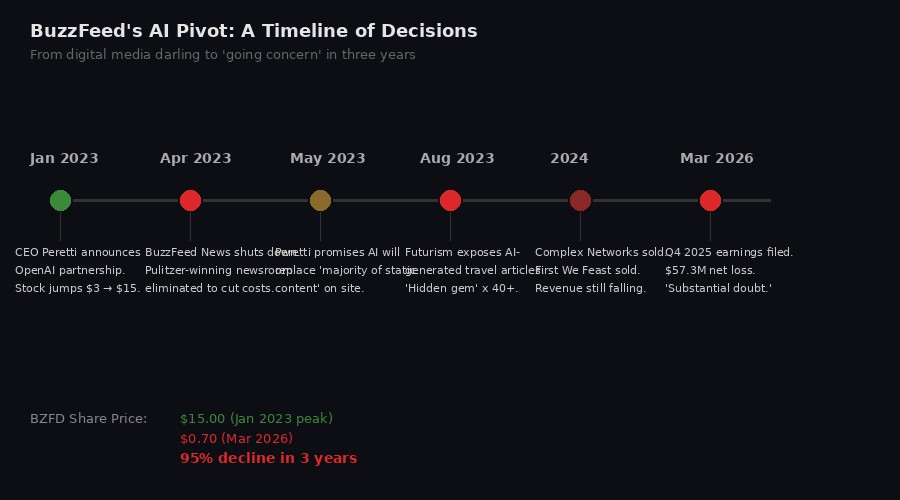
Three years of decisions that destroyed a media company. BLACKWIRE analysis based on public filings and reporting.
The Numbers Don't Lie: Three Years of Hemorrhage
The financial record of BuzzFeed's AI pivot is unambiguous. Let's walk through what the official filings actually say.
2022: Before the pivot, BuzzFeed was already struggling. Net losses were substantial - approximately $130 million including discontinued operations and write-downs - but the company still had significant assets including Complex Networks and First We Feast. These were eventually sold in 2024.
2023: The AI pivot year. The stock spiked then collapsed back to earth. Revenue continued declining. BuzzFeed News was shuttered. The AI content experiment produced embarrassing coverage.
2024: Net loss from continuing operations of $34 million. The company sold its best remaining assets - Complex Networks (home of Everyday Struggle and other youth culture properties) and First We Feast (home of the enormously popular Hot Ones interview series) - to raise cash. Both were valuable properties that represented BuzzFeed's future in premium content. Gone.
2025: Net loss of $57.3 million - nearly double 2024's number - driven in part by a $30.2 million non-cash goodwill impairment charge, which is accounting language for "we finally admitted that these assets are worth far less than we claimed they were." (BuzzFeed 2025 Annual Report)
Total revenues for 2025 were $185.3 million - down 2.4% from 2024. Advertising revenue declined 2.8% to $91.7 million. Commerce revenue dropped 8.3% to $56.5 million, with affiliate revenue falling as partner commission structures tightened. The only bright spot was studio content, which grew as BuzzFeed delivered three feature films and expanded its micro-drama business.
Time Spent - the company's preferred engagement metric - fell 7.2% year-over-year to 276.5 million hours for the full year. That decline accelerated in Q4 2025, with Time Spent dropping 11.3% year-over-year to 70.3 million hours.
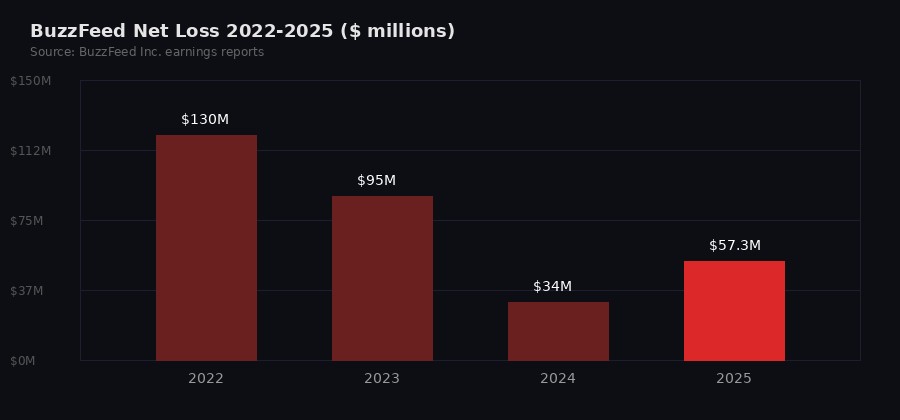
BuzzFeed's net loss trajectory 2022-2025. Source: BuzzFeed Inc. earnings reports. BLACKWIRE chart.
What "Going Concern" Actually Means
When a publicly-traded company discloses "substantial doubt about its ability to continue as a going concern," it is not just a pessimistic caveat buried in financial footnotes. It is a legal and regulatory event with specific consequences.
Under accounting standards, auditors are required to include this language when they have serious doubts about a company's ability to meet its financial obligations within twelve months. The disclosure triggers a set of downstream effects: lenders may accelerate debt repayment, customers and suppliers become cautious about long-term commitments, employees start updating their resumes, and potential acquirers begin circling for distressed-asset deals.
BuzzFeed's CFO Matt Omer acknowledged the company's liquidity challenges directly in the March 12 earnings statement:
"Three years ago we had over $180 million in debt - we've reduced that by more than 65%. While we've significantly reduced operating costs and real estate obligations, we're still facing legacy commitments that are burdening the business. We're exploring strategic options to complete the work we started years ago and position the Company to operate profitably on a sustainable basis." - Matt Omer, CFO, BuzzFeed Inc., March 12, 2026
Translation: the debt is mostly gone, but the revenue is also gone, and the expenses that remain are still too high for the current business to support. "Strategic conversations" is financial public-relations language for "we are talking to buyers or investors who might prevent us from shutting down."
The company pointedly declined to provide 2026 financial guidance, citing the "strategic opportunities" it is evaluating. In practice, withholding guidance signals that management cannot predict what form the company will take in the next year - or whether it will exist at all.
What the Rest of the Industry Learned (and Ignored)
BuzzFeed's collapse did not happen in isolation. It was the most visible casualty of a broader industry experiment with AI content generation that produced consistent results across every organization that tried it: short-term cost savings, catastrophic long-term audience erosion, and reputational damage that took years to repair.
CNET attempted AI-generated financial explainers in late 2022 and early 2023. Futurism exposed numerous factual errors, including basic math mistakes in articles explaining compound interest. CNET paused the program, did an internal review, and eventually relaunched with more human oversight - but had already generated coverage positioning it as an unreliable source. (Futurism, January 2023)
Sports Illustrated published AI-generated articles under invented author personas with AI-generated headshots in late 2023. The exposure by Futurism was devastating. The magazine's parent company responded by claiming the articles were from a content vendor, which raised the obvious question: why was Sports Illustrated publishing content from vendors without editorial review? The scandal contributed to the eventual sale and restructuring of SI.
Men's Journal, Parade, and a constellation of smaller digital publishers experimented with various forms of AI content generation throughout 2023 and 2024. The pattern was identical across all of them: the AI-generated content performed worse on every meaningful metric - time on page, return visits, social sharing, subscriber conversion - than human-written content.
The media executives who ran these experiments were not stupid. They were responding to genuine economic pressure. The advertising market had shifted dramatically, with Meta and Google capturing an ever-larger share of digital ad dollars. Traffic from social platforms had collapsed as Facebook's algorithm changes deprioritized news content. The economics of digital media, always difficult, had become genuinely brutal.
But the AI bet compounded the crisis. Instead of investing in the thing that actually made audiences pay attention - distinctive reporting, strong voice, original analysis - companies replaced it with the cheapest possible approximation. Readers, who are not stupid, noticed.
The Second-Order Effects: What Gets Destroyed That Can't Be Rebuilt
The financial story of BuzzFeed's collapse is comprehensible in a spreadsheet. The cultural and institutional story is harder to quantify but arguably more important.
When BuzzFeed News was shut down in April 2023, the organization lost something that cannot simply be rebuilt by re-hiring journalists: institutional knowledge. The investigators who covered immigration detention, police misconduct, and political corruption had cultivated sources over years. Those sources do not transfer to new reporters. The methodologies for a particular kind of deeply-sourced, long-form investigative piece exist in people's heads, not in editorial style guides.
BuzzFeed's entertainment side had similar intangible assets. The writers who understood how to write a listicle that actually captured something true about millennial experience - not just any list of twenty things, but one that made readers feel seen - understood this because they were millennial readers themselves. They were writing from the inside. AI writes from pattern-matching on text that those humans produced. The map is not the territory.
HuffPost, BuzzFeed's other major property, maintained human editorial operations and retained stronger performance. In Q4 2025, HuffPost generated 16.6 million hours of Time Spent - significantly ahead of competitors including The New Yorker, Vanity Fair, and New York Magazine. This is a useful control case: the human-edited property performed dramatically better than the AI-optimized one, even within the same struggling company.
The same quarterly report notes that BuzzFeed.com itself remained the "#1 brand in total U.S. time spent in its competitive set" at 42.4 million hours in Q4 2025, up 9% year-over-year. But competitive sets are defined conveniently. And 42.4 million hours of engagement that cannot be converted into sustainable revenue is not a business - it is an audience waiting to be told the service is shutting down.
The Timeline: Key Events in BuzzFeed's AI-Driven Decline
Peretti's Paradox: Still Betting on the Thing That Lost the Bet
The strangest part of BuzzFeed's current situation is the response from its CEO. Any reasonable post-mortem of what happened would conclude that the AI pivot was, at minimum, poorly executed and, more likely, fundamentally misconceived as a strategy for building audience loyalty.
Peretti's response to the going concern filing was to announce more AI. In the March 12 earnings statement, he said BuzzFeed's 2026 focus would be "demonstrating the value of our brands, Studio IP, and new AI apps to the market." The company believes there is a "gap between the value of our individual assets and our market capitalization" - suggesting they think the market is undervaluing them, rather than correctly pricing the execution risk.
This is the CEO of a company that bet on AI content and lost, planning to bet on AI content again. There is a clinical term for doing the same thing repeatedly and expecting different results, but it is probably unkind to use it here.
What Peretti may be betting on is that the AI content products of 2026 are substantially better than what BuzzFeed deployed in 2023. This is true in raw capability terms. Large language models have improved dramatically. The "hidden gem" problem - where a model produces repetitive, template-driven text - is genuinely less severe in current-generation models than it was three years ago.
But the fundamental issue was never just output quality. It was audience trust, which is built on the perception that real humans with real perspectives are making editorial choices. The moment readers understood that BuzzFeed had replaced its writers with automation, the social contract of the brand changed. You cannot rebuild that trust by using better automation. You rebuild it by committing to human creativity, which is expensive, which is why BuzzFeed stopped doing it in the first place.
The Broader Lesson: AI as Cost-Cutting Tool Versus AI as Creative Amplifier
BuzzFeed's story is not primarily a story about artificial intelligence. It is a story about the difference between two fundamentally different ways to deploy new technology.
The first approach treats AI as a cost-cutting tool: replace expensive human labor with cheap automated labor, capture the cost differential as margin, and hope the audience doesn't notice the quality difference. This is the approach BuzzFeed, CNET, Sports Illustrated, and dozens of smaller publishers have tried. The pattern of results is consistent: short-term savings, long-term audience destruction.
The second approach treats AI as a creative amplifier: use it to help human creators do more, faster, and better - generating research, identifying patterns in large datasets, handling production tasks that free up editorial capacity for the work that actually requires human judgment. This is how the most successful AI deployments in media and creative industries have worked.
The New York Times, for example, has used AI to process large document dumps in investigative reporting - feeding thousands of pages of court filings or government records into AI tools that can surface relevant patterns for reporters to investigate. The Times also uses AI for production tasks like image cropping and metadata generation. But it has not replaced its reporters with AI, and its subscription revenue has grown consistently while legacy advertising-dependent competitors have collapsed.
The Atlantic, The Guardian, and other subscription-focused publishers have similarly invested in AI tools for research and production while maintaining the human editorial voice that subscribers pay for. Their experiences suggest that the trade-off between quality and cost is real but navigable - if you prioritize quality.
BuzzFeed chose cost. The market responded accordingly.
What Happens Next
BuzzFeed's CFO said the company is engaged in "strategic conversations to unlock value." In practice, this means some combination of three possible outcomes.
Sale of remaining properties: HuffPost remains a significant audience asset, even if its advertising revenue has declined. A larger media company or private equity firm might see value in the brand, the audience data, or the content library. Axios, The Daily Beast, and other mid-tier digital publishers have been acquired in various states of distress in recent years.
Sale of the company as a whole: BuzzFeed Inc. at $0.70 per share has a market capitalization of approximately $40-50 million - a fraction of what the company was worth at its peak of $1.5 billion following its 2021 SPAC deal. At that price, the acquisition cost is low enough that a larger company might absorb it purely for the audience data, brand recognition, or real estate of relationships with content partners.
Structured wind-down: The least charitable but possibly most realistic scenario. The company sells off individual assets - HuffPost here, the studio business there, the brand IP somewhere else - until what remains is not viable as an independent operation and formally ceases to exist.
The going concern disclosure makes the timeline urgent. Without a capital injection, debt restructuring, or major asset sale, BuzzFeed's liquidity situation deteriorates by the quarter. The "strategic conversations" Omer mentioned have a deadline that is now publicly visible in the filing.
What almost certainly will not happen: the "new AI apps" that Peretti promised will not save the company. The company does not have the runway, the technical talent, or the audience loyalty to launch a successful consumer AI product in 2026, competing against OpenAI, Google, Anthropic, and dozens of well-capitalized startups. This is not a pivot. It is a last-ditch narrative for a dying company to tell its remaining investors.
A Cautionary Note Written in $57 Million
BuzzFeed built something genuinely remarkable. The company figured out how to make content that people shared, how to build a brand that felt like it understood you, how to create a newsroom that could simultaneously produce viral personality quizzes and Pulitzer Prize-winning investigations. That combination of talents was rare and valuable.
The decision to trade all of that for the marginal cost savings of AI content generation will stand as one of the most documented corporate miscalculations of the early AI era. Not because AI is bad - it is not - but because the specific bet BuzzFeed made (replace creative human labor wholesale with automated text generation) was premised on the idea that audiences don't really care about authenticity, voice, or the sense that a real person made something for them.
They do care. They have always cared. The entire history of successful media is a history of audiences forming parasocial relationships with the humans who created content for them - writers, editors, photographers, video producers whose distinctive perspectives became the reason to return. AI, at least in its current form, cannot manufacture that relationship. It can only impersonate it badly enough that audiences eventually notice and leave.
BuzzFeed's $57.3 million net loss in 2025 - and its going concern warning in March 2026 - is not abstract data. It is the price of confusing cost reduction with value creation. The bill, delivered three years after the bet was made, is sitting on Jonah Peretti's desk right now.
He is apparently planning to run the same play again.
Get BLACKWIRE reports first.
Breaking news, investigations, and analysis - straight to your phone.
Join @blackwirenews on Telegram