260,000 Fans, One Stage: BTS Returns to Seoul and the World Stops
After four years of mandatory military service, all seven members reunited at Gwanghwamun Square on March 21, 2026. What happened next says everything about identity, sacrifice, and the weight Korean culture now carries on the global stage.

A crowd at a massive open-air concert - the scale of BTS's Seoul comeback dwarfs most entertainment events in living memory. [Pexels / Stocksnap]
Margarita Perez flew from Germany. She is 58 years old, an architect, and she did not get a ticket. She will stand outside Gwanghwamun Square and watch BTS on a giant screen anyway.
Jacqueline, a 29-year-old teacher from Mexico City, had not secured a ticket either. She came to Seoul regardless - because "the last few years have been a sad time," she told the BBC, standing near a store where fans can press their hands against plaster casts of the band members' palms. "I loved their solo albums, but they're more amazing when they're together."
And Ami Ostrovskaia, who moved to Seoul from Russia specifically to study Korean - not because she loved the language abstractly, but because BTS was the reason. "BTS is the reason I'm here," she said. "It's why I started learning about Korean history, culture, food, sports, and the language."
These are not fan girl anecdotes. These are dispatches from a cultural phenomenon that has few modern comparisons - a band whose return from military service has generated more international movement, streaming records, and economic projection than almost any entertainment event in recent memory. On Saturday, March 21, 2026, BTS performed at Gwanghwamun Square in Seoul for an estimated 260,000 people, with a live-stream beaming to more than 190 countries on Netflix.
The band's new album, Arirang, sold 3.98 million copies on its first day of release. Their 82-date world tour is projected to generate over $1 billion in revenue - some estimates go higher. [Source: BBC, AP News]
But the numbers, as always, are only the surface. What BTS has done - what their comeback to Seoul represents on March 21, 2026 - is something older and stranger and more politically significant than any chart position. It is about who gets to claim the world as their audience.
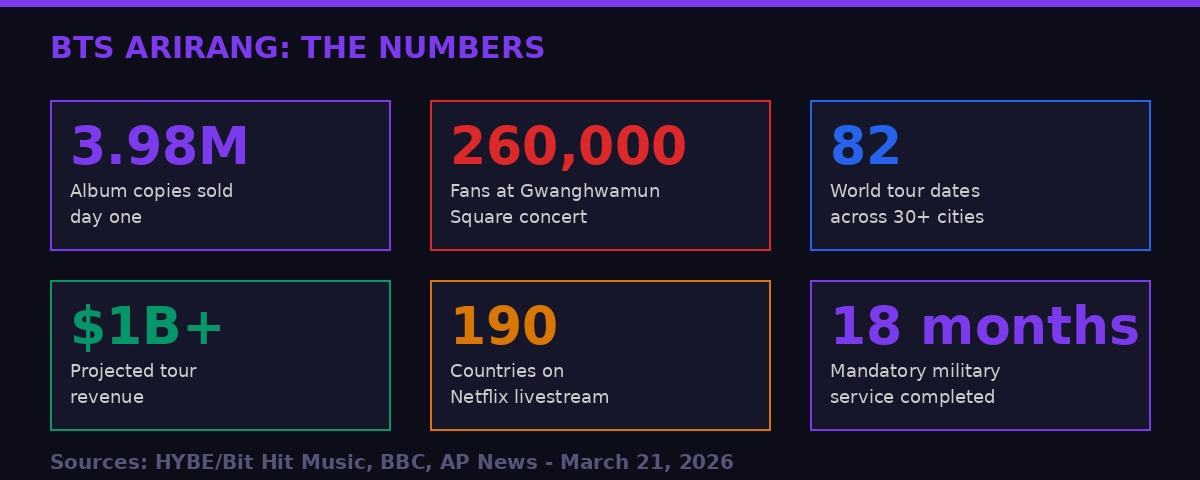
The numbers behind BTS's March 2026 comeback. Source: HYBE / Bit Hit Music, BBC, AP.
The Weight of the Hanbok: What 'Arirang' Actually Means

Gwanghwamun Square - the backdrop for Saturday's concert - sits at the historic heart of Seoul, framed by a 14th century royal palace gateway. [Pexels]
The album title is not accidental. Arirang is the name of Korea's most beloved folk song, a sentimental ballad about hardship and the hope of something better beyond it. Its exact origins are disputed - some trace it to the Joseon Dynasty, others find fragments older still - but every Korean schoolchild knows it. It is the kind of song that plays at the end of things: at funerals, at national moments, when distance from the homeland becomes too much to bear quietly.
Choosing this title is a statement. Before the hiatus, BTS had largely moved toward gleaming, polished pop designed for maximum global accessibility - Dynamite, Butter, tracks that charted in the United States, the UK, everywhere, because they were built to. Smooth, shimmery, commercial genius. The sacrifice was some of the raw political edge of their earlier work.
Music critic Mark Savage at the BBC noted that the new album opens with 15 minutes of "the rebellious, rap-heavy energy" of their 2014 debut era. A track called FYA channels Jersey club music with "revving synths and distorted beats." Another, Hooligan, builds its rhythm track from the sound of sharpening knives before breaking into falsetto. Produced by El Guincho - the Spanish musician behind Rosalia and Charli XCX's most cutting-edge work - it is deliberately uncomfortable. Deliberately Korean. [Source: BBC Music Review]
"This is international, make it unforgettable."
- BTS, from the album Arirang (2026)
The promotional video for the album shows all seven members listening to a wax cylinder recording: the first known recording of Arirang, made in the United States in 1896, performed by seven Korean men at Howard University. The band deliberately places itself in that lineage - 130 years of Koreans exporting their culture to the world, each generation picking up what the last one carried.
This is soft power with a spine. Not the kind that smooths over national identity to sell more units globally - the kind that says: you will know who we are, and you will come to us.
Four Years in Uniform: The Sacrifice That Earned the Stage

South Korea's mandatory military service applies to all male citizens between 18 and 28. For BTS, it meant putting the world's biggest band on hold for over four years. [Pexels]
To understand what Saturday's concert means, you have to understand what preceded it.
South Korea requires all male citizens to serve 18 to 21 months of mandatory military service. When BTS announced their hiatus in June 2022 - at the absolute peak of their commercial power, with HYBE stock climbing, with concert tours selling out in minutes - it was not a choice made lightly. It was a legal obligation that no amount of fame, cultural value, or economic argument was going to dissolve entirely.
Debate had raged for years. Some Korean legislators argued that BTS should receive exemptions, as classical musicians and Olympic athletes historically had. The band's contribution to Korean soft power - tourism, brand exports, cultural prestige - was quantified in the billions. The counter-argument, made by military officials and some of the Korean public, was that fairness demanded equal service regardless of fame.
Fairness won. Jin enlisted first, in December 2022. RM followed in April 2023. V and Jimin in September 2023. j-hope in April 2024. The last member - Suga - completed service in June 2025, paving the way for the full-group reunion. [Source: BBC]
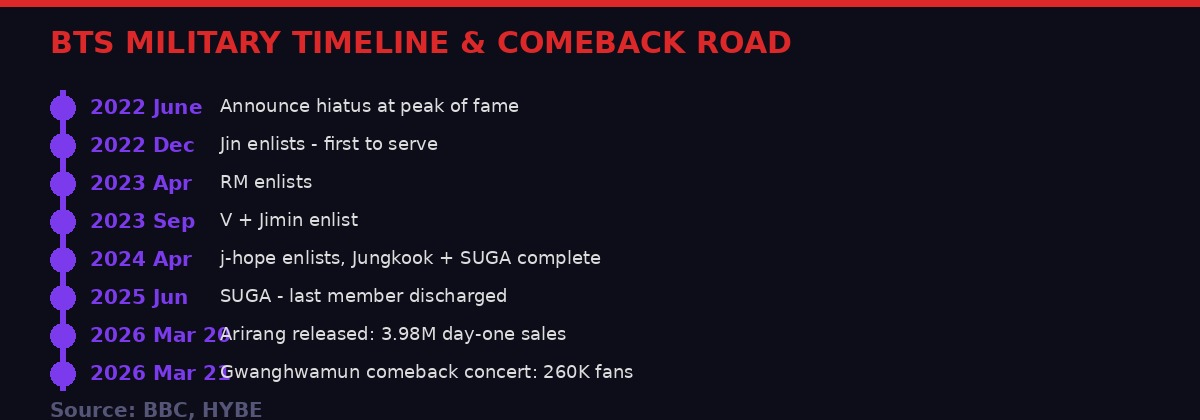
From hiatus to homecoming: the four-year road that led to Gwanghwamun Square. Source: BBC, HYBE.
During those four years, HYBE's operating profit fell by nearly 37.5 percent. The K-pop industry as a whole faced intensifying competition, a wave of scandals involving other agencies, and questions about whether the genre's Western crossover appeal was structurally durable or just a BTS-shaped anomaly.
Saturday's concert is the answer to those questions. Or at least, the opening statement of it.
"They've always exceeded my expectations. They might feel the pressure, but I believe they'll do their best."
- Park Joo-young, student, Seoul. Quoted by BBC.
The stakes could not be higher. But the band chose to open with rebellion rather than reassurance. That is not the choice of a group playing it safe with a comeback. That is the choice of a band that served their country, came home, and decided they had earned the right to say exactly what they wanted to say.
Seoul as Stage: The City That Lit Up Purple

Seoul's landmarks lit up in the band's signature purple for the event. Authorities deployed 7,000 police officers to manage crowd safety. [Pexels]
Gwanghwamun Square is not a neutral venue. Framed by the 14th century Gyeongbokgung Palace gateway, it is where South Koreans have historically gathered for major democratic protests - the 2016-17 candlelight protests that brought down President Park Geun-hye, mass demonstrations against corruption and abuse of power. It is a space with civic weight.
The decision to perform there, rather than in a commercial stadium, signals something about how BTS and their management want this comeback to be read: not as product launch, but as homecoming. A public act. A civic ritual.
Authorities deployed around 7,000 police officers for crowd safety, including SWAT units, per BBC reporting. Seoul's landmarks lit up in the band's signature purple. Only around 22,000 fans entered the cordoned concert area with free tickets; the remaining 240,000-plus gathered in the wider square to watch giant screens. Netflix livestreamed the event globally, capitalizing on its heavy investment in Korean content.
The economic ripple effects extend well beyond ticket sales. South Korean tourism authorities have tracked what analysts now formally call the "BTS effect": measurable spikes in foreign tourists visiting Korea specifically because of the band's visibility. Jacqueline from Mexico City, already in Seoul, is booked to see the band again when the world tour hits Latin America next month. That is not a coincidence - it is a pattern repeated across dozens of countries and hundreds of thousands of fans who first discovered Korea through this music.
Netflix's deal with BTS is not charity. The streaming platform has pumped billions into Korean content - from Squid Game to dozens of dramas - and BTS is the cultural infrastructure that primes global audiences to engage with Korea. Live-streaming the comeback concert to 190 countries is a marketing mechanism dressed as a gift. It works because both sides are telling the truth about it.
The Diaspora Who Came to Seoul Because of Seven Men

Fans from Russia, Germany, Mexico and dozens of other countries descended on Seoul for the concert - many of whom first discovered Korea through BTS. [Pexels]
Ami Ostrovskaia's story is its own kind of cultural analysis. She is Russian, she moved to Seoul, and the thing that motivated the move was a K-pop band. Through BTS, she learned Korean. Through Korean, she learned Korean history. Through Korean history, she arrived in a country not her own and found it familiar enough to build a life in.
This is the mechanism that makes BTS uniquely interesting to study as a cultural phenomenon, rather than just an entertainment one. They are a gateway. Not to a consumer product - to a civilization. To its food, language, history, geography, social codes, and contradictions.
The K-pop industry understood this early and has exploited it systematically - fan engagement, language learning apps, cultural exchange programs, tourism packages. But BTS has been the sharpest edge of that mechanism because they have never been purely product. From their earliest albums, they wrote about Korean social pressure, about academic failure and family disappointment, about young men struggling inside a system that demands performance without rest. That honesty found resonance in countries where those pressures exist under different names but identical weight.
Margarita Perez from Germany, standing outside in the crowd at 58, is not their target demographic in any marketing model. She came anyway. That gap between who the industry targets and who actually shows up is where the real cultural story lives.
"BTS is the reason I'm here. It's why I started learning about Korean history, culture, food, sports, and the language."
- Ami Ostrovskaia, Russian student who relocated to Seoul. Quoted by BBC.
The Army - the fan collective, one of the most organized and fiercely loyal fan communities in the history of popular music - has functioned for years as a kind of distributed cultural diplomacy corps. They translate lyrics. They correct misrepresentations of Korea in international media. They fundraise for Korean humanitarian causes. They are, by any metric, a global soft power force with no equivalent outside a nation state's formal infrastructure.
South Korea did not build this. It benefited from it, studied it, and eventually began deliberately replicating its conditions. BTS came first. The policy and the tourism strategy came after.
Nowruz and Eid: Spring Festivals Under Siege

March 21 is also Nowruz - the Persian New Year, one of the world's oldest festivals. For millions of Iranians this year, it arrived under bombardment. [Pexels]
March 21 is not only the day BTS performed to 260,000 fans in Seoul. It is also Nowruz - the Persian New Year, the spring equinox festival celebrated by Iranians, Kurds, Azerbaijanis, Tajiks, Kazakhs, Uzbeks, and dozens of other communities across Central Asia and the Middle East. It is more than 3,000 years old. It marks the rebirth of nature, the sweep-away of the old year's misfortunes, and the arrival of something new.
This year, for millions of Iranians, it arrived under bombardment.
Iran has been under US and Israeli airstrikes since February 28. As of the BBC's reporting on March 20, the US-based Human Rights Activists in Iran had counted 3,114 deaths in the country, including 1,354 civilians, of whom at least 207 were children. Tehran has responded with retaliatory strikes on Israel and Gulf states. A new CSIS analysis, verified by the BBC, placed damage to US military assets in the region at approximately $800 million in the conflict's first two weeks alone. [Sources: BBC Persian, BBC Verify / CSIS]
Mina, a woman in her 50s in Damavand, northeast of Tehran, told BBC Persian what Nowruz felt like this year. She was in tears. "Every day feels so long. It's like I've lost track of time," she said. Her son Amir had moved the family away from Tehran. "I don't want this to be our last Nowruz," he told the BBC.
"You can't smell Nowruz in the air. When the new year comes, I don't know whether the sound of the holiday announcement on TV will be mixed with the noise of missiles and drones."
- Mina, displaced resident of Tehran. Quoted by BBC Persian, March 20, 2026.
And yet: people went out anyway. A woman named Parmis was getting her nails done on March 17 when a loud explosion went off nearby. Nobody in the salon flinched. "I feel like some are still carrying on despite everything," she said. The Haft Sin table - Nowruz's ceremonial centrepiece, set with seven symbolic items - was still being assembled in homes across Iran.
Defiance as normality. Tradition as resistance. The festival is 3,000 years old because it has survived occupations, empires, revolutions, and wars before. This one too.
Meanwhile, on the other side of the world, in the Sydney suburb of Lakemba - 61 percent Muslim, the centre of Islamic culture in Australia - Ramadan was drawing to a close this week. Australian Prime Minister Anthony Albanese attended Lakemba mosque to mark Eid al-Fitr and was heckled and booed. Worshippers read out a statement about the community's anger at Australia's role in the Middle East war. The scene was broadcast nationally. [Source: BBC Australia]
The Islamophobia Register Australia reports an average of 18 anti-Islamic incidents per week - up from 2.5 per week before October 7, 2023. A 636 percent increase. The December 2025 Bondi Beach massacre, which police attributed to Islamic State ideology and which killed multiple people at a public Hanukkah celebration, accelerated the spike further.
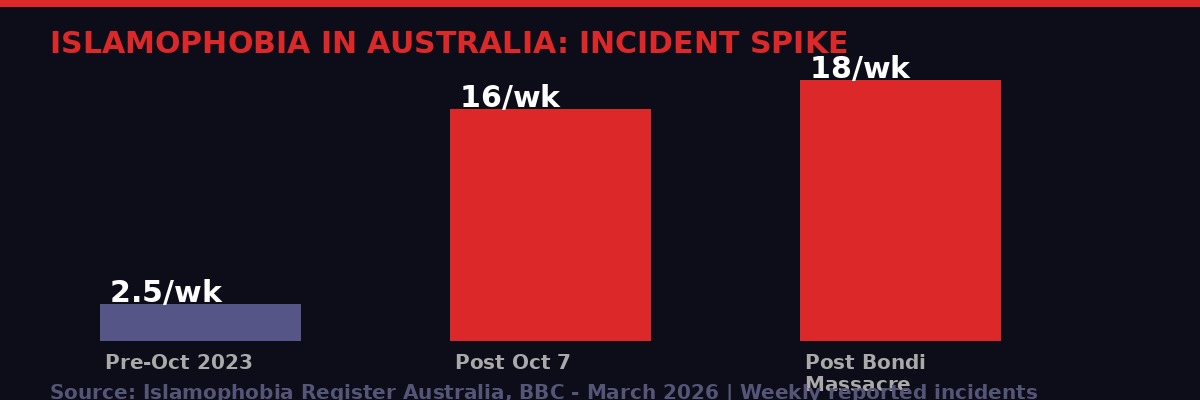
Islamophobic incidents in Australia have risen 636 percent since October 7, 2023. Source: Islamophobia Register Australia, BBC.
Dr. Moshiuzzaman Shakil, a Bangladeshi doctor living in Lakemba, described losing a client after the Bondi attack. "They asked me: are you a Muslim? Yes, I'm a Muslim," he told the BBC. The implicit logic - that his faith made him suspect - is the atmosphere in which Australia's 600,000-plus Muslims are now celebrating Eid.
Spring arrived on March 21 for all these communities at once. Each one celebrated, mourned, or persisted in their own way.
What Culture Does When the World Is on Fire

Culture continues, even as war, displacement, and discrimination reshape the context in which it's received. The crowd at Gwanghwamun Square was also watching a world on fire. [Pexels]
The BTS story and the Nowruz story and the Eid story are not separate. They are the same story, told in different registers on the same day.
They are all about what people do when the institutions that are supposed to protect them are either absent, hostile, or actively bombing their cities. They retreat into culture. Into the things that have lasted. Into the shared rituals that remember who they were before the crisis and insist on who they intend to remain after it.
BTS performing at Gwanghwamun Square is a statement about Korean identity that would not carry its weight if it were not also a statement about endurance. These men spent four years in military service - not because they chose to, but because their country required it, and because they chose to comply rather than dodge that requirement through the exemptions that fame might have made available. They came home and made an album named after their oldest folk song. They opened with the sound of sharpening knives.
Mina in Damavand went out and bought flowers for her Haft Sin table despite the explosions. She cannot smell Nowruz in the air this year. She is setting the table anyway.
Dr. Shakil in Lakemba goes to work knowing that a client ended their professional relationship with him because of his religion. He lives in a suburb that gets police surveillance trailers outside its mosque during Ramadan, because the community has been threatened enough times that they requested the presence. He celebrates Eid this week in that context.
These are not stories of victimhood. They are stories of continuation. The world is on fire - it has been before - and culture does not stop. It adjusts, compresses, deepens. It carries more weight per note, per table setting, per flower bought despite everything.
Context to hold: The last time Iranians celebrated Nowruz during wartime was the 1980s, during the eight-year Iran-Iraq war. The generation that survived those Nowruz celebrations is now the generation watching this one. They know how this feels. They also know that it ends. The festival is older than any current conflict by about 3,000 years.
Chuck Norris, the Meme Economy, and What We Lose When Icons Die

Chuck Norris died on March 19, 2026, at 86. For tens of millions of people who never saw a single Walker, Texas Ranger episode, he was the funniest man on the internet. [Pexels]
On March 19, two days before the BTS concert, a different kind of cultural death occurred.
Chuck Norris died at 86. His family described it as a "sudden passing." He was surrounded by family and at peace, they said. The circumstances remained private. [Source: AP News]
For a specific generation of internet users - primarily those who came of age between approximately 2005 and 2015 - the name Chuck Norris triggers an immediate reflex. Not the action movies. Not Walker, Texas Ranger. Not his real accomplishments as a six-time undefeated World Professional Middleweight Karate champion who founded his own martial arts discipline. The reflex is to generate, or remember, a Chuck Norris Fact.
Chuck Norris doesn't read books. He stares them down until they give up the information.
Death doesn't text Chuck Norris. Death writes a formal letter.
The Chuck Norris Facts meme emerged around 2005 and became one of the internet's earliest viral formats - a template for celebrating exaggerated toughness with deadpan absurdity. It was affectionate. It treated him as a god of competence and invincibility. Norris himself was famously good-humored about it.
The outpouring on social media after his death was remarkable for the layers of it. George W. Bush issued a formal statement noting Norris had "turned the dark off" when he walked into a room - borrowing from the meme language to honor him. Sylvester Stallone called him "All American in every way." Arnold Schwarzenegger called him "a badass, in real life and in Hollywood." Dolph Lundgren wrote that Norris had the "respect, humility and strength it takes to be a man." [Source: AP News]
"He was All American in every way. Great man and my condolences to his wonderful family."
- Sylvester Stallone, via Instagram. Quoted by AP News.
What Norris represented - what millions mourned when the news came - was a specific kind of cultural confidence. Born Carlos Ray Norris in Ryan, Oklahoma, to poverty. Joined the Air Force at 18. Deployed to Korea, started training in judo and Tang Soo Do because that's what was available. Came home, opened a martial arts studio, taught Bob Barker and Priscilla Presley and Steve McQueen. Got into movies on McQueen's recommendation.
The life is a genuinely American story in the best sense of that phrase - not the triumphalist kind, but the immigrant-inflected, pulled-from-nothing, built-something-real kind. And then the internet took that story and transmuted it into mythology, and he became something stranger and more enduring than any action movie could have achieved.
The BBC noted that millions who mourned his death this week had never actually watched a single film or episode of Walker, Texas Ranger. They knew him entirely through the meme. They mourned anyway - because the meme had made him real to them in its own way. That is a new kind of celebrity death, and a new kind of cultural inheritance.
What Spring Means Now

March 21 - the spring equinox - lands differently around the world depending on what you carry into it. [Pexels]
March 21 is the spring equinox. In the Northern Hemisphere, it marks the day when light overtakes darkness in the daily cycle. Nowruz is tied to this moment because its oldest root is astronomical - it is the new year because it is when the sun arrives properly at last.
This year the equinox arrives into a world that is more heavily armed, more internally fractured, and more digitally connected than any spring in human history. Wars are running simultaneously in the Middle East, Ukraine, and the Afghan-Pakistan border. Climate-driven flooding has killed people in Hawaii this week. A 120-year-old Hawaiian dam is at risk of failure. TSA workers in the US are being forced to staff airports without pay during a funding standoff. CBS Radio, nearly a century old, shut down this week - an era ended quietly without most people noticing.
Into all of this: 260,000 people in a square in Seoul, lit up purple, watching a band play the oldest Korean folk song in new clothes.
It would be sentimental to claim that BTS cures anything. It would be dishonest to pretend it does not matter. What actually happens in moments like this - when culture arrives at scale in a world that is burning - is not cure. It is the reminder that the burning is not the whole story.
Mina sets her Haft Sin table in Damavand and does not know if the new year will be her last. She sets it anyway because it is Nowruz and Nowruz comes every year and she is still here.
Ami Ostrovskaia stands in Gwanghwamun Square and presses her hands against a cast of Jung Kook's palm and tries to understand why a band from Seoul convinced a Russian woman to move her life to Korea. She understands it the moment the music starts.
Chuck Norris did not turn the lights on when he walked into a room. He turned the dark off. On a week like this one, with everything burning, you understand why that image spread so far. People needed it. They need it now.
Spring arrived today. Take it however you can get it.
Get BLACKWIRE reports first.
Breaking news, investigations, and analysis - straight to your phone.
Join @blackwirenews on Telegram