260,000 Reasons Not to Give Up: BTS Returns to a World on Fire

On Thursday morning in Iran, a teenager named Saleh Mohammadi was hanged. He was a member of the national wrestling team. He was accused of killing police officers during anti-government protests. Rights groups say he was tortured into a confession, tried without due process, and killed alongside two other men at dawn in Qom Province, according to BBC News.
On Friday evening in Seoul - the same day, the same spinning planet - 260,000 people stood in Gwanghwamun Square to watch seven young men from South Korea perform music together for the first time in four years. The band is called BTS. The album is called Arirang, the name of Korea's most beloved folk song. Arirang translates to "the pass." As in: the difficult crossing. As in: the thing you go through to reach the other side.
This is not a coincidence the universe arranged for a culture reporter. This is just Friday, March 20th, 2026. This is Nowruz - the Persian New Year, a holiday 3,000 years older than the states that are currently bombing each other across the Middle East. This is Eid al-Fitr, the celebration at the end of Ramadan, the day Australian Prime Minister Anthony Albanese walked into Lakemba Mosque in Sydney and got heckled by a crowd furious about Gaza. This is the spring equinox. The day the world tilts toward the light.
Culture does not wait for politics to fix itself before it shows up. It never has. The 260,000 who came to Seoul did not pretend the world is fine. They just decided, for one night, to be there anyway.
The Hiatus That Wasn't Really a Hiatus

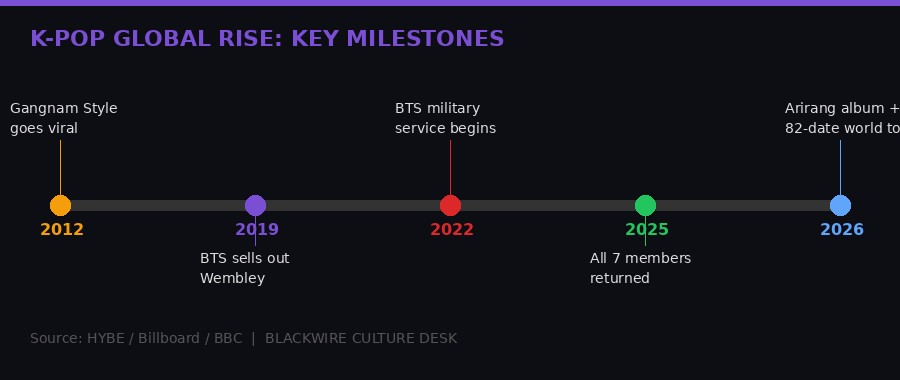
South Korea has mandatory military service. For most men, it is 18 months, and there is no exception for being the most commercially successful band on the planet. BTS's label HYBE delayed the inevitable as long as possible, but by December 2022, Jin - the eldest member - had enlisted. One by one, across two years, all seven followed. Suga, who served in a social service role due to a shoulder injury, was the last to return, completing his service in June 2025.
HYBE's share price dropped by almost 37.5% during the hiatus, according to BBC Music. The K-pop industry did not collapse - new groups filled the vacuum - but something was missing from the top of the pyramid. BTS had done things no other K-pop act had managed: sold out Wembley Stadium, performed on Saturday Night Live, gone to the United Nations to speak about mental health, charted at number one in the United States in English and in Korean. Their absence was felt like a dropped signal that never quite resolved.
The solo years were productive. RM released critically praised albums. Jungkook had a global solo hit in "Seven." J-Hope headlined at Lollapalooza. But the machinery of BTS - the seven-part harmony of personalities, the specific alchemy of their collaboration - was on pause. Fans counted the days on apps. Group chats in Manila, Lagos, Mexico City, and Mumbai went quiet, then came back to life when each discharge announcement arrived.
Ami Ostrovskaia moved from Russia to Seoul specifically because of BTS. She is 23. She started learning Korean, studying Korean history and food and sports, and eventually applied to a Korean university. She is not unusual. She is thousands of people. "BTS is the reason I'm here," she told the BBC, standing in Gwanghwamun Square days before the concert, holding small dolls of Suga and Jungkook.
"I was crying the whole night when I didn't get a ticket. But then thanks to a friend, I got lucky. I was so happy - it felt like all my problems were gone. This means I'll be joining their full-group performance after so many years. It's really meaningful for me." - Ami Ostrovskaia, Seoul, March 2026
Arirang: What the Album Actually Says

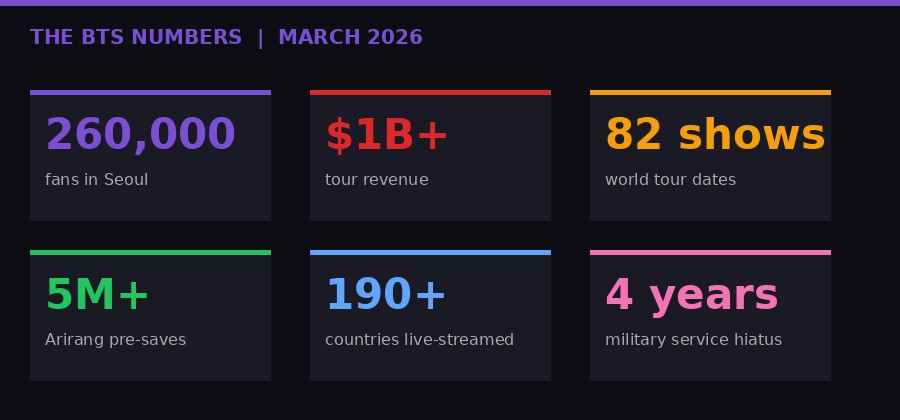
The album released on Friday, the same day as the Seoul concert. Five million pre-saves on Spotify, the highest number ever achieved by a K-pop group. The BTS account on X (formerly Twitter) briefly crashed the platform's trending algorithms. HYBE stock surged 14% in the 48 hours before release.
But the music itself is the real story, because the safe path would have been to return with more of the polished radio-friendly sound that made them megastars. Songs like "Dynamite" and "Butter" - sleek, upbeat, designed to hit the English-language mainstream - had worked. They could have made more Butter.
They didn't. According to BBC Music's review of the album, the opening 15 minutes of Arirang have "the rebellious, rap-heavy energy of the band's 2014 album, Dark and Wild." A track called "FYA" is built on Jersey club rhythms with "revving synths and distorted beats." Another, "Hooligan," uses sounds of sharpening knives and cinematic strings. The production on several tracks came from Spanish musician El Guincho, who has worked with Rosalia and Charli XCX - artists at the experimental edge of pop.
The album's conceptual anchor is the title song "Arirang" - a 3,000-year-old Korean folk melody. The first known recording of the original Arirang was made in 1896, in the United States, by seven Korean men performing at Howard University in Washington DC. BTS found this recording, included a reference to the wax cylinder in a promotional video, and built a bridge across 130 years of Korean cultural export. The message is not subtle: we have been here before. We have been crossing difficult passes before. The music carries that.
"This is international, make it unforgettable," they declare on one track - what the BBC's music correspondent called "a manifesto for their comeback." It works because it doesn't sound like a manifesto. It sounds like seven men who missed making music together.
The City Braces - and Complains - for 260,000

The concert is free - in the sense that attending costs nothing. But 260,000 people in a historic urban square means Seoul has effectively become a logistics crisis for the day. Three subway stations near Gwanghwamun will close. Dozens of buildings have restricted access. Thirty-one entry points with metal detectors ring the square. Seven thousand police officers have been deployed, including SWAT units carrying anti-drone systems, according to the BBC's Seoul correspondent.
The 22,000 actual concert tickets - for the inner cordoned-off area - were released free of charge through an online reservation system. More than 100,000 people were queuing online when the first 13,000 tickets dropped. They were gone instantly. Another 7,000 followed. Gone in minutes. Rachel, who told the BBC she does not even consider herself a BTS fan, spent an hour trying on her phone and desktop simultaneously: "None of them worked."
Not everyone is charmed by the scale. "They've pulled in police and fire personnel en masse. If something happens elsewhere, there may be no staff left to respond," one Seoul resident posted on X. A ruling party lawmaker, Lim O-kyeong, expressed concern that Netflix - the sole live-streamer - was extracting exclusive rights from an event that requires enormous public resources to execute safely.
Then there is Sohn Yeon-ju. She is a lawyer in her 30s. Her wedding is scheduled in a venue near Gwanghwamun Square, just hours before the concert. She has been calling the Seoul metropolitan government for days trying to understand how her family and hundreds of guests will reach the venue with all roads controlled. The police, as of Thursday, suggested that wedding guests might be allowed to board police buses if the nearest subway station is closed. "I don't have any particular feelings about BTS," she told the BBC, "but given the situation, it's frustrating."
Park Su-bin is in her 30s and uses a wheelchair. She is a BTS fan of seven years. She has tickets to an April concert, so she skipped the Gwanghwamun event. "I know officials will strengthen safety measures, but there will be so many people that I'm still a bit worried," she said. Accessibility at mass events in Seoul has long been criticized by disability rights groups, and a 260,000-person crowd with 31 metal detector checkpoints creates exactly the kind of chaotic press of bodies that becomes impassable for wheelchair users.
The ARMY: A Diaspora That Chose Itself

Margarita Perez is 58 years old. She is a German architect. She did not manage to get a ticket for the Seoul concert. So she flew to South Korea anyway, to be near it, to "stay close" as she told the BBC. She has been scouting the area around Gwanghwamun for days, identifying good viewing spots near the giant screens.
This is not unusual behavior in BTS fandom circles. It is, in fact, mild compared to what ARMY - the official name for the fanbase - has done over the years. In 2020, when right-wing operatives bragged online about reserving millions of tickets to a Trump campaign rally in Tulsa and planning not to show up, it was BTS fans and K-pop stans on TikTok who first organized the effort and made it go viral. The rally had an embarrassingly small turnout. ARMY does not limit itself to fan activities.
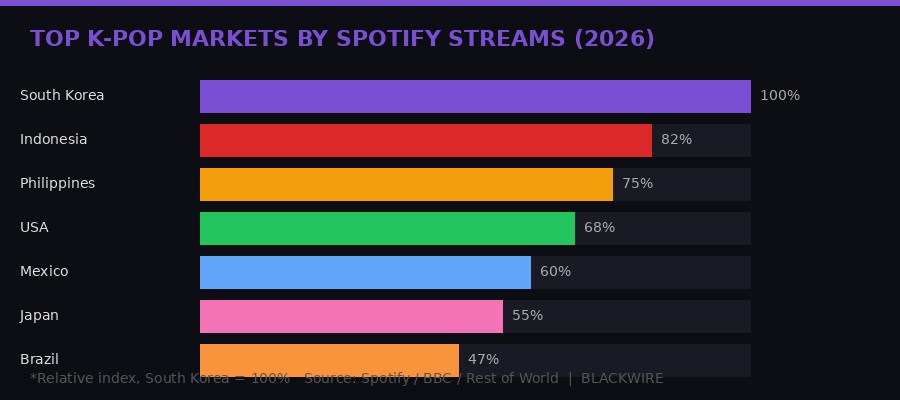
The ARMY's geographic spread is genuinely unusual. Spotify lists Mexico as K-pop's fifth-largest streaming market, with the genre's listening growing by over 500% in the country over the past five years. About one million young Mexicans tried to buy 150,000 BTS concert tickets for their May dates in Mexico City, according to the country's president Claudia Sheinbaum - who wrote a formal diplomatic letter to South Korea's president Lee Jae Myung asking for more shows to be added. Mexico's consumer watchdog has sanctioned StubHub and Viagogo for ticket resale price gouging, because demand for BTS is apparently a matter of national consumer protection.
"I wrote a letter to the president of Korea... I still haven't received the answer, but let's hope it's positive." - Mexico President Claudia Sheinbaum, January 2026, on requesting more BTS concert dates (Source: BBC)
The demographic picture of ARMY is worth examining closely because it doesn't match the Western music industry's stereotype of K-pop fandom. A 58-year-old German architect in Seoul. A 23-year-old Russian student who changed her entire life trajectory. A 58-year-old Korean mother showing up with her daughters. Researchers at the University of Southern California who studied BTS's fandom structure found it spans every continent, multiple generations, and is disproportionately female compared to Western pop fandoms - but also includes significant male participation in Southeast Asia and Latin America in ways that Western acts rarely achieve.
What binds them is not always the music. It is, more often, the parasocial relationship BTS cultivated through years of daily content - live streams, written messages, documentary footage - and the group's explicit, sustained discussion of mental health, loneliness, and the pressure to perform happiness. In 2018, RM spoke at the United Nations about the struggles of self-acceptance. In 2021, the group addressed a rise in anti-Asian racism in the United States in a statement that was read by millions. ARMY did not choose a pop band. ARMY chose something that told them their feelings were real, and that they were not alone in having them.
Korea's Soft Power and the Global Stakes

The Seoul city government is not just providing venue logistics out of civic goodwill. BTS returning to Gwanghwamun Square - in front of the Heunginjimun Gate, a 14th-century royal gateway - is a soft power event of the highest order. Netflix's live-stream to 190 countries will put Seoul on every screen on earth at the same moment. Hotels in the Gwanghwamun area have been fully booked for over a month, at significantly inflated prices. Tour operators in Tokyo, Bangkok, and Manila have been running Seoul packages specifically marketed around the concert weekend.
South Korea's approach to cultural export - what policy makers call Hallyu, the Korean Wave - was not accidental. It emerged from deliberate investment after the 1997 Asian financial crisis, when the government began funding the entertainment and content industry as a new economic pillar. What started as regional soap operas and pop groups became, over 25 years, a global phenomenon. BTS's 2021 album "BE" broke records in 14 countries simultaneously. "Squid Game" on Netflix became the most-watched series in the platform's history. "Parasite" won the Oscars. Korean food has gone from niche to mainstream in cities from London to Los Angeles.
According to Billboard, BTS and HYBE stand to make more than $1 billion from the 2026 comeback - across concerts, merchandise, licensing, album sales, and streaming revenue. Some analysts suggest the number could approach $2 billion, which would eclipse Taylor Swift's Eras tour as the highest-grossing tour in history. These are figures that governments notice. A Seoul city official told the BBC that the city is providing the concert venue, crowd management, and safety measures at public expense, but no direct financial support - a framing that drew some skepticism from critics who noted the massive public resource deployment required for 260,000 attendees.
The K-pop industry itself is in a complicated position as BTS returns. The years of BTS's hiatus saw a glut of new groups, copycat production models, and declining album sales in some markets as the new-release cycle became overwhelming. Fan fatigue and a series of scandals - ranging from financial misconduct at agencies to allegations of manipulation in fan voting systems - damaged trust in the industry's structure. BTS's return is read by analysts as a litmus test: can legacy acts anchor an industry that has been oversaturated? Park Joo-young, a student who has waited years for this moment, told the BBC: "They've always exceeded my expectations. They might feel the pressure, but I believe they'll do their best."
The World They're Returning To

It would be too easy - and too dishonest - to write about this concert without naming what is happening simultaneously on this planet on this day.
In Tehran, it is Nowruz. The Persian New Year, 3,000 years old, falling on the spring equinox. A woman named Parmis went to get her nails done on March 17th, a routine Nowruz preparation, and while she sat in the salon a loud explosion went off nearby. No one in the salon flinched, she told the BBC. The desensitization to war is now that complete. Another woman, Mina, fled Tehran with her son for the relative safety of Damavand northeast of the capital. "I don't want this to be our last Nowruz," her son Amir told the BBC, adding that his biggest fear is the destruction of Iran's infrastructure.
As of this week, the US-based group Human Rights Activists in Iran has documented 3,114 people killed in Iran since strikes began on February 28th, including 1,354 civilians, at least 207 of them children. Iran has launched retaliatory strikes on Israel and Gulf states. The Strait of Hormuz - through which a third of the world's traded oil once flowed - has seen near-normal passage of ships, barely 100 vessels since March began, according to BBC Verify.
Saleh Mohammadi is dead. He was a teenager. He was a wrestler. Iran's government called it justice for the killing of police officers during protests sparked by economic collapse and political anger. Human rights organizations said he was tortured into a confession. The UN Special Rapporteur on Iran called the executions a "severe violation of international human rights law." The protests that led to his arrest reportedly spread to 180 cities across all 31 of Iran's provinces. At least 7,000 people were killed during the January crackdown, including 236 children, according to the US-based Human Rights Activists News Agency (Hrana).
And in Sydney on Friday morning, Australian Prime Minister Anthony Albanese attended Eid prayers at Lakemba Mosque - one of Australia's largest - at the invitation of community leaders, on the day marking the end of Ramadan. He was heckled by attendees calling him a "genocide supporter." A man was removed by police and later released without charge. The Lebanese Muslim Association, which operates the mosque, issued a statement saying Albanese was welcome and that engagement with political leadership is not a betrayal - "but we also need to be clear," the statement said, acknowledging the "ongoing suffering in Gaza."
"Choosing to engage with the elected leadership of this country is not a betrayal of those concerns. It is how we give them a voice." - Lebanese Muslim Association, Sydney, March 20, 2026
None of this is distant from Seoul. The BTS ARMY has members in Iran. Members in Gaza. Members in Sydney. Members in every place where things are currently, catastrophically, not okay. They opened their phones tonight to a new album. They stood in a square while history piled up around them. And they stayed.
What This Moment Actually Means

There is an argument, made usually by people who are comfortable, that culture is trivial in times of crisis. That concerts and albums are escapism. That anyone paying attention to BTS when people are dying in Iran is performing some kind of moral failure.
That argument has always been made. It was made about jazz during the Depression. It was made about rock and roll during Vietnam. It was made about hip-hop during the crack epidemic. It was made, probably, about Nowruz during the eight-year Iran-Iraq war - the last time Iranians were bombing and being bombed while their spring festival arrived. The argument is always wrong.
Culture is not what happens when the serious stuff is done. Culture is how people survive the serious stuff. A 23-year-old Russian woman moves to Seoul because seven Korean men sang about being lonely and not fitting in, and she recognized herself in that. She built a life in a country she might never have visited, learned a language she had no practical reason to learn, formed friendships with people she shares no ethnicity or nationality or religion with. She built a diaspora. She chose one. She will stand in Gwanghwamun Square tonight with a purple lightstick and feel, for a few hours, exactly where she is supposed to be.
Kim Young-ran brought her two daughters. She is a Korean mother in her 50s. She thinks the concert will help promote Korean culture to the world. Her daughters think they are just going to a concert. Both things are true simultaneously, and neither requires the other to work.
The Arirang folk song - the one BTS named their album after - is about the difficulty of crossing a mountain pass and leaving someone behind. It was sung by Koreans who were separated, displaced, grieving. The first known recording was made in the United States by Korean men who were far from home. Those seven men and the seven men on stage at Gwanghwamun are separated by 130 years and by everything that has happened to Korea in those years - colonization, war, partition, economic catastrophe, and eventually a K-pop industry that redrew the global cultural map. The song persists. The crossing continues.
The 82-date world tour runs from April 2026 through 2027, covering Singapore, Tokyo, Munich, Los Angeles, and dozens of other cities. Mexico City has three confirmed dates in May; Mexico's president is formally requesting more. Projected tour revenue: $1 billion (Billboard) to $2 billion (analyst estimates). Netflix will stream the full Seoul concert to 190+ countries. The album "Arirang" was pre-saved 5 million times on Spotify - the all-time K-pop record.
A Timeline of the Comeback
The Morning After

Tomorrow, Seoul will clean up after a quarter of a million people. Sohn Yeon-ju, if the police buses work out, will have had her wedding. The subways will reopen. The hotels will start charging normal rates again. BTS will take the tour to Goyang Stadium in April, then to Singapore, Tokyo, Munich, Los Angeles, and eventually to every city where ARMY has been waiting.
In Tehran, Nowruz will continue. Iranians will visit each other's homes in smaller numbers than usual, because some have been displaced and some are afraid to travel. Maryam, who told the BBC she is "defiantly" setting out her Haft Sin table despite everything, will do so. The seven symbolic items representing life, health, and prosperity will sit on the table. The tradition is 3,000 years old. It has survived the Mongol invasions, the Safavid dynasty, the Qajar collapse, the oil nationalization crisis, the Islamic Revolution, the eight-year war with Iraq, and now it is surviving this too.
In Sydney, the Lebanese Muslim Association's statement will be read and debated. Albanese will say the reception was "overwhelmingly positive." The people who heckled him will say their point stands. Gaza will still be burning. The Bondi mass shooting victims will still be dead. The Eid prayers will have been prayed anyway, because that is what holy days do - they arrive on schedule regardless of the political situation, and people observe them anyway, and that insistence on observance is itself a form of resistance.
Saleh Mohammadi is still dead. He cannot hear the Arirang album. His family in Iran is marking Nowruz without him. He was young enough to be in the BTS ARMY. He might have been. We don't know.
What we know is this: at Gwanghwamun Square on March 20th, 2026, on the spring equinox, on Nowruz, on Eid al-Fitr, in a world actively cracking apart in multiple locations simultaneously, 260,000 people stood in a historic square in front of a 14th-century gate and watched seven men sing about crossing difficult passes together.
They did not fix anything. They were not trying to. They showed up. In the middle of everything, they showed up. And 260,000 people came, from Russia and Germany and Mexico and Korea and everywhere else the signal had reached, because someone needed to show that showing up is still possible.
That is not nothing. That is, in fact, everything music has ever done.
Get BLACKWIRE reports first.
Breaking news, investigations, and analysis - straight to your phone.
Join @blackwirenews on TelegramSources: BBC News - BTS Seoul concert, March 2026 | BBC Music - Arirang album review | BBC - Mexico president letter on BTS | BBC - Iran protest executions | BBC - Nowruz under war | BBC - Albanese Eid heckled | HYBE / Billboard (via BBC) - tour revenue estimates | Human Rights Activists News Agency (Hrana) - Iran protest deaths
All images illustrative. Concert crowd images: Pexels (CC0). Infographics: BLACKWIRE Culture Desk / PIL-generated. OG image: BLACKWIRE.