Bitcoin Breaks Free: $71K, War Premium, and Wall Street's $126T Blockchain Grab
Bitcoin just posted its best week since September 2025 - while Nasdaq bled and gold stumbled. Simultaneously, Wall Street's two biggest exchange operators announced they're putting the entire $126 trillion equity market on blockchain. And the SEC and CFTC stopped their decade-long turf war. Everything changed this week.

Bitcoin rose 8.5% in the week ending March 15 - its best performance since September 2025. (Photo: Pexels)
THIS WEEK'S NUMBERS
The Pattern Nobody Expected
Bitcoin was supposed to be the risk-on casualty of the U.S.-Iran war. On February 28, when the first American and Israeli strikes hit Iran on a Saturday morning - the only liquid market open - bitcoin dropped 8.5% almost instantly. Floor: $64,000. Commentators called it a flight to safety away from risk assets. The narrative made sense.
Three weeks later, the narrative is dead. Bitcoin is up 13% since those first strikes. Gold is down 6%. The S&P 500 is in the red. Asian equities just posted their worst week since March 2020. The only assets that outperformed bitcoin were oil and the U.S. dollar - and both are direct, obvious beneficiaries of a Middle Eastern war that's disrupting 25% of global oil transit.
What's more striking than the return is the pattern. Each escalation in the Iran conflict has been larger than the last. Iranian missiles hit Gulf states on March 2. Sustained aerial bombardment continued through March 7. Tanker attacks in the Strait of Hormuz lit up markets on March 12. Trump threatened then backed off from hitting Kharg Island on March 14. But each time bitcoin sold off, it found buyers at a higher level than before. According to CoinDesk analysis, the floor has risen approximately $1,000-$2,000 per war event in a series of higher lows that's compressing the price range from below.
The trendline of higher lows now sits against a ceiling of $73,000-$74,000 that has rejected bitcoin four separate times. That compression cannot hold indefinitely. Either the next war escalation breaks buyers - delivering a genuine crack below the upward trendline - or bitcoin punches through $74,000 and the short squeeze begins.
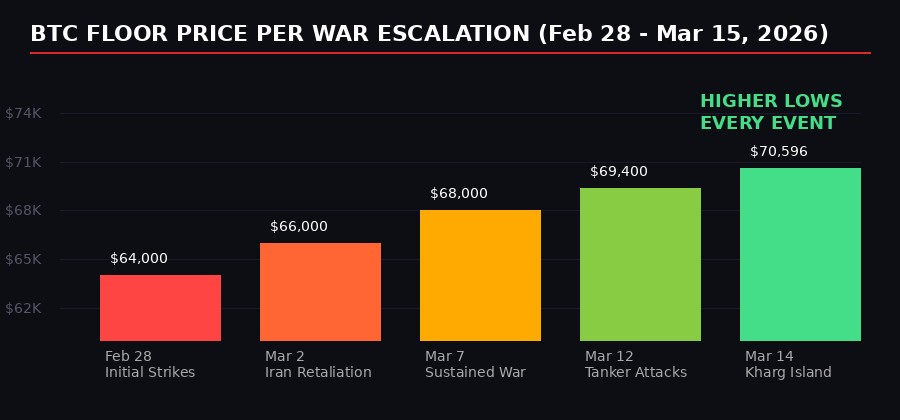
Bitcoin's floor price per escalation event: Feb 28 ($64K) to Mar 14 ($70.6K). Higher lows on every print. (Source: BLACKWIRE / CoinDesk data)
Safe Haven or Speed Indicator - What Is Bitcoin Now?
The debate about bitcoin as a safe haven versus a risk asset has run for years. In late 2025, when bitcoin dropped 50% from its October all-time high across five consecutive negative months, the safe haven thesis looked like wishful thinking. Correlation with software stocks was near all-time highs. Bitcoin was trading like a leveraged tech ETF.
That correlation appears to be breaking. Using BlackRock's iShares Bitcoin Trust (IBIT) as a proxy, bitcoin is up approximately 3.5% this week and approached a one-month high on Friday. The iShares Expanded Tech Software ETF (IGV), which bitcoin had been tightly tracking, trended lower all week. So did gold. So did U.S. equities. Bitcoin moved in the opposite direction.
But calling bitcoin a safe haven based on three weeks of war data misses the more interesting interpretation. Bitcoin isn't acting like gold - a passive store of value that investors rotate into when they're scared. It's acting like something different: a 24/7 liquidity sponge that absorbs geopolitical shock faster than any other market because it's the only thing trading when crises happen on weekends.
"Bitcoin is acting like the fastest shock absorber in global markets. Each escalation draws a sell-off. Each sell-off finds buyers faster, at higher prices. The weak hands were cleared out in February's $2.5 billion liquidation cascade. What's left is a market that can absorb war headlines without breaking." - CoinDesk, March 15, 2026
This is a meaningful structural shift. In February, a single liquidation event wiped out $2.5 billion in leveraged positions over one weekend, pushing bitcoin below $77,000 and erasing roughly $800 billion in total crypto market cap from the October peak. That looked like the kind of event that breaks sentiment for months. Instead it cleared the deck. Perpetual futures funding rates are still negative - meaning short sellers are paying longs, indicating bearish positioning remains dominant. Fear and greed index: extreme fear. Yet the price keeps rising on every escalation attempt.
The market that emerges from this pattern is fundamentally different from the one that existed in October 2025 at the all-time high. That market was driven by leveraged retail and momentum chasing. This one appears to be driven by institutional accumulation - patient buying that treats every war dip as an entry point. The $1.3 billion in net ETF inflows recorded in March alone, reported by SoSoValue, would mark bitcoin ETFs' first month of net positive flows since October 2025.
Nasdaq and ICE Want to Own the Everything Exchange
While bitcoin was repricing itself in the context of a shooting war, the more seismic shift of the week happened in a boardroom announcement that most crypto traders barely noticed: both Nasdaq and Intercontinental Exchange - the parent company of the New York Stock Exchange - announced separate deals to put the global equity market on blockchain rails.
The numbers are enormous. The global equity market is worth approximately $126 trillion. Right now exactly $0 of it trades on a blockchain in any meaningful way. These announcements suggest that's about to change faster than anyone expected.
Nasdaq's deal is with Payward - the parent company of crypto exchange Kraken. According to CoinDesk reporting, Nasdaq is developing a framework that would allow any publicly listed company to issue blockchain-based versions of their shares while preserving traditional ownership rights and governance structures. The offering could go live as early as the first half of 2027. Kraken handles global distribution.
ICE went in a different direction, making a strategic investment in crypto exchange OKX at a $25 billion valuation. The deal includes plans to launch new tokenized stocks and crypto futures products, giving ICE direct access to OKX's 120 million-user base across emerging and international markets.

Wall Street's biggest exchange operators are embracing blockchain tokenization. Nasdaq and NYSE parent ICE both moved this week. (Photo: Pexels)
The strategic logic is straightforward. Crypto exchanges have global distribution and a user base conditioned to 24/7 trading. Traditional exchanges have regulatory credibility, listing relationships, and the institutional trust that comes from 150 years of infrastructure. Neither can fully enter the other's market without the other's help. The result, as Cryptio CEO Antoine Scalia told CoinDesk, is a "frenemy" relationship - competitive on the product layer, dependent on each other for distribution and legitimacy.
The legal framework that makes any of this possible arrived in January 2026, when the SEC issued a Staff Statement on Tokenized Securities clarifying that blockchain-issued equities carry the same legal weight as their paper counterparts. That statement gave Wall Street incumbents the cover they needed to move. Both Nasdaq and ICE moved within weeks.
The tokenized equity market currently sits at approximately $1 billion in total value - having tripled from mid-2025 levels as Kraken, Ondo Finance, Robinhood, and others rolled out token versions of major equities. BCG and Ripple's joint forecast projects tokenized assets growing at 53% annually to reach $18.9 trillion across all asset classes by 2033. The equity market alone is projected to move even faster, given the structural advantages: 24/7 trading, fractional ownership, programmable settlement, and no T+2 clearing delay.
The implication for traditional crypto markets is significant. If Nasdaq and ICE succeed in onchaining the equity market, the user base for crypto infrastructure scales by orders of magnitude. Every retail investor who owns Apple stock becomes a potential blockchain wallet holder. Every institutional fund manager who wants after-hours exposure becomes a DeFi participant whether they understand DeFi or not.
Strategy's 1-Million-Bitcoin Endgame
Michael Saylor's playbook isn't subtle, but it's working. Strategy (MSTR) held 738,731 BTC as of the company's last disclosure - approximately 3.5% of the entire 21 million bitcoin that will ever exist. The company bought 17,994 BTC last week alone. At its current pace of accumulation, it could hold 1 million BTC - 4.76% of total supply - before the end of 2026.
The math, as detailed by CoinDesk: Strategy needs to acquire 261,269 more BTC. With 297 days remaining in the year, that implies roughly 6,158 BTC per week. At an average acquisition price of $85,000 per coin, the remaining purchases would cost approximately $22.2 billion - funded through ongoing equity and preferred stock issuance. The company's STRC preferred stock issuance from Monday through Thursday last week alone implied as many as 11,000 BTC in purchases, not counting common stock raises.
Since launching its bitcoin treasury strategy in August 2020, Strategy has averaged approximately 10,700 BTC per month - equivalent to roughly 128,000 BTC per year. In 2026 so far, the company has already acquired 64,948 BTC, putting it well ahead of its historical pace.
"Bitwise CIO Matt Hougan says bitcoin could reach $1 million per coin if it captures a significantly larger share of the global store-of-value market now dominated by gold and government bonds." - CoinDesk, March 15, 2026
The Strategy accumulation machine matters for market structure in a way that's hard to overstate. Every week, Saylor's team is buying thousands of coins and locking them in treasury. That's supply permanently removed from circulation. Combined with post-halving issuance of approximately 450 BTC per day across the entire network, the net supply pressure is substantial. Strategy alone is buying roughly 2,000-6,000 BTC per week - multiples of what gets mined.
Critics of the Strategy model point to circular risk: the company funds bitcoin purchases through equity dilution, which only works if investors believe bitcoin appreciation outpaces dilution. If bitcoin stalls or drops hard enough, the model inverts. The stock price crashes, the ability to raise new capital collapses, and the machine stops. That risk isn't theoretical - MSTR's stock dropped more than 60% during the five-month bear run from October to February. But the company kept buying through all of it. That institutional conviction - buying while the retail price crashed - is itself a market signal.
SEC and CFTC End Their Decade of Turf War
The regulatory news of the week was structural rather than dramatic, but its long-term implications are significant. The U.S. Securities and Exchange Commission and the Commodity Futures Trading Commission signed a formal memorandum of understanding on March 11, committing to jointly coordinate their approach to digital asset regulation. According to the signed memo, the agencies will hold regular joint meetings, share data, and coordinate rulemaking in ways they explicitly did not two years ago.
For the past decade, the SEC and CFTC have been locked in regulatory turf wars over jurisdiction of crypto assets. The question of whether a token is a security (SEC jurisdiction) or a commodity (CFTC jurisdiction) has produced $billions in legal fees, hundreds of enforcement actions, and effectively zero clear rules for companies building in the space. Projects couldn't get straight answers on basic compliance questions because the agencies weren't talking to each other.

The SEC-CFTC MOU represents the first formal coordination mechanism between the two agencies on digital assets. (Photo: Pexels)
"More than aligning our rules, a harmonized framework also demands coordinating our responses to the firms that operate within it, including those that have questions of interpretation or request exemptive relief." - SEC Chair Paul Atkins, March 10, 2026
The memo's core commitment is to clarify product definitions through joint interpretations and rulemakings - specifically targeting the security/commodity line that has been the source of most legal uncertainty. It also covers clearing and margin, trade data reporting, and intermediary requirements. The agencies are even reportedly discussing physically co-locating in the SEC's building, according to Bloomberg reporting from March 6.
The crypto market structure bill working through the Senate remains separate from the MOU - Senate Majority Leader John Thune told Punchbowl News he doesn't expect it before the "April time period." Congress breaks for two weeks at Easter, and competing legislative priorities including a Department of Homeland Security funding bill and the SAVE Act mean the market structure bill faces a constrained legislative calendar.
But the MOU matters independently of legislation. It establishes an operating framework that companies can rely on now. If the SEC and CFTC agree on how to classify a given token, that determination doesn't require a new law - it requires two agencies that historically refused to coordinate to simply talk to each other. The MOU is that mechanism. Its practical value is front-loaded: expect joint guidance on specific asset classifications within months, not years.
Ethereum Foundation Sells, Bitmine Buys: The ETH Treasury War
While bitcoin dominated the narrative, the ethereum market produced its own structural news. The Ethereum Foundation completed an over-the-counter sale of 5,000 ETH to BitMine Immersion Technologies for approximately $10.2 million - at an average price of $2,042.96 per coin. The foundation disclosed the transaction on X on March 14.
The sale is part of the EF's stated treasury policy: maintain annual operating expenses near 15% of total treasury value with a 2.5-year operating buffer. The foundation staked up to 70,000 ETH in February to earn yield on idle assets, and periodically sells smaller tranches to fund operations including protocol research and development, ecosystem grants, and community programs.
The buyer, BitMine - run by Fundstrat's Tom Lee - is the largest publicly traded ether treasury company, holding approximately 4.53 million ETH worth more than $9.4 billion. BitMine's portfolio is almost entirely ether. It also holds 195 BTC, over $1 billion in cash, a stake in MrBeast's company Beast Industries (funded by a $200 million investment in January), and a 7% stake in OpenAI-linked Eightco.
The OTC nature of the deal matters. A 5,000 ETH sale on a public exchange at current prices would push the price down. An OTC deal at a fixed price leaves the market untouched. But the broader implication is that institutional demand for ethereum is deep enough to absorb foundation selling without market disruption. That's a healthier dynamic than the 2021-2022 cycle, when large foundation sells were market-moving events that traders tracked and front-ran.
ETHEREUM FOUNDATION TREASURY MECHANICS
Tom Lee had called the bitcoin-led correction a "mini crypto winter" in early March, predicting it was nearly over. The acquisition at $2,042 per ETH - while ETH trades below its September 2024 levels - suggests Fundstrat is positioning for a significant ethereum recovery over the medium term. Whether that thesis proves correct depends heavily on Ethereum's continued DeFi market share, the trajectory of Layer 2 adoption, and whether ETH reclaims its role as the institutional staking yield asset of choice.
The Fed Factor: Next Week's Bomb
Bitcoin's performance this week happened in the shadow of the most consequential scheduled event of the quarter: the Federal Reserve's March 17-18 FOMC meeting. The crypto market has been pricing this meeting with unusual intensity because of an unusual problem - oil above $100 creates a dilemma that the Fed's current framework wasn't designed to handle.
The IEA called the current Middle East supply disruption the largest in history. West Texas Intermediate crude oil is up more than 40% since the war started February 28. That's a supply shock, not a demand shock. The Fed's inflation mandate doesn't distinguish between the two - if consumer prices rise, the Fed is supposed to tighten. But tightening into a supply shock that's already strangling growth is textbook stagflation policy error.
Markets have been pricing a rate cut pause - or more precisely, a rate cut deferral. The December 2025 cut delivered 25 basis points and was expected to be the first of several. Now, with oil above $100 and inflation expectations rising on energy prices, the March meeting could see the Fed hold and signal fewer cuts for 2026 than the market priced in January.
For bitcoin, the Fed meeting is a bifurcation point. If Jerome Powell signals policy holds with a hawkish tone, risk assets - including crypto - face a near-term headwind. If he threads the needle by acknowledging the supply-shock nature of inflation while maintaining easing bias, bitcoin's recent safe-haven outperformance could continue. The institutional buyers who've been accumulating through the war selloffs will be watching for any signal that dollar strength accelerates - which historically pulls capital back out of alternative stores of value.
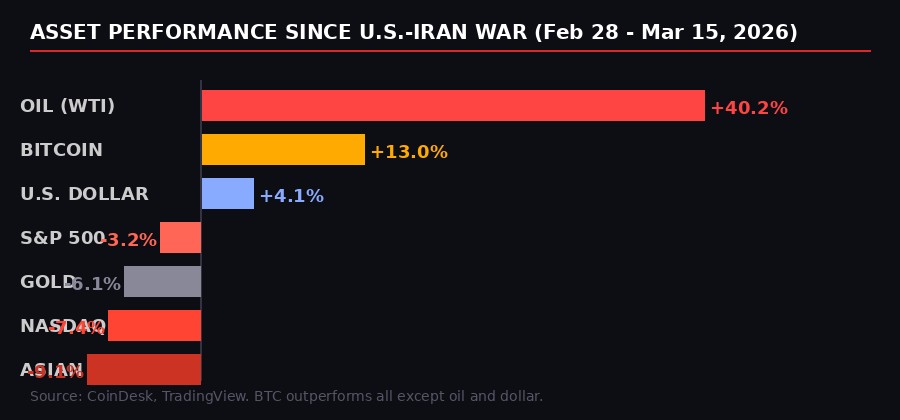
Asset performance since the U.S.-Iran war began February 28, 2026. Bitcoin +13%, outperforming equities and gold. Only oil and the dollar beat it. (Source: BLACKWIRE analysis)
The Timeline
What Happens Next
Three threads determine where markets go from here, and they're all converging in the same week.
First: the Iran conflict. Trump's conditional threat - "I'll spare oil infrastructure for reasons of decency, but I'll immediately reconsider if Iran keeps blocking the Strait of Hormuz" - is an extremely unstable equilibrium. Iran's stated response is that any strike on energy infrastructure triggers retaliation against U.S.-linked facilities. Both sides have drawn lines that leave almost no room for de-escalation without someone backing down publicly. If the Strait of Hormuz closes fully, WTI could move well above $100, inflation expectations spike globally, and bitcoin faces its first test of whether the higher-lows pattern holds against a genuinely catastrophic macro shock.
Second: the Fed meeting. Powell has never liked being forced by external events - tariffs, wars, supply shocks - to deviate from his stated framework. A hold with hawkish language on March 18 would confirm the Fed isn't going to cut into oil-driven inflation. Markets have mostly priced this. But surprise cuts - or surprise hawkishness beyond what's priced - could move bitcoin 10% in either direction within hours. The ETF inflow story depends heavily on institutional confidence that the Fed isn't about to tighten hard.
Third: the tokenization story. The Nasdaq-Kraken and ICE-OKX deals are not going live next week. But the direction they establish - the largest traditional exchange operators formally committing to blockchain rails - reshapes how every institutional allocator thinks about crypto infrastructure exposure. If equities go onchain, the addressable market for crypto exchanges, blockchain infrastructure, and digital asset custodians expands by orders of magnitude. That's a multi-year repricing of every infrastructure play in the space.
Bitcoin at $71,000 is not bitcoin at its October all-time high. The leverage is gone. The retail frenzy is gone. The fear and greed index sits in "extreme fear" even as the price rises. That's an unusual combination: a price that keeps climbing while sentiment stays deeply negative. In tradfi, that's called a "wall of worry" - a bull market that climbs against persistent skepticism because the buyers are institutional and patient rather than retail and momentum-driven.
The $126 trillion bet Nasdaq and ICE just made tells you what Wall Street actually thinks about where this goes. They're not investing hundreds of millions in blockchain infrastructure because they think it's a fad. They're doing it because 24/7 global trading with programmable settlement and fractional ownership is strictly better than the legacy system - and they want to own the rails when it flips.
Bitcoin broke its tech-stock correlation this week. Nasdaq decided to bring its stocks to bitcoin's world. The SEC and CFTC stopped fighting each other. Three years of policy stagnation and market confusion may be giving way to an entirely different regime - one where the question isn't whether traditional finance adopts blockchain, but who controls the infrastructure when it does.
Get BLACKWIRE reports first.
Breaking news, investigations, and analysis - straight to your phone.
Join @blackwirenews on Telegram