Bitcoin Hits $75,000 Then Retreats - Strategy Bought $1.57B Anyway
The derivatives-fueled short squeeze pushed Bitcoin to a six-week high before sellers stepped back in. Meanwhile the institutional accumulation machine logged another $1.57 billion purchase, ETF inflows hit $767 million for the week, and the Federal Reserve's rate decision lands in 48 hours. Here's every number that matters.

The $75K Flash: What Actually Happened
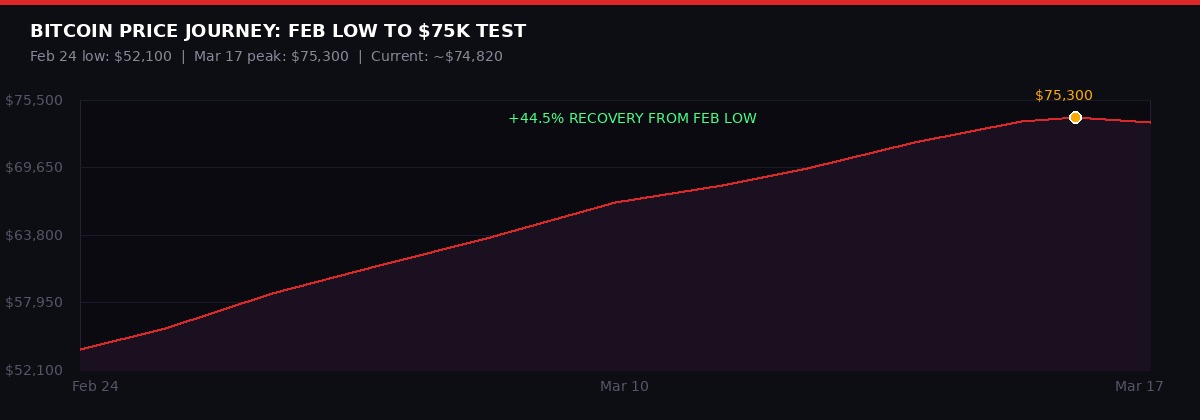
Bitcoin hit $75,300 in the early hours of March 17 UTC. It held there for less than an hour. By 4:52 AM UTC it was back below the key psychological level, with CoinDesk reporting the rally as "derivatives-led" and already unraveling. The correction was immediate and sharp.
This wasn't a demand-driven breakout. The move was a short squeeze - traders who had bet against Bitcoin got liquidated as the price spiked, feeding more buying, until there was no more fuel. The moment short liquidations dried up, sellers reasserted themselves and the price snapped back like a rubber band. Classic derivatives overshoot.
The setup had been building since late February. Bitcoin had bottomed around $52,100 during the worst of the oil shock and Iran war panic that gripped markets. From that low, the recovery to $75,300 represents a 44.5% move in under three weeks. (CoinDesk, March 17, 2026)
Bitcoin - Key Levels
The critical question now: does this become a double-top failure at $75K, or does the market consolidate and attempt a clean break with real spot demand? The derivatives funding rates will tell that story over the next 24-48 hours. Elevated funding with a stalled price is a red flag. Normalizing funding while price holds near $75K is a green light.
Adding to the complexity is the Federal Reserve meeting scheduled for Wednesday, March 18. Markets will not make a decisive commitment in either direction until the Fed speaks. Every major rally attempt at this level for the past three months has stalled ahead of a Fed catalyst.
Strategy's Machine Never Stopped: 761,068 Bitcoin
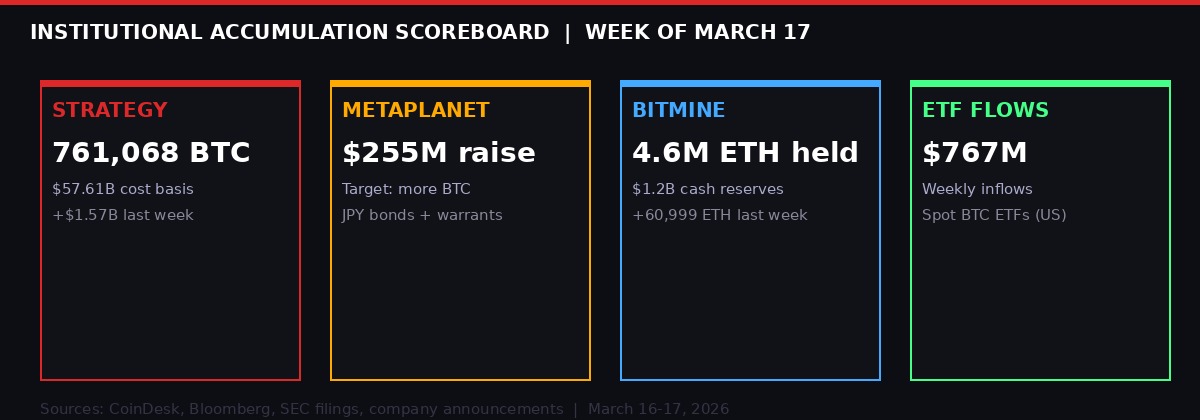
While retail traders argued about $75K being a ceiling or a floor, Michael Saylor's Strategy logged another purchase. The company added $1.57 billion worth of Bitcoin last week, bringing its total stack to 761,068 BTC acquired at an average cost of $75,706 per coin - a total outlay of $57.61 billion. (CoinDesk, March 16, 2026)
Let that number sit. Strategy has spent $57.61 billion buying Bitcoin. That is not a bet. That is a structural position large enough to affect market dynamics every single week. The company's cost basis now sits at $75,706 - meaning at current prices near $74,820, Strategy is technically underwater on a mark-to-market basis by roughly $0.9 billion. That has not slowed the buying by a single satoshi.
"The wildest thing about my $1 million prediction is that it's not wild at all." - Matt Hougan, CIO of Bitwise Asset Management, March 16, 2026
Saylor's strategy - deliberately lowercase - is simple. He raises capital through convertible notes and at-the-money equity offerings, converts those proceeds into Bitcoin, and holds indefinitely. The mechanism creates a flywheel: Bitcoin appreciation lifts the stock price, enabling more capital raises at better terms, enabling more Bitcoin purchases. The machine feeds itself.
The only question is whether the flywheel survives a prolonged drawdown. At $57.61 billion in cost basis, a sustained price collapse below $50,000 would create impairment charges that could undermine the financing model. The strategy has survived every bear cycle so far. But the position size is now in territory where the failure mode - if it came - would be systemic rather than corporate.
Key stat: Bitwise CIO Matt Hougan noted on March 16 that institutional investors displayed "diamond hands" behavior during the 50% plunge from late 2025 highs, a departure from historical patterns where institutions often led sell-offs. This cycle, institutions held - and in many cases kept buying - through the drawdown.
Bitmine Goes All-In on Ethereum: 4.6 Million ETH
Strategy has its imitators, and the most aggressive Ethereum version is Bitmine. The company disclosed on March 16 that it now holds nearly 4.6 million ETH after purchasing an additional 60,999 ETH last week. It maintains a $1.2 billion cash reserve despite the aggressive accumulation pace. (CoinDesk, March 16, 2026)
Tom Lee, Fundstrat's co-founder and one of the more reliable macro-crypto bridges on Wall Street, publicly endorsed the Ethereum accumulation thesis during the current Iran war environment, arguing that crypto's outperformance during geopolitical stress reflects a genuine shift in how global capital thinks about digital assets as a hedge.
Ethereum's weekly performance is notable: ETH surged 13% over seven days, outperforming Bitcoin's weekly gains. The gap suggests a rotation into altcoins as Bitcoin approaches resistance - a pattern familiar from the 2021 and late-2024 cycles where Bitcoin dominance peaked before altcoins ran.
Bitmine's 4.6 million ETH position at current prices of approximately $2,180 represents a mark-to-market value of roughly $10 billion. The Ethereum Foundation is simultaneously generating controversy by publishing a new mandate document that critics say signals the Foundation intends to take a "backseat" during a critical period of institutional interest. That internal tension is a risk factor for Bitmine's thesis if it creates governance uncertainty at the protocol level.
$767 Million in ETF Inflows: The Infrastructure Play
Spot Bitcoin ETFs in the United States absorbed $767 million in net inflows during the week ending March 14-16, according to CoinDesk reporting. That is a significant figure during a week that also saw the market push toward multi-week highs - suggesting institutional buyers were adding exposure on the way up rather than trimming.
ETF inflows are a clean signal precisely because they represent money that has cleared compliance processes, obtained board approvals, and committed to a settled custodial structure. These are not retail punters buying on Coinbase. Every dollar in ETF inflows is a dollar that went through a compliance function at a pension fund, family office, or registered investment advisor. The $767 million figure for a single week represents structural demand - not speculation.
Bernstein research flagged this week that their analysis of Bitcoin's recent market behavior shows an "institutional ownership shift" is underway. The traditional dynamic where institutional traders offload during stress and retail holds is reversing. Institutions are now the HODLers. Retail is increasingly the noise. (CoinDesk, March 16, 2026)
Crypto Market Snapshot - Week Ending March 17
Metaplanet, the Japanese Bitcoin treasury company, raised $255 million through a structure combining premium-priced shares and warrants, with the financing designed to unlock up to $531 million total if warrants are exercised. They are building the Japanese-market version of Strategy's model, using yen-denominated financing in a country where institutional Bitcoin adoption is accelerating against a backdrop of persistent yen weakness.
The T. Rowe Price move is the most eyebrow-raising development in the ETF space this week. The $1.8 trillion asset manager amended its SEC filing to include not just Bitcoin and Ethereum in its proposed crypto ETF - but dogecoin and shiba inu. Institutional money reaching for meme coins is either a sign of market maturity or a sign of exactly the kind of late-cycle excess that has historically preceded corrections. The filing also detailed custody arrangements and potential staking plans for the actively managed structure. (CoinDesk, March 16, 2026)
XRP Flips BNB - But the Story Is in the Derivatives
XRP broke through $1.50 resistance on a 125% volume spike, pushing its market cap to $93.4 billion and displacing BNB as the fourth-largest cryptocurrency by market capitalization. The move was driven by futures positioning: Binance's XRP futures open interest has climbed 59% since October's lows even as the token's price remains 58% below its all-time high. (CoinDesk, March 17, 2026)
The XRP rally exists in the context of the SEC's dramatically changed posture toward crypto under the current administration. The dropped Ripple lawsuit earlier this year removed the legal overhang that had capped XRP's price for years. Retail and institutional investors are now pricing in a world where XRP can pursue its cross-border payments use case without existential regulatory risk.
The 125% volume spike on the $1.50 breakout is meaningful. Volume spikes of that magnitude on breakouts tend to attract algorithmic momentum buyers, which can amplify moves significantly in the short term. The sustainability depends on whether real utility-based demand follows. XRP's payments narrative requires actual bank integrations and transaction volume growth - not just speculative positioning in futures markets.
The DOJ's Crypto Cop Problem
While markets run, a regulatory scandal is simmering in Washington. US Senators are publicly slamming the Department of Justice over the shutdown of its National Cryptocurrency Enforcement Team - the unit specifically built to prosecute crypto-related crime. The criticism centers on a conflict of interest allegation: the DOJ officials who ordered the shutdown hold personal cryptocurrency positions. (Cryptonews, March 2026)
The NCET was established in 2022 following a series of high-profile crypto fraud cases. It handled prosecutions including aspects of the FTX collapse, ransomware cases, and sanctions evasion involving crypto. Its shutdown leaves a significant enforcement gap at precisely the moment crypto has re-entered mainstream financial markets with billions in institutional capital.
The conflict-of-interest framing is politically explosive. If DOJ leadership holds crypto positions and then guts the enforcement unit, the optics are catastrophic regardless of the actual decision-making process. Senators including some on the Senate Banking Committee have called for disclosures of personal holdings from officials involved in the shutdown decision.
The implication for markets: Reduced enforcement creates two contradictory pressures. On one hand, the short-term reflex is bullish - less regulatory heat, more freedom for operators. On the other hand, the absence of credible enforcement enables bad actors to run scams that destroy retail investor confidence when they inevitably blow up. The 2022 cycle collapse was accelerated by fraud (FTX, Three Arrows, Celsius). Enforcement is a long-term health necessity even when it feels restrictive in the short term.
The senators' pressure may or may not result in the unit's reinstatement. The current administration has signaled a crypto-friendly posture across multiple agencies. But "crypto-friendly" has a spectrum - it can mean removing barriers for legitimate operators or it can mean removing accountability for bad actors. The DOJ shutdown leans toward the latter interpretation and has drawn criticism even from some pro-crypto policymakers.
New York prosecutors are moving in the opposite direction simultaneously, pushing to criminalize unlicensed crypto operations at the state level. The regulatory patchwork between a permissive federal environment and aggressive state-level enforcement creates compliance uncertainty that institutional players - the same ones putting $767 million a week into ETFs - find costly and confusing.
Fed Decision Wednesday: What Crypto Needs to Hear
The Federal Reserve's rate decision on Wednesday March 18 is the single most important event for crypto markets in the next week. Bitcoin has demonstrated a clear correlation with risk-asset sentiment around Fed communications - rate cuts or dovish signals pump risk appetite, hawkish signals drain it.
The current market consensus: no cut this week. The Fed has kept rates elevated as core inflation remains sticky even as growth indicators soften under the impact of tariff uncertainty and the Iran war oil shock. The last thing Powell wants is to cut rates while oil is elevated - that's a stagflationary nightmare and the Fed's greatest fear.
What matters is the forward guidance language. Three scenarios:
Dovish pivot signals: If Powell's language shifts toward rate cuts being "appropriate in coming months" or similar language, crypto will rip. Bitcoin has historically responded within hours to dovish Fed language. $80,000 becomes a realistic target within the week.
Neutral hold language: "We remain data-dependent, will assess at future meetings." This is the base case and is largely priced in. Bitcoin holds the $70,000-$76,000 range. No decisive move in either direction.
Hawkish surprise: If inflation data has forced the Fed to flag rate hike possibilities or extend the holding period, Bitcoin tests the $68,000-$70,000 range. ETF inflows slow. The derivatives-funded rally of the past 10 days partially unwinds.
The macro backdrop adds layers. US-China trade talks resumed in Paris last week. A trade deal framework - even a partial one - would remove one of the major uncertainty overhangs on global growth. Oil prices have pulled back slightly from the $108+ highs reached when Iran war fears peaked. Each de-escalation signal reduces the stagflation risk premium that has been suppressing risk appetite since February.
Fed Decision Scenarios - Bitcoin Impact
Circle's 100% Rally and the Stablecoin Regulation Race
The most overlooked story in crypto markets this week is Circle. The USDC issuer has rallied 100% in a month as a publicly traded entity, driven by three converging forces: growing demand for USDC in institutional DeFi, a higher interest-rate environment that makes stablecoin reserves profitable, and the rapid expansion of tokenized real-world assets that require stablecoin infrastructure. (CoinDesk, March 16, 2026)
Bank of America CEO Brian Moynihan delivered perhaps the most remarkable statement in traditional finance's engagement with crypto this week: he warned that $6 trillion in bank deposits could flow into stablecoins. That is not a warning framed with alarm - it is framed as a business reality that banks must prepare for. (Cryptonews, March 2026)
The $6 trillion figure puts stablecoin adoption in perspective. Total global stablecoin supply is currently around $200 billion. If 10% of Moynihan's $6 trillion figure materialized, that would be a 3x increase in stablecoin supply. If 50% materialized, it would be 15x. The banking system is beginning to treat stablecoin migration not as a fringe event but as a baseline scenario they need to hedge against.
Barclays made its first stablecoin investment this week - taking a stake in Ubyx, a stablecoin infrastructure company. Barclays becoming a stablecoin investor is a signal that even conservative European banking institutions see the space as something they cannot afford to ignore.
The Senate stablecoin bill is in trouble though. Coinbase has threatened to pull its backing for the current draft, citing provisions it says would benefit large banks at the expense of crypto-native issuers. The bill's path to passage is uncertain, and the Coinbase opposition adds to the complexity. Passage of a stablecoin framework would be a major catalyst for Circle's business. Failure or delay limits the regulatory clarity that makes institutional adoption easier to justify. (Cryptonews, March 2026)
OpenSea Delays Token: The NFT Market's Unfinished Business
OpenSea delayed its highly anticipated token launch on March 16, citing "challenging crypto market conditions." The platform offered optional fee refunds for certain traders and announced 0% token trading fees for 60 days starting March 31 as a pacifier. (CoinDesk, March 16, 2026)
The delay is a candid admission that NFT market sentiment has not recovered sufficiently to support a successful token launch. The 2021-2022 NFT boom generated billions in trading volume at OpenSea. The subsequent collapse has left the platform as a shadow of its peak - still the dominant NFT marketplace, but operating in a dramatically contracted market.
The token was supposed to be a catalyst for re-engagement. The delay means the catalyst gets pushed out to a later date when presumably the broader market will have established a firmer floor. Whether that floor has been established at $74,000 Bitcoin or requires another cycle remains the open question.
For context: during the 2021 bull market, top NFT collections like Bored Apes traded above $200,000 per unit. Current floor prices are in the $20,000-$30,000 range, a 85-90% decline from peak. A genuine NFT recovery requires not just higher crypto prices but renewed cultural and commercial interest in NFTs as a category - something that has been harder to sustain than simple price appreciation.
What Happens Next: The 48-Hour Setup
The next 48 hours are binary for Bitcoin. The market goes into the Fed decision with a technically fragile setup - a failed breakout at $75,300 that needs either a catalyst to re-test and clear resistance, or risks sliding back toward $68,000-$70,000 support.
The structural bid is enormous. $767 million in weekly ETF inflows. Strategy adding $1.57 billion. Metaplanet raising $255 million. These are not things that reverse because Bitcoin failed a breakout by a few hundred dollars. The institutional bid is there. The question is timing.
If the Fed delivers neutral language and oil holds its recent decline toward $90-$95 per barrel, the path of least resistance is sideways-to-up consolidation in the $72,000-$76,000 range heading into April. Historical patterns from 2024 and 2021 suggest that post-halving cycles maintain structural upward bias even through multi-month consolidation phases.
The wild card is geopolitical. The Iran war situation has been the dominant macro overlay for crypto since February. Every de-escalation signal has correlated with crypto rallies. Every escalation signal has reversed them. The Strait of Hormuz threat to oil supply is the chain reaction that connects crypto to global macro in a way that was not true in previous cycles. If a ceasefire framework emerges, the oil shock premium in inflation expectations deflates, the Fed gets room to pivot, and crypto gets its next leg up. If escalation resumes, expect another leg down regardless of how much Strategy buys.
The machines are still buying. The institutions have diamond hands. The ETF flows are structural. But even structural bids cannot override macro reality if the macro turns ugly again. Watch Wednesday. Watch the Strait.
Get BLACKWIRE reports first.
Breaking news, investigations, and analysis - straight to your phone.
Join @blackwirenews on Telegram