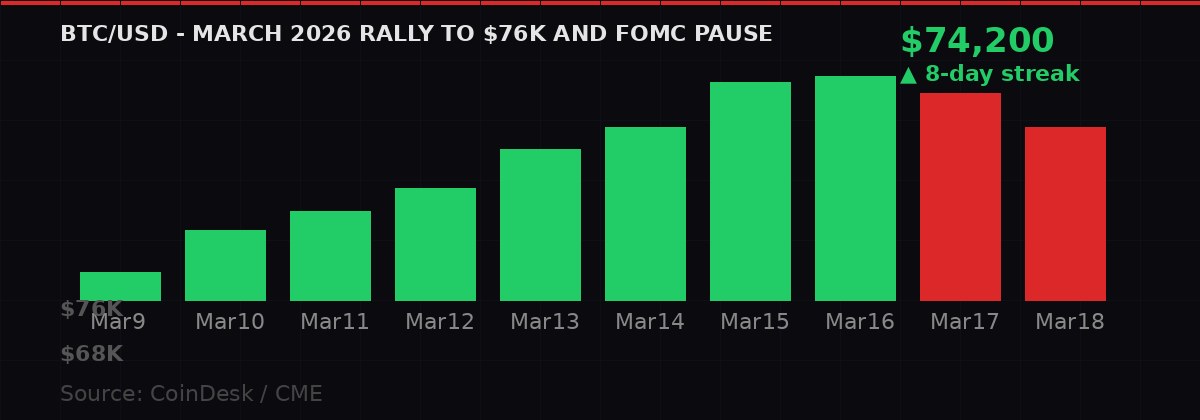
Five major stories are breaking simultaneously on March 18, 2026. Bitcoin stands at $74,200 with the most important Fed meeting of the year about to drop. North Korea's most prolific hacking operation just confirmed a new breach of a major crypto payment platform. America's securities regulator finally told the industry what the rules are. A payments giant just placed a $1.8 billion bet that stablecoins are the future. And Michael Saylor's Strategy is now sitting on 761,068 BTC with annual dividend obligations north of $1 billion.
This is not a slow news day. This is everything moving at once. Let's go through it.
Bitcoin at $74K: Eight Days Up, Fed Day Looming
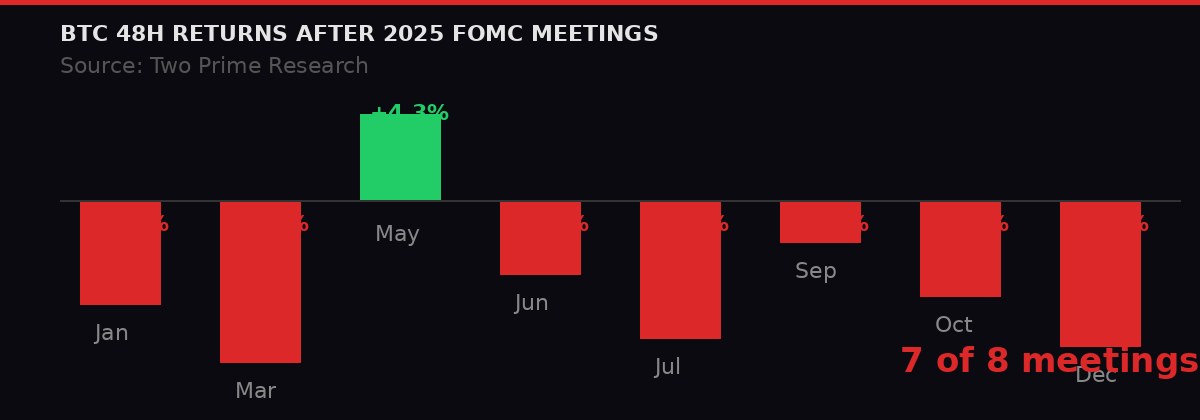
BTC posted negative returns in 48 hours following 7 of 8 FOMC meetings in 2025. Source: Two Prime Research
Bitcoin just completed an 8-day winning streak that took it from roughly $68,000 to a peak of $76,000 on Tuesday. As of midday Wednesday March 18, it has pulled back to $74,200. Trading volume is down 33% from Tuesday's peak. The momentum looks tired, and history says that is not a coincidence - it is a pattern.
Research compiled by bitcoin lender Two Prime looked at every FOMC meeting in 2025. Bitcoin posted negative returns in the 48 hours following 7 of those 8 meetings. The one exception was May 2025, where BTC rallied strongly - but that was an outlier against a dominant trend. The event itself drives the volatility, not the outcome.
"Bitcoin heads into the March FOMC meeting with strong momentum - however, data suggests this strength may mask a recurring pattern. FOMC meetings have historically acted as short-term bearish catalysts for BTC." - Two Prime Research
This time the outcome is not seriously in question. CME FedWatch puts the probability of a hold at around 99%. The Fed funds rate stays in the 3.50%-3.75% range. What matters is what Jerome Powell says in his press conference - any hint of fewer cuts ahead, any hawkish commentary about oil prices or inflation persistence, and traders will sell first and ask questions later.
The macro context makes the risk asymmetric to the downside. Oil is hovering near $100 a barrel. Middle East tensions remain elevated. February's jobs report showed the U.S. lost 92,000 jobs and unemployment rose to 4.2% - a deteriorating picture that normally would push the Fed toward cuts. But with inflation remaining sticky, the Fed is stuck. One cut priced in for all of 2026. That is not the environment where bitcoin rockets past $80,000.
Derivatives markets are confirming the caution. Funding rates across major tokens are slightly negative - traders are leaning short or hedged going into the announcement. Open interest has stalled. The altcoin season index hit a six-month high, which is interesting and worth watching. ZEC and MORPHO outperformed Tuesday. But none of that matters much if BTC breaks lower on the Fed print.
FOMC Day Checklist - What Moves BTC
Kevin Warsh is set to take over as Fed Chair in June. Warsh is viewed as more hawkish than Powell on balance - and some Bitcoin analysts have flagged him as a bearish variable for crypto if he leads the Fed toward tighter policy. That transition is months away, but it hangs over the medium-term rate outlook.
The short play is a "sell the news" pop immediately after the FOMC announcement, a brief relief rally, then a reversal lower over the next 24-48 hours matching the historical pattern. The bull case needs Powell to explicitly signal inflation is cooling faster than expected and more cuts are possible. That would be a genuine surprise. The market is not pricing it.
North Korea Hacked Bitrefill: Lazarus Group Claims Another Victim
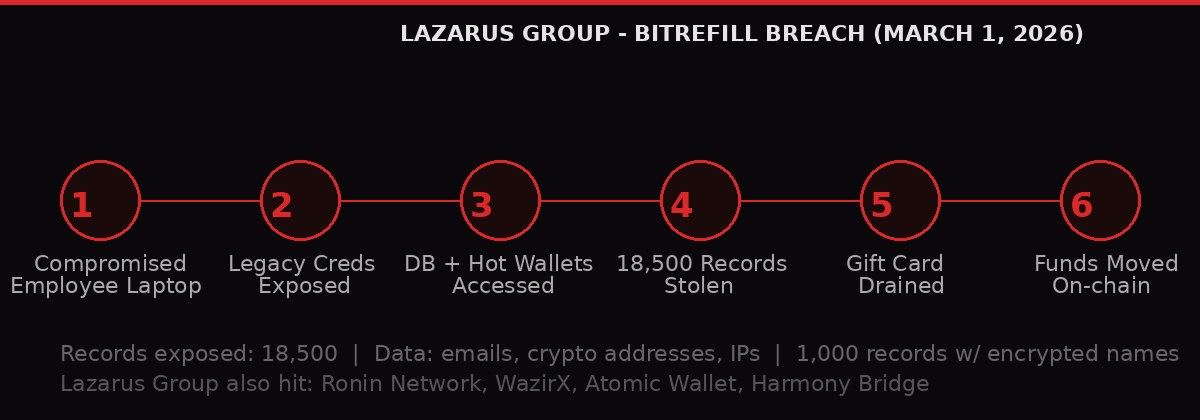
How the Lazarus Group compromised Bitrefill on March 1, 2026 - from employee laptop to hot wallet drain. Source: Bitrefill disclosure
On March 1, 2026, North Korea's Lazarus Group - also tracked as Bluenoroff - successfully compromised Bitrefill, the crypto payment and gift card platform. The attack remained undisclosed for 17 days. Bitrefill went public on March 18, confirming the breach in a detailed report posted to X.
The entry point was an employee laptop. Compromised credentials from that machine gave the attackers access to legacy systems, which then provided a path into Bitrefill's production infrastructure. Hot wallets were drained. Database access exposed 18,500 purchase records containing email addresses, cryptocurrency payment addresses, and IP address metadata. Approximately 1,000 of those records included encrypted usernames tied to specific product purchases.
"The modus operandi - including malware, on-chain tracing, and reused IP and email addresses - was consistent with previous attacks attributed to North Korea's Lazarus Group." - Bitrefill statement, March 18, 2026
Bitrefill says customer data was not the primary target. Log analysis suggests the attackers were running queries focused on cryptocurrency holdings and gift card inventory - not extracting the full database. They wanted the money and the product, not the customer list. The customer data exposure appears to be collateral damage from the infrastructure access the attackers needed to move funds.
This is Lazarus Group's playbook, executed to near-perfection. The group has successfully hit Ronin Network (over $600 million in 2022), Harmony's Horizon Bridge ($100 million), WazirX ($235 million in 2024), and Atomic Wallet. The U.S. Treasury sanctioned Lazarus and associated addresses in a landmark $800 million crypto sanctions package announced earlier in March 2026.
Bitrefill says it will cover losses from operational capital. The company is profitable and has been operating for over a decade without a major breach. Systems are back online. Affected customers were notified by email. The company is working with external security researchers, on-chain analysts, and law enforcement.
The security response checklist Bitrefill outlined is worth noting. Comprehensive external penetration testing. Tightened internal access controls. Enhanced logging and monitoring. Refined incident response procedures with automated shutdown protocols. Standard post-breach hardening - but the fact that a decade of operation preceded this event shows even mature, profitable crypto companies are not immune to nation-state level attacks.
Lazarus Group - Known Crypto Victims (Partial)
Ronin Network ($620M, 2022) - Harmony Bridge ($100M, 2022) - Atomic Wallet ($100M, 2023) - WazirX ($235M, 2024) - Bitrefill (March 2026) - Total U.S. Treasury DPRK crypto sanctions: ~$800M (March 2026)
The timing matters. North Korea's state-sponsored hacking operations exist to fund the regime's nuclear and missile programs, bypassing sanctions through crypto conversion. The Treasury sanctioned multiple Lazarus-linked addresses earlier this month. This Bitrefill attack predates that announcement by weeks, suggesting it was executed while the sanctions pressure was building but before the latest crackdown landed. Lazarus does not slow down. They accelerate.
SEC Drops a Bomb: First-Ever Token Taxonomy Changes Everything
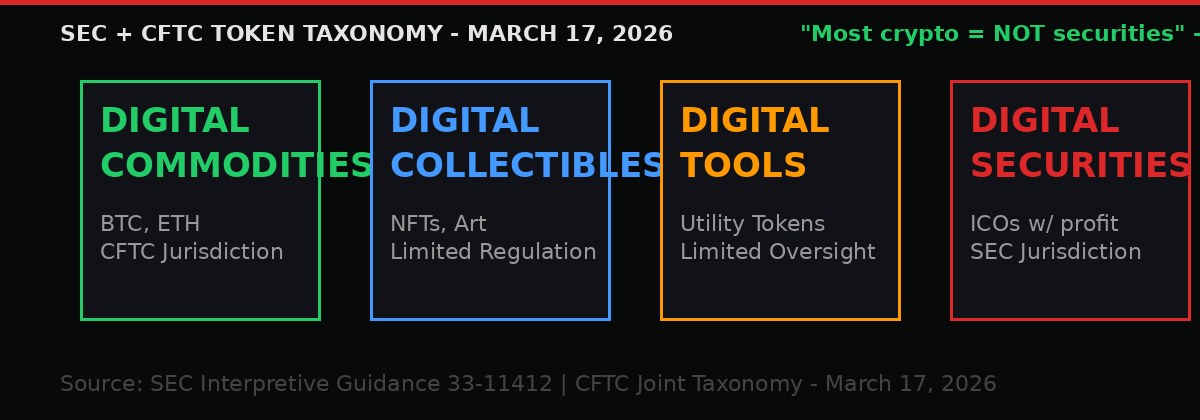
The SEC-CFTC joint taxonomy: four categories of crypto assets and which regulator governs each. Source: SEC Interpretive Guidance 33-11412, March 17, 2026
After more than a decade of regulatory limbo, the U.S. Securities and Exchange Commission and Commodity Futures Trading Commission jointly issued formal token classification guidance on March 17, 2026. This is not a rulemaking - it is interpretive guidance, which means it does not carry the weight of law. But it is the clearest official statement the crypto industry has ever received about where it stands.
SEC Chairman Paul Atkins, speaking at the Digital Chamber's DC Blockchain Summit in Washington, summarized the key conclusion bluntly:
"Most crypto assets are not themselves securities." - SEC Chairman Paul Atkins, March 17, 2026
That sentence represents a seismic shift from the Gary Gensler era. Gensler spent years arguing the opposite - that most tokens were unregistered securities, enforcement actions were the primary regulatory tool, and the industry had to come in and register. That approach resulted in hundreds of millions in fines, chilled innovation, and pushed significant crypto activity offshore. Atkins is reversing that posture explicitly.
The joint SEC-CFTC taxonomy classifies crypto assets into four categories. Digital Commodities - things like Bitcoin and Ether that have decentralized networks and no central issuer making profit promises - fall under CFTC jurisdiction. Digital Collectibles, roughly covering NFTs and similar assets, get limited regulatory treatment. Digital Tools, which are utility tokens with functional use cases, get similarly limited oversight. Digital Securities - the only category that remains under SEC jurisdiction - are tokens issued by a company with explicit profit promises tied to management efforts.
The guidance also clarifies a crucial question: can a token that starts as a security become a non-security? The answer is yes. Once the issuer has fulfilled its promises - or definitively failed to - the investment contract relationship ends. Airdrops, protocol staking, and protocol mining are explicitly excluded from securities treatment. This gives existing projects a legal pathway out of the securities regime as they become more decentralized.
Atkins told reporters after the summit to "hold on to your seats," because the agency has dozens of additional proposals in the pipeline. A formal rulemaking - expected to be over 400 pages - will follow in the next week or two. That rulemaking will include Atkins' planned "innovation exemption" for crypto firms.
"We're not the securities and everything commission anymore." - Paul Atkins, SEC Chairman
The crypto industry's response was enthusiastic. That line at the Blockchain Summit drew applause. Years of legal uncertainty - which cost exchanges, DeFi protocols, and token issuers hundreds of millions in legal fees and regulatory penalties - are beginning to clear. The market impact was muted Wednesday because traders already partially priced this shift following Atkins' confirmation and early policy signals. But for long-term compliance planning across the industry, this guidance changes the calculus fundamentally.
The CFTC under Chairman Mike Selig co-signed the same taxonomy, emphasizing "harmonization" between the two agencies. The fact that both regulators published jointly, on the same day, from the same event, signals a coordinated policy posture not seen since the early days of financial regulation rulemaking. Previous SEC-CFTC coordination on crypto had been minimal to nonexistent under the Biden administration.
Mastercard's $1.8 Billion Stablecoin Bet: BVNK Acquisition and What It Means
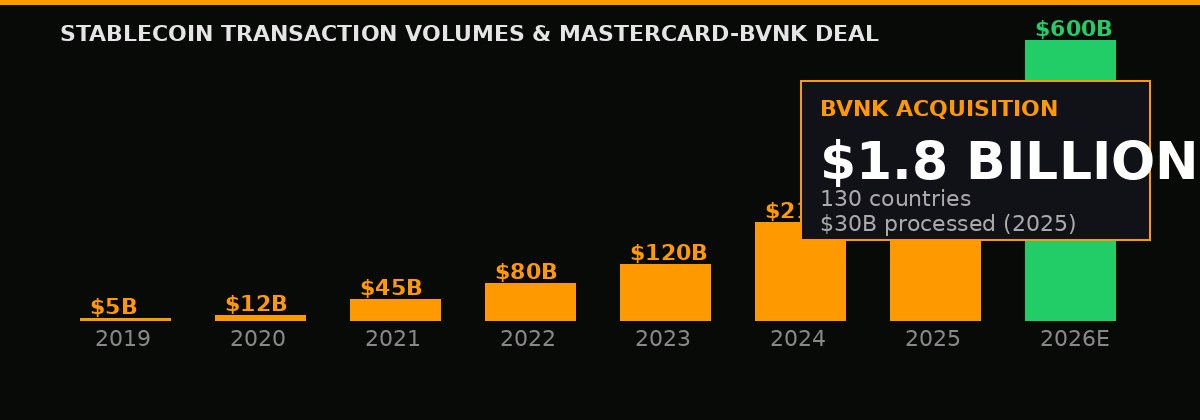
Stablecoin transaction volumes have grown from $5B in 2019 to $350B in 2025. Mastercard's BVNK acquisition positions it for the next wave. Source: CoinDesk / Visa-Allium data
Mastercard announced Tuesday it will acquire BVNK, a London-based stablecoin infrastructure firm, for $1.8 billion. The deal is the clearest signal yet that traditional payments giants are not waiting to see how the stablecoin era unfolds - they are buying their way into it.
BVNK processes stablecoin payments across more than 130 countries. Analyst estimates put the firm's 2025 stablecoin payment volume at over $30 billion. Revenue as of late 2024 was approximately $40 million - meaning the $1.8 billion price tag is a massive forward bet on growth, not a valuation based on current earnings. Mastercard is paying roughly 45x revenue for infrastructure it believes will underpin the next decade of global payments.
Wall Street analysts lined up behind the deal. Mizuho's Dan Dolev called it validation that "stablecoins are integral to the future of payments." TD Cowen analysts, with a Buy rating and $671 price target on Mastercard, wrote that BVNK "connects onchain payment rails with Mastercard's existing network." Cantor Fitzgerald framed it as positioning Mastercard for the "stablecoin adoption wave" driven by institutional demand for faster, cheaper cross-border settlement.
"Card networks are the most exposed payment rail to stablecoin disruption." - Harvey Li, Founder, Tokenization Insight
That framing is key. For most of the past five years, the conventional wisdom on stablecoins was that they would eventually bypass card networks entirely. Why pay 2% interchange fees when you can settle in minutes at near-zero cost on a blockchain? That thesis threatened Mastercard's entire business model. The company is now responding by owning the rails rather than defending against them.
The use cases BVNK enables are exactly where traditional payment systems fail. Business-to-business payments. Global payroll across emerging market jurisdictions. Remittances. Cross-border settlements that currently take two to five business days through SWIFT. BVNK enables 24/7 settlement and operates without reliance on correspondent banking intermediaries.
Jack Dorsey's payments firm - historically a Bitcoin maximalist operation - recently acknowledged customer demand for stablecoins and began reluctantly integrating them. If even the hardest of Bitcoin purists are giving in to stablecoin demand, the direction of travel for the global payments industry is clear. Mastercard just paid $1.8 billion to be at the front of that line.
Stablecoin transaction volume hit an estimated $350 billion annually in 2025. That figure is expected to climb sharply as regulatory clarity - like the SEC's guidance published Tuesday - removes friction for institutional adoption. The GENIUS Act working its way through Congress would further cement stablecoin legitimacy in U.S. law.
Strategy Holds 761,068 BTC - And the Funding Machine Is Changing
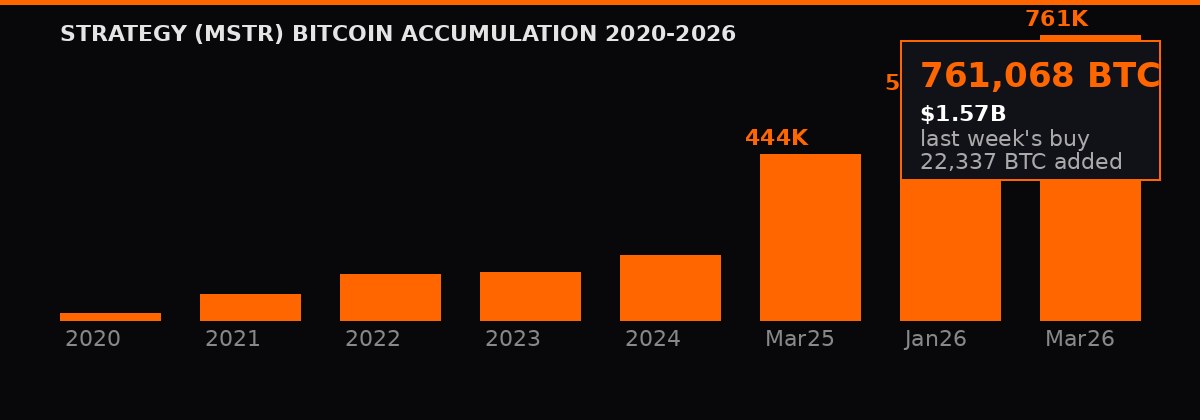
Strategy's Bitcoin holdings grew from 21,000 BTC in 2020 to 761,068 BTC by March 2026. The funding model is shifting from common stock to perpetual preferred. Source: Strategy SEC filings
Michael Saylor's Strategy (MSTR) disclosed Monday that it purchased 22,337 BTC last week - its fifth-largest single-week acquisition on record - at an average price of roughly $70,000 per coin. Total holdings now stand at 761,068 BTC. At current market prices, that position is worth approximately $56.5 billion.
The funding mechanism behind this latest buy is the story. For the first time, Strategy used its STRC perpetual preferred stock as the primary vehicle, raising $1.18 billion through STRC issuance. Common stock ATM sales accounted for only $396 million. This is a meaningful shift. Common stock dilution has been the primary tool since 2020. With MSTR shares down over 70% from peak, the company is incentivized to avoid further common share dilution while the stock price remains depressed.
The STRC preferred stock carries an 11.5% dividend rate. The $1.18 billion issuance implies roughly $135 million in annual dividend obligations from this tranche alone. Strategy's total annual dividend burden has now crossed $1 billion. The company has approximately $2.25 billion in USD reserves earmarked to service those obligations.
Strategy (MSTR) - Key Metrics March 2026
The STRC preferred has shown signs of pricing pressure since March 15. Three consecutive days trading below $100 par value. With the one-month volume-weighted average price also below par, Strategy may need to increase the STRC dividend again - potentially another 25 basis points - to support preferred share prices. That would add another ~$30 million in annual obligations per billion raised.
The math is getting complicated. Strategy is running an asymmetric bet: if Bitcoin continues rising, the gains on 761,068 BTC massively outweigh the dividend burden. If Bitcoin falls significantly - say back toward $50,000 or below - the dividend obligations remain fixed while the collateral value collapses. The company's common stock is already down 70%. A sustained BTC drawdown would stress the preferred structure in ways that have not yet been tested.
Saylor's stated goal is 1 million BTC by end of 2026. At current pace - roughly 100,000+ BTC per quarter - that target is mathematically achievable. Whether the capital markets continue to support preferred issuance at this scale, with yields already over 11%, is the open question. The machine keeps running as long as investors buy the preferred. The day it stops buying is the day the game changes.
Kalshi Gets Hit With 20 Criminal Counts in Arizona
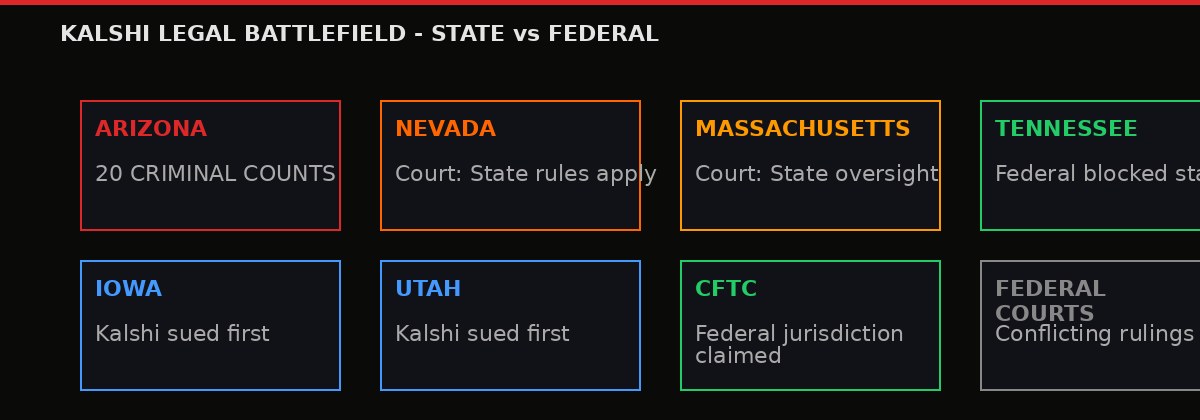
Kalshi faces a patchwork of state legal challenges while the CFTC claims federal jurisdiction. Arizona just escalated with 20 criminal counts. Source: Arizona AG office, court records
Arizona Attorney General Kris Mayes filed 20 criminal counts against Kalshi on March 17, 2026. The charges: operating an unlicensed gambling business, and accepting bets on elections in violation of Arizona law. The targets are KalshiEx LLC and Kalshi Trading LLC.
The contracts in question include bets on the outcome of the 2028 presidential race and the 2026 Arizona gubernatorial race. Arizona law prohibits unlicensed wagering businesses. It also separately bans betting on elections outright - there is no licensing pathway around that prohibition.
"Kalshi may brand itself as a 'prediction market,' but what it's actually doing is running an illegal gambling operation and taking bets on Arizona elections." - Arizona AG Kris Mayes
This escalation comes days after the CFTC issued guidance asserting federal jurisdiction over prediction markets and framing platforms like Kalshi as regulated derivatives venues rather than gambling operators. The CFTC's position directly conflicts with Arizona's. The federal agency says these are commodity futures contracts. Arizona says they are illegal bets. Both cannot be right, and the courts will eventually resolve it.
Kalshi's legal strategy has been aggressive. The company sued Arizona on March 12 - before the AG filed charges. It has also sued Iowa and Utah in recent weeks, using federal courts to preemptively challenge state enforcement. The company argues it operates under exclusive CFTC jurisdiction and state gaming laws do not apply.
"Sadly, a state can file criminal charges on paper thin arguments. States like Arizona want to individually regulate a nationwide financial exchange - and are trying every trick in the book to do it." - Kalshi spokesperson
The court record is mixed. A federal judge in Nevada ruled last year that Kalshi's sports contracts are subject to state gaming regulators. Massachusetts similarly found state oversight might apply to sports contracts. But a federal judge in Tennessee blocked state regulators from enforcing a cease-and-desist earlier this year. Three different courts, three different answers.
The Arizona charges are the most serious escalation yet. Criminal counts against a federally-regulated derivatives exchange are legally unusual territory. If Arizona's criminal charges survive federal preemption arguments - which Kalshi will raise immediately - the implications for every prediction market operating in the United States are significant. This is no longer just a regulatory debate. It is a criminal prosecution.
The Bigger Picture: Everything Happening at Once
Step back from the individual stories and a pattern emerges. The United States crypto regulatory framework is being rebuilt in real time. The SEC and CFTC published their first joint token taxonomy. The GENIUS Act on stablecoins is advancing in Congress. CFTC Chairman Selig is creating space for prediction markets at the federal level. The SEC's Atkins is signaling an innovation exemption for crypto firms. This is not incremental change - it is structural transformation of the regulatory landscape.
At the same time, the threat environment is not improving. Lazarus Group hit Bitrefill the same week North Korea was sanctioned for $800 million in crypto-linked activity. They do not slow down. Every major exchange, payment platform, and DeFi protocol is a target. The March 1 Bitrefill breach sat undisclosed for 17 days - long enough for the attackers to convert funds through multiple hops. On-chain tracking firms were watching. But the funds moved fast.
Strategy's $56 billion BTC position and Mastercard's $1.8 billion stablecoin bet tell the same story from different angles: institutional capital has committed to this asset class. Not tentatively, not with pilot programs, but with hundreds of billions at stake. The experiment-phase argument for Bitcoin died somewhere between $50,000 and $74,000.
Today's FOMC decision is the immediate binary. Powell hawks out on oil and inflation, BTC sells off and retests $68,000-$70,000. Powell acknowledges weakening growth and keeps cuts on the table, BTC holds and consolidates above $72,000. Either way, the macro ceiling on crypto remains: rates at 3.5%, oil at $100, and geopolitical instability still filtering through CPI. The conditions for a genuine breakout to $90,000+ require either a rate cut surprise or a major macro shock that sends capital fleeing to alternative stores of value.
The week ahead depends on two variables: what Powell says today, and whether BTC can hold $72,000 in the post-FOMC 48-hour window. If it holds, the next leg higher has real legs with institutional accumulation continuing at this pace. If it does not hold, look for a flush to $68,000-$70,000 before the next buyer emerges. The Lazarus breach will drive security audits across the industry. The SEC taxonomy will drive legal restructuring at dozens of token projects. The Mastercard deal will drive stablecoin M&A activity from competing card networks.
We are not in a quiet period. Every system - regulatory, security, monetary, payments infrastructure - is being stress-tested simultaneously. The survivors will look very different from the companies that entered 2026. The ones who do not survive will be the ones who treated "crypto winter is over" as an excuse to stop being careful.
What to Watch Next
The FOMC statement drops at 2:00 PM Eastern (8:00 PM Berlin). Powell's press conference follows at 2:30 PM. Watch for: any language about oil and inflation being "transitory" vs "persistent." Watch for: any hint that the single 25bps cut priced for 2026 might be adjusted. Watch for: Powell's response to questions about a weakening labor market vs elevated CPI. That tension is the market's core puzzle right now.
On Bitrefill: affected users should assume their email, crypto payment address, and IP are in circulation on dark web markets. The breach is 17 days old. Security hygiene steps - new crypto addresses for any ongoing transactions, vigilance about phishing emails referencing Bitrefill, and IP-linked activity monitoring - apply immediately.
On the SEC taxonomy: legal teams at every major token project will be working through the guidance this week to determine which category they fall into and whether the investment contract analysis requires restructuring their token's relationship to investors. The 400-page formal rulemaking expected in the next two weeks will provide more specifics on the innovation exemption Atkins has flagged.
On Mastercard-BVNK: watch for responses from Visa, PayPal, and Stripe. The $1.8 billion acquisition price will force every major payments network to answer the same question Mastercard just answered: own the stablecoin rails or be disrupted by them. Expect at least one competing acquisition announcement within 90 days.
On Kalshi: the Arizona criminal case will move to federal court quickly. Kalshi will argue preemption. The timeline to a ruling could be six to twelve months. In the interim, Kalshi continues operating. But the criminal exposure changes the calculus for executive team risk and investor appetite at the Series C level.
On Strategy: Saylor needs BTC to stay above $70,000 to keep the preferred stock narrative intact. A sustained break below that level forces uncomfortable conversations about the dividend buffer and whether STRC issuance at 11.5% remains viable at scale. Watch the STRC preferred price as a leading indicator of stress.
BLACKWIRE will have the Fed decision analysis as it breaks.
Get BLACKWIRE reports first.
Breaking news, investigations, and analysis - straight to your phone.
Join @blackwirenews on Telegram