Bitcoin Holds $71K as Kharg Burns: Fed Week, Strategy's Million-BTC Chase, and the Market That Won't Break
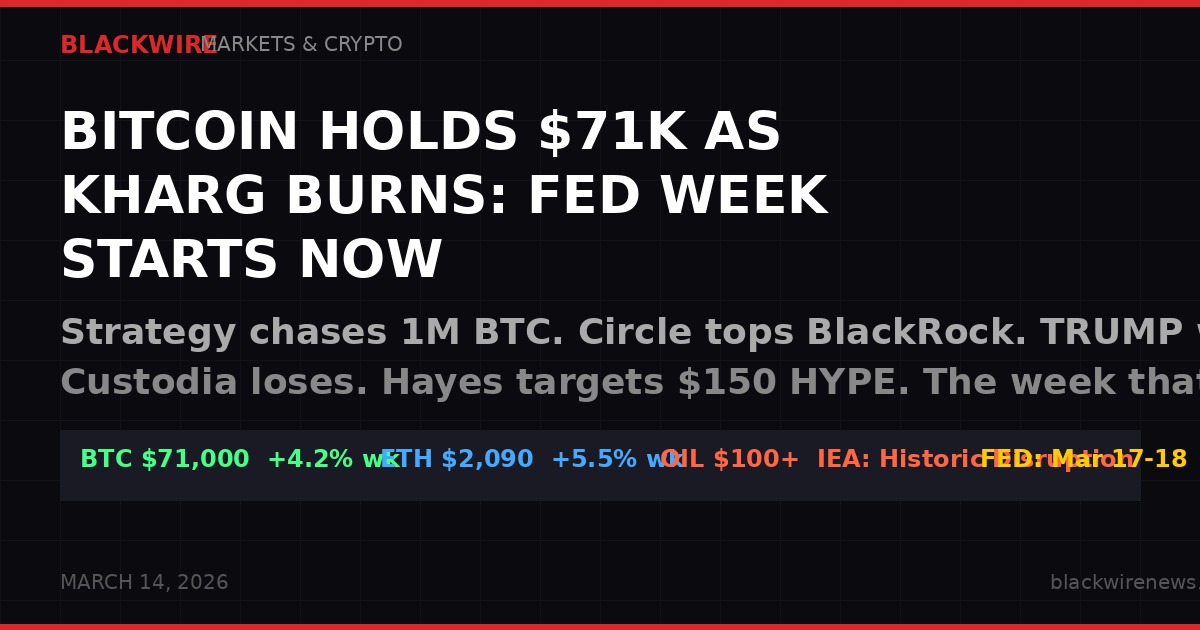
Bitcoin at $71,000 on March 14, 2026. Up 4.2% on the week despite war, oil above $100, and escalating threats to Kharg Island. / BLACKWIRE
Friday night, the U.S. bombed Kharg Island. Iran's main crude export terminal. The site that moves 90% of Iran's oil exports. Bitcoin dropped 3.5% in 45 minutes - from $73,838 to $71,300 - and then it stopped.
That reaction tells you everything about where this market stands right now. The war premium is priced in. The tail risk is partially understood. And the world's largest open-source monetary network is functioning as a reserve asset while traditional markets stay closed on weekends and the geopolitical situation deteriorates in real time.
But the Friday reversal also exposes the ceiling. Bitcoin has now rejected the $73,000-$74,000 range four times in two weeks. The bulls need a catalyst to break through. That catalyst arrives Tuesday when Jerome Powell and the FOMC open their two-day meeting. What comes out of that meeting will define the next major move for every risk asset on the planet.
WEEKLY MARKET SNAPSHOT - MARCH 7-14, 2026
- Bitcoin (BTC): $71,000 - up 4.2% on the week, -3.5% from Friday high
- Ethereum (ETH): $2,090 - up 5.5% on the week
- Solana (SOL): $88 - up 4.2% on the week
- BNB: $655 - up 4.5% on the week
- Dogecoin (DOGE): up 5.0% on the week
- TRUMP Memecoin: $3.90 - up 44% from Thursday low of $2.71
- WTI Crude Oil: above $100/barrel
- 24h Liquidations: $371M (short: $207M, long: $163M)
Source: CoinDesk, Coinglass, March 14 2026
The War Premium Is Now a War Discount
Two weeks ago, when the first Tomahawk missiles hit Tehran, bitcoin was at $68,000. Today it's $71,000. That 4.4% gain during an active war with oil above $100 and the largest energy supply disruption in IEA history is not noise. It's a data point that rewrites the risk-asset playbook.
In the early days of the conflict, every headline produced an outsized reaction. A missile strike meant a 6-8% crypto drawdown. A Hormuz closure threat took 10% off in hours. The market was pricing unknown tail risk - the fear of something that had never been fully priced before.
That dynamic has shifted. Two weeks in, traders have built a framework. Strikes happen. Oil spikes. Bitcoin dips 3-4%. Then recovers. The pattern has repeated enough times that the reflexive sell-the-headline impulse has faded. Experienced traders are buying the dip because they've seen it work three times already.
Friday's session crystallized the two-way nature of this market. The initial surge to $73,838 squeezed short positions. $207 million in short liquidations got wiped out as bears who'd positioned for a conflict-driven decline were forced to cover. Then the Kharg headlines hit and the new longs - the people who chased the squeeze - got liquidated for $163 million on the way back down. Classic two-sided whipsaw in a news-driven market.
"The market is adapting to the conflict in real time. Early in the war, every headline produced an outsized reaction because nobody could price the tail risk. Now, traders have a framework." - CoinDesk markets report, March 14 2026
The bigger concern is the new variable Trump introduced Friday night. In a Truth Social post, he said he had spared oil infrastructure "for reasons of decency" but would "immediately reconsider" if Iran continued blocking the Strait of Hormuz. Iran responded that any strike on energy infrastructure would trigger retaliatory attacks on U.S.-linked regional facilities.
That's a conditional escalation threat that didn't exist 48 hours ago. If Kharg becomes the next target, the oil supply disruption - already called historic by the IEA - gets dramatically worse. $130 oil is no longer an outlier scenario. And at $130 oil, the stagflation narrative stops being theoretical and becomes impossible for the Fed to ignore.
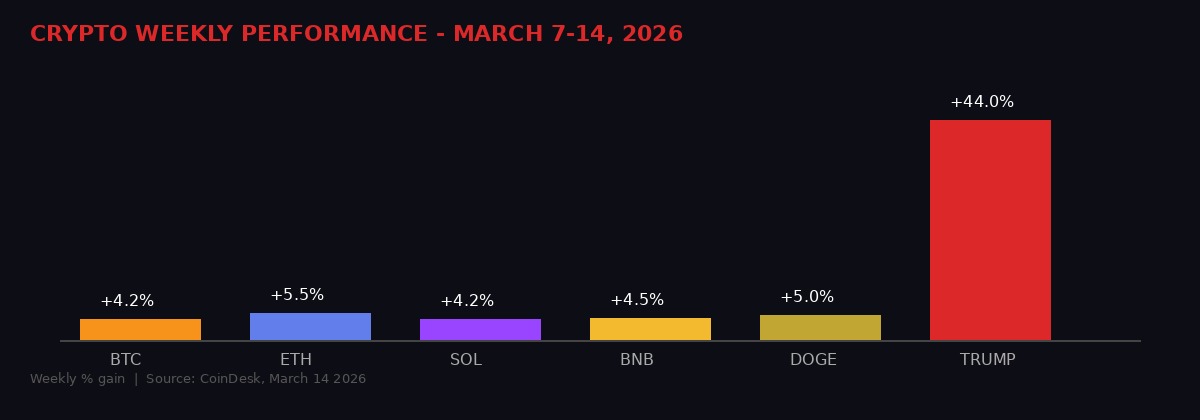
Weekly performance across major crypto assets, March 7-14, 2026. Every major was green despite war escalation. TRUMP token surged 44% from its all-time low on gala news. / BLACKWIRE
The Fed Meeting That Could Change Everything
March 17-18. Two days that will determine whether crypto has room to run or faces its next significant correction. The Federal Open Market Committee meets for the first time since oil crossed $100 and the Iran conflict entered its third week.
The rate decision itself is not the story. CME FedWatch currently prices a 95%+ probability of a hold at 3.5%-3.75%. Nobody serious is expecting a rate change. The market knows that. The market has already priced the hold.
What the market hasn't priced - and what could move crypto by 15-20% in either direction - is the dot plot and Powell's press conference language. Specifically, whether the Fed acknowledges that oil above $100 with the largest energy supply disruption in history changes their inflation path.
For five months, crypto has been pricing in rate cuts that haven't arrived. The Fed has held steady. The market has held its breath. If Powell signals on Tuesday that the next move might be a hike rather than a cut - or even that cuts are off the table through year-end - the risk-off repricing would be severe and immediate.
The stagflation case is no longer abstract. You have: a hot war driving oil above $100, supply chain disruptions in Gulf shipping lanes, U.S. consumer prices that were already sticky before the conflict, and a labor market that hasn't cracked enough to give the Fed cover to cut. Layer in $100+ oil and you have a textbook stagflation setup that puts the Fed in an impossible position.
FED MEETING SCENARIOS - MARCH 17-18
- HOLD (EXPECTED): CME FedWatch 95%+ probability. Statement language matters more than the decision.
- HAWKISH HOLD: Fed flags oil/inflation risk. Signals no cuts in 2026. BTC sell-off likely.
- DOVISH HOLD: Fed acknowledges war-driven slowdown. Keeps cut option open. BTC rally catalyst.
- SURPRISE HIKE: Near-zero probability but would trigger extreme market stress across all risk assets.
- DOT PLOT: Any upward revision to 2026 median rates would signal delayed easing and likely hit crypto.
The irony is that bitcoin's war-era resilience might have made the Fed more comfortable holding. If risk assets were in freefall, there'd be political pressure to ease. With crypto at $71,000 and the Nasdaq still elevated, Powell has room to stay hawkish without the markets forcing his hand.
Every trader sitting on crypto exposure right now needs to have Tuesday circled in red. Whatever Powell says at 2:30 PM EST will be the most important 45 minutes for this market in months.
Strategy's Billion-Dollar Weekly Bet: The Math to One Million Bitcoin
Michael Saylor doesn't blink. While retail traders panic-sold on Kharg headlines and leveraged longs got liquidated for $163 million on Friday afternoon, Strategy was buying more bitcoin. That's been the story for five months straight, and now there's a number attached to the ambition: one million BTC by December 31.
The company currently holds 738,731 BTC, per the Strategy.com investor disclosure updated last Monday. To reach one million by year-end with roughly 297 days (42 weeks) remaining in 2026, Strategy needs to acquire 261,269 more coins. At an average purchase price of $85,000, that's $22.2 billion in total deployment. That's $523 million per week, every week, for the rest of the year.
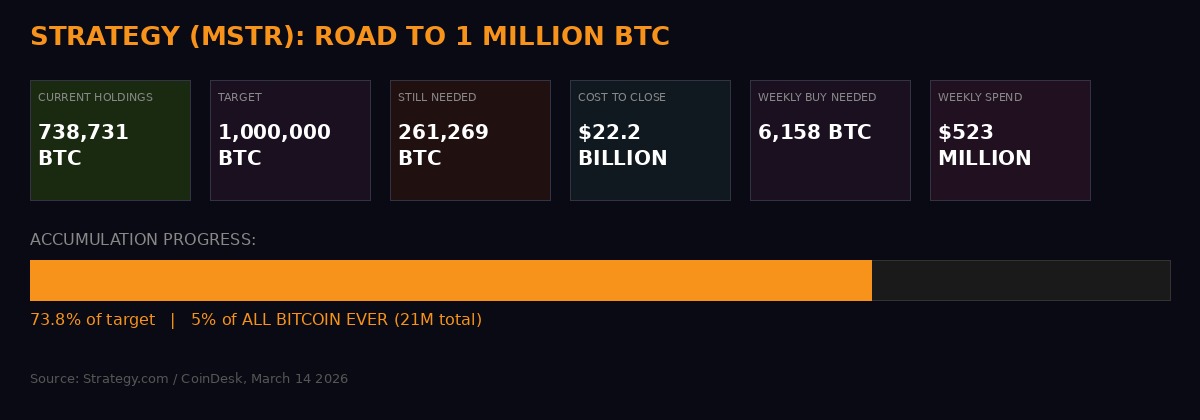
Strategy's current holdings vs. the 1 million BTC target. At current pace, the company would control nearly 5% of all bitcoin that will ever exist. / BLACKWIRE
The pace is aggressive but not impossible based on recent behavior. Last week alone, Strategy added 17,994 BTC. The week before showed similar velocity. Their preferred stock issuance - the STRC series launched in 2025 - generated enough capital to suggest as many as 11,000 BTC purchases just from Monday to Thursday, before factoring in common stock issuance which may have funded thousands more.
Since launching its bitcoin treasury strategy in August 2020, Strategy has averaged approximately 10,700 BTC per month - roughly 128,000 BTC per year. In 2026 alone, through mid-March, they've already accumulated 64,948 BTC, putting them well ahead of the historical annual run rate. If that pace holds, 1 million is achievable without requiring exceptional capital markets conditions.
What makes this significant beyond the headline number: one million BTC represents approximately 4.76% of all bitcoin that will ever exist (21 million cap). One entity - a publicly-traded U.S. company with Michael Saylor as executive chairman - would control nearly 5% of a monetary system that is theoretically decentralized. That's a concentration of ownership that has no historical precedent in sound-money theory and raises questions that the bitcoin community has largely avoided confronting directly.
The bear case for Saylor's bet is sitting right there in the MSTR stock chart. Shares have fallen dramatically from their 2024 peak as the bitcoin price declined from its highs. Strategy borrowed against future capital raises to fund these purchases. If bitcoin stays under $70,000 and capital markets tighten further, the weekly $523 million purchase pace becomes increasingly difficult to maintain. The 1 million BTC target requires bitcoin to cooperate on price, capital markets to remain open for preferred stock issuance, and Saylor to maintain credibility with institutional investors who've watched MSTR underperform its own bitcoin holdings for months.
"Strategy would need to acquire roughly 6,158 BTC per week - about $523 million - to reach the 1 million milestone by December 31, 2026. The company has already purchased 64,948 BTC so far this year, putting it well ahead of its historical average pace." - CoinDesk, March 14 2026
Circle Tops BlackRock: The $11 Billion Tokenized Treasury War
BlackRock entered the tokenized Treasury market in 2023 and hit a 46% market share peak. Twelve months later, that share has collapsed to 18%, and BlackRock's BUIDL fund at $2 billion is now in second place. The new leader is Circle's USYC token at $2.2 billion. And the broader market they're fighting over just hit $11 billion for the first time in history - up 27% since January 1.
Circle didn't build this position organically. The USYC token was originally issued by Hashnote, which Circle acquired in January 2025 for $1.3 billion. The acquisition looked expensive at the time. Twelve months later, USYC is the largest tokenized Treasury product in existence, and Circle has positioned itself as both the stablecoin infrastructure layer (USDC) and the yield-bearing institutional alternative.
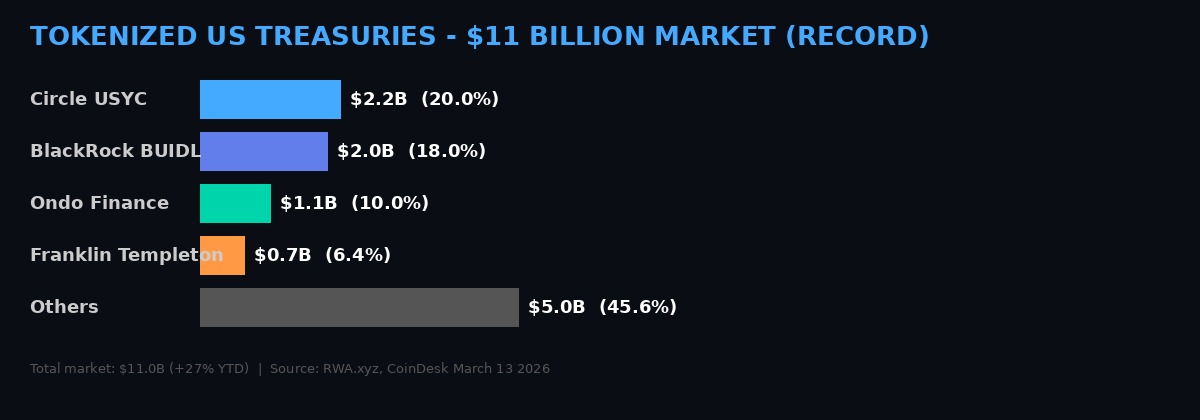
The $11 billion tokenized Treasury market as of March 2026. Circle's USYC overtook BlackRock's BUIDL to claim the top position. The market grew 27% since January 1. / BLACKWIRE
The driver of recent growth is Binance. The exchange introduced USYC as off-exchange collateral for institutional derivatives trading in July 2025. Under the structure, traders can hold USYC through Binance Banking Triparty (with partner banks) or through Ceffu, Binance's institutional custody platform. The USYC supply on BNB Chain has since swelled to $1.84 billion - meaning most of Circle's entire USYC position is effectively Binance institutional collateral.
This is the use case that was always theoretically possible but took years to actually materialize: tokenized yield-bearing assets as collateral for derivatives trading. Instead of posting cash margin that earns nothing, traders post USYC that earns 4-5% annualized yield on U.S. Treasuries. Capital efficiency improves. The yield accrues to the trader rather than the exchange. And the settlement is near-instant because it's blockchain-based rather than T+2 traditional finance.
Jeremy Allaire, Circle CEO, called it on Friday via X: "Tokenized treasuries and repo as collateral is a major emerging use case and we are proud of how quickly this has grown." That's not just a victory lap - it's a product positioning statement. Circle is telling institutional investors: we're not just a stablecoin issuer anymore. We're the yield layer for the onchain financial system.
The broader market context matters here too. January's crypto market correction - when bitcoin dropped from its 2024 highs toward $60,000 - actually accelerated tokenized Treasury adoption. Institutions and sophisticated traders parked capital in USYC and similar products to earn yield while waiting for re-entry opportunities. The "safe harbor" use case during volatility may be more powerful than anyone initially modeled.
USDC volumes overtaking Tether's USDT for the first time since 2019 (per separate March 13 data) further validates Circle's institutional push. Mizuho raised its Circle price target from $100 to $120 following the volume data, maintaining neutral on valuation but acknowledging the structural momentum behind the USDC/USYC ecosystem.
The TRUMP Whale Who Made $2.5M in Hours - And What It Means
A dormant crypto wallet sat silent for five months. Then, on March 13 at 01:49 UTC, it woke up and bought $7.2 million worth of TRUMP tokens in four transactions over a few hours. By the time the token's 60% rally from its all-time low subsided, that wallet was up $2.47 million.
On-chain data from Arkham Intelligence captured the full sequence. The wallet started with a single test buy - the classic whale behavior of confirming execution before deploying size. Then came two purchases of approximately 1 million tokens each, worth a combined $6.23 million. Then a final 200,000-token add worth $742,000. Total cost basis: approximately $7 million. Peak value during the subsequent spike to $4.50: above $9.4 million.
The catalyst was the announcement of a second Mar-a-Lago gala for top TRUMP token holders, scheduled for April 25. The exclusive event - open only to the top 297 holders by time-weighted average balance between March 12 and April 10 - creates a specific, measurable incentive to accumulate. If you can crack the top 297, you get access to Trump personally. The previous version of this event in May 2025 generated ethics investigations and congressional scrutiny. It also made early buyers a lot of money.
This is the TRUMP tokenomics machine running at full speed. The announcement creates a buying incentive. The buying drives up price. The price spike generates media coverage. The coverage drives more buying. Somewhere in that chain, a dormant whale with five months of patience and $7 million in dry powder recognized the setup and executed before the price moved.
The uncomfortable reality is the baseline. TRUMP peaked at approximately $74 in January 2025 before Trump's inauguration. Today, even after the 60% rally from Thursday's low to $4.50, the token is down roughly 96% from that peak. The gala pump brought it from $2.71 to $4.50, then it settled around $3.90. The $2.47 million profit the whale captured looks impressive - but it's one skilled trade in an asset that has destroyed an extraordinary amount of capital since its launch.
"After five months of total silence, a dormant crypto wallet suddenly bought roughly 2.2 million TRUMP tokens on Thursday... The token's 60% price spike followed the announcement of an April 25 gala and luncheon at Trump's Florida estate, an exclusive event open only to the top 297 token holders." - CoinDesk, March 13 2026 (via Arkham Intelligence onchain data)
The ethics questions here are not subtle. The gala format - where buying a president's memecoin grants access to the president himself - has drawn criticism from both sides of the aisle. A disclaimer on the event website states Trump will appear "in a personal capacity with no private meetings," but the line between president-as-token-promoter and president-as-policy-maker is not convincingly drawn. Congressional scrutiny of the first gala is still ongoing. A second one was announced anyway.
Custodia Loses, Kraken Wins: The Fed's Crypto Banking Pivot
The 10th Circuit Court of Appeals ruled 7-3 against Custodia Bank on Friday, closing the crypto bank's multi-year legal battle with the Federal Reserve over master account access. The decision was expected but still stings for Wyoming's crypto-banking experiment.
Custodia has been fighting the Fed since 2021 for direct access to the Federal Reserve's payment rails - what's known as a "master account." Without one, banks must use an intermediary institution to access the Fed's systems, adding cost and friction to every dollar that moves. For a crypto-native bank, those frictions compound into a significant competitive disadvantage against traditional finance.
The 7-3 vote confirmed earlier rulings that the Federal Reserve has unreviewable discretion over master account applications. One dissenting judge - Timothy Tymkovich - argued sharply against the majority: "Holding that the Reserve Banks have unreviewable discretion over master accounts places us on the wrong side of the statutes and, likely, that of the Constitution as well." His dissent may seed future legal challenges. For now, Custodia is out.
The timing is either ironic or deliberate, depending on how cynical you are about the Fed. Even as the 10th Circuit closed the door on Custodia, the Federal Reserve Bank of Kansas City earlier this month granted Kraken's banking arm a special "limited master account" - the first such account ever granted to a crypto firm. It's not a full master account, but it carries many of the same features, and it opens the door to future applications from other crypto-native banks.
The Fed is also working on a national-level policy for "skinny" master accounts that would formalize the limited-access model across the entire Federal Reserve system. That process is early stage - timeline unclear, no application window yet - but it signals a thaw in the adversarial relationship between the crypto banking sector and the central bank.
TIMELINE: CRYPTO BANKING AND THE FED
The broader implication: the path to banking access for crypto is shifting from litigation to politics. Kraken got its account not through courts but through the new regulatory environment under the Trump administration, which has been broadly crypto-friendly since January 2025. Other crypto firms will likely follow the Kansas City model rather than the Custodia model. The legal route is closed. The political route is open - for now.
Arthur Hayes Targets $150 HYPE - And Explains Exactly Why
Arthur Hayes doesn't do vague. In a CoinDesk Markets Outlook interview published Thursday, the BitMEX founder and Maelstrom CIO laid out the specific bull case for Hyperliquid's HYPE token - and the specific conditions that would invalidate it. Current price at publication: roughly $15. His target: $150. A 10x move predicated on fundamentals, not hype.
The revenue case first. Hayes cited Hyperliquid's 30-day fee data showing an annualized revenue run rate approaching $1 billion. That's real fee generation from real trading activity - not incentive-driven volume, not wash trading, not liquidity mining rewards inflating the numbers. He specifically called out the volume-to-open-interest ratio as his preferred metric for distinguishing genuine trading demand from manufactured activity. By that measure, Hyperliquid comes out ahead of every competing perpetual DEX.
The supply discipline case second. Hayes disclosed that his firm sold its initial HYPE position around $50-$55, anticipating selling pressure from token unlocks. The team then chose not to sell the majority of its monthly token allocations - a decision Hayes called decisive in turning him bullish again. When insiders choose not to dump, it signals either genuine belief in the long-term value or a rational expectation that waiting yields more. Either way, it removes a supply overhang that kills most DeFi token bull cases.
The new market case third. Hyperliquid's HIP-3 permissionless listing system now allows trading in non-crypto assets including oil proxies and equity indices. Hayes noted that during weekend geopolitical events - specifically the Iran conflict - retail traders used Hyperliquid to access oil and market-linked positions when traditional brokers were closed. The platform offers 10-20x leverage on these products versus 2-3x on traditional retail platforms. That leverage differential, in a volatile geopolitical environment, drives explosive volume.
"Retail traders can trade assets like oil or Nasdaq proxies 24/7 on-chain using stablecoins and crypto wallets. Hayes said leverage of 10x-20x is often available compared with the 2x-3x many retail investors receive on traditional brokerage platforms." - CoinDesk, March 13 2026
The risk case is equally specific. Hayes says he'd reassess if HYPE's price-to-earnings ratio rises sharply (meaning price outpaces the $1B revenue run rate), market sentiment turns euphoric, or if competitors erode Hyperliquid's roughly 70% share of perpetual DEX revenue with lower fees. Those are reasonable exit triggers - more specific than "if the market turns against me."
Hayes also made two side calls worth flagging. He reiterated the $250,000 bitcoin price target for 2026, defending it despite missing earlier milestones. And he highlighted Zcash as a privacy narrative play, citing AI-powered blockchain surveillance making privacy coins relevant again to users who want financial anonymity without the regulatory exposure of Monero. Neither call is consensus. Both are worth tracking.
What Comes Next: The Week That Matters
Heading into the week of March 16, the market is coiled around a single event. Everything else is noise until the Fed speaks.
Bitcoin's technical setup is clear. Four rejections at the $73,000-$74,000 range means that level is significant resistance. A hawkish Fed statement breaks the market below $67,000-$68,000 - potentially fast. A dovish Fed statement gives bitcoin the narrative momentum to attempt a fifth test of that resistance, and this time with institutional buying behind it.
The war remains the baseline. Trump's conditional threat on Kharg Island oil infrastructure is the wildcard. If that threat is executed, the IEA "historic disruption" becomes catastrophically worse and every stagflation model breaks into the danger zone. If Iran backs down on Hormuz, the threat is retracted, oil drops, and the Fed has more flexibility. Neither outcome is certain. The weekend will be watched.
Strategy will almost certainly announce another purchase Monday. That announcement has become a weekly market mover - a reminder that someone is systematically buying every dip regardless of price. When Saylor buys, the signal is simple: the biggest institutional buyer in the world is not scared of the war, not scared of the Fed, and not scared of $100 oil. That signal has market-moving weight even before you count the actual coins.
The tokenized Treasury market at $11 billion is accelerating regardless of near-term crypto price action. Circle has now demonstrated the institutional collateral use case at scale. BlackRock is still in the game. Franklin Templeton, Ondo Finance, and new entrants are pushing the total higher. This market doubles to $22 billion before year-end if the current growth rate holds. The rails for institutional onchain finance are being built right now, one USYC deposit at a time.
The TRUMP gala creates a near-term trading window. Top-297-holder qualification runs through April 10. That's four weeks of potential buying pressure from people who want a seat at Trump's table and are willing to accumulate tokens to get it. The pump-to-dump cycle that follows the May 2025 gala is the likely template.
And Custodia's loss, combined with Kraken's win, draws a clear map for any crypto bank seeking Fed access. Don't litigate. Don't challenge the Fed's authority through courts. Get political, get compliant, get to Kansas City. The Fed has decided to open the door through administrative policy rather than legal compulsion. Walk through the door that's open.
Bitcoin at $71,000 with a Fed meeting in 72 hours and oil above $100. This is the most consequential week for crypto pricing in three months. Position accordingly.
Get BLACKWIRE reports first.
Breaking news, investigations, and analysis - straight to your phone.
Join @blackwirenews on Telegram