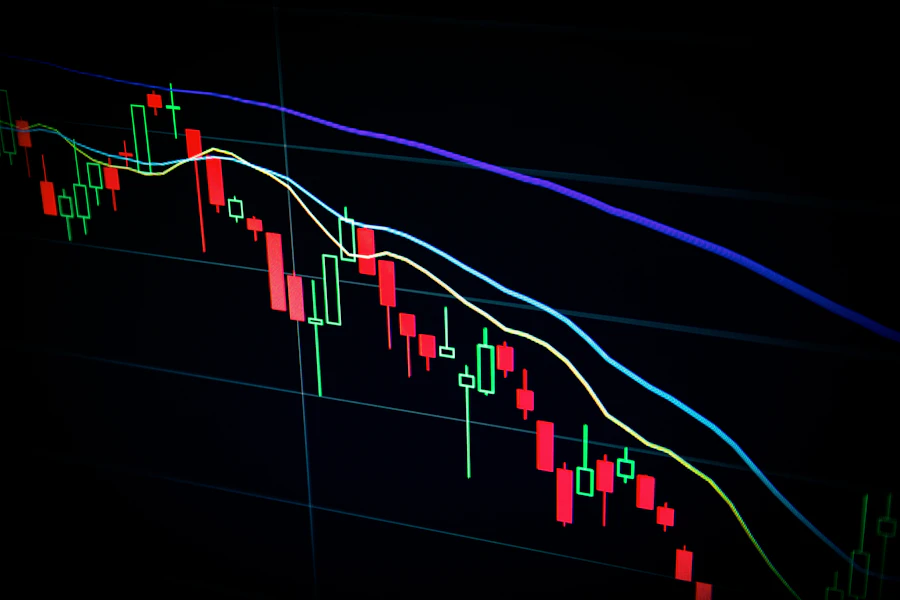
The round trip was brutal. Bitcoin opened this week near $68,000, ripped to $74,000 on Wednesday as ETF headlines and institutional noise lit up the tape, and then gave back everything by Saturday morning. BTC hit $67,929 on the weekend open, down 3.4% in 24 hours, and the chart looks exactly like it has for the past three months: a sharp bounce, a rejection at resistance, and a fade back to the lower range.
That script is not random. Under the hood, Glassnode data published Saturday shows that 43% of all outstanding bitcoin supply is now sitting at an unrealized loss. Nearly half the market is underwater. That number explains the $74K ceiling better than any technical analysis could. Every time price approaches breakeven for those holders, supply floods the market. The ceiling is made of human psychology as much as anything else.
Meanwhile, a stronger dollar is doing its own damage. The DXY posted its steepest weekly gain in over a year as markets priced in sticky inflation, elevated energy costs from the Iran war, and a Federal Reserve that has zero room to cut rates right now. The Iran conflict has no visible end. Oil is elevated. Hormuz is disrupted. Those are not temporary headwinds.
Saturday Snapshot - March 7, 2026 (CoinDesk)
The On-Chain Fragility: What 43% Underwater Actually Means
Glassnode's metric is measuring bitcoin's UTXO set - the actual coins that were last moved at prices above where the market is trading today. When 43% of supply is at a loss, you have a massive cohort of holders who bought at higher prices and are sitting on unrealized losses. Some are long-term conviction holders who will not sell. But a significant portion are retail investors who bought near the $100K-$126K range in late 2024 and early 2025 and have been waiting for a chance to break even.
The implication is structural, not just psychological. Every time bitcoin rallies toward $72K, $74K, $78K - price passes through the average cost basis for millions of those underwater coins. The holders become sellers. That overhead supply creates a ceiling that is extremely difficult to break through without an enormous influx of fresh capital from buyers willing to absorb all that pent-up selling pressure at higher prices.
Historically, bear markets resolve when the underwater supply is either absorbed by conviction holders through time, or when it gets forced out through a capitulation event that flushes weak hands at lower prices. The market has not seen that flush yet. The low since the October 2025 peak of $126,000 has been approximately $58,000-$62,000 territory. If the cycle plays out as prior bear markets have, the flush may still be ahead.
"Bitcoin's price is convincingly in deep bear market territory now. We expect a further 30% price drop during 2026 as the Iran war started." - CK Zheng, founder, ZX Squared Capital (CoinDesk, March 7, 2026)
A 30% drop from current levels would put BTC in the $47,000-$48,000 range - a level that would push the underwater supply percentage significantly higher and create the exact kind of capitulation environment that clears the market for the next cycle. That is not a prediction. It is a scenario that the on-chain data makes structurally possible.
The 43% figure also needs context in dollar terms. Bitcoin's peak was $126,000. Today it trades at roughly $68,000. That is a 46% decline from the all-time high, in nominal terms. Adjusted for where the average underwater holder bought, the paper losses sitting in those wallets represent tens of billions of dollars in unrealized damage across the holder base. That weight does not disappear. It either gets sold, or it waits.
The Dollar Wrecking Ball: Steepest Weekly Gain in Twelve Months
The DXY - the index measuring the dollar against a basket of major currencies - posted its largest weekly gain in over a year. That is not a minor macro footnote. The dollar is the denominator for virtually every risk asset price on the planet. When it strengthens sharply, assets priced against it get cheaper in real terms even before any selling occurs.
The specific driver this week was the Iran conflict and its effects on energy markets. The US-Iran war has pushed oil higher, revived inflation fears that markets spent most of 2024 putting to bed, and created a credible scenario where the Federal Reserve is trapped: it cannot cut rates while inflation is rising, but the economy is simultaneously showing cracks. February's jobs report - which came in at a shocking loss of 92,000 payrolls with unemployment rising to 4.4% - illustrates exactly that trap.
Stagflation. The word the market hates above all others. Prices going up, growth going down. The Fed cannot rescue either problem with the same tool. Rate cuts would fire up inflation further. Holding rates restricts growth. Hiking rates in a weakening job market would be political suicide. So the Fed does nothing, and the dollar strengthens as markets price in a longer period of tight monetary conditions.
"As tensions escalated in the Middle East last week, investors moved quickly to the safety of the U.S. dollar, which strengthened as markets began pricing in higher energy prices and reignited inflation fears, potentially delaying Federal Reserve rate cuts." - Bjorn Schmidtke, CEO, Aurelion (CoinDesk, March 7, 2026)
A stronger dollar kills the crypto narrative at multiple levels. First, it makes BTC cheaper to produce in non-US markets where miners are paying local currency costs but receiving dollar-denominated revenue. Second, it reduces the purchasing power of the global retail audience that drives speculative demand. Third, and most importantly for institutional players, it raises the opportunity cost of holding non-yielding assets like BTC when dollar-denominated instruments pay meaningful real rates.
The dollar surge also tells you something important about the Iran conflict's perceived longevity. If markets expected a quick resolution, energy prices would have peaked and faded by now. The continued dollar strength is a bet that the conflict persists - and persistent conflict means persistent inflation, persistent Fed paralysis, and persistent headwinds for risk assets.

Altcoin Carnage: Ether Below $2,000, SOL in Freefall
If the BTC chart looks bad, the altcoin charts look worse. Ether fell 4.4% on Saturday to $1,974 - cracking below the psychologically important $2,000 level. SOL dropped 4% to $84.31. XRP slid 2.2% to $1.37. Dogecoin fell 2.9% to $0.09. The entire complex gave back the week's gains in a single session.
ETH below $2,000 is a number worth pausing on. In the bull run that peaked in late 2024, Ethereum traded north of $5,000. The current price represents a 60%-plus decline from those levels. Ether is trading at prices last seen in mid-2023, before the spot BTC ETF approvals, before the institutional money wave, before the bull cycle fully materialized. The gains of the entire institutional crypto era have been erased for ETH holders who bought in late 2024.
The ETH story has a structural complexity that BTC's does not. Ether is not just a store of value play - it is the gas for the entire DeFi and smart contract ecosystem. When ETH falls this sharply, it creates cascading effects: DeFi protocol treasuries lose value, yield farming economics shift, collateral positions that were funded with ETH get riskier, and the general sentiment around the Ethereum ecosystem darkens. The Ethereum Foundation's recent push to position ETH as the "trust layer for AI" may be a sign of how hard they are working to find a new narrative after the DeFi bull cycle faded.
SOL at $84 tells a different story. Solana was one of the cycle's biggest winners, peaking above $290 in late 2024. From peak to present, that is a 70%-plus drawdown. The memecoin and consumer crypto activity that drove Solana's outperformance in 2024 has dried up. The network is still functioning and technically impressive, but the speculative fervor is gone. At $84, SOL is back to levels it first touched in early 2024.
The broader altcoin market is exhibiting a familiar bear market pattern: during rallies, BTC outperforms; during selloffs, alts get hit harder. This "alt compression" is a defining feature of crypto bear markets. Capital concentrates in bitcoin as the perceived safe haven within the asset class, and everything else sees disproportionate selling. The data this week confirms that dynamic is fully in effect.
$1.7 Billion in Dry Powder: The Stablecoin Signal
Here is the part of the story that does not fit the pure bear narrative. Messari data shows stablecoin inflows jumped 415% over the past week to $1.7 billion, with daily stablecoin transfer volumes up nearly 10%. That is a significant amount of capital sitting on the sidelines in dollar-denominated, blockchain-native form.
Stablecoin accumulation in crypto has historically served one of two functions. Either it represents exits - investors selling volatile assets into stable coins ahead of further expected selling - or it represents potential re-entry capital waiting for better prices. Distinguishing between the two in real time is difficult, but the sheer volume and the velocity of the increase suggest at least some portion of this is capital that has de-risked but has not left the ecosystem entirely.
The $1.7B figure also needs to be read against the backdrop of the Iran conflict narrative. On-chain capital flows tend to concentrate in stablecoins during acute geopolitical uncertainty, not because investors are waiting to buy dips, but because they want the optionality. War creates volatility, and volatility creates opportunity - if you have stable capital ready to deploy, you can pick entries at moments of panic that longer-term holders cannot.
The question the market cannot answer right now: is that $1.7B patient capital or scared capital? Patient capital, if deployed at lower prices, becomes the bid that absorbs the overhead supply problem. Scared capital, if it exits the ecosystem entirely by converting to fiat, removes the liquidity the market needs to sustain any rally attempt.
The stablecoin signal is, at minimum, evidence that crypto remains a live trade for a meaningful portion of the market. Nobody accumulating $1.7B in stablecoins is planning to ignore the asset class. They are waiting. The price that brings them back in is unknown. But they are still there.
The Four-Year Cycle: Bitcoin Cannot Escape Its Own History
CK Zheng at ZX Squared Capital has put a specific number on the downside: 30%. From $68,000, that implies a fall to approximately $47,600. The framework behind that call is the four-year halving cycle, and it is worth understanding in detail because the data supporting it is uncomfortably consistent.
The halving that matters here happened in April 2024. At that event, bitcoin's block reward dropped from 6.25 BTC to 3.125 BTC per block. Historically, bitcoin's price peaks approximately 16 to 18 months after each halving, driven by the supply shock combined with retail FOMO. The October 2025 peak at $126,000 came roughly 18 months after the April 2024 halving - right on the historical schedule.
April 2024 - Bitcoin halving. Block reward drops to 3.125 BTC. Supply issuance rate halved.
October 2025 - Bitcoin peaks at $126,000. Roughly 18 months post-halving. On historical schedule.
November 2025 - February 2026 - Bear market begins. BTC drops from $126K toward $80K range.
March 7, 2026 - BTC at $67,929. Down 46% from ATH. Iran war adds macro pressure. 43% of supply at a loss.
2026 Bear Market Scenario - ZX Squared projects another 30% downside. Historical cycle low typically 12-18 months after peak, before next halving accumulation phase.
The reason the cycle perpetuates, according to Zheng, is not mechanical but psychological. Individual investors buy during hype, hold through optimism, panic-sell during capitulation, and then miss the recovery. That behavioral loop is self-reinforcing and scale-invariant - it happened with the same general shape in 2018, 2022, and now in 2026. Institutional money was supposed to break this pattern by providing rational, cycle-agnostic capital. It has not.
"The 'four-year crypto cycle' momentum is gaining strength and is extremely difficult to break due to individual investors' psychological behaviors." - CK Zheng, ZX Squared Capital (CoinDesk, March 7, 2026)
The institutional thesis that was going to "fix" the four-year cycle has run into a practical problem: institutions have not committed enough capital to overwhelm the behavioral dynamics of the retail-dominated holder base. ETFs and Digital Asset Treasury companies represent roughly 10% of the total crypto market cap. They are meaningful participants, but not market-defining ones. At 10%, they cannot prevent a cycle-driven bear market - they can only modulate its speed and depth.
The Treasury Company Contagion Risk
There is a newer element to this bear market that did not exist in prior cycles: corporate bitcoin treasury companies. Firms like MicroStrategy-style balance sheet holders accumulated bitcoin during the bull run using debt instruments - convertible bonds, equity raises, and other leverage mechanisms. At $126,000, those positions looked like genius. At $68,000, the math becomes more uncomfortable. At $47,600, some of those positions face existential pressure.
Zheng flagged this risk explicitly in his March 7 note to CoinDesk. He warned that Digital Asset Treasury firms "may be forced to sell cryptos to meet certain debt servicing requirements during this bear market, which may create a vicious cycle." That language is precise and important: forced selling during a down market creates downward price pressure, which increases unrealized losses, which accelerates forced selling.
The mechanics depend on the specific debt structures these companies used. Convertible bonds with equity conversion options at prices far above current market become liabilities. If a company issued convertible notes at $80,000 BTC and the stock has dropped alongside the asset, they face dual pressure: the bond converts at a loss to equity holders, and rolling the debt requires either selling BTC or issuing new equity at deeply diluted prices.
The total exposure is not fully transparent because these are dispersed across multiple jurisdictions and corporate structures. But the macro implication is clear: the corporate treasury playbook that looked like a revolutionary capital allocation strategy during the bull market is now a source of potential forced selling in the bear. If even a small number of these companies face liquidity events at lower prices, the resulting BTC hitting the market amplifies the downside move.
This is a structural risk that has no precedent in prior cycles, because the institutionalized corporate treasury BTC playbook is a 2020-2025 phenomenon. Regulators, creditors, and markets are all figuring out in real time how these positions unwind when the underlying asset is 46% off its peak and still falling.

The Iran Factor: Geopolitics as Crypto's Ceiling
Every market analysis right now has to account for the Iran war as a persistent variable, not a resolved event. The US-Iran conflict began with the February 2026 strikes on Iranian nuclear facilities. As of March 7, the Strait of Hormuz remains disrupted, Iranian oil exports are severely curtailed, and Trump's "unconditional surrender" demand has no takers in Tehran. There is no off-ramp visible.
For crypto specifically, the war creates a specific macro configuration that is almost universally bearish: elevated oil prices, rising inflation, a stronger dollar, delayed rate cuts, reduced global risk appetite, and geopolitical uncertainty that drives institutional capital toward perceived safe havens - specifically US Treasuries and gold, not bitcoin.
The failed "digital gold" narrative gets tested hard in exactly these conditions. Gold is up. Bitcoin is down 46% from its peak. When institutional investors need to hedge geopolitical risk, they buy physical gold and treasuries. Bitcoin is not in that playbook yet - not at scale. The ETF flows this year show continued retail and mid-market demand, but the sovereign wealth funds, central banks, and major pension funds that drive true safe-haven flows are not buying bitcoin as a war hedge.
The Iran war timeline is also directly relevant to the Fed's decision-making. Every additional week of elevated oil prices is another week that the inflation data gets worse. The February CPI reading, which will incorporate rising energy costs, is expected to come in hot. A hot CPI in March removes any residual possibility of a rate cut at the April FOMC meeting. That gives the market another month-plus of the same configuration: high rates, strong dollar, weak risk assets.
The Stablecoin Inflow Paradox and What Triggers Re-Entry
Return to the stablecoin data for a moment. $1.7 billion in net inflows, a 415% week-over-week surge. That money is in the ecosystem. It is not in BTC. It is not in ETH. It is parked in USDT, USDC, and similar instruments, earning zero yield, waiting for something.
The historical pattern for stablecoin accumulation of this magnitude is that it precedes volatility - either a sharp leg down that triggers aggressive buying, or a macro catalyst that triggers risk-on rotation. In a pure cycle framework, the catalyst for re-entry is usually fear turning to capitulation and then recovery as the underwater supply gets cleared.
The specific price levels that could trigger stablecoin re-entry are not knowable in advance, but the market is developing rough consensus around a few zones. The $58,000-$62,000 range represents the most significant swing low in this bear cycle so far. A test of that zone with high stablecoin inflows waiting in the wings creates conditions for a potentially sharp recovery bounce. The question is whether that $1.7B is patient enough to wait for those levels, or whether it re-enters at higher prices and becomes part of the overhead supply problem.
There is also the altseason element. Social media mentions of "altseason" have dropped to two-year lows, according to Santiment data. Historically, peak pessimism about altcoins has been a contrarian indicator - the moment retail gives up on alts is frequently near the point where the next alt rally begins. That does not mean it is imminent. It means the setup for one is forming. Contrarian signals can take months to resolve.
The Bitcoin Treasury Bet That Kazakhstan Made This Week
Not all national-level crypto news is bearish this week. Kazakhstan's sovereign wealth fund made a notable move, purchasing bitcoin for its national reserves - a first for any Central Asian sovereign fund. The purchase was not at scale relative to the market, but the symbolism is significant: institutional adoption is still expanding at the nation-state level even as retail sentiment craters.
This is the bull counterargument in condensed form. While retail capitulates and the four-year cycle grinds toward its trough, governments, sovereign funds, and institutional allocators are building positions at lower prices. The accumulation is happening in the distribution phase. When the cycle turns, the supply available to new buyers at the beginning of the next run will be tighter than it was at the start of this one.
That is a bullish long-term argument that does not help anyone currently holding at a loss. But it is real, and it is worth noting alongside the bear data. Bitcoin has not failed as an asset class - it is doing exactly what it has done three times before: cycling from euphoria to despair and back.
Key Levels and What Happens Next
Here is where the market stands, stripped of sentiment:
Current BTC price: $67,929. The weekly chart shows a range that has held roughly $60,000-$74,000 for the past six weeks. The mid-week surge to $74,000 was the most significant breakout attempt of this range, and it failed. That failed breakout strengthens the case for a range break to the downside rather than the upside.
The key downside levels: The $62,000 range is the first significant support. Below that, the $58,000 area is where the real capitulation scenario plays out. ZX Squared's 30% downside target lands near $47,600 - a level that would represent a 62% peak-to-trough decline, similar in magnitude to the 2022 bear market that took BTC from $69,000 to $16,000 (77% decline).
The key upside trigger: A weekly close above $76,000 with expanding volume would be the first credible sign that the range is breaking to the upside. That requires a macro catalyst - most likely a ceasefire in Iran, a dovish Fed surprise, or a significant new institutional buying event. None of those appear imminent as of Saturday, March 7.
The stablecoin watch: If the $1.7B in stablecoin inflows continues to build without deploying, that signals capital is waiting for lower prices. If it starts rotating into BTC and ETH at current levels, it creates buying pressure that could surprise to the upside. Track weekly stablecoin netflow data from Messari and Glassnode as a leading indicator.
The Iran timeline: This is the macro variable that overrides everything else. Any credible peace signal from the Gulf would trigger immediate risk-on across all assets. Oil would drop, the dollar would weaken, and the Fed would have room to cut again. That sequence is the fastest possible path to a crypto recovery. It is also, as of today, not visible on any near-term horizon.
The market is where it is. Bitcoin has nearly halved from its all-time high. 43% of supply is underwater. The dollar is ripping. Alts are cratering. The four-year cycle is doing what the four-year cycle does. None of this is a surprise if you follow the data rather than the narrative. The next move will be driven by which of these forces breaks first - and right now, the bears have the better hand.
Get BLACKWIRE reports first.
Breaking news, investigations, and analysis - straight to your phone.
Join @blackwirenews on TelegramSources: CoinDesk (March 7, 2026) | CoinDesk / ZX Squared Capital | Glassnode on-chain data | Messari stablecoin flow data | Aurelion (via CoinDesk) | CoinMarketCap