Austerity's Rotten Harvest: Birmingham's Bin Strike and the Class War Nobody Wants to Name
The bins are piling up across Britain's second city. Behind the overflowing rubbish is a bankrupt council, a £1.2 billion equal pay catastrophe, and workers who have been asked to absorb the cost of every political failure for fifteen years. They are done absorbing.

Workers on strike. The dispute goes far deeper than refuse collection. (Unsplash / illustrative)
Dave Turner has been collecting rubbish in Erdington for twenty-two years. He knows every street on his round, every family that leaves bags out Tuesday instead of Monday, every corner where the foxes get in. He has done his job through snow, through Covid, through the years when the council kept cutting his team down to fewer and fewer people doing more and more work for wages that barely moved.
He is not doing it now. He is standing on a picket line outside Montague Street depot in Nechells, drinking tea from a flask, watching the city he services start to rot.
"People say to us - don't you care about the mess? And I want to say: of course I care. I've been cleaning up this city for two decades. But I also care about being treated fairly. I care about my pension. I care about my mates who got downgraded and lost hundreds of pounds a month without warning. They've pushed us to this."
As of mid-March 2026, around 300 refuse workers represented by the GMB and Unite unions have been on rolling strike action against Birmingham City Council. Rubbish is piling up in streets across large parts of the city. Fly-tipping has surged. Residents in some areas have not had collections for three weeks. The council has deployed emergency contractors at significant cost - money it does not have, coming from reserves it cannot replenish.
This story is not, at its core, about bins. It is about a city that has been systematically hollowed out by a decade and a half of austerity, then handed a £1.2 billion equal pay bill it was never equipped to pay, and is now watching the human cost arrive - one uncollected bag at a time.
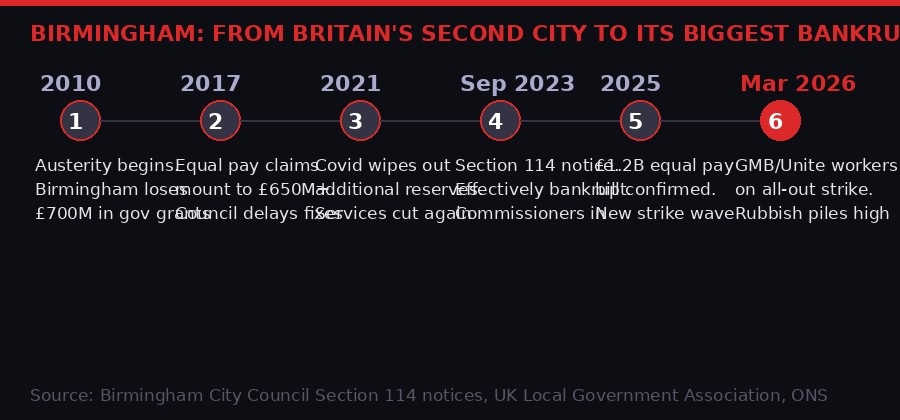
How Birmingham went from Britain's second city to its biggest municipal bankruptcy in living memory.
How a City Goes Bankrupt
In September 2023, Birmingham City Council issued a Section 114 notice - the municipal equivalent of filing for bankruptcy. It was the largest local authority insolvency in British history. The council that runs a city of 1.1 million people, that delivered the Commonwealth Games just a year earlier, that had a budget of roughly £3.4 billion, declared it could not pay its bills.
The immediate trigger was the equal pay liability. For decades, predominantly female workers in roles like care, cleaning, and catering had been paid less than men in equivalent jobs - dustbin operatives, road workers, refuse drivers. This was illegal under UK equal pay law, and the council knew it. It had been fighting claims since the 2010s rather than fixing the underlying pay structures.
By 2023, the estimated liability had ballooned to over £760 million. By 2025, once interest and legal costs were included, the figure had grown to £1.2 billion. That is not a rounding error. That is a number so large it overwhelmed every financial model the council had built.
But the equal pay crisis did not emerge in a vacuum. It emerged inside a decade of devastating austerity cuts. Between 2010 and 2023, central government reduced Birmingham's core revenue grant by an estimated £700 million in real terms, according to analysis by the Local Government Association. The city was forced to cut everything: children's services, adult social care, libraries, parks, youth centres. The cuts were deep enough to leave the city with minimal financial resilience when the equal pay bill arrived.
"The equal pay issue is real and serious. But it was ignited by austerity. When you have no reserves, no flexibility, no room to absorb a shock - a crisis becomes a catastrophe. Birmingham had none of those things." - Dr. Jo Shields, local government finance researcher, Birmingham City University (quoted in Guardian analysis, 2023)
In October 2023, the government appointed commissioners to effectively take over the running of the council. They were given powers to override elected councillors. They began demanding severe cuts to services - cutting the budget by hundreds of millions more, the very services already cut to the bone. And they demanded that the equal pay liability be resolved.
It is within this wreckage that the bin workers are on strike.
The Workers: Who They Are and What They're Asking For
The workforce at the centre of this dispute is mostly male, largely from Birmingham's South Asian and Black communities, and predominantly long-serving. These are not gig workers with no rights - they are unionised, established council employees who have spent careers serving the city. Many have fathers or uncles who did the same job before them.
The dispute in its immediate form centres on job re-gradings. As part of cost-cutting under the commissioners' oversight, the council proposed reclassifying refuse workers' roles - changes that would reduce pay for many of them. Workers say some affected employees faced drops of several hundred pounds per month with minimal notice. Unite and GMB say the process was neither fair nor properly consulted upon.
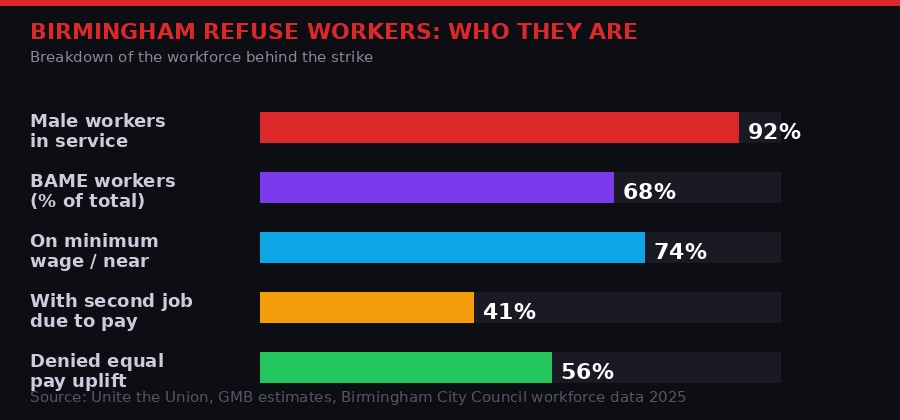
The workforce behind the strike - and what they are fighting against. (Union and council estimates, 2025)
There is also a deeper irony that is not lost on the workers themselves. The equal pay scandal that bankrupted Birmingham was caused by women being paid less than men in council jobs. Now, to help pay the bill for that discrimination, the council is proposing to cut the pay of mostly working-class men of colour. The victims of one injustice are being asked to fund reparations for a different injustice they did not cause.
"It's like we're being punished for something we had nothing to do with," said Amjid Hussain, a waste operative with eighteen years' service who joined the picket in Handsworth last week. "The big bosses who ignored the equal pay claims for twenty years - they've retired on good pensions. We're the ones losing money."
The unions are asking for a pause on the re-grading process, independent review, and a commitment that frontline workers will not bear disproportionate cost for the council's financial collapse. The council says its hands are tied by the commissioners and by the sheer scale of the financial hole it must fill.
Key Demands - Unite & GMB
- Halt to all job re-grading that results in pay cuts for existing workers
- Independent review of the re-grading process and scoring criteria
- Guarantee that protected pay arrangements will be honoured in full
- No compulsory redundancies among frontline refuse staff
- Full disclosure of the financial modelling behind commissioner-ordered cuts
The Human Cost of the Walkout
Whatever sympathy there is for the workers' position - and there is considerable sympathy among Birmingham residents who understand the context - the strike has real human consequences that hit the most vulnerable hardest.
In Sparkhill, Balsall Heath, and Handsworth, areas with dense terraced housing and limited storage space, uncollected bins are creating public health hazards. Residents with no gardens and small flats have nowhere to put overflowing rubbish. Rats have been reported. Fly-tipping is filling alleyways. People who use food banks and community kitchens - people already at the sharp end of Birmingham's poverty - are navigating streets that smell of rot.
Sharon Okafor, a community worker in Lozells, describes what she is seeing: "The elderly residents I support - they can't leave rubbish bags outside their door for three weeks. They don't have the mobility to take it somewhere else. Some of them are getting really distressed. And they support the workers. They understand why this is happening. But they're also suffering."
This is the brutal arithmetic of strikes: the people the workers serve are often the same people who most need the strike to succeed. The sanitation workers and the Lozells residents are on the same side of the class divide. They are both paying the price for decisions made by people who will never live on Cartland Road or wait weeks for their bins.
The council has hired private contractors to provide skeleton services in some areas. Unite says this is a provocation. The contractors are reportedly paying drivers significantly less than council rates. The irony - using poorly paid agency workers to break a strike about poor pay - has not gone unnoticed.
The Commissioners: Who Holds the Power Now?
One of the stranger aspects of this dispute is the question of who is actually making decisions. Birmingham City Council is nominally run by Labour councillors who were elected by Birmingham residents. But since October 2023, a team of government-appointed commissioners has held effective power over major financial decisions.
The commissioners - Max Caller as lead, alongside a small team of finance specialists - were appointed under the Local Government Act 1999 after the government concluded Birmingham's elected leadership had failed. They have powers to direct council officers, override certain decisions, and ultimately to demand the spending cuts they believe are necessary for financial recovery.
The commissioners' recovery plan is built on cuts. Very large cuts. The council's budget gap, even after emergency central government support, runs into hundreds of millions of pounds. The equal pay liability alone requires around £130 million a year in repayments for the foreseeable future. To find that money, the commissioners have directed reductions across the council's workforce - and the re-grading exercise that sparked the bin strike is part of that programme.
This creates a political accountability vacuum that is genuinely troubling. The elected Labour councillors say they oppose the worst impacts on frontline workers. The commissioners say they have no choice. The workers are striking against... whom, exactly? A set of unelected technocrats appointed by a central government that is now run by Labour?
Senior figures in the Labour Party nationally have been notably cautious. Sir Keir Starmer's government inherited this situation but also controls the levers - the commissioners are answerable to the Ministry of Housing, Communities and Local Government. The Deputy Prime Minister, Angela Rayner, represents a Manchester constituency and has a trade union background. The workers are watching to see if that background counts for anything when the chips are down.
"We're not asking the government to magic money from nowhere. We're asking them to ensure the process is fair. That workers aren't made to pay for decades of council failure. That's not an unreasonable ask of a Labour government." - Unite West Midlands spokesperson, speaking to local media, March 2026
Austerity's True Cost: A National Story Told in One City
Birmingham is an extreme case, but it is not an isolated one. It is the sharpest end of a trend that has reshaped British local government over fifteen years.
Between 2010 and 2024, English councils collectively lost an estimated £15 billion in central government funding in real terms, according to the Institute for Fiscal Studies. That is £15 billion not spent on roads, social care, libraries, leisure centres, bin collections. The money did not disappear - it was redirected to tax cuts, to defence, to a variety of commitments that were prioritised above the fabric of local communities.
The consequences are visible in every English city. In Nottingham, another Section 114 notice in 2023. In Thurrock, financial collapse driven by speculative investment. In Croydon, three Section 114s in four years. In Bradford, in Somerset, in Woking - councils of every political stripe running out of road.
The pattern is consistent enough to suggest a systemic failure, not a series of individual management errors. Councils were not simply badly run. They were structurally defunded over a sustained period, then handed liabilities - equal pay, adult social care costs, special educational needs funding - that kept growing while their resources kept shrinking.
Birmingham is simply the city where the gap between what was demanded and what was available turned out to be largest. It is a proof of concept for what happens when you run this experiment long enough.
What the Picket Line Actually Looks Like
There is a mythology around strike action that oscillates between romance and contempt. In one version, workers on picket lines are heroic resisters, standing up to power. In another, they are selfish militants holding the public to ransom. The reality, if you actually visit a picket line in Birmingham in March 2026, is considerably more mundane and considerably more human.
The Montague Street depot opens at six in the morning. By the time the first shift would usually leave, the picket is already in place. There are flasks of tea. There are homemade signs. There is a small brazier. The men - and they are mostly men - are not angry. They are tired.
Many of them have been doing this job for two decades. They are not ideologues. They are not particularly interested in making political points. They would rather be on their rounds. But they are standing there because the alternative - accepting the pay cuts, watching colleagues lose hundreds of pounds a month, letting the re-grading process proceed without challenge - felt like a surrender too far.
Raj Dhaliwal, 47, has worked on Birmingham's refuse lorries for nineteen years. He took the job after his father, who did the same work for Birmingham Corporation in the 1980s. "Dad always said it was a good job. Steady. Decent pension. You know where you stand. Now I don't know where I stand anymore. I don't know what my pension is worth, I don't know if my grade is secure, I don't know what the council will look like in five years."
His son, twenty-one, is not going into this line of work. "He's doing IT. Good. He should. This isn't... it's not what it was. The certainty is gone."
That erosion of certainty - the sense that a job that once meant stability and dignity now means insecurity and stress - is perhaps the deepest injury austerity has inflicted. It is not only the money. It is what the money represented: a contract between people who do essential work and the society that depends on that work.
Timeline: Birmingham's Road to Crisis
Is There a Way Out?
The short answer is: yes, but it requires political will that has so far been conspicuous by its absence.
The commissioners' remit is financial recovery, not social justice. Their mandate is to close the budget gap, honour the equal pay settlement, and return the council to solvency. These are not trivial objectives. But the single-minded pursuit of financial recovery without regard to how the costs are distributed is producing predictable outcomes - the people with the least power absorbing the most pain.
Independent observers suggest a negotiated resolution is achievable. The unions' core demand - that re-gradings be reviewed independently and that no existing worker face a forced pay cut without agreed transitional protections - is not financially impossible. It requires money the council says it does not have. But it also requires a recognition that the people on those picket lines are not obstacles to recovery. They are the people whose labour the recovery depends on.
There is also a broader political dimension. ACAS, the advisory service, has been involved in the talks. The government in Westminster has the power to direct the commissioners to prioritise a negotiated settlement - or at minimum, to ensure the process is conducted fairly. Whether Labour's leadership is willing to use that lever on behalf of workers in a Labour-run city is the central political question of this dispute.
Some senior Labour figures have privately expressed frustration at the way the Birmingham situation is being handled. The sight of a Labour government's commissioners directing pay cuts for union workers in a Labour city, while strikes that could have been resolved sit unresolved, is uncomfortable optics for a party that built its identity on the labour movement.
But optics are not resolution. Resolution requires negotiation, flexibility, and someone somewhere with the authority and willingness to say: the cost of this austerity will not be loaded entirely onto the people with the least.
"If the bins don't get collected, everyone notices. That's the point. The nurses, the social workers, the librarians - they got cut and people didn't notice as much because the impact was diffuse, it came slowly. The bins are immediate. We're visible. Maybe that's what it takes." - Unite shop steward, Tyseley depot, March 2026
The Culture of a City Under Pressure
Birmingham is not just a balance sheet. It is a city of 1.1 million people, Europe's youngest major city by age profile, with communities drawn from every corner of the world - Pakistani heritage Brummies who have been in Sparkhill for three generations, Yemeni families in Bordesley Green, Jamaican and Nigerian families in Handsworth, young white graduates in Digbeth who moved for the creative economy, Slovakian workers in the car industry belt, Somali families in Winson Green.
This is the city that hosted a Commonwealth Games that was genuinely joyful - that showed a different, prouder Birmingham to the world. And it is the city where that same council, months later, issued a bankruptcy notice.
The bin strike sits inside a wider civic anxiety. Libraries are closing. Youth services have been gutted - youth violence in the city has risen in proportion to the hollowing out of the provision that once offered alternatives. The Highgate Leisure Centre, the Erdington Swimming Pool - these are not luxuries. For working-class communities with no gardens and no money for private gyms, they are the public square. They are going.
Community organisations are trying to fill gaps. Churches, mosques, gurdwaras, voluntary sector groups - they are running food banks and drop-in centres and mental health support with increasing strain and decreasing capacity. The statutory safety net has been cut back far enough that the voluntary sector is structurally overloaded.
The bin strike is the most visible expression of something that has been quietly destroying the infrastructure of civic life for fifteen years. It is visible precisely because rubbish accumulates in plain sight, in streets and alleyways, where you cannot avoid it. The other damage - the youth worker who is no longer there, the library that closed three years ago, the care home that shut last autumn - that damage is harder to photograph.
But it is all the same damage. Done by the same decisions. To the same city.
What Happens Next
As of the time of writing, no resolution is imminent. Both sides are entrenched. The council is constrained by the commissioners. The unions are constrained by their members' legitimate grievances. The government is constrained by its own fiscal rules and the political delicacy of being seen to bail out a bankrupt Labour council at public expense.
The most likely near-term scenarios are: a negotiated pause in the re-grading process that allows both sides to claim a partial win; a ACAS-mediated agreement on transitional pay protection; or a protracted dispute that grinds on through spring and into summer, leaving Birmingham streets increasingly unpleasant and the workers increasingly exhausted.
The least likely scenario - but the one that would actually address the underlying problem - is a national conversation about what we are collectively willing to fund, and how we distribute the cost of funding it. That conversation requires an honest account of what austerity actually cost, who paid that cost, and who benefited.
Fifteen years of evidence is in. The evidence says the cost was paid by working-class communities, by council workers, by the people who use libraries and swimming pools and rely on care services. The benefit went to those at the top of the income distribution who got their taxes cut and are not standing on a picket line in Nechells in March wondering if they can cover their mortgage next month.
Dave Turner knows all this. He probably could not articulate it in the language of fiscal policy or distributional analysis. But he has lived it on every route he has driven for twenty-two years, through every cut that made his job harder and every year that his real wage fell. He is standing on that picket line because he has run out of other options.
The bins will eventually get collected. The strike will eventually end. The question is whether, when it does, anything will actually have changed - or whether the city will just put the lid back on and keep moving, waiting for the next pile to build up.
Get BLACKWIRE reports first.
Breaking news, investigations, and analysis - straight to your phone.
Join @blackwirenews on Telegram