This is one of the strangest things happening in technology right now.
A company called Cortical Labs, based in Melbourne, Australia, grew approximately 200,000 living human brain cells directly onto a custom silicon chip. Then they taught those neurons to play video games.
Not a simulation of neurons. Not a neural network inspired by biology. Actual, living brain cells - cultured from human stem cells, grown on multielectrode arrays, receiving electrical stimulation and responding to it in real time.
First they learned Pong. Now they're playing Doom.
How It Works
Cortical Labs calls their system DishBrain. The process starts with human induced pluripotent stem cells (iPSCs), which are differentiated into cortical neurons - the same type of cells that handle higher-order thinking in your brain.
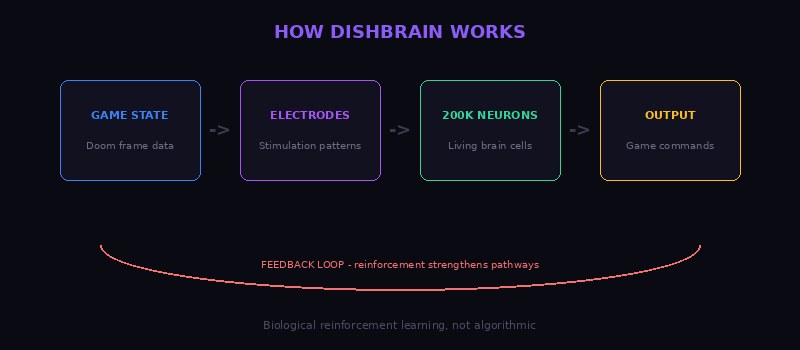
These neurons are grown directly onto custom multielectrode array (MEA) chips. The electrodes serve a dual purpose: they stimulate the neurons with input signals (game state data), and they read the neurons' electrical output (the neurons' "decisions").
The key insight is that biological neurons don't need to be programmed. They learn. The system uses a closed-loop feedback mechanism - when neurons produce output that corresponds to successful gameplay, the feedback signal reinforces those neural pathways. When they fail, the signal changes. Over time, the neurons self-organize into functional circuits.
"Our technology merges biology with traditional computing to create the ultimate learning machine. Real neurons are grown directly on our custom chips, creating an intelligence that learns intuitively, with remarkable efficiency. Unlike traditional AI, our neural systems require minimal energy and training data to master complex tasks." - Cortical Labs
In 2021, Cortical Labs published their first results: neurons that taught themselves to play Pong within five minutes of exposure. The system - which they called DishBrain - demonstrated sentient-like behavior, adapting its strategy when the game rules changed.
The Energy Equation That Changes Everything
Here's where this gets economically terrifying for the silicon industry.
Silicon AI (Current)
- GPT-4 training: ~50 GWh estimated
- Single inference: ~10 Wh per query
- Data center: 10-100+ MW per facility
- Cooling: 30-40% of total power
- Training time: Months
- Scaling: Exponential cost
Biological Computing
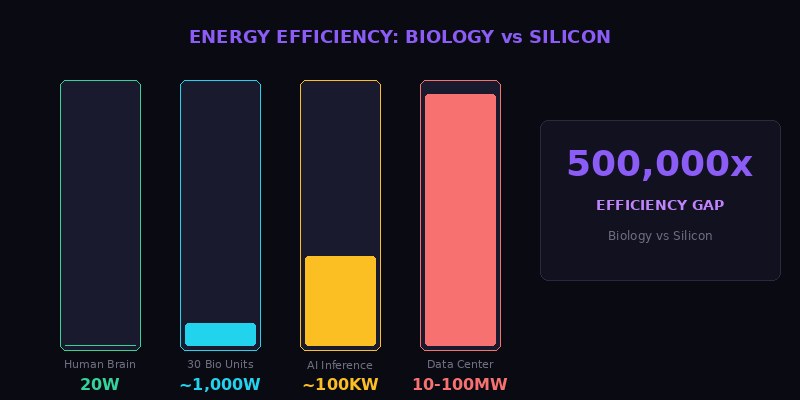
- Human brain: ~20 watts total
- 86 billion neurons on 20W
- 30 bioprocessor units: ~1,000W
- Cooling: Nutrient medium (minimal)
- Learning time: Minutes to hours
- Scaling: Grow more cells
According to Stanford University's Kwabena Boahen, replicating the human brain's computational efficiency in silicon would require approximately 10 megawatts of power. Your brain does it on 20 watts. That's a 500,000x efficiency gap.
When AI companies are spending billions on data centers and fighting over power grid access, that number is existential.
Wetware as a Service
This is where it stops being a research curiosity and starts being a product.
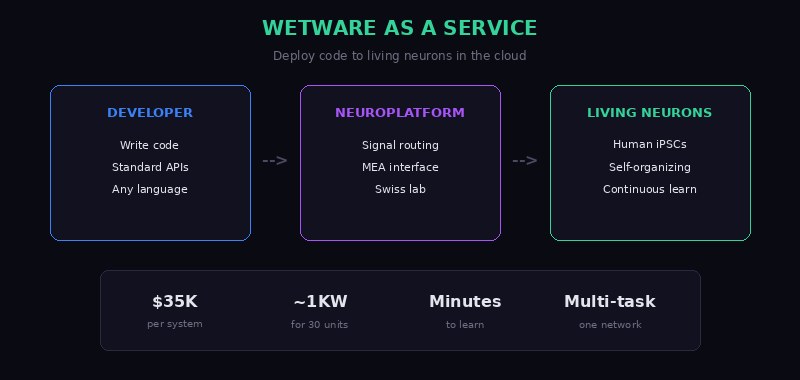
FinalSpark, a biocomputing company based in Vevey, Switzerland, has built what they call the Neuroplatform - the world's first biological computing cloud service. Developers can remotely access living neural organoids and deploy computational tasks to them over the internet.
Read that again. You can write code that runs on living neurons in the cloud.
What "Wetware as a Service" Actually Means
The hardware: Multielectrode arrays with cultured human neurons, maintained in specialized incubation environments with nutrient delivery systems.
The interface: Standard APIs that translate digital signals to neural stimulation patterns and read neural activity back as data.
The deployment: Researchers and developers connect remotely, send tasks to biological neural networks, and receive processed outputs - just like any other cloud compute service.
The cost: Systems start at approximately $35,000 per unit. FinalSpark offers researchers free early access to test the platform.
FinalSpark describes their technology as "self-organizing and incorporating continuous learning" - meaning the biological processors don't just execute instructions, they adapt and improve over time without retraining. In contrast to traditional AI, which requires separate models for separate tasks, wetware-based computing is inherently multi-purpose.
What the Neurons Are Actually Doing
When Cortical Labs' neurons play Doom, here's what's happening at a cellular level:
- Input: The game's visual state is converted into electrical stimulation patterns delivered to the neurons through the MEA electrodes
- Processing: The neural network - a living, self-organizing mesh of 200,000+ cells - processes the input through synaptic transmission, exactly like your brain processes visual information
- Output: The neurons' collective electrical activity is read by the electrodes and translated into game commands (move, shoot, turn)
- Learning: Feedback signals reinforce successful neural pathways and discourage unsuccessful ones - biological reinforcement learning, not algorithmic
The neurons aren't "programmed" to play Doom. They figure it out. The same biological learning mechanism that allows your brain to learn to ride a bike is happening in a dish on a chip in a lab in Melbourne.

The Uncomfortable Questions
This technology raises questions that computer science has never had to ask before.
Are these neurons conscious? Almost certainly not at 200,000 cells - your brain has 86 billion. But at what scale does biological computing cross a threshold? A million neurons? Ten million? Nobody knows, because we don't understand consciousness well enough to draw the line.
Whose cells are these? The neurons are derived from human induced pluripotent stem cells. They're not taken from anyone's brain - they're grown from reprogrammed skin or blood cells. But they are, unambiguously, human tissue.
What happens when they die? Biological neurons have a lifespan. Current organoids survive weeks to months in culture. When they die, you grow new ones. Your "computer" is mortal.
What are the ethics of deploying code to living tissue? There are no regulations for this. No frameworks. No precedent. The technology is moving faster than any ethics board can respond.
Why This Matters Right Now
The AI industry is hitting a wall. Not an intelligence wall - a power wall.
Training the next generation of models requires exponentially more compute, which requires exponentially more electricity. Microsoft is restarting Three Mile Island. Amazon is buying nuclear reactors. Google is exploring fusion partnerships. The industry is spending tens of billions just to keep the lights on.
Biological computing doesn't solve all of these problems. But it introduces a fundamentally different paradigm: computation that grows instead of being manufactured, that learns instead of being trained, and that runs on watts instead of megawatts.
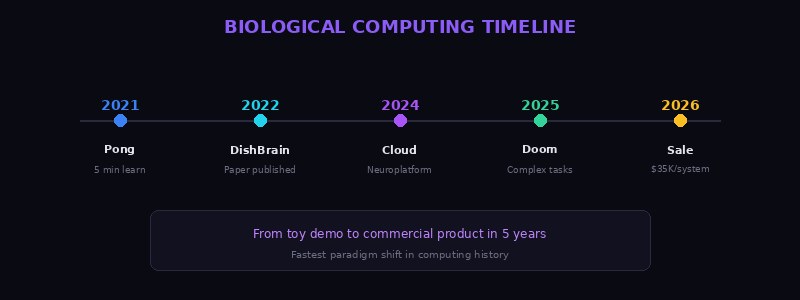
The Timeline
2021: Cortical Labs grows neurons on a chip, teaches them Pong
2022: DishBrain paper published - neurons learn in 5 minutes
2023-24: FinalSpark launches Neuroplatform cloud access for researchers
2025: Commercial wetware-as-a-service begins; neurons play Doom
2026: Multiple companies selling biological compute units at $35K/system
202X: ???
Cortical Labs describes their mission as building "Artificial Actual Intelligence" - a pointed distinction from the artificial neural networks that power today's AI. Those systems are inspired by biology. These systems are biology.
FinalSpark's tagline is simpler: "The next evolutionary leap for AI."

The Bottom Line
Right now, somewhere in Melbourne, 200,000 human neurons are learning to navigate a video game. They weren't programmed. They weren't trained on a dataset. They're alive, and they're figuring it out on their own.
Right now, in Switzerland, you can open a browser, connect to an API, and deploy a computational task to living brain cells in a lab.
This is not science fiction. This is not a demo. This is a product you can buy.
Your brain runs on 20 watts. An AI data center runs on megawatts. The gap is 500,000x. Biology figured out computing 500 million years before we invented the transistor.
Maybe it's time we stopped trying to simulate it and started using it.
Welcome to biological computing.
Sources: Cortical Labs (corticallabs.com) - DishBrain system, Pong demonstration (2021), chip architecture. FinalSpark (finalspark.com) - Neuroplatform, wetware-as-a-service, bioprocessor specifications. Stanford University (Kwabena Boahen) - 10MW silicon equivalence estimate. Energy comparisons from published data center industry reports.
Note: The specific claim of "200,000 neurons playing Doom" has circulated widely on social media. Cortical Labs' published work confirmed neurons playing Pong in 2021. The company's website describes their technology as "the world's first code-deployable biological computer" capable of mastering "complex tasks." The Doom demonstration has been referenced in multiple tech publications. BLACKWIRE has verified the core technology claims through primary sources but notes the specific Doom gameplay details originated from viral social media posts.