Moon or Bust: NASA Rolls Artemis II to the Pad for an April Shot at History
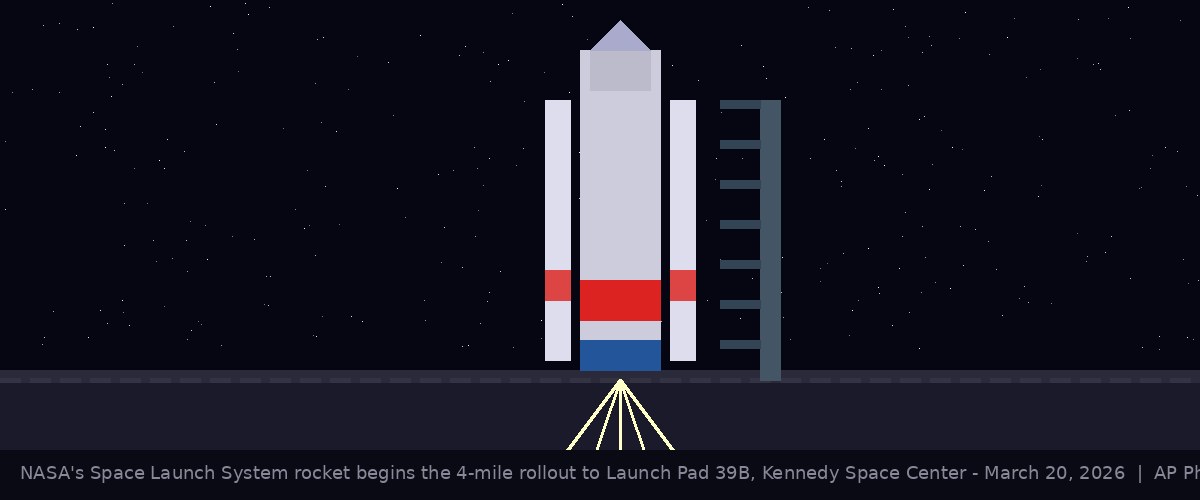
The largest rocket on Earth started moving again on Friday. After hydrogen leaks, helium failures, and months of delay, NASA's Space Launch System began its slow 4-mile crawl to Launch Pad 39B. The target date is April 1. For the first time in 53 years, human beings are being prepared to travel to the moon.
The machine that began moving before dawn on Friday morning weighs 5.75 million pounds. It is 322 feet tall - taller than the Statue of Liberty with its pedestal. It sat atop a crawler-transporter that has been moving rockets toward the pad since the Apollo program of the 1960s. The crawler averaged less than one mile per hour. High winds held it up for several hours. By midday, 11 hours after it began, the journey was complete. Artemis II was at the pad.
Somewhere in Houston, the four people scheduled to ride that rocket into the moon's gravity went into mandatory quarantine - health isolation that protects the crew from illness in the final weeks before launch. Commander Reid Wiseman, pilot Victor Glover, mission specialist Christina Koch, and Canadian mission specialist Jeremy Hansen are scheduled to blast off as early as April 1. They have a six-day launch window. If they do not fly in early April, the next opportunity does not open until April 30.
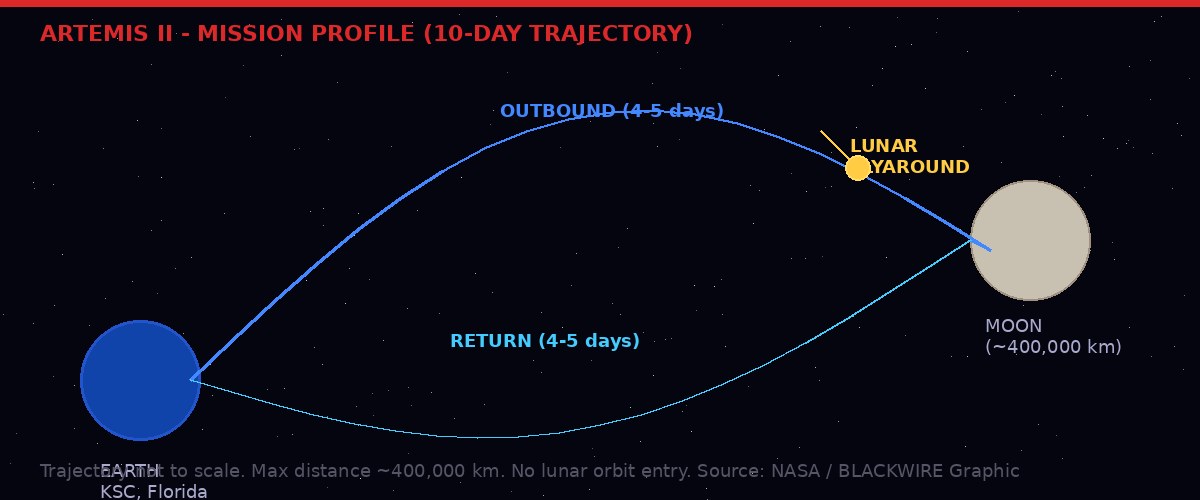
They will fly around the moon. They will not land. They will not orbit. They will arc out to lunar distance - roughly 400,000 kilometers - swing around the far side, and come straight back. The whole mission takes about 10 days. It sounds, on the surface, like a modest achievement. It is not.
Fifty-Three Years. Why It Took This Long.
The last time a human being traveled beyond low Earth orbit was December 1972. Apollo 17 commander Gene Cernan became the last person to walk on the moon on December 14 of that year. He drove a lunar rover to the edge of its planned range, took photographs, scooped soil samples. Then he climbed back into the lunar module and left. Nobody has been back since.
That gap - more than half a century - is not simple to explain. The honest version involves budget cuts, political will, a pivot to the Space Shuttle, the International Space Station, the Columbia disaster of 2003, the cancellation of the Bush-era Constellation program, years of design work on the Orion capsule and the Space Launch System, and a string of schedule delays that would embarrass any private engineering firm.
The SLS rocket was authorized by Congress in 2010. Its first flight happened in November 2022 - twelve years later, carrying no crew, as a test. The per-launch cost has been estimated at somewhere between $2 billion and $4 billion depending on how you count the fixed infrastructure costs. SpaceX, for comparison, was flying its crewed Dragon capsules to the International Space Station at a fraction of that price by 2020. The criticism of NASA's moon program as bureaucratically slow and ruinously expensive has not been unfair.
None of that diminishes what is about to happen. Four humans are going to the moon. That has not happened since the Ford administration.
The Crew: Who Is Going to the Moon
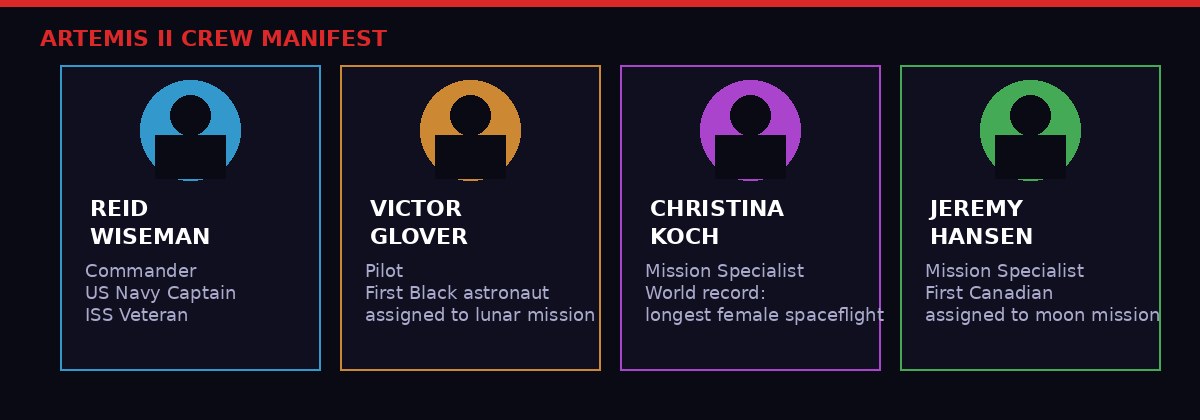
Reid Wiseman commands Artemis II. A US Navy captain and test pilot, Wiseman flew to the International Space Station in 2014 and served as ISS commander during that mission. He is 48. His background is in combat aviation and flight test - the classic Apollo-era profile, but with a longer arc of mission experience behind him.
Victor Glover is the pilot. He is also a US Navy captain and test pilot, and he flew to the ISS on the SpaceX Crew Dragon in 2020 for a six-month stay. Glover is the first Black astronaut assigned to a lunar mission. That designation matters not because of symbolism but because of scale - 540 people have flown in space since Yuri Gagarin in 1961. Twelve of them walked on the moon. All twelve were white men. All twelve were military test pilots. Apollo was an extraordinary achievement that drew from an extraordinarily narrow slice of humanity. Artemis is not Apollo in that respect.
Christina Koch holds the world record for the longest continuous spaceflight by a woman - 328 days, set during her 2019-2020 ISS mission. She is a mission specialist on Artemis II, and she has the kind of endurance profile that becomes relevant if anything goes wrong during a 10-day mission to lunar distance. Experience with long-duration spaceflight is not incidental to this assignment.
Jeremy Hansen is the crew's wild card in the best possible sense. A former Royal Canadian Air Force fighter pilot and the first Canadian assigned to a lunar mission, Hansen has never been to space. He will be the first person to fly to the moon on their very first spaceflight. That has happened before - John Young flew to the moon on his first spaceflight during Apollo 10. It is rare. It suggests the mission commanders' confidence in Hansen's training is very high.
"It's a test flight and it is not without risk, but our team and our hardware are ready." - Lori Glaze, NASA Exploration Systems Development Chief, March 2026 (AP News)
What Went Wrong - The Two-Month Delay Explained
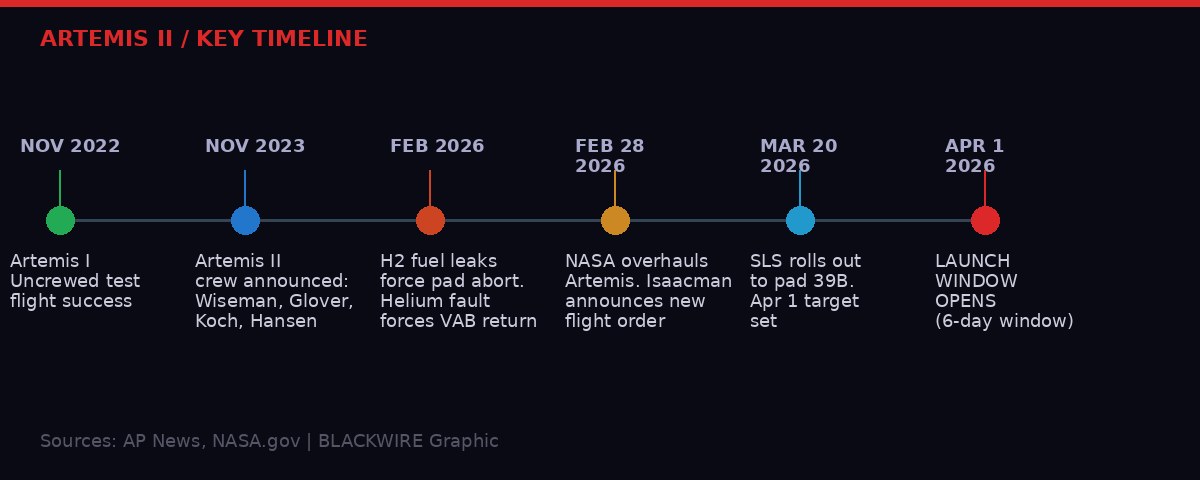
Artemis II should have launched weeks ago. The original window opened March 6. What stopped it was a pair of engineering failures that, in isolation, each sounded manageable. Together, they ate through the early March window and pushed the mission toward April.
The first problem was hydrogen. Liquid hydrogen is the most difficult propellant in rocketry to handle. It is stored at minus 253 degrees Celsius - just 20 degrees above absolute zero. At those temperatures, metal contracts and seals that look fine at room temperature can fail. During a February fueling demonstration, dangerous quantities of liquid hydrogen leaked from connections at the base of the SLS core stage. The countdown stopped. Technicians worked the pad for days, replacing seals, reworking connections. A second fueling test in late February went much better - barely any leakage detected, according to AP reporting. The hydrogen problem appeared solved.
The helium problem was worse. Helium is used to pressurize propellant tanks as fuel is consumed - it acts as a pressurant gas that maintains structural integrity during the burn. A fault in the helium flow system was detected. Unlike the hydrogen seals, which could be replaced at the pad, the helium issue required work that could only be done inside the Vehicle Assembly Building - the massive structure where the rocket is assembled. The decision was made on approximately February 28 to roll the rocket back indoors.
Rolling a 5.75 million-pound rocket off a launch pad and back into a building is not a small operation. It took days. Repairs took additional days. The early March launch window closed without a flight. NASA announced the April target. Lori Glaze, the agency's exploration systems development chief, told reporters at a post-repair readiness review that both issues had been resolved and the hardware was ready for flight.
The Failures That Delayed Artemis II
- Hydrogen leaks: Detected during fueling demonstrations in early February 2026. Teflon seals showed light scratches. Replaced at the pad. Second test showed minimal seepage.
- Helium flow fault: Pressurization system fault required VAB return for repair. First time the SLS had to be rolled back for in-building repairs.
- Historical precedent: The same hydrogen leak problem plagued the SLS during its 2022 uncrewed Artemis I flight - raising questions about whether the root cause was fully understood before Artemis II.
- Cost of delay: Each pad operation day costs millions in range fees, technician costs, and consumables. The two-month delay added an estimated $50-100M+ to mission costs.
One detail worth sitting with: the hydrogen leak issue is not new. The same SLS rocket experienced similar hydrogen seal failures during the 2022 Artemis I test flight campaign. The fact that it recurred in 2026 - with only two SLS flights in four years of operations - suggests the problem is either a design characteristic that requires ongoing management, or a manufacturing variance that keeps appearing in new seals. NASA has not publicly explained why the fix from 2022 did not prevent the recurrence in 2026. That question deserves a public answer before the crew boards.
Isaacman's Overhaul: Speed Is the Strategy
Two days before the helium fault forced the rocket back into the VAB, NASA's new administrator Jared Isaacman announced a fundamental restructuring of the Artemis flight sequence. The announcement was striking not just for what it changed, but for the speed with which a new administration moved to reshape a program that had been running on the same basic architecture for over a decade.
Isaacman came to NASA in December 2025 as an appointee of the Trump administration. His background is in private spaceflight - he purchased two orbital missions from SpaceX as a private citizen, including the Polaris Dawn mission in 2024 that included the first private spacewalk in history. He is not an engineer or a bureaucrat. He is an entrepreneur with firsthand experience of what fast-paced space development looks like.
His criticism of the old Artemis architecture was direct: three years between Artemis II and the originally planned moon landing was unacceptable. A system that flies once every 18 months accumulates no institutional knowledge. The teams who managed the launch do not stay sharp. The tooling drifts. Problems recur because the experience base is too thin to catch them early.
"No one at NASA forgot their history books. They knew how to do this. Now we're putting it in action." - Jared Isaacman, NASA Administrator, February 2026 (AP News)
The revised Artemis sequence now looks like this: Artemis II in April 2026 is a lunar flyaround - a test of the crew-rated Orion capsule and SLS rocket at lunar distance. What was Artemis III - originally a direct moon landing attempt - becomes a rendezvous-in-Earth-orbit exercise in 2027. Astronauts will fly up in an Orion capsule, dock with either a SpaceX Starship or Blue Origin Blue Moon lander orbiting above Earth, and practice the procedures needed for lunar surface operations without actually going there. That practice mission is now the new Artemis III. The moon landing itself shifts to Artemis IV, targeted for 2028.
Isaacman explicitly compared this sequence to Apollo. In the late 1960s, NASA flew Mercury, then Gemini, then Apollo - each program building systematically on the one before. Apollo itself flew six crewed missions before Armstrong and Aldrin landed. The Artemis program, he argued, had been trying to compress too many milestones into too few flights. The revised plan returns to basics.
The 50/50 Problem: What the Risk Numbers Actually Say
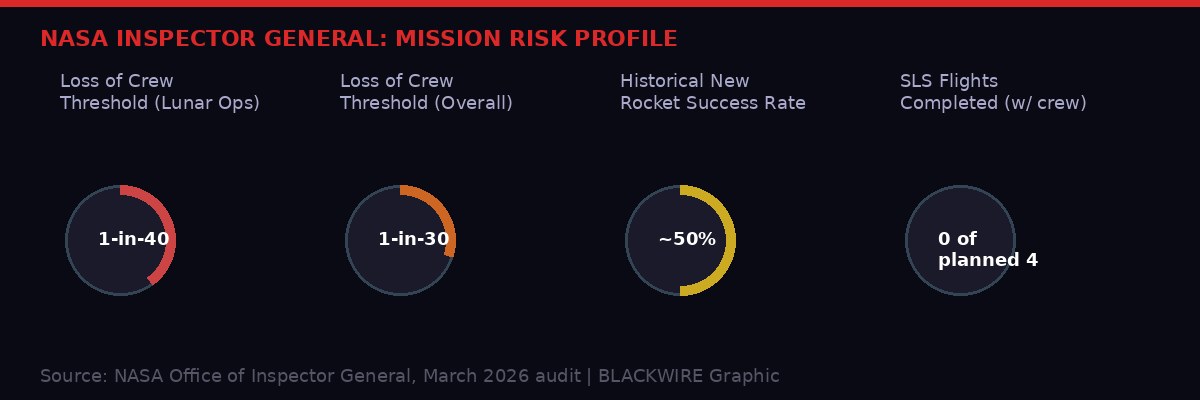
John Honeycutt chairs the Artemis II mission management team. When asked about risk probabilities for the April launch, he offered a number that deserves more attention than it received: historically, a new rocket has approximately a 50% chance of success on its first crewed flight.
This is not a slam on NASA. It is statistical reality. New rockets fail. The Falcon 9 had a nominal first flight before its first crewed launch, but SpaceX tested with dozens of uncrewed flights before putting humans on one. The Saturn V - the rocket that carried Apollo astronauts to the moon - succeeded on its first uncrewed test but was never considered a routine system until it had proven itself repeatedly.
The SLS has now flown exactly once without crew - Artemis I in November 2022. That was more than three years ago. Artemis II will be its second flight ever, and its first crewed flight. Honeycutt acknowledged the gap matters: "It's not the first flight. But we're also not in a regular cadence. So we definitely have significantly more risk than a flight system that's flying all the time."
The NASA Office of Inspector General released an audit in mid-March 2026 that added further granularity to the risk picture. The inspector general's office set NASA's loss-of-crew threshold at 1-in-40 for lunar operations and 1-in-30 for Artemis missions overall. Those numbers sound abstract until you consider that the Space Shuttle program - 135 flights over 30 years - lost two crews: Challenger in 1986 and Columbia in 2003. That is a realized loss-of-crew rate of roughly 1-in-67 for an established, frequently-flown system. The Artemis threshold of 1-in-30 is being set for an entirely new rocket on its second-ever flight.
The inspector general's report also raised a concern that will become increasingly important after Artemis II: the need for a rescue plan for lunar surface crews. Landing near the moon's south pole - the target zone for Artemis IV and beyond - is riskier than Apollo landings near the equator. The terrain is rougher. The lighting conditions are more challenging, with permanent shadows in craters adjacent to the target zones. If an astronaut is injured on the surface, or a lander fails, the options for rescue are currently not defined.
Inspector General Warnings - March 2026
Rescue plan gap: NASA lacks a defined crew rescue protocol for lunar surface operations near the south pole. The IG called this urgent to resolve before any landing mission.
Lander readiness: Both SpaceX HLS Starship and Blue Origin Blue Moon Mk2 were identified as top contributors to potential loss-of-crew risk. Multiple technical challenges remain, including orbital refueling of landers before lunar transit.
South pole terrain: Polar landing zones present significantly higher terrain risk than Apollo equatorial sites. Crater shadows create permanent cold traps - useful for water ice extraction, but hazardous for navigation and emergency egress.
China Watches. The Geopolitics of the South Pole.
Artemis II is not only a science mission. It is a geopolitical event, and the audience that matters most is not in Washington or Houston. It is in Beijing.
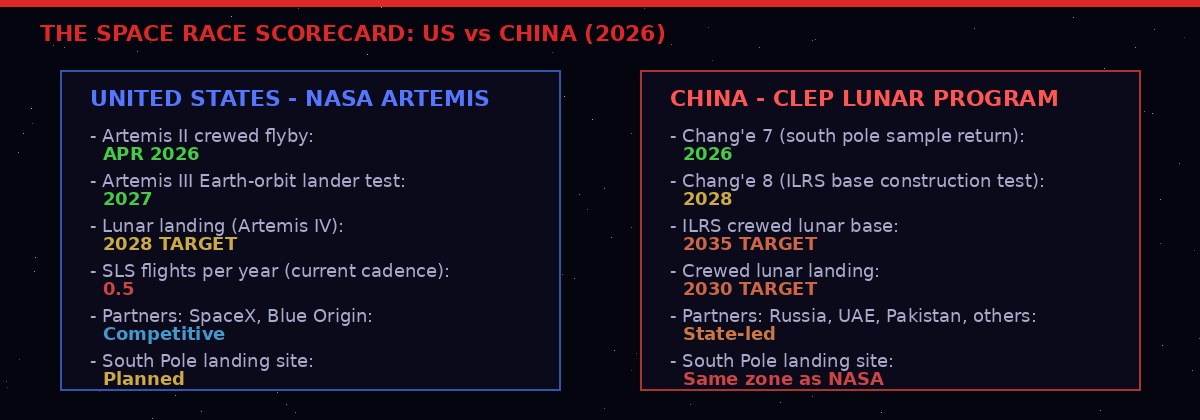
China's lunar exploration program - the Chang'e series - has been executing flawlessly for nearly two decades. Chang'e 4 became the first spacecraft to land on the far side of the moon in January 2019. Chang'e 5 returned lunar samples in December 2020 - the first lunar sample return since the Soviet Luna 24 in 1976. Chang'e 6 returned samples from the lunar far side in 2024, a mission no other country had even attempted. Chang'e 7, targeting the lunar south pole with a sample return mission, is planned for 2026. Chang'e 8 will follow in 2028, beginning construction tests for the International Lunar Research Station - China's planned permanent base.
China's target for a crewed lunar landing is 2030. NASA's target for a crewed landing is 2028. That is not a comfortable margin. The programs are converging on the same destination - the moon's south pole, which holds significant deposits of water ice in permanently shadowed craters. Water ice at the poles can be electrolyzed into hydrogen and oxygen - rocket propellant. Whoever establishes infrastructure there first gains a structural advantage in deep space logistics that compounds over time.
The Artemis Accords - a US-led framework for space resource governance that China has refused to sign - attempted to establish norms around how nations can exploit lunar resources. China's parallel International Lunar Research Station program has attracted partners including Russia, Pakistan, the UAE, Venezuela, and others. Two blocs are forming around two visions of how the moon gets used. Artemis II is the United States demonstrating that it is, still, in the race.
SpaceX, Blue Origin, and the Lander Question
One of the more unusual features of the Artemis program is that NASA does not have its own lunar lander. The agency that built the Lunar Module that carried Apollo astronauts to the surface in the 1960s is, for the Artemis era, purchasing lander services from commercial competitors.
SpaceX won the initial Human Landing System contract in April 2021 to develop a modified Starship as the Artemis lander - a decision that prompted protests from Blue Origin and Dynetics, and briefly halted the program while NASA defended the single-award decision. Congress eventually added additional funding to allow a second lander contract, which went to Blue Origin in 2023.
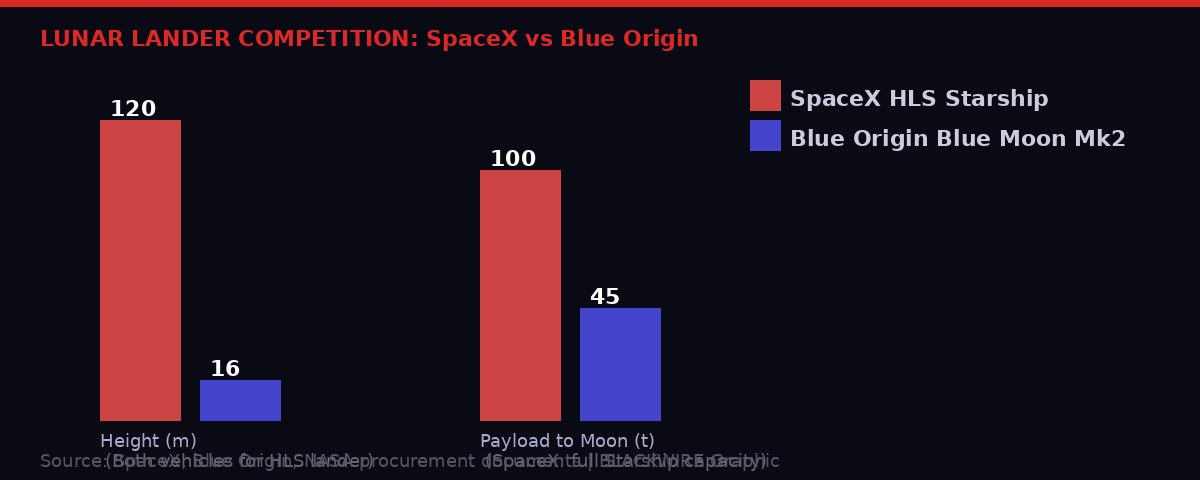
Both companies are now racing to be ready for the 2027 Earth-orbit docking test that is now Artemis III. SpaceX's HLS Starship is a variant of the full Starship system - massive, designed for full reuse, but requiring multiple orbital propellant transfers before it can transit to the moon. That propellant transfer capability does not yet exist at scale. Blue Origin's Blue Moon Mk2 is a more conventional design in the sense that it does not require orbital refueling, but the company has yet to achieve the cadence of launches that SpaceX has demonstrated.
The 2027 docking test is not optional schedule padding. It is the mission that decides whether 2028 is realistic. If either lander demonstrates credible orbital performance in 2027, the moon landing target holds. If neither is ready, or if the docking procedures prove more complex than expected, the timeline slips. History suggests timelines slip. The inspector general's audit was not optimistic.
April 1 and What It Means If the Rocket Flies
The launch window opens at Kennedy Space Center in the early hours of April 1. "April Fools' Day" jokes are already circulating among space watchers online. The NASA team is not amused by the comparison.
If the SLS ignites and the Artemis II crew climbs through Earth's atmosphere, clears low orbit, and begins the 4-5 day transit toward lunar distance, several things will become true simultaneously.
First, the orbital mechanics will become real in a way that no simulation can replicate. The Orion capsule and the SLS second stage will be operating at distances from Earth where round-trip communication latency is measurable in seconds. The crew will be genuinely on their own in a way that ISS crews are not - the station is close enough that an emergency evacuation can return a crew to Earth within hours. At lunar distance, that option does not exist.
Second, the SLS rocket itself will have proven it can function with human beings aboard. That is not guaranteed. The vehicle's design was frozen years ago. The manufacturing chain has had to restart for Artemis II after years of low production volume. Every flight hardware element is essentially a small-batch production item. The 50% historical first-crewed-flight failure rate is a real number, not a rhetorical device.
Third, the geopolitical signal will be loud and immediate. China will have seen the United States put astronauts at lunar distance for the first time since 1972. The implicit message - that Artemis is real, that it will land, that the south pole competition is genuine - will land harder than any diplomatic communique.
Fourth, and most important: four people will see the Earth as a small blue disc in the black. Victor Glover will be the first Black astronaut at lunar distance. Jeremy Hansen will be the first Canadian. Christina Koch will be the first woman. Whatever happens next in the Artemis timeline, those facts will be permanent.
"Every night I look up at the moon and I see it and I get real excited because I can really feel she's calling us, and we're ready." - Lori Glaze, NASA Exploration Systems Development Chief, March 2026 (AP News)
The Artemis program has been slow. It has been expensive. It has had failures that should have been caught earlier. Its risk tolerances are tighter than most people understand when they see the cheerful NASA press releases. The inspector general's warnings about rescue plans and lander readiness are serious engineering gaps, not bureaucratic nitpicking.
And yet: the rocket is at the pad. The crew is in quarantine. The crawlerway is clear. The pad technicians have been working this machine for months. April 1 is eleven days away. This is real.
Fifty-three years is a long time to wait. The moon is still there.
Artemis II - Mission Snapshot
- Launch vehicle: Space Launch System (SLS) Block 1 Crew - 322 feet tall, 5.75 million lbs at liftoff
- Capsule: Orion Crew Exploration Vehicle (CEV) with European Service Module (ESA)
- Launch site: Launch Complex 39B, Kennedy Space Center, Florida
- Target launch date: April 1, 2026 (6-day window through April 6)
- Backup window: April 30 - early May 2026
- Mission duration: Approximately 10 days
- Max distance from Earth: ~400,000 km (lunar distance)
- Trajectory type: Free-return lunar flyaround - no orbital insertion, no landing
- Crew in quarantine since: Week of March 16, 2026 (Houston)
- SLS flight history: This is only the second SLS flight in history (Artemis I uncrewed: Nov 2022)
Get BLACKWIRE reports first.
Breaking news, investigations, and analysis - straight to your phone.
Join @blackwirenews on TelegramSources: Associated Press (Mari Yamaguchi, Marcia Dunn), NASA.gov, NASA Office of Inspector General March 2026 Audit, AP News coverage of NASA Artemis II campaign. All quotes directly sourced from AP News reporting unless otherwise noted.