Left Behind: Americans Abandoned in a War Their Government Started
They voted for the anti-war candidate. Then missiles started falling over the Middle East, and when they called the US State Department, they got voicemail. The human story of Americans stranded in a conflict zone with nothing but a passport that turned out to mean very little.
The passport said "United States of America." The response from the embassy said full voicemail. BLACKWIRE graphic.
Dylan packed a bag in about seven minutes. He was 31 years old, teaching at a school in Bahrain, and he had just heard five explosions in rapid succession. When he looked out the window, smoke was rising from the naval base at Juffair. It was the morning of February 28, 2026 - the day the United States and Israel launched coordinated strikes against Iran.
"After I saw the smoke, it was like I was staring into the face of death," Dylan later told The Guardian. "I knew I needed to do something immediately."
What he did not know yet was that he would need to do everything himself. The embassy phone line was full. The State Department hotline was unreachable. His parents back in the US frantically tried calling on his behalf - also no answer. For the next several days, Dylan sheltered in a school while the region around him filled with explosions, intercepted missiles, and sirens. Eventually, it was not the US government that offered him a path out. It was the British consulate - overheard on speakerphone while talking to his British friend - that gave him his first real piece of advice.
"The British were far more responsive and helpful," he said.
That detail - that a 31-year-old American teacher had to rely on the goodwill of a foreign government to navigate his own country's war - sits at the center of a story that is larger than one man, one war, or one administration. It is a story about what a government owes the people who carry its passport, and what happens when that debt comes due and there is nobody at the window.
The Morning Everything Changed
In the weeks leading up to February 28, there had been regional tensions - there are always regional tensions - but nothing that prompted the US State Department to formally advise its citizens in the Gulf to leave. No evacuation advisory. No emergency registration push. No "here is what happens if things go badly."
So when the strikes happened, an estimated tens of thousands of American citizens scattered across Bahrain, the UAE, Qatar, Saudi Arabia, Kuwait, and surrounding countries woke up to a conflict that had been launched in their backyard without a plan for getting them out.
According to a State Department official, the department's Task Force "directly provided security guidance and travel assistance to about 32,000 impacted Americans" in the aftermath. Most who were offered seats on charter flights "declined, opting to remain in country or take commercial flight options," the official said. (Reuters, March 12, 2026)
That framing - that Americans mostly chose to stay - obscures how chaotic the first days actually were. Commercial flights did not disappear instantly, but airspace over much of the Gulf was genuinely unpredictable, and the window for cheap, organized departure closed rapidly. The State Department did not release an online form for citizens requesting assistance until March 5 - a full week after the conflict began.
One week. Seven days. That is how long it took to put a form online.
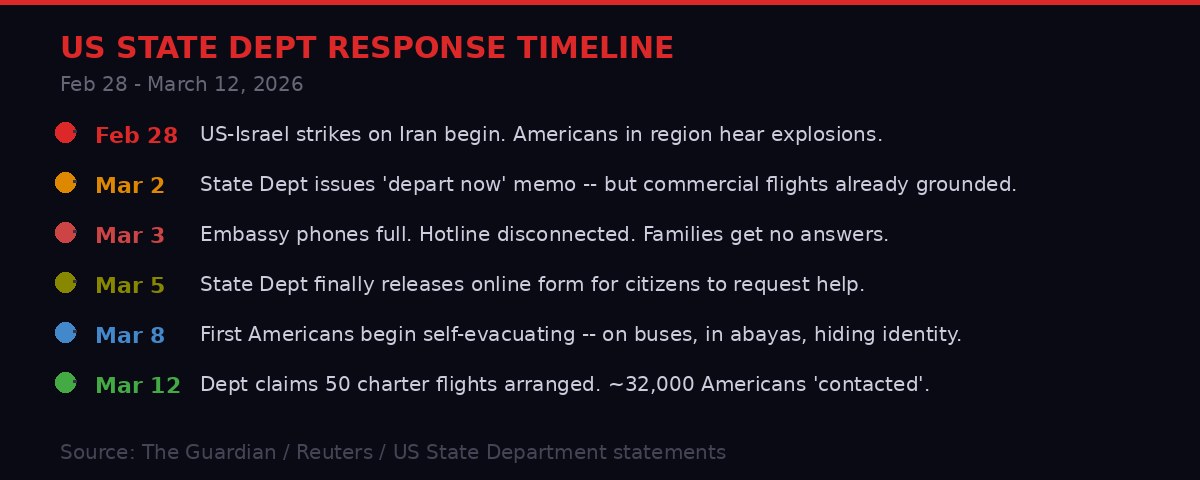
The week between bombs falling and help arriving. BLACKWIRE timeline graphic / Sources: The Guardian, Reuters, State Department statements.
The People Who Fell Through the Gap
Ashley was on a month-long holiday in Abu Dhabi. She is from North Carolina originally but lives in France now, works in product marketing in tech, and had brought her boyfriend and their five-year-old along. They were not expats embedded in the Gulf long-term - they were tourists, in the most ordinary sense, on a family break.
When the strikes began, Ashley immediately tried to arrange departure. She called the State Department's emergency line. She read the website's reassurances that "the number one priority is the safety of American citizens." She called the number they listed.
"They said 'all you have to do is call this number,' and then you call the number, and they had no idea what was going on. There was no one to help you." - Ashley, US citizen stranded in Abu Dhabi, to The Guardian, March 2026
Then came the State Department's March 2 memo: "depart now." But by that point, Ashley explains, the skies were closing. Airlines were adjusting routes. Airport operations were in flux. "There was no way to depart. So it just became this mess of the US government saying all these things that were impossible," she said.
She eventually found a commercial flight on March 6 UAE time - to Portugal, not the US. Two hours before takeoff, missiles were being intercepted near the airport. She described the flight through Middle Eastern airspace as genuinely terrifying.
"Every time we hit turbulence as we were travelling through the Middle East, it was really scary."
When they landed in Europe, she felt physically sick.
A mother. A five-year-old. A government that issued a "depart now" order when departure was functionally impossible, then waited three more days to start "reaching out to people." Ashley's verdict was not hysterical. It was measured and specific.
"It's wild that a government that starts a war would then wait days into the war to start repatriating everyday citizens. Have a plan in place. Help us to feel supported." - Ashley, speaking to The Guardian from Portugal, March 2026
The Trump Voters Who Felt Betrayed
There is a particular kind of political pain in this story that goes beyond bureaucratic failure. Aaliya - 37, a US citizen living in Abu Dhabi with her husband and two young children - had voted for Donald Trump. More than that, she says she actively encouraged family members to vote for him. The reason was his anti-war stance.
Trump had campaigned, at various points, on ending wars and not starting new ones. For diaspora Americans living in the Gulf - a region acutely sensitive to US military action - this was not a peripheral campaign promise. It was the central reason to choose him.
When the bombs fell on February 28, Aaliya's trust fell with them.
"There wasn't a coherent plan on how to help US citizens. We were an afterthought. We felt betrayed and embarrassed." - Aaliya (last name withheld), US citizen in Abu Dhabi, to The Guardian, March 2026
She said she had "encouraged all her family to vote for Trump" because of his promise to "put America and Americans first." The abandonment she felt was not just practical - it was ideological. The candidate she trusted had, in her experience, done exactly the opposite of what he promised: started a war and then left its collateral citizens to figure things out on their own.
This is a common rupture in wartime. The people closest to the blast radius - whether by geography, ethnicity, or political belief - often discover that the abstraction they voted for is very different from the reality they live in. For Aaliya, "America First" apparently did not extend to the Americans who happened to live in Bahrain or the UAE.
"I shouldn't have had to have the random luck that my dad somehow had a connection to a legislator." - Dylan, 31, American teacher stranded in Bahrain
How Dylan Got Out - and What That Should Tell Us
Dylan's route out of Bahrain is worth following in granular detail, because it illuminates how ad-hoc and dangerous the self-evacuation process actually was.
After days sheltering in a school with explosions and missile interceptions audible outside, he decided on March 2 to drive across the King Fahd Causeway into Saudi Arabia. He made this call not because anyone advised him to, but because he was afraid the causeway might be bombed and he wanted to cross while it still existed.
Saudi Arabia issued him a visa on arrival - a process that worked, but that many Americans would not have even known to attempt. He then spent three more days before deciding to travel to Jeddah rather than fly from Riyadh or Dammam - a choice driven by an intuitive sense that coastal cities might be safer. The overland journey took 20 hours.
He was traveling with a female friend. During the journey, some people they encountered were hostile toward her because she was not wearing a hijab. She put on an abaya. Dylan started speaking Portuguese instead of English.
"I was speaking Portuguese with my friend because I didn't want people to think I was American," he said. "We were being very low-key."
An American citizen, in a country he was passing through on his own initiative, hiding his nationality. Not because of paranoia - because of genuine, rational fear about how his passport might be perceived in a region being bombed by his government.
He eventually flew from Jeddah to Lisbon on March 8. He hopes to return to Bahrain if the war ends. He has not received any apology or explanation from the State Department.
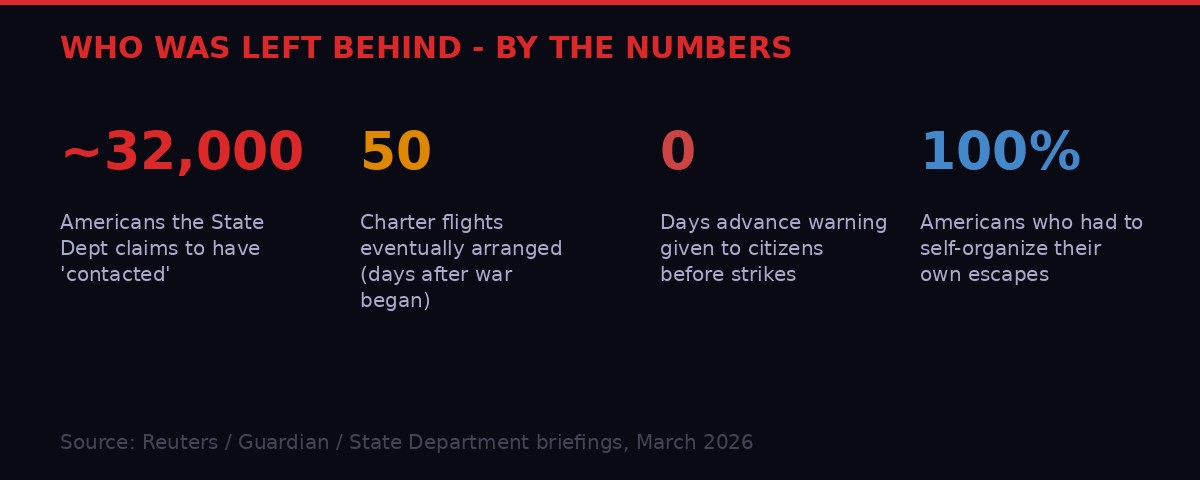
The scale of abandonment, in figures. BLACKWIRE data graphic / Sources: Reuters, Guardian, State Department press statements, March 2026.
The Broader Pattern: Citizens as Afterthoughts
What happened to Dylan, Ashley, and Aaliya is not exceptional in the history of American foreign policy. It is the rule.
In every major US military engagement since World War II, American civilians in affected regions have faced a version of the same problem: the government that claims their protection initiates or escalates conflict without a coherent plan for the non-combatants holding US passports who happen to be nearby.
The scale varies. During the 2006 Israeli-Lebanese conflict, around 25,000 Americans were eventually evacuated from Lebanon - but only after significant delays and logistical failures that drew Congressional criticism. In the 2021 Kabul withdrawal, American citizens and green card holders were left scrambling through Taliban checkpoints with no State Department support. The pattern is old. The justifications shift. The failures repeat.
What is different in 2026 is the speed of information. Dylan could document his experience in real time. Ashley could speak to reporters from Portugal within days of landing. Aaliya's account reached millions through The Guardian within two weeks of the strikes. The government's failures are no longer processed slowly through official channels and formal hearings - they arrive immediately, in first person, with names (however partially redacted for safety).
This matters because accountability in the information age theoretically moves faster. Whether it actually does is another question. The State Department's response to all three accounts was a single official statement: the Task Force contacted 32,000 people, most declined offered seats, nearly 50 charter flights were arranged. Clinical, passive, implying that most people chose their situation rather than having it imposed on them.
Dylan, Ashley, and Aaliya all dispute this framing. None of them felt they had real choices. None of them feel the government fulfilled its basic obligation. And critically, none of them are particularly radical voices - they are ordinary people with ordinary lives who simply expected that their government, having started a war, might extend the courtesy of a functioning phone line.
The Diaspora Question - Who Gets Protected?
There is a harder, less polite question underneath the logistics failures, and it is this: in the American political imagination, does the word "citizen" carry the same weight when that citizen is living abroad in a Muslim-majority country, teaching in Bahrain, raising kids in the UAE?
The US has approximately 9 million citizens living abroad at any given time - one of the largest overseas citizen populations in the world. They are teachers, engineers, oil workers, aid workers, academics, spouses of foreign nationals, retirees, tech workers running global product lines. They hold valid US passports. They pay US taxes in many cases. They vote in US elections.
But they are, in the cultural imagination of most domestic politicians, essentially invisible. "America First" has always been a domestic framing - its implicit geography is the continental United States, its implicit citizen is the one who never left. The American abroad is an abstraction, and abstractions do not vote in sufficient blocs to demand real infrastructure.
The Middle East complicates this further. Many American citizens in the Gulf are there precisely because the region is economically vibrant and culturally rich - but they are also, in some corners of the domestic conversation, regarded with ambient suspicion if they are Arab-American, Muslim, or have dual citizenship. The question of whether Aaliya's experience of abandonment was purely bureaucratic, or whether it also carried an implicit message about whose safety really counts, is not one that official statements will ever address directly.
What we can say is this: when the British consulate was more accessible than the American embassy in Bahrain, something has gone structurally wrong. Not accidentally wrong - systemically wrong. The UK maintains a robust network of consular services precisely because it believes, institutionally, that its citizens abroad represent a national interest worth protecting. The US version of that belief, as experienced on the ground in March 2026, was a full voicemail box.
Timeline of Abandonment - February 28 to March 12, 2026
What This Reveals About American Identity in 2026
There is something uncomfortable in Dylan's decision to speak Portuguese and pretend not to be American. It is uncomfortable because it represents a form of identity negotiation that Americans are not supposed to need - the US passport is supposed to be a door-opener, a signal of relative safety, a document that commands institutional respect. In March 2026, in certain parts of the Middle East, it was closer to a liability.
This is not entirely new. American travelers have quietly downplayed their nationality in various geopolitical contexts for decades - particularly after Iraq, after Abu Ghraib, during the height of anti-American sentiment in the early 2000s. But there is something more acute about hiding your identity in a country that your own government has decided to bomb. Dylan was not hiding from general anti-Americanism. He was hiding because the US had just initiated a large-scale military operation in the region and the blowback was real and present.
Ashley's framing - "it's a shame that you can't count on your own government" - is worth sitting with. She does not sound angry in the explosive sense. She sounds disappointed, in the particular way people get disappointed when something they assumed was solid turns out to be made of cardboard. She assumed the US government had a plan. It did not. She assumed her citizenship meant something in a crisis. It mostly meant a website that said "depart now" when departure was functionally unavailable.
Aaliya's story is perhaps the sharpest, because it has the clearest political edge. She trusted Trump specifically on the question of war. That trust was demolished within 72 hours of the strikes. Her sense of betrayal is not partisan - she is not a liberal who resented Trump and now feels vindicated. She is someone who believed a specific promise, made a political choice based on that promise, and then watched the promise evaporate in real time while sitting in a Gulf city listening to air defense systems activate overhead.
This is the kind of biographical rupture that changes how people think about political promises. Not as ideas to be evaluated abstractly, but as contracts to be tested against lived experience. Aaliya's contract was tested, and the counterparty defaulted.
The Structural Failure Behind the Human Failure
It would be easy, and wrong, to frame this entirely as a Trump administration failure. The structural problems are older and deeper than any single presidency.
The US does not have mandatory registration for citizens living abroad. Roughly a quarter of overseas Americans register with the State Department's STEP (Smart Traveler Enrollment Program) - meaning the government often does not know where its citizens are when a crisis hits. Dylan registered late, Ashley was a tourist rather than a registered expat, and Aaliya's registration status was not specified. The system is opt-in, voluntary, and historically underpromoted.
Consular staffing is chronically underfunded relative to the scale of the overseas citizen population. The State Department has faced budget pressures and hiring freezes across multiple administrations. The phone lines that went to voicemail in Bahrain were not a Trump-specific innovation - they were the product of years of treating consular services as a low-priority line item.
The gap between what Americans are told their passport guarantees and what it actually delivers in a crisis is not new. It is advertised as a symbol of safety and access. In practice, it is a bureaucratic document serviced by an infrastructure that has never been sized for genuine large-scale emergencies. The last time the US had to extract large numbers of citizens from a sudden conflict, in Kabul in 2021, the result was similarly chaotic - and the lessons, whatever they were, were apparently not institutionalized before 2026.
What would institutionalization look like? Mandatory pre-departure registration. Pre-negotiated evacuation agreements with regional partners. Staffed 24/7 emergency lines with real people on them. Pre-positioned charter contracts that can be activated within hours rather than days. Crisis communication protocols that do not rely on civilians finding each other through congressional aides and speakerphone conversations with British consular staff.
None of this is technologically complicated. It requires political will and sustained budget commitment over multiple administrations - which is exactly why it does not exist.
What Comes Next for the People Who Lived It
Dylan says he wants to return to Bahrain if the war ends. He liked his life there. He is not sure his contract will still be waiting for him. He is back in the US for now, staying with family, trying to process two weeks of trauma compressed into a 20-hour bus ride and a transatlantic flight.
Ashley is back in France. Her five-year-old asked questions that she did not know how to answer. She says she will think very carefully before taking her family to that region again, not because of the culture or the people, but because of what she now knows about the support infrastructure available to her as an American citizen in a crisis zone.
Aaliya's future in Abu Dhabi is uncertain. She has not said whether she will stay. What she has said is that she feels "embarrassed" - a word that carries particular weight coming from someone who actively recruited family members to vote for the administration that made these decisions. Her embarrassment is not just personal. It is political, and it will travel.
There are approximately 32,000 people who received some form of State Department contact during this crisis. Behind each of those contacts is a story like Dylan's, or Ashley's, or Aaliya's - a story about the distance between what citizenship is supposed to mean and what it actually delivered in the most acute test it could face.
The government will not tell those stories. It will provide statistics, official statements, and carefully worded acknowledgments of "challenges." The people who lived them are telling their own.
That is the only accountability that appears to be available.
Get BLACKWIRE reports first.
Breaking news, investigations, and analysis - straight to your phone.
Join @blackwirenews on TelegramSources: The Guardian (March 16, 2026) - "US citizens: Trump had no 'backup' plan to help them leave Middle East after Iran strike"; Reuters (March 12, 2026) - "US has arranged nearly 50 charter flights from Middle East"; Reuters (March 2, 2026) - "US urges citizens to immediately depart from over dozen Middle Eastern countries"; US State Department press statements, February-March 2026. Names Dylan, Ashley, and Aaliya used as reported by The Guardian; Aaliya's last name withheld for safety per original reporting.