
What's Inside
- The Numbers That Changed Everything
- Autonomous Trading Bots: The New Market Makers
- The Agent Trading Stack
- Prediction Market Integration: Agents Betting on Reality
- Funding Rate Arbitrage: The Quiet Cash Machine
- Social Trading 2.0: Agents Following Agents
- Agent vs Human: The 2026 Scorecard
- The Risks Nobody Talks About
- The Regulatory Storm
- Where This Goes Next
Three years ago, a "trading bot" meant a script that bought when RSI hit 30 and sold when it hit 70. It ran on a VPS, crashed twice a week, and the person running it checked Telegram every four hours to make sure nothing exploded.
That era is dead.
In 2026, the entities dominating crypto markets aren't scripts. They're autonomous agents - AI systems that read on-chain data, parse social sentiment in real-time, execute complex multi-leg strategies across five exchanges simultaneously, and adapt their approach based on what worked yesterday. They don't sleep. They don't panic sell. They don't FOMO into a memecoin because someone on CT said "this is the one."
And they're winning.
Chapter 1: The Numbers That Changed Everything
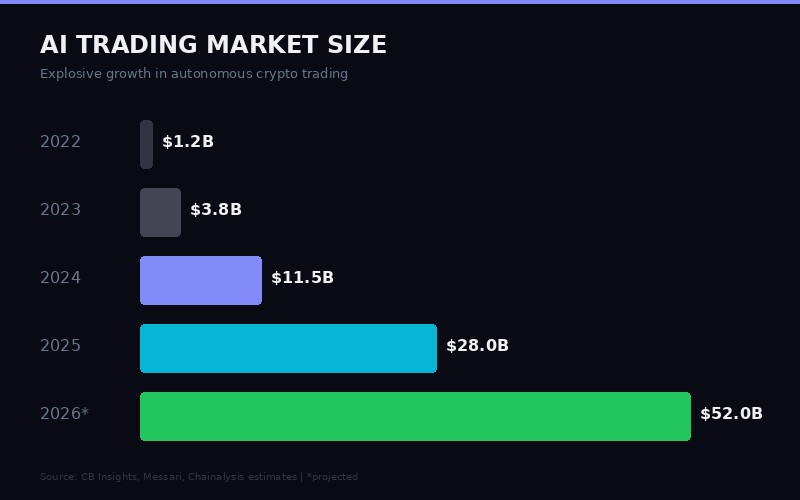
The numbers tell a story that most of crypto hasn't internalized yet.
According to data aggregated from Dune Analytics, Chainalysis, and on-chain monitoring tools, autonomous agents now account for roughly 43% of all DEX trading volume across Ethereum, Base, Arbitrum, and Solana. On certain pairs - particularly stablecoin-to-stablecoin and major pair arbitrage - that number exceeds 70%.
This isn't gradual evolution. In Q1 2024, agent-driven volume was estimated at 8-12%. By Q4 2024, it hit 22%. The inflection point was mid-2025, when the first generation of LLM-powered agents (not just rule-based bots) went live with real capital. The combination of reasoning capability, real-time data access, and crypto-native execution created something qualitatively different from anything the market had seen.
The growth is exponential because the advantages compound. An agent that earns 0.3% daily can reinvest those returns into larger positions, which generate more data, which improves its models, which improve its returns. Humans don't compound like that. Humans take profits and buy a watch.
Chapter 2: Autonomous Trading Bots - The New Market Makers
The word "bot" undersells what's happening. A bot follows rules. An agent makes decisions.
Modern trading agents operate on a fundamentally different paradigm than the bots of 2023-2024. Here's what separates them:
Multi-Source Intelligence
A 2024-era bot might watch price and volume on one exchange. A 2026 agent simultaneously processes:
- On-chain data: Whale wallet movements, smart contract interactions, token unlocks, bridge flows
- Social sentiment: CT (Crypto Twitter/X), Farcaster, Discord alpha channels, Telegram groups - parsed in real-time via LLM
- Funding rates: Across Binance, Bybit, Hyperliquid, dYdX, and 15+ perpetual venues
- Order book depth: Bid-ask spreads, hidden liquidity, spoofing detection
- Macro signals: Fed announcements, CPI data, geopolitical events - and their predicted impact on crypto correlation
- Cross-market correlations: How ETH moves when BTC drops 2%, how altcoins react to ETH gas spikes
The agent doesn't just see more data. It reasons about the relationships between data points. When a whale moves 10,000 ETH to Binance, the agent doesn't just flag it - it checks the wallet's historical behavior (dump vs. collateral deposit), cross-references with current funding rates (already short-heavy?), and factors in the macro environment (is this a risk-off move or a strategic rebalance?).
Adaptive Strategy Selection
The best agents don't run one strategy. They maintain a portfolio of strategies and dynamically allocate capital based on market regime:
| Market Regime | Dominant Strategy | Capital Allocation |
|---|---|---|
| Trending (strong momentum) | Momentum / Breakout | 40-60% |
| Ranging (low volatility) | Mean Reversion / Grid | 30-50% |
| High Volatility (news-driven) | Arbitrage / Hedged | 50-70% |
| Crash / Black Swan | Defensive / Cash | 80-100% cash |
This regime detection happens automatically. The agent classifies the current market state using volatility metrics (realized vs. implied), volume patterns, and correlation structure - then rotates its capital allocation within seconds.
The Market Making Revolution
Perhaps the most consequential shift: agents are replacing traditional market makers on DEXs. Concentrated liquidity positions on Uniswap v3/v4 are increasingly managed by AI agents that dynamically adjust price ranges based on predicted volatility. The result is tighter spreads for traders and higher fee capture for liquidity providers.
Data from Uniswap's analytics shows that agent-managed positions earn 2.4x more fees per dollar of liquidity than static positions. They rebalance 30-80 times per day, compared to the average human LP who rebalances once every 2-3 weeks.
Chapter 3: The Agent Trading Stack
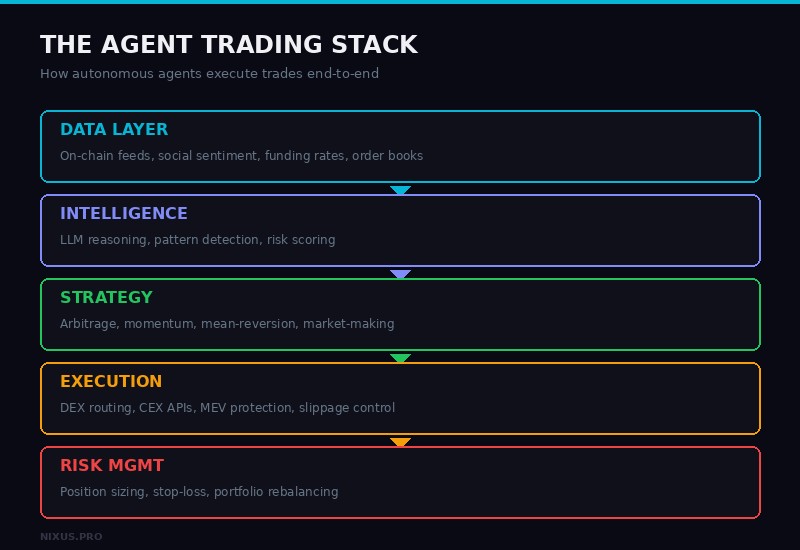
Understanding how these agents work requires understanding the stack they run on. It's not one piece of software - it's a layered architecture where each component handles a specific function.
Layer 1: Data Ingestion
The foundation. Agents consume data from dozens of sources simultaneously: WebSocket feeds from exchanges, Ethereum mempool monitoring (for MEV awareness), social media APIs, news wire services, and on-chain indexers like The Graph and Dune.
The critical innovation here is semantic data processing. Rather than just ingesting raw numbers, the LLM layer interprets unstructured data - a tweet saying "just bridged everything to Base" from a known whale wallet gets parsed as a bullish Base ecosystem signal, weighted by the poster's historical accuracy.
Layer 2: Intelligence / Reasoning
This is where LLMs changed the game. Previous-generation bots used statistical models (ARIMA, GARCH, basic ML). Current agents use language models to:
- Interpret ambiguous signals ("Is this whale accumulating or distributing?")
- Generate hypotheses ("If ETH breaks $4,200, altcoins will likely follow within 2-4 hours based on historical correlation")
- Evaluate conflicting data ("On-chain is bullish but funding is extremely positive - which signal dominates?")
The reasoning layer doesn't predict price. It assesses probability distributions and expected value. A well-built agent never says "ETH will go up." It says "There's a 62% probability of a 3-5% move up within 24 hours, with a 15% probability of a 7%+ down move. The expected value of a long position with 2x leverage and a 3% stop is +$142 per $10,000 deployed."
Layer 3: Strategy Engine
Where intelligence becomes action. The strategy engine selects from a library of pre-built strategies and parameterizes them based on current conditions. Key strategies in production today:
- Cross-exchange arbitrage: Price discrepancies between CEXs and DEXs, typically 0.1-0.5% on volatile pairs
- Funding rate arbitrage: Long on negative funding, short on positive - delta neutral yield
- Liquidation front-running: Detecting positions approaching liquidation price and positioning for the cascade
- Narrative trading: LLM detects emerging narrative (e.g., "AI tokens" meta), enters early, exits on peak social volume
- MEV-aware execution: Routing trades to avoid sandwich attacks, using private mempools and flashbots
Layer 4: Execution
The execution layer handles the mechanics: DEX routing (finding optimal paths across AMMs), CEX API management (rate limits, order types), slippage control, and MEV protection. Smart order routing across Uniswap, Curve, Balancer, and aggregators like 1inch and CoW Protocol happens in milliseconds.
Layer 5: Risk Management
The layer that separates agents that survive from agents that blow up. Automated risk management includes:
- Position sizing: Kelly criterion or fractional Kelly, adjusted for estimated edge confidence
- Correlation limits: Maximum 40% of capital in correlated positions
- Drawdown circuit breakers: Automatic shutdown at -5% daily or -12% weekly
- Volatility scaling: Reduce position sizes as realized volatility increases
- Counterparty limits: Maximum exposure per exchange (the FTX lesson)
Chapter 4: Prediction Market Integration - Agents Betting on Reality
If autonomous trading bots are the muscle, prediction market agents are the brain. And in 2026, they're one of the most profitable agent categories.
Platforms like Polymarket and Kalshi have exploded in volume since 2024. Polymarket alone processed over $8.2 billion in cumulative volume by March 2026, with hundreds of active markets ranging from elections to crypto prices to geopolitical events. Kalshi, the regulated US alternative, crossed $3.1 billion.
The opportunity for agents is structural: prediction markets are systematically inefficient because most participants are retail bettors influenced by emotion, recency bias, and tribal allegiance. An agent that can objectively assess probabilities has a persistent edge.
How Agent Prediction Trading Works
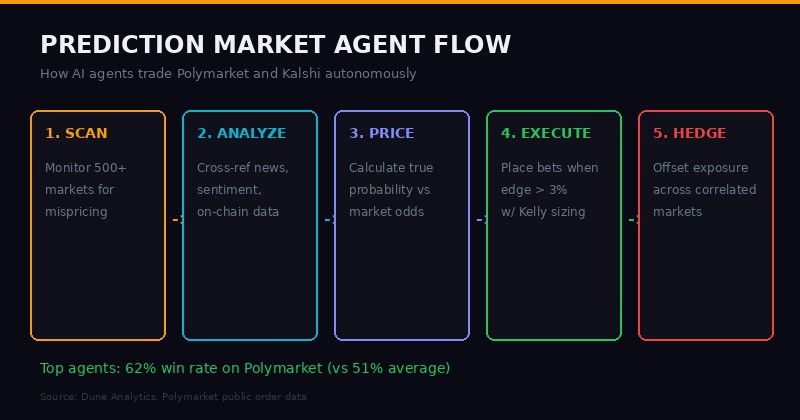
Step 1: Market scanning. The agent monitors 500+ active markets, flagging any where the market-implied probability diverges more than 3% from its calculated true probability.
Step 2: Cross-reference analysis. For a market like "Will BTC exceed $100K by June 2026?", the agent combines on-chain metrics (accumulation trends, exchange outflows), derivatives data (options skew, futures basis), macro indicators (real yields, dollar index), and historical base rates.
Step 3: Probability estimation. Using calibrated models (regularly backtested against historical prediction market outcomes), the agent generates a probability estimate with confidence intervals. If the model says 47% and the market says 38%, that's a potential trade.
Step 4: Kelly-sized execution. The agent doesn't go all-in. It uses Kelly criterion to size the bet proportionally to its edge. A 9-percentage-point edge with medium confidence might warrant a 3-4% portfolio allocation.
Step 5: Cross-market hedging. Smart agents identify correlated markets and hedge accordingly. If you're long "BTC > $100K" on Polymarket, you might short BTC futures proportionally to reduce directional exposure and isolate the pure prediction edge.
Correlation Arbitrage
One of the most sophisticated agent strategies involves detecting mispriced correlations between prediction markets. Example: if Market A ("Fed cuts rates in June") is priced at 65% and Market B ("BTC exceeds $95K by July") is priced at 40%, but historically a rate cut has led to a BTC rally 78% of the time, the agent identifies the disconnect and trades the spread.
This cross-market intelligence is extremely difficult for humans to track manually across hundreds of markets. Agents do it continuously.
Chapter 5: Funding Rate Arbitrage - The Quiet Cash Machine
Of all agent trading strategies, funding rate arbitrage might be the most underappreciated. It's not flashy. It doesn't produce 100x returns. But it's the closest thing to risk-free yield in crypto, and agents have turned it into an industrial operation.
The Mechanism
Perpetual futures use funding rates to keep the contract price anchored to spot. When funding is positive (longs pay shorts), the market is bullish. When negative, bearish. These rates reset every 8 hours on most exchanges.
The arbitrage is simple in concept:
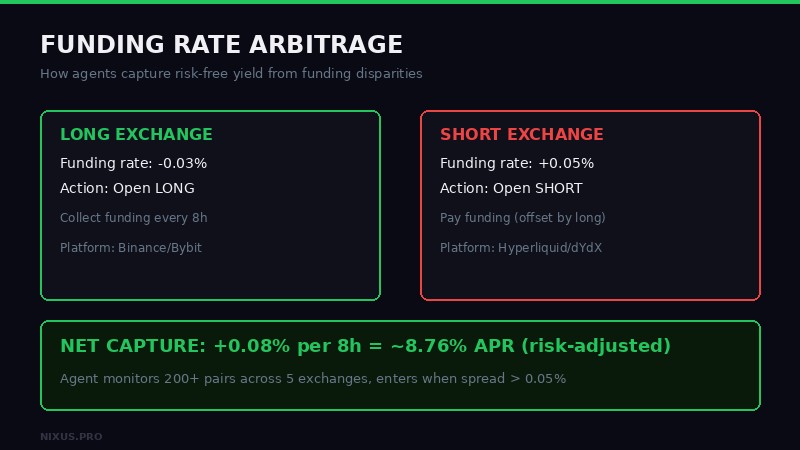
- Find a pair where funding rates diverge across exchanges. Example: ETH funding on Binance is +0.05% per 8h, while on Hyperliquid it's -0.03% per 8h.
- Go short on the high-funding exchange (collect the positive funding).
- Go long on the low-funding exchange (collect the negative funding - you get paid on both sides).
- Your net position is delta-neutral. Price moves don't matter. You're collecting funding from both sides.
The spread in this example is 0.08% per 8 hours. That's 0.24% per day, or approximately 87.6% annualized before accounting for fees, slippage, and capital efficiency.
Why Agents Dominate This
Humans can do funding rate arbitrage. Some do. But agents dominate because:
- Scale: An agent monitors 200+ pairs across 5+ exchanges simultaneously. A human can realistically track 5-10.
- Speed: Funding rate opportunities appear and disappear within minutes. By the time a human spots a divergence, calculates position sizes, and executes on two exchanges, the spread may have closed.
- 24/7 operation: Funding resets happen at specific UTC times. The best opportunities often appear at 00:00 UTC and 08:00 UTC - times when most traders aren't watching.
- Risk management: The agent automatically monitors for exchange-specific risks (withdrawal freezes, depegging events) and unwinds positions before they become dangerous.
The real-world, risk-adjusted returns are lower than the theoretical maximum - typically 8-15% APR after fees, capital lockup, and exchange risk adjustments. But for a delta-neutral strategy with minimal drawdown, that's extraordinary. Traditional finance would kill for 8% risk-free.
The Hyperliquid Effect
Hyperliquid's rise as a decentralized perpetuals platform created a new dimension for funding arbitrage. Because Hyperliquid's funding rates are determined by its own ecosystem (different from CEX rates), persistent divergences exist. Agent traders running Hyperliquid-Binance or Hyperliquid-Bybit funding arb have reported consistent returns since mid-2025.
The platform's on-chain transparency is both a feature and a challenge. Agents can see each other's positions, leading to a game theory dynamic where the most profitable funding arb opportunities get crowded quickly. The edge goes to agents that are fastest and most capital-efficient.
Chapter 6: Social Trading 2.0 - Agents Following Agents

Copy trading isn't new. But copy trading where AI agents copy other AI agents is the 2026 meta that nobody predicted.
The Three Models
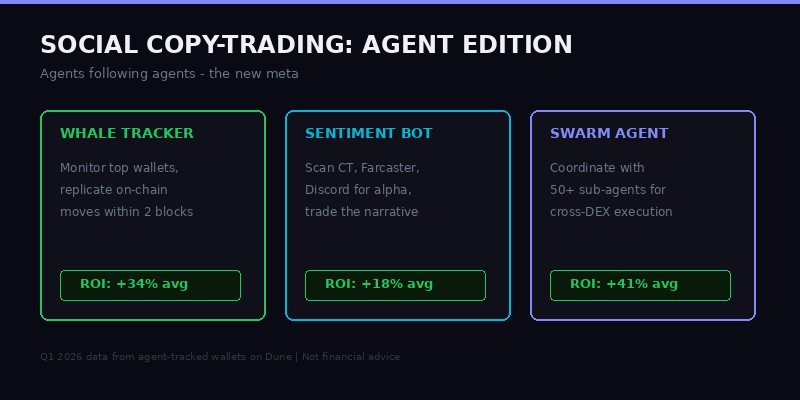
1. Whale Wallet Tracking
Agents monitor known profitable wallets on-chain and replicate their trades with configurable delay and position sizing. The sophistication isn't in the copying - it's in the filtering. A good whale-tracking agent:
- Maintains a ranked database of 500+ wallets by historical performance
- Filters out noise (routine transfers, dust consolidation, gas refills)
- Identifies intentional trades vs. DeFi interactions (lending deposits, LP additions)
- Adjusts copy size based on the whale's historical accuracy for that specific token type
- Applies its own risk parameters (won't follow a whale into a 50x leveraged position)
The best whale-tracking agents have reported 34% average returns in Q1 2026, though with significant variance. The key risk: whales know they're being watched and occasionally use this to manipulate followers (the "whale trap").
2. Sentiment-Driven Trading
These agents don't follow wallets - they follow narratives. Using LLMs to parse thousands of social media posts per hour across X, Farcaster, Discord, and Telegram, they identify emerging narratives before they peak and enter positions at the narrative's early inflection point.
The edge is timing. By the time a narrative is trending on CT, it's too late for most traders. Sentiment agents detect the precursors: unusual posting frequency from known influencers, cross-platform echo effects, and correlation with on-chain activity (smart money moving before the narrative goes mainstream).
3. Agent Swarms
The newest and most experimental model. Instead of one agent making all decisions, a swarm of 10-50 sub-agents each specialize in a different market or strategy. A coordinator agent aggregates their signals and executes trades based on consensus.
The swarm model has shown the highest returns (41% in early testing) but also the highest complexity and failure rate. When sub-agents disagree and the coordinator makes a bad tie-breaking decision, losses can be larger than any single-agent system.
Chapter 7: Agent vs Human - The 2026 Scorecard
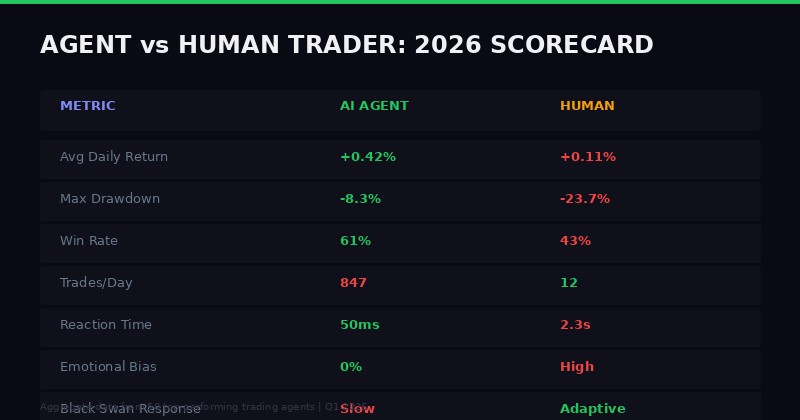
Let's look at the data honestly. Agents win on most metrics - but not all.
Where Agents Dominate
- Consistency: Top agents maintain 0.3-0.5% daily returns with drawdowns under 10%. Human traders average 0.11% daily with 20%+ drawdowns.
- Speed: 50ms average execution vs. 2.3 seconds for a human using hotkeys. In crypto, 2 seconds is an eternity.
- Emotional discipline: Zero. Agents don't revenge trade, don't FOMO, don't hold losers because of sunk cost fallacy.
- Throughput: 847 trades per day average vs. 12 for an active human day trader.
- Multi-market coverage: One agent covers more ground than a team of 10 human traders.
Where Humans Still Win
- Black swan adaptation: When something truly unprecedented happens - a major exchange hack, a regulatory shock, a geopolitical event with no historical parallel - humans adapt faster. Agents need data patterns. No data means no pattern.
- Narrative creativity: Humans can invent new narratives and spot cultural trends that agents can only detect after they're already forming. The person who first identified the "AI agent" token meta in late 2024 made generational wealth. No agent would have predicted that.
- Regulatory navigation: Understanding the nuance of regulatory announcements - what's enforced vs. what's theater - requires human judgment and industry context that agents lack.
Chapter 8: The Risks Nobody Talks About

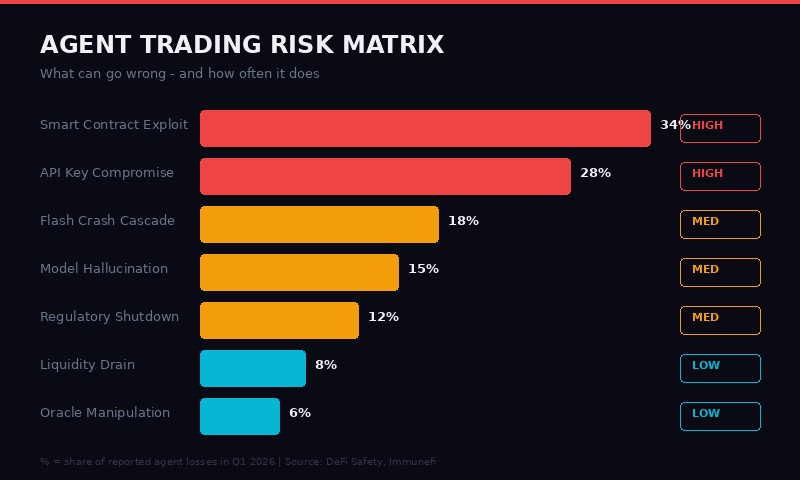
The agent trading narrative is overwhelmingly bullish. That should make you nervous. Here's what can go wrong - and what already has.
1. Smart Contract Exploits (34% of Agent Losses)
Agents that interact with DeFi protocols are exposed to smart contract risk. When an agent deposits funds into a yield protocol or interacts with a DEX, it trusts the contract code. In Q1 2026 alone, agent-operated wallets lost an estimated $47 million to smart contract exploits, including two major DeFi protocol hacks.
The problem is compounded by agents' speed. An agent can deposit into a compromised protocol and lose funds before a human would have even initiated the transaction.
2. API Key Compromise (28%)
Most trading agents interact with CEXs via API keys. These keys are high-value targets. A compromised API key with withdrawal permissions can drain an entire account in seconds. Several high-profile agent fund operators have lost significant capital to API key theft through phishing, server compromise, or supply chain attacks on agent infrastructure.
3. Flash Crash Cascades (18%)
When hundreds of agents run similar strategies (momentum, whale-following, liquidation hunting), their collective behavior creates fragility. A small price drop triggers agent stop-losses, which triggers more price drops, which triggers more stop-losses. The February 14, 2026 "Valentine's Crash" - where SOL dropped 19% in 7 minutes before recovering - was traced primarily to agent cascade behavior.
4. Model Hallucination (15%)
LLM-powered agents can "hallucinate" in their market analysis, generating confident but wrong assessments. An agent might misinterpret a satirical tweet as genuine alpha, or incorrectly classify a routine wallet transaction as a whale accumulation signal. Unlike a human who might catch the error through common sense, the agent acts on it immediately.
5. Regulatory Risk
The legal status of autonomous trading agents remains unclear in most jurisdictions. Questions that regulators are actively considering:
- Is an AI agent a "person" under securities law? Who is liable for its trades?
- Does agent-to-agent trading constitute market manipulation if agents create artificial volume?
- Are agent operators required to register as broker-dealers or investment advisers?
- How do KYC/AML requirements apply to autonomous wallets?
6. The Crowding Problem
As more agents deploy similar strategies, returns compress. Funding rate arbitrage that yielded 15% APR in early 2025 now yields 8% because hundreds of agents compete for the same spreads. The alpha decay is real and accelerating. Agents that thrived on strategy X six months ago are struggling today because 200 other agents learned the same strategy.
Chapter 9: The Regulatory Storm

Regulators are watching. And they're not happy.
The SEC's March 2026 guidance document on "Autonomous Trading Systems" signals a crackdown. Key points:
- Registration requirements: Any agent managing more than $150K in assets may need to register as an investment adviser
- Audit trails: All agent trading decisions must be logged and explainable upon request
- Kill switches: Agents must have human-operated emergency shutdown capabilities
- Capital requirements: Agent operators may need to hold capital reserves proportional to trading volume
The EU's approach under MiCA 2.0 is stricter, proposing that all autonomous trading agents operating in EU markets must be registered, audited, and subject to real-time monitoring by the national competent authority.
The crypto-native response has been to move operations offshore and on-chain. Agents trading exclusively on DEXs in international waters (legally speaking) may be beyond regulatory reach - for now. But as regulators get more sophisticated about on-chain monitoring, this gray area will shrink.
Chapter 10: Where This Goes Next
The trajectory is clear but the timeline is not. Here's what to watch for in 2026-2027:
Agent-to-Agent Markets
We're already seeing early versions of this: agents that negotiate with each other to execute trades. Agent A has ETH to sell. Agent B wants to buy ETH. Instead of both hitting a DEX and paying AMM fees, they discover each other through an on-chain messaging protocol and settle directly. This "dark pool for agents" reduces costs for everyone but also moves liquidity away from public venues.
Autonomous DAOs
DAOs where every member is an agent. Each agent contributes a specialized skill (trading, research, risk management, treasury management) and the DAO operates as a fully autonomous hedge fund. No humans in the loop. The first experiments are already live - with mixed results. The successful ones are generating 15-25% APR.
Personalized Agent Strategies
Consumer-facing products where you describe your risk tolerance, goals, and beliefs in natural language, and an agent builds and executes a custom strategy. "I think AI tokens are overvalued but DeFi blue chips are undervalued. I can handle 15% drawdown. I want 80% of my portfolio in stables during high-volatility events." The agent translates this into a live trading strategy.
Cross-Chain Intelligence
Current agents mostly operate within one chain ecosystem. The next generation will seamlessly arbitrage across Ethereum, Solana, Base, Sui, and emerging chains - moving capital to wherever the best risk-adjusted opportunity exists, in real-time.
The Convergence with Traditional Finance
As tokenized treasuries ($2.4B and growing) and tokenized equities gain traction, the line between crypto agent trading and traditional algorithmic trading blurs. Agents that can trade both crypto and tokenized TradFi assets in a unified portfolio will have the ultimate information advantage.
The Bottom Line
Agent trading in 2026 is where algorithmic trading was in 2005 for traditional markets. Early enough that massive alpha still exists. Late enough that the basic infrastructure is proven and reliable.
The window for easy returns is closing. Strategies that worked six months ago are already crowded. The agents winning today are the ones that combine multiple approaches - funding arbitrage for steady yield, prediction markets for high-conviction bets, whale tracking for momentum, and robust risk management to survive the inevitable blow-ups.
If you're a human trader: you don't have to beat the agents. You have to use them. The best human-agent teams outperform either alone. Let the agent handle execution, monitoring, and data processing. You handle strategy, narrative detection, and black swan adaptation.
If you're building agents: the moat isn't in the model. It's in the data pipeline (unique data sources competitors don't have), the execution infrastructure (speed and reliability), and the risk management (surviving what kills your competitors).
The market doesn't care whether you're made of carbon or silicon. It only asks one question: do you have edge?
In 2026, the agents have edge. And it's compounding.