Stolen Trophy: How CAF Gave Senegal's AFCON Title to Morocco
Two months after winning Africa's biggest football prize on the pitch, Senegal had it taken away at a desk. Here is the full story of a ruling that has split a continent - and what it says about the institutions that govern African sport.

Photo: Pexels / Football pitch under stadium lights - a symbol of a game whose rules were rewritten after the final whistle.
The trophy was already in Dakar. The parade had already happened. The players had already returned home to a country that celebrated them as continental champions for the second time in three years. And then, on a Tuesday evening in March, 60 days after the final whistle had blown in Rabat, the Confederation of African Football issued a statement that erased all of it.
Senegal, CAF declared, had "forfeited" the Africa Cup of Nations final. Morocco were now the champions. The result - a 1-0 Senegalese victory won in extra time after one of the most chaotic finales in the tournament's history - was being rerecorded as a 3-0 defeat.
In Dakar, a young man named Daouda Seck told AFP reporters: "I'm stunned. Football no longer exists. This is not football. No-one here understands or accepts this decision. We're shocked. Corruption has ended up winning."
In Rabat, fans drove through the streets honking horns, waving flags, letting off flares. A woman wearing the national team's jersey told a local sports channel: "The cup has returned to us. The cup that was denied to us."
Two cities. One ruling. An entire continent's argument about justice, sovereignty, and who gets to own the game.
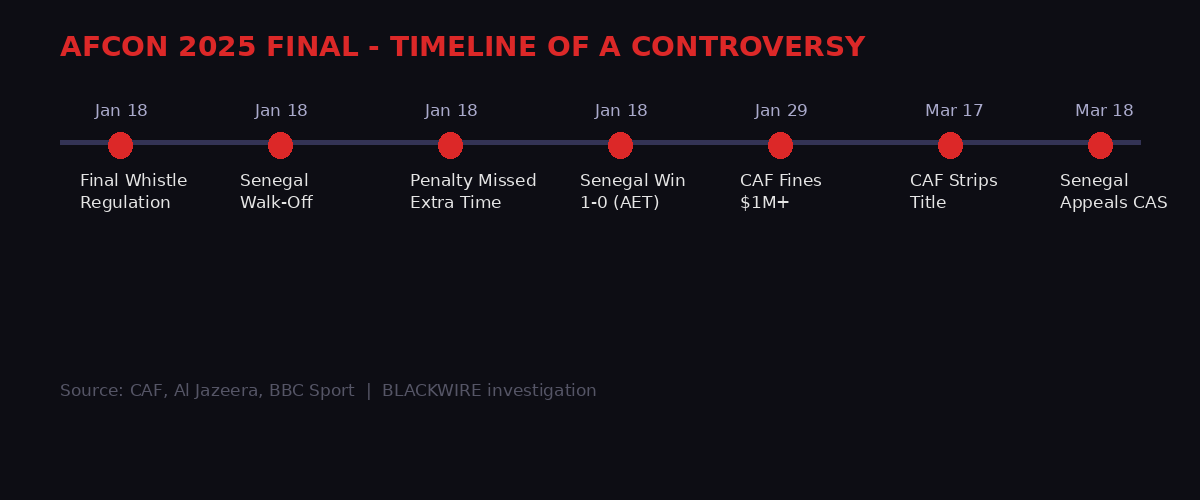
Timeline: From the final whistle in Rabat to CAF's bombshell ruling two months later. Source: CAF, Al Jazeera, BBC Sport.
The Final That Was Always Going to End This Way

Photo: Pexels / A stadium packed with fans - the kind of atmosphere that makes a final, and breaks it.
To understand the ruling, you have to understand what happened on January 18 in Rabat, because nothing about it was ordinary.
Senegal and Morocco had entered the AFCON 2025 final with a backdrop of tension that went beyond normal football rivalry. The host nation had, by the semi-final stage, been repeatedly accused by opposition teams of benefiting from favorable refereeing decisions. Senegal's management had publicly raised these concerns before the final even began, per reporting from Al Jazeera Sport.
Morocco coach Walid Regragui vehemently denied any advantage. His team had played some of the tournament's best football. But the suspicion was already embedded in the narrative by kick-off.
The match itself was ferocious. Late in regulation time, with the score 0-0, Congolese referee Jean-Jacques Ndala awarded Morocco a penalty after a VAR review of a challenge by El Hadji Malick Diouf on Morocco forward Brahim Diaz. This came in the second minute of added stoppage time, after already eight minutes of added time had been signaled - itself a source of Senegalese anger, having already seen a goal by Ibrahim Sarr disallowed moments earlier.
Senegal's players and coaching staff, led by coach Pape Thiaw, walked off the pitch. They stayed off for 14 minutes.
Moroccan ball boys added a surreal dimension to proceedings: they attempted to seize a towel being used by Senegalese goalkeeper Edouard Mendy, apparently as a distraction tactic. Supporters from both sides stormed or attempted to storm the field. Reporters from Senegal and Morocco fought each other in media areas.
When Senegal eventually returned, Brahim Diaz missed the penalty. Extra time followed. In the 94th minute of extra time, Pape Gueye struck a goal that sent Senegal's supporters into rapture. Final score: Senegal 1-0 Morocco (AET). Africa's champions. Or so they thought.
"It was never my intention to go against the principles of the game I love so much. I simply tried to protect my players from injustice." - Coach Pape Thiaw, in a statement on Instagram after the final
What CAF's Rule Book Actually Says - and Why That Matters

Photo: Pexels / The decision that changed African football came not from a referee but from an appeals board.
At a disciplinary hearing on January 29, CAF took action - but not the action Morocco wanted. The governing body imposed fines totaling more than $1 million on both federations, handed bans to players and officials from both sides, and condemned the scenes at the final as "shameful" for African football. Morocco's federation, notably, was separately fined $200,000 for the behavior of its ball boys, per Al Jazeera.
Crucially, the result was left untouched. Senegal remained champions. Morocco filed an immediate appeal, which CAF dismissed.
But Morocco's federation also pursued a separate legal avenue: an appeal to CAF's Appeals Board. And there the landscape shifted.
The Appeals Board invoked Article 82 of the AFCON tournament regulations, which reads: "If, for any reason whatsoever, a team withdraws from the competition or does not report for a match, or refuses to play or leaves the ground before the regular end of the match without the authorization of the referee, it shall be considered loser and shall be eliminated for good from the current competition."
The board ruled that by walking off the pitch, Senegal had forfeited the match. The 1-0 result was rerecorded as a 3-0 defeat. Morocco were declared African champions.
This ruling raises an immediate legal contradiction that legal observers have been quick to identify. The referee, Jean-Jacques Ndala, chose to continue the match. He allowed Senegal to return. He let play resume. Under the Laws of the Game, the referee's on-field decisions are generally considered final. By retroactively overriding the referee's authority, the Appeals Board entered contested territory that may well define the limits of sporting governance in Africa - and beyond.
Veteran coach Claude Le Roy, who managed Senegal between 1988 and 1992, captured the sentiment on French television: "No one could have imagined such a statement two months after the final. For years, all the refereeing decisions have been flouted by the CAF."
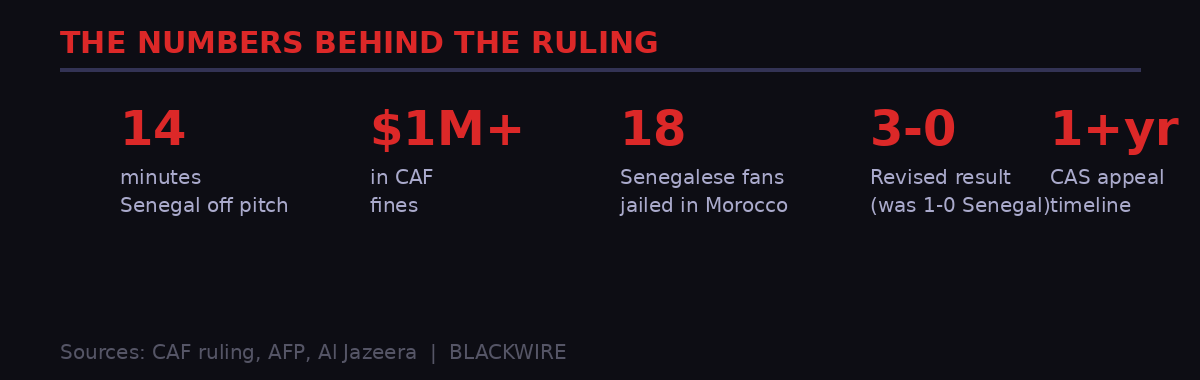
The numbers behind the decision that changed African football's history books. Source: CAF, AFP, Al Jazeera.
The Senegalese Fans Who Paid with Their Freedom

Photo: Pexels / Supporters who traveled to Rabat for the final paid a price no football match should demand.
The ruling is about much more than silverware. Before CAF's Appeals Board even delivered its verdict, Senegalese supporters who had traveled to Rabat for the final were already living with consequences far heavier than any fine.
Eighteen Senegalese fans who rushed the pitch during the final chaos were arrested by Moroccan authorities. According to AFP reporting confirmed by Senegal's football federation, they were sentenced to prison terms ranging from three months to one year, plus fines of up to 5,000 Moroccan dirhams - roughly $545 USD.
Senegal's Prime Minister Ousmane Sonko publicly denounced these sentences in late February, calling them an injustice. The Senegalese Football Federation had already condemned the verdicts as disproportionate.
These were ordinary fans. They were not hooligans who had planned violence. They were people who, in the confusion and charged atmosphere of a final that had already descended into something barely recognizable as football, made decisions they perhaps would not have made in calmer circumstances. Some are still serving their sentences today.
The jailed fans are the human face of a controversy that decision-makers in Rabat and Cairo have been able to discuss in the comfortable language of regulations and appeals procedures. For the 18 men who walked onto that pitch, this was not a legal abstraction. It was months of their lives.
"I think the best team won on the pitch, and that should be respected off it as well." - Ralf Nonga, Senegalese student, speaking to AFP after CAF's ruling
Prime Minister Sonko's involvement is itself significant. When a head of government is publicly criticizing another country's judiciary over a football match, you have moved far beyond sports and into the territory of diplomatic tension. The AFCON final, and its aftermath, has become a test of the relationship between two African nations that cannot afford to be enemies at a moment when the continent faces so many shared external pressures.
The Precedent That Haunts African Football

Photo: Pexels / What does it mean to "win" a championship when the rules can be changed two months later?
This is not the first time a walk-off in African football has triggered a governance crisis. The same movie played out in 2019, and the ending should give Senegal some cause for hope - or at least for argument.
In the 2019 African Champions League final, Moroccan club Wydad Casablanca walked off the pitch in protest against VAR during the second leg against Esperance of Tunisia. The referee declared Esperance winners. CAF's executive committee then, controversially and without clear authority, ordered a replay. Esperance took the matter to the Court of Arbitration for Sport in Lausanne. CAS declared Esperance champions and publicly rebuked CAF for attempting to override a referee's decision.
The parallel is exact. In both cases, a team walked off. In both cases, a referee made an in-game decision to continue or award a result. In both cases, CAF's administrative bodies attempted to override the referee after the fact. CAS ruled against CAF in 2019. Senegal's lawyers are pointing to this precedent with considerable confidence.
As Al Jazeera Sport reported, the FSF's statement made clear the federation will "initiate an appeal as soon as possible before the Court of Arbitration for Sport in Lausanne." The CAS process typically takes between one and two years. Which means the question of who actually won AFCON 2025 will likely remain officially contested well into 2027 - potentially longer.
During that time, both Morocco and Senegal will have competed at the 2026 FIFA World Cup, which begins in June. Neither country's ban from continental competition - part of the January disciplinary sanctions - extends to FIFA competitions. The world will watch two sides play the sport's biggest stage while their continental title fight remains unresolved.
The Silence That Was Never Silent: Morocco's View

Photo: Pexels / In Morocco, Tuesday night felt like a correction of history. In Senegal, it felt like its erasure.
It would be dishonest to tell this story without representing the Moroccan perspective fully, because it is not without substance.
From Morocco's point of view, Senegal did, factually, leave the field during a live match without referee authorization. Article 82 is clear. The walk-off was not a minor technical infraction. It was a team physically abandoning the game during active play, leaving Morocco's penalty taker standing alone at the spot waiting for opponents who had gone to their dressing room.
For Moroccan fans, the walk-off was an act of bad faith that overshadowed everything else. "There was an overwhelming sense that justice had been done after what Moroccans saw as a violation of the rules," BBC Africa reported from Rabat.
Moroccan journalist Jalal Bounour told BBC Newsday that Moroccan fans welcomed the news with "great excitement and joy" and it was "a sleepless night" of celebration. "I believe this was a sporting injustice, Morocco was certainly wronged and the facts were clear," one Rabat resident told the BBC.
The Moroccan argument is not irrational. Walking off a football pitch during a match is a serious act. It destabilizes the competition. It breaks a fundamental social contract between teams, officials, and spectators. If no sanction follows, what stops other teams doing the same whenever they are aggrieved by a decision?
Morocco's federation, the FRMF, was pursuing legal action within its rights under CAF regulations. The Appeal Board's ruling was delivered through a legitimate procedural mechanism. Morocco did not invent the rules; they used them.
The problem is not that Morocco was wrong to appeal. The problem is that two months of letting Senegal celebrate as champions before stripping the title creates a wound far deeper than any on-field ruling ever could. The process made this worse, not better. And the question of whether the referee's authority was properly respected remains live - not settled.
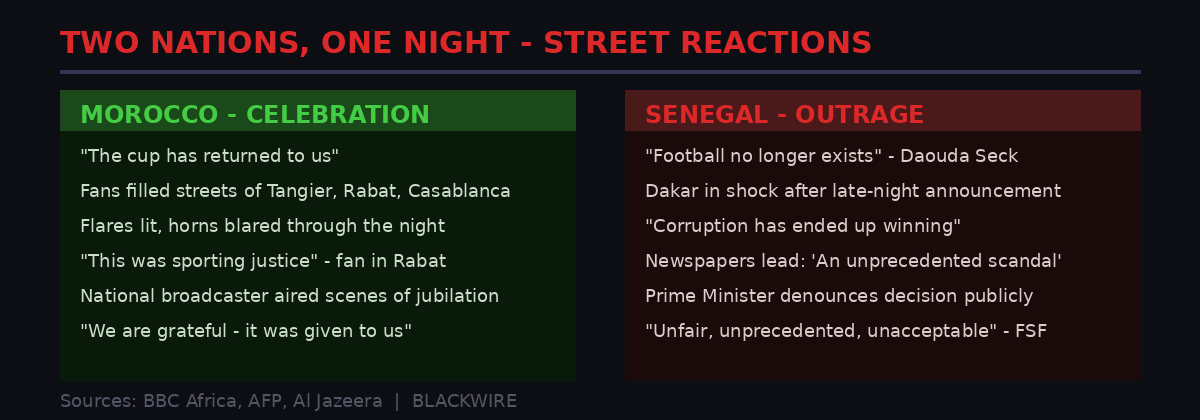
Two nations, one ruling, opposite streets. The human reactions that no regulation can capture. Source: BBC Africa, AFP, Al Jazeera.
What Sadio Mane Tried to Do - and Why It Matters

Photo: Pexels / In the chaos of the walk-off, one veteran player tried to bring his team back. History will remember that.
In the accounts of what happened during those 14 minutes of chaos, one figure emerges as quietly significant: Sadio Mane.
The veteran Senegalese striker - who already has an AFCON winners' medal from 2021 and 2022, and who has long been one of Africa's most recognized footballers - reportedly emerged as a voice for calm during the walk-off. According to reporting from Al Jazeera Sport, Mane attempted to persuade his teammates to return to the pitch, acting as a de facto mediator between the enraged coaching staff and the team's obligations to the competition.
He did not succeed immediately. The 14-minute walk-off happened regardless. But the fact that a player of his stature was trying to pull the team back, rather than leading or endorsing the departure, complicates any narrative of deliberate sabotage. The walk-off appears to have been an emotional, spontaneous response by a coaching staff pushed beyond its limits by a sequence of decisions it viewed as fundamentally unjust - not a calculated plot to abandon the competition.
Coach Pape Thiaw said exactly this in his Instagram statement: he was trying to protect his players from injustice. Whether or not one agrees with his judgment, the intent he describes was not to forfeit the match. He believed the referee would stop play and deal with the situation. The referee instead did something remarkable: he waited. He allowed both sides to collect themselves. He let the match continue.
And this is where the heart of the legal argument lives. If the referee's choice to continue constituted implicit authorization for Senegal's return - which the Laws of the Game might be argued to imply - then the Appeals Board's ruling, delivered 60 days later from a committee room, overrode not just CAF's own earlier decision, but the judgment of the on-field official whose authority is the foundation of the entire game.
The Bigger Picture: Can African Football Trust Its Institutions?

Photo: Pexels / The question that outlives this ruling: can the institutions of African sport command genuine trust?
The AFCON title controversy does not exist in a vacuum. It sits inside a longer history of African football's troubled relationship with its own governing bodies.
CAF has faced sustained criticism for governance failures over the past decade. Former president Ahmad Ahmad was banned by FIFA for ethics violations. Corruption investigations have circled the organization's commercial dealings. Hosting decisions have been contested. Refereeing standards have been inconsistently applied. The body has, repeatedly, given ammunition to those who argue that African football is capable of producing world-class players but is hamstrung by institutions that cannot match them.
The 2019 Wydad Casablanca case - which CAF lost at CAS - was a warning. The lesson was clear: when you try to retroactively override a referee's decision through administrative procedure, you lose at the highest court in world sport. CAF appears to have failed to internalize that lesson.
Senegal's federation, the FSF, did not mince language. Its statement called the decision "unfair, unprecedented, and unacceptable" and warned that it "casts a shadow over African football." The authorities also called for an "independent international investigation into suspected corruption within CAF's governing bodies."
The word "corruption" is a loaded one. The FSF has not produced evidence of specific corrupt acts in connection with this ruling. But the environment of suspicion that has surrounded CAF for years means that when a host nation ends up being declared champions two months after losing, through an administrative process rather than on the pitch, the accusation lands with force - regardless of whether it is literally accurate.
What matters for the long term is this: if CAS once again overrules CAF, if Senegal is reinstated as champions through the Swiss arbitration process that already humiliated the confederation in 2019, the damage to CAF's credibility will be structural. No federation, no player, no fan will be able to look at an AFCON trophy and be certain the result reflects what actually happened on the pitch. That uncertainty - that sense that the final whistle is not really final - is corrosive to everything that makes sport worth watching.
"CAF is set to become a laughing stock in the football world, and Africans will be ridiculed for everything that has been said and criticised regarding the organisation of this tournament." - Senegalese fan, speaking to the BBC after Tuesday's ruling
Where This Goes Next - and What It Means for the World Cup

Photo: Pexels / Both Senegal and Morocco will compete at the 2026 World Cup while their continental title dispute remains unresolved.
There is, embedded in this entire saga, an absurdity that the formal language of institutional statements has struggled to capture: come June 2026, both Senegal and Morocco will run out at the FIFA World Cup. They will be introduced to the world's cameras. One of them may be announced as defending AFCON champions. But which one?
The answer, as of today, is officially Morocco - but practically and legally, the matter is unresolved. Senegal's appeal to CAS has been announced. CAS timelines stretch to twelve months or longer. The world will watch two sides who officially share a disputed continental title compete on football's biggest stage, while lawyers in Lausanne work through the implications of Article 82 and the referee's authority to continue a match when a team walks off.
FIFA President Gianni Infantino, notably, had already condemned Senegal's walk-off the day after January's final, calling it unacceptable. FIFA's position, implicit in Infantino's statement, aligned with Morocco's interpretation of events. Whether that influences the CAS process - which is legally independent - remains to be seen.
For the players on both sides - for Pape Gueye, who scored the goal that everyone thought won the title; for Brahim Diaz, who missed the penalty that everyone thought lost it - the uncertainty must be maddening. These are men who played one of the most emotionally charged matches in African football history. They deserve clarity. The institutions that govern their sport have so far been incapable of providing it.
The Senegalese fans who were sentenced to Moroccan prison for rushing the pitch - they served or are serving real time for events that CAF originally left without a result change. The Appeals Board changed the result. The jail sentences remain.
Back in Dakar, the trophy that Senegal brought home in January still exists. It has not been physically collected. The Lions of Teranga have not been forced to hand it back. At some point, perhaps, a bureaucratic process will catch up with the material object. Somewhere in Dakar, in an office or a cabinet, sits a trophy that the world's most powerful sports administration body says belongs to someone else.
That image - a physical trophy in a building where it no longer officially belongs - is the clearest symbol of what CAF has created. Not a solution to a controversial final. Not justice for either side. Just a wound that will take years to close, assuming it closes at all.
Senegalese football analyst and former player Shiva Amini (speaking in a different context about African football's institutional challenges) has described the atmosphere within West African football as one of "intense and systemic pressure" from governing bodies that operate without sufficient external accountability. The AFCON ruling has given that description a very concrete example.
African football deserves better than this. The players who fill the stadiums deserve better. The fans who sell possessions to travel across borders to watch their teams deserve better. And the 18 young Senegalese men who sat in a Moroccan jail while their team's trophy was being legally contested certainly deserve better.
The trophy will end up somewhere. CAS will rule, eventually. History will assign a winner to the 2025 Africa Cup of Nations. But the sense - felt across the continent, voiced in different languages by people in Dakar, in Rabat, in living rooms and cafes from Lagos to Johannesburg - that African football's institutions failed the beautiful game on a January night in Rabat, and then failed it again two months later in a committee room: that sense may be much harder to overturn.
Get BLACKWIRE reports first.
Breaking news, investigations, and analysis - straight to your phone.
Join @blackwirenews on Telegram