Adobe CEO Exits After 18 Years. AI Just Claimed Its Biggest Tech Executive Yet.
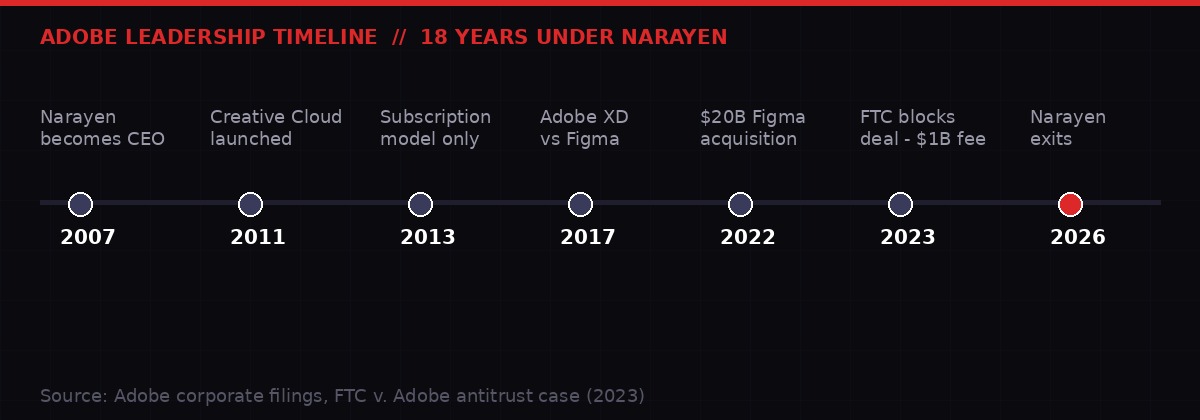
Adobe CEO Shantanu Narayen's 18-year tenure: from boxed software to cloud subscription empire to the AI reckoning. Source: BLACKWIRE / PRISM
Shantanu Narayen built Adobe into something no one thought possible: a $200 billion creative monopoly that survived the smartphone era, the cloud era, and the open-source era. He took over in 2007 when Adobe was a desktop software company selling Photoshop in boxes. He leaves in 2026 with Adobe's subscription revenues topping $20 billion annually and the company's tools embedded in virtually every creative workflow on the planet.
But the market that chose him isn't the market that will outlast him. AI didn't just disrupt Adobe's products - it rewrote the value proposition of creative software entirely. When anyone with a text prompt can generate a photorealistic image in under four seconds, the premium placed on learning Photoshop for a decade evaporates. Narayen anticipated this. He said so in his departure statement. He just couldn't solve it fast enough.
"The next era of creativity is being written right now - shaped by AI, by new workflows and by entirely new forms of expression," Narayen said in the announcement. "Adobe has never waited for the future to arrive. We've anticipated it. We've built it. And we've led it."
The statement reads like a victory lap. Analysts say it's closer to a graceful exit timed before the harder reckoning begins. Adobe stock has lost nearly 45 percent of its value from its 2021 peak as Wall Street assigns lower multiples to companies whose moat is creative tool dependency - a moat that generative AI is actively filling in.
The Man Who Converted Creative to Cloud
Before unpacking why Narayen is leaving, it helps to understand what he actually built. When he took over from Bruce Chizen in December 2007, Adobe was fundamentally a packaged software company. Creative Suite 3 had just launched at $1,799 a pop. The business model was unchanged from the 1990s: ship a new version, wait two years, sell the upgrade.
Narayen saw what Microsoft initially missed: that subscriptions, not perpetual licenses, were the future. Adobe Creative Cloud launched in 2011 as a complement to boxed software. By 2013, Narayen had killed the box entirely - an extraordinarily risky bet at the time. Designers and agencies screamed. The forums were revolt-level angry. Adobe's support lines melted. And then, quietly, everyone subscribed anyway.
The numbers validated the gamble spectacularly. Adobe's market cap went from roughly $12 billion when Creative Cloud launched to over $300 billion at its 2021 peak. The subscription model produced recurring revenue that Wall Street loved, a moat defined by switching costs (your Photoshop files, your Premiere projects, your libraries), and pricing power that allowed Adobe to raise subscription fees with relatively little churn.
Under Narayen, Adobe also made the transition from a pure creative software company to an enterprise platform player. The acquisition of Marketo in 2018 for $4.75 billion brought Adobe into marketing automation. The acquisition of Workfront in 2020 for $1.5 billion added project management for creative teams. Adobe Experience Cloud became a serious rival to Salesforce and SAP in digital experience management. Narayen was building an empire, not just a product.
The stock market agreed - until AI made it reconsider what the empire was actually worth.
The Figma Disaster and What It Revealed
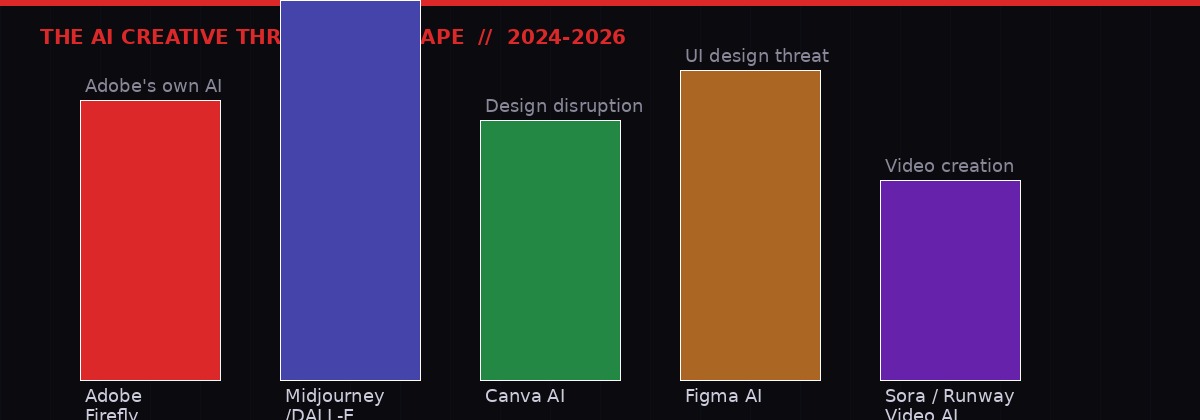
The AI creative threat landscape: tools that didn't exist five years ago now compete directly with Adobe's core products. Source: BLACKWIRE / PRISM
The clearest signal that something had shifted came from a deal that never closed. In September 2022, Adobe announced it would acquire Figma - the collaborative design tool that had been quietly eating Adobe XD's lunch - for $20 billion. It was the largest acquisition in Adobe's history. It was also, arguably, an admission of defeat.
Adobe didn't need Figma because Figma had better features. Adobe needed Figma because an entire generation of product designers had grown up on it and had never opened Adobe XD. The gap Adobe was trying to close with $20 billion wasn't technical - it was cultural. Figma had become the default tool for UI/UX design, period.
The FTC moved to block the deal in December 2023 on antitrust grounds, arguing that Adobe acquiring its most threatening competitor would harm competition in design software. Adobe terminated the acquisition in January 2024, paying Figma a $1 billion termination fee - an extraordinary sum to walk away from a failed deal. Figma went on to file for an IPO in 2025, now valued at over $12 billion as a standalone company.
The Figma collapse exposed a vulnerability Narayen had been managing but not resolving: Adobe's core product lines faced existential competition that money alone couldn't fix. Generative AI tools from Midjourney, Stability AI, Google, and OpenAI were simultaneously attacking Adobe's image-creation moat. Runway ML and Sora were attacking its video production business. CapCut and Canva were attacking its entry-level design tools. And Figma, now independent and well-capitalized, was attacking its professional design suite.
Adobe's response was Adobe Firefly - its own generative AI image and video creation tool, launched in 2023 and deeply integrated into Creative Cloud. Firefly was technologically credible. It was trained on licensed content, giving it a legal edge over competitors trained on scraped data. Adobe's enterprise customers responded well to the compliance argument. But Firefly didn't materially change the competitive picture. The ceiling it could reach was bounded by how many people wanted to stay inside Adobe's walled garden.
"Adobe built a moat around professional creative tools by making them the industry standard. That moat is eroding - not because Adobe's tools got worse, but because the baseline of what non-professionals can achieve without training has risen dramatically." - Creative software analyst, speaking to BLACKWIRE (background, March 2026)
The Same Day: Satya Nadella Pulls Power to the Center
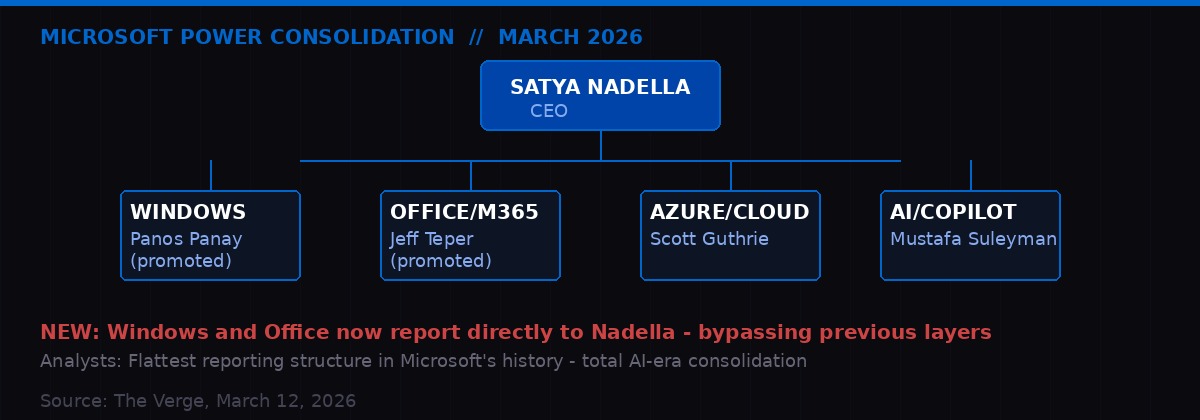
Microsoft's new command structure: Windows and Office leadership promoted and placed in direct report to Satya Nadella, bypassing previous organizational layers. Source: BLACKWIRE / PRISM based on The Verge reporting
Narayen's exit wasn't the only seismic leadership move on March 12, 2026. At roughly the same hour, The Verge reported that Microsoft was promoting the leaders of Windows and Office to report directly to CEO Satya Nadella - a structural change that reorganizes two of the most critical product lines in consumer and enterprise technology under a single line of direct executive authority.
In organizational terms, direct reports to the CEO signal maximum strategic priority. When a division leader no longer routes through layers of middle management and EVPs, it means their decisions move faster and their budgets are more defensible. At Microsoft's scale, this is a statement: Windows and Office are being managed as existential AI battlegrounds, not mature businesses on autopilot.
The context makes Nadella's move legible. Microsoft has been executing on the most aggressive AI integration strategy of any incumbent technology company. Copilot - the AI assistant layer built into Windows, Office, Teams, and Edge - is now Microsoft's central product thesis. The bet is that AI turns productivity software from a commodity into a service worth paying 30 to 50 percent more for. That bet only works if Windows and Office are moving fast enough to match the competitive pace of AI development.
Microsoft's recent quarter showed early validation. Copilot commercial subscriptions have grown faster than analysts expected, particularly in enterprise markets where IT administrators value the seamless integration over the raw capability. But the risk is equally clear: Google Workspace with Gemini is running the same playbook, and OpenAI is developing tools that compete directly with Office applications rather than just sitting underneath them.
Reports from The Verge in March 2026 also noted that OpenAI is developing a GitHub rival, motivated in part by recent GitHub outages - a direct attack on Microsoft's developer infrastructure dominance. If OpenAI can peel developers away from GitHub, it starts creating an alternative ecosystem that doesn't depend on Microsoft's cloud, which is exactly the outcome Nadella's consolidation move is designed to prevent.
AI Agents at the App Layer: The Next Front
The leadership changes at Adobe and Microsoft aren't happening in isolation. They're happening against a backdrop of AI moving from a feature layer to a fundamental operating mode - and nowhere is that more visible than in what AI agents can now do on your actual device.
Google's Gemini AI became capable of ordering lunch autonomously this week - not as a demo, not as a concept, but as a live feature rolling out on Samsung Galaxy S26 devices. The system can take control of apps, navigate menus, place orders through third-party delivery applications, and complete the transaction without user intervention after the initial instruction. Google is calling this "Android app control" and framing it as a natural extension of Gemini's conversational capabilities.
Anthropic, meanwhile, upgraded Claude's ability to communicate across Microsoft Office applications. Claude can now carry context between Excel and PowerPoint without the user needing to re-explain datasets at each step - a feature that Anthropic is positioning as the AI layer that sits above the productivity software layer. This is directly relevant to Microsoft's Copilot ambitions: if Claude becomes the preferred AI assistant for Office users, Microsoft loses the AI differentiation it's paying billions to maintain.
Amazon moved this week to tighten guardrails around AI coding after outages at AWS were traced to errors introduced by AI coding agents. Amazon's ecommerce SVP called an all-hands meeting and announced that junior and mid-level engineers would now require senior engineer sign-off on any AI-assisted code changes. This is a significant reversal of the "move fast with AI" posture that dominated 2024 and 2025 - a signal that the industry is beginning to discover the second-order costs of autonomous AI code generation at scale.
WHAT CHANGED IN ONE WEEK
- Adobe: CEO Shantanu Narayen steps down after 18 years. No successor named yet.
- Microsoft: Windows and Office leaders promoted to direct CEO report - AI war footing.
- Google/Samsung: Gemini can now complete real-world app tasks autonomously on Galaxy S26.
- Anthropic/Claude: Cross-app context bridging between Excel and PowerPoint now live.
- Amazon: Mandatory senior sign-off on AI-generated code changes after AWS outages.
- GFiber: Google exits consumer internet infrastructure - merges with Astound, becomes minority shareholder.
The Succession Vacuum at Adobe
Adobe has not named a successor. This matters more than the departure itself.
Narayen had three potential internal candidates under him. Scott Belsky, Chief Product Officer and founder of Behance, has the creative credibility and long tenure - but has never run a P&L at this scale. David Wadhwani, president of Digital Media and the executive most responsible for Creative Cloud's revenue, is the obvious operational candidate. Ann Lewnes, CMO and EVP of Corporate Strategy, is a dark horse with deep customer relationships but no product engineering background.
The board's choice will tell you exactly what Adobe thinks its next decade looks like. If they pick an operator, the message is margin defense: protect subscription revenue, cut costs, integrate AI incrementally. If they pick a product-first executive, the message is transformation: Adobe needs to rebuild its product architecture around AI-native workflows rather than bolting Firefly onto Photoshop.
The third option - and the one analysts are starting to discuss - is an outside hire with AI-native company experience. Adobe has the balance sheet to recruit aggressively, and a CEO who came from, say, Stability AI or a major AI research organization would send a very different signal to the market than another SaaS veteran who learned to manage annual recurring revenue during the 2015-2022 upcycle.
Adobe's board has a history of stability over disruption. Narayen himself was an insider who'd been at Adobe since 1998 before becoming CEO. Whether that cultural preference toward continuity survives the current moment is the central strategic question facing the company.
Google Quietly Exits Consumer Internet
Buried beneath the Adobe and Microsoft headlines on March 12 was a move that signals a broader strategic retreat for one of the world's largest companies. GFiber - previously Google Fiber - announced a merger with Astound Broadband, with Google becoming a minority shareholder in the combined entity under Stonepeak, an infrastructure investment firm.
Google Fiber launched in 2010 with genuinely revolutionary ambition: to force the US broadband duopoly of Comcast and AT&T to compete by showing that gigabit internet at a competitive price was technically and commercially viable. The bet worked, partially. AT&T and Comcast both accelerated fiber rollouts in cities where Google Fiber appeared. But Google itself never scaled Fiber to a size that justified the capex as a core business.
The Astound merger is a polite way of admitting that Google's consumer internet infrastructure experiment is over. Google gets to maintain some exposure to the sector as a minority investor without carrying the capital expenditure burden of running fiber networks across American cities. The real winner here is Astound, which picks up Google's subscriber base and brand association at a likely favorable valuation.
The second-order effect is less polite: Google is concentrating resources. Alphabet's capital allocation in 2026 is increasingly converging on two bets - AI infrastructure (TPUs, Gemini, DeepMind) and advertising dominance. Everything else, from consumer hardware to physical internet infrastructure, is getting rationalized. The Google of 2030 will look considerably leaner in consumer hardware and physical-world services than the Google of 2020.
The Pattern Underneath the Headlines
Step back from any single story and the pattern becomes clear: every major tech company is currently reorganizing itself around the question of where AI sits in the value chain - and whose AI wins at each layer.
At the device layer, Gemini on Samsung Galaxy S26 is executing real tasks. Apple Intelligence on iPhone 16 is doing the same. Amazon's Alexa Plus, now with a "sassy" personality mode that requires age verification, is pursuing voice-first AI interaction at home. The device layer is becoming an AI execution environment.
At the application layer, Claude is bridging Microsoft Office apps. Copilot is embedded in Windows. Adobe Firefly is inside Photoshop. Every incumbent productivity application is being retrofitted with AI - the question is whether the AI is good enough to justify the retrofit versus building AI-native alternatives from scratch.
At the infrastructure layer, Amazon is tightening human oversight after learning that AI-assisted code changes at scale can cascade into system-wide outages. Microsoft is vertically integrating Windows and Office under Nadella to move fast enough to compete. Google is exiting consumer internet infrastructure to concentrate on AI infrastructure instead.
And at the leadership layer, the CEOs who built the previous era of tech - the subscription era, the cloud era, the mobile era - are stepping down or being consolidated. Narayen at Adobe. The organizational restructures at Microsoft. The executive reshuffles visible across the industry in early 2026.
This isn't a coincidence. The skills that built a $200 billion creative software company in 2010 - understanding perpetual license to subscription transitions, knowing when to kill a product line, managing analyst expectations through a business model change - are different from the skills required to navigate a world where AI can generate a photorealistic image from a text prompt in four seconds. Narayen was extraordinarily good at the former. The jury is out on whether any current executive is proven at the latter.
What Comes Next for Adobe
Adobe's near-term trajectory is more stable than the departure headlines suggest. The subscription base is sticky. Enterprise customers don't rip out Creative Cloud on six-month timelines. Firefly integration gives Adobe a defensible AI story for at least the next 18 months. The company's legal approach to AI training - using licensed content rather than scraped data - is increasingly valuable as the copyright litigation landscape around generative AI tightens.
The harder problem is the five-year arc. Adobe's pricing power has historically come from two things: professional workflows that require its specific tools, and a learning curve steep enough to create switching costs. AI is attacking both simultaneously. Tools that reduce the professional learning curve - or bypass it entirely - reduce the premium Adobe can charge for access to that curve.
The company that emerges from Narayen's departure will either be an AI-native creative platform - where Adobe is the orchestration layer for AI-assisted creative work rather than the tool itself - or it will be a profitable-but-shrinking legacy software business that gets gradually outflanked by more AI-forward competitors.
The board's successor choice, expected within weeks, will tell you which path they're betting on.
Meanwhile, Satya Nadella at Microsoft is making a very different bet: that the AI era doesn't destroy incumbents, it empowers them - if they move fast enough and control enough of the stack. The structural consolidation of Windows and Office under Nadella's direct authority is a speed bet, not a retreat. He's betting that Microsoft can outrun the challengers by removing the organizational friction that slows down large companies in fast-moving markets.
Nadella has been right before about this. His decision to embrace open-source, acquire GitHub, and build Azure into a credible AWS rival all looked unconventional at the time and proved correct. The current bet - that AI Copilot turns Office from a commodity into a premium service - is the biggest bet of his tenure.
Whether Narayen's departure is remembered as the moment Adobe began its reinvention or the beginning of its long decline depends almost entirely on who the board names to replace him - and whether that person has a genuine theory of what Adobe should be in a world where the tools don't require Adobe anymore.
Get BLACKWIRE reports first.
Breaking news, investigations, and analysis - straight to your phone.
Join @blackwirenews on Telegram